第3章近世アフリカと広域世界Early Modern Africa and the Wider World
3.2 The Songhai Empire3.2 ソンガイ帝国
Learning Objectives学習の目標
By the end of this section, you will be able to:
この節を学ぶと、次のことができるようになる。
Describe the characteristics that defined imperial Songhai
帝国期のソンガイを特徴づけた性質を説明する。
Discuss the ways in which internal conflict led to the decline of the Songhai Empire
内部の争いがソンガイ帝国の衰退をどう招いたかを論じる。
The Sudanic kingdom of Songhai was the largest fifteenth-century African state in West Africa. At its height, it stretched from Senegal-Gambia on the Atlantic coast in the west all the way to Kano in the Hausaland region of present-day Nigeria in the southeast, and to the salt-mining trade center of Taghaza in the north. Founded by Sunni Ali in the late fifteenth century, Songhai reached its imperial height under the founder of the Askia dynasty, Muhammad Ture, a general and provisional governor who overthrew Sunni Ali’s legitimate successor.
英語のヒント
スーダン地域の王国ソンガイは、15世紀の西アフリカ最大の国家だった。最盛期には、西の大西洋岸のセネガル・ガンビアから、南東の現在のナイジェリア、ハウサ地方のカノまで、さらに北の岩塩採掘と交易の拠点タガザまで広がった。15世紀後半にスンニ・アリが建国したソンガイは、アスキア朝の創始者ムハンマド・トゥーレのもとで帝国として最盛期に達した。彼は将軍で臨時の総督でもあり、スンニ・アリの正統な後継者を倒して権力を握った人物だった。
The Rise of Imperial Songhaiソンガイ帝国の興隆
The earliest dynasty of kings of the Songhai state was the Za , which tradition and later historical records suggest ruled the kingdom during the eleventh and twelfth centuries. Tradition also holds that the first fourteen rulers of the Songhai state, which was initially centered on Kukiya, approximately eighty miles southeast of Gao, were jahiliyyah (“ignorant of God”); jahiliyyah is a word used by Muslims to describe the ignorance of people before gaining knowledge of Islam. Sometime in the 1000s, the dynasty converted to Islam, possibly under Za Kusay. It was also at some point during this period that the political focus of the kingdom shifted from Kukiya to Gao.
英語のヒント
ソンガイ国家の最初の王朝はザ王朝であり、伝承と後世の歴史記録によれば、11~12世紀に王国を治めたとされる。当初のソンガイは、ガオの南東約80マイルにあるクキヤを中心としていた。伝承では、最初の14人の支配者はジャーヒリーヤ、すなわち「神を知らない」状態にあったという。ジャーヒリーヤとは、イスラームを知る前の人々の無知を表すため、ムスリムが用いる語である。1000年代のある時点、おそらくザ・クサイのもとで、王朝はイスラームへ改宗した。また、この時期のどこかで、王国の政治的な中心もクキヤからガオへ移った。
As kola nuts, dates, ivory, salt, leather, enslaved people, and gold passed through the capital, traders and merchants prospered. While a boon locally, the prosperity of Gao drew the attention of the new and expansionistic West African kingdom of Mali, which annexed Gao around 1325. This was the heyday of imperial Mali, and for the next century, its rulers profited from Gao’s trade and collected taxes from its kings.
英語のヒント
コーラの実、ナツメヤシの実、象牙、塩、皮革、奴隷化された人々、金が首都を通過するなか、交易者や商人は繁栄した。ガオの繁栄は地元に恩恵をもたらしたが、西アフリカで新たに台頭し、領土拡張を進めるマリ王国の目も引いた。マリは1325年頃にガオを併合した。これはマリ帝国の最盛期に当たり、その後100年間、マリの支配者たちはガオの交易から利益を得て、ガオの王たちから税を徴収した。
The annexation of Gao greatly expanded the Malian Empire, but it did not last. Periodic rebellions by the peoples of Timbuktu, Takedda, and Gao, coupled with invasions from the north, civil war, and a struggling economy, caused Gao’s Malian rulers to withdraw from the region in the 1430s. The leader of the Songhai rebels at Gao, Sunni Ali, became the first king of the new Songhai Empire. From his capital at Gao, Sunni Ali engaged in a war of conquest against his Muslim neighbors. Marshalling his massive cavalry and fleet of war canoes, the king extended his empire into the desert in the north and as far as Djenné in the southwest. In the late fifteenth century, his army pushed southward beyond the Niger and raided deep into the Volta River Basin, encroaching on the territory of the Mossi, multiple linguistic groups whose cultures differed but who were loosely connected politically.
英語のヒント
ガオの併合によってマリ帝国は大きく拡大したが、その支配は続かなかった。トンブクトゥ、タケッダ、ガオの住民が繰り返し起こす反乱に、北からの侵入、内戦、経済の不振が重なり、ガオを治めていたマリ側の支配者は1430年代にこの地域から撤退した。ガオのソンガイ反乱勢力の指導者スンニ・アリは、新しいソンガイ帝国の初代君主となった。スンニ・アリは首都ガオを拠点に、近隣のムスリム勢力への征服戦争を進めた。大規模な騎兵と戦闘用カヌーの船団を集結し、北は砂漠へ、南西はジェンネまで帝国を拡張した。15世紀後半には、軍がニジェール川を越えて南へ進み、ボルタ川流域の奥深くまで襲撃して、モシ人の領域へ侵入した。モシ人とは、文化は異なるが政治的には緩やかにつながった、複数の言語集団である。
In 1468, Sunni Ali sacked Timbuktu. He drove its Amazigh governor from the city, killed many of its scholars, and forced others into exile. Sunni Ali’s conquest of Timbuktu earned him a reputation as a butcher and a tyrant. “[Quotation omitted for rights reasons.]” one chronicler from Timbuktu recorded. Sunni Ali’s assault on the scholarly community at Timbuktu prompted the survivors’ exodus to Oualata, leading to a significant decline in Islamic scholarship at Timbuktu. Many of the merchants who had thrived under the city’s Tuareg overlords also fled. As a result, the city slipped into a period of economic decline and did not recover until after Sunni Ali’s death.
英語のヒント
1468年、スンニ・アリはトンブクトゥを略奪した。アマジグ人の総督を町から追い出し、多くの学者を殺し、ほかの学者たちを亡命に追いやった。この征服によって、スンニ・アリには虐殺者、暴君という評判が付いた。トンブクトゥのある年代記作者は、次のように記している。〔権利の関係で割愛〕スンニ・アリによるトンブクトゥの学者共同体への攻撃は、生存者のワラタへの大量脱出を招き、トンブクトゥのイスラーム学問を大きく衰退させた。トゥアレグ人の支配者のもとで栄えていた商人の多くも逃れた。その結果、町は経済的な衰退期に入り、スンニ・アリの死後まで回復しなかった。
It was not enough for Sunni Ali to capture Timbuktu. Securing the vital corridor of trade along the growing Songhai Empire’s western frontier also required capturing the southern trading center of Djenné, a long-standing point of exchange for caravans carrying salt, gold, and enslaved Africans bound for the Atlantic or trans-Saharan slave trades. Sunni Ali attempted to capture Djenné for several years, but the fact that the city was surrounded by water during the annual flooding of the Bani River made the task impossible. Only after a seven-month siege was he finally able to subdue the city, which surrendered in 1473.
英語のヒント
スンニ・アリにとって、トンブクトゥを占領するだけでは足りなかった。拡大するソンガイ帝国の西の国境沿いに、重要な交易の通路を確保するには、南の交易拠点ジェンネも占領しなければならなかった。ジェンネは以前から、塩、金、大西洋またはサハラ横断の奴隷交易へ送られるアフリカ人を運ぶ隊商の交換拠点だった。スンニ・アリは数年間、ジェンネの攻略を試みたが、毎年バニ川が氾濫すると町は水に囲まれ、攻略は不可能になった。7か月にわたる包囲の末、ようやく町を屈服させることに成功し、ジェンネは1473年に降伏した。
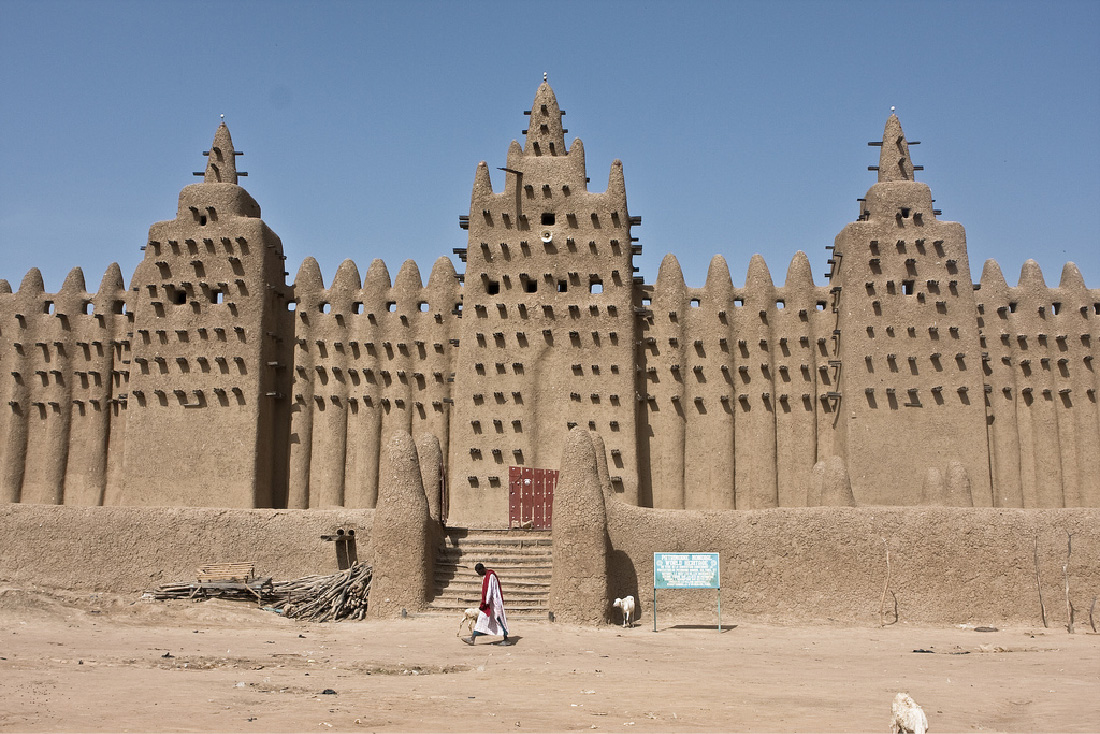
In contrast to his harsh actions at Timbuktu, Sunni Ali accommodated the community of Muslim scholars at Djenné, where they remained great preservers of Islamic learning and continued to produce work on Islamic philosophy and the sciences through the seventeenth century. The mosque and university had thousands of teachers and students who mastered a wide range of subjects, including Islamic law, astronomy, math, and philosophy (Figure 3.10).
英語のヒント
トンブクトゥでの苛酷な行動とは対照的に、スンニ・アリはジェンネのムスリム学者共同体を受け入れた。学者たちはイスラーム学問の重要な守り手であり続け、17世紀までイスラーム哲学や諸科学の研究を生み出した。モスクと学問所には数千人の教師と学生がおり、イスラーム法、天文学、数学、哲学など幅広い分野を修めた(図3.10)。
The Great Mosque at Djenné.ジェンネの大モスク
(credit: “Great Mosque of Djenné” by JM/Flickr, CC BY 2.0) · CC BY 2.0
Figure 3.10 The earliest version of the Great Mosque at Djenné was built in the thirteenth and fourteenth centuries. Founded as a center of religious learning and scholarship, the Great Mosque continues to serve these functions today, although it is now at least the third version of the structure. (credit: “Great Mosque of Djenné” by JM/Flickr, CC BY 2.0)
図3.10 ジェンネの大モスクの最初の建物は、13~14世紀に建てられた。宗教教育と学問の中心として創建され、現在もその役割を果たしている。ただし、現在の建物は少なくとも三代目に当たる。(出典:JM/Flickr「Great Mosque of Djenné」、CC BY 2.0)
The Reign of Askia the Greatアスキア大王の治世
On the death of Sunni Ali in 1492, his son Sonni Baru came to the throne but reigned less than a year. Muhammad Ture, one of Sunni Ali’s generals and provincial governors, challenged Sonni Baru, and when the two met in battle in April 1493, Sonni Baru was defeated. Muhammad Ture then usurped the throne and took power as Askia Muhammad, later known as Askia the Great. His reign marked the beginning of the Askia dynasty.
英語のヒント
1492年にスンニ・アリが死ぬと、息子ソンニ・バルが即位したが、治世は1年に満たなかった。スンニ・アリ配下の将軍で、地方総督でもあったムハンマド・トゥーレがソンニ・バルに挑み、1493年4月の戦いでソンニ・バルを破った。ムハンマド・トゥーレは王位を簒奪し、アスキア・ムハンマドとして権力を握った。のちのアスキア大王である。この治世がアスキア朝の始まりとなった。
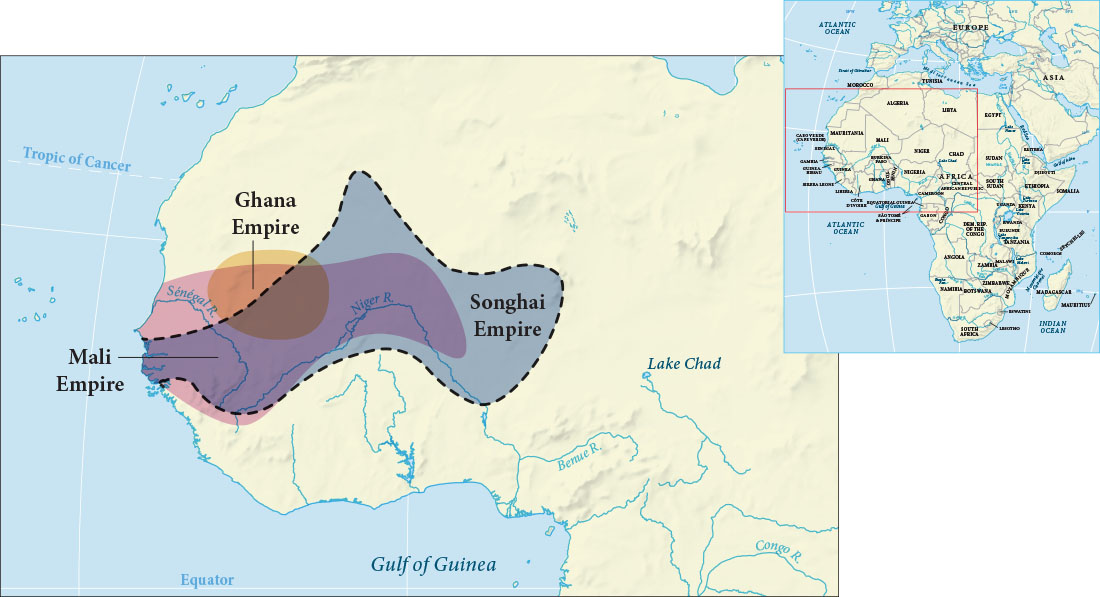
Askia the Great strengthened the Songhai Empire and made it the largest in West Africa’s history by adding tributary lands to the east and to the west. At its height, the Songhai Empire stretched from Kano in Hausaland in the southeast (present-day Nigeria) to Taghaza with its valuable salt mines in the north, and modern-day Senegal on the Atlantic coast (Figure 3.11). One of Askia’s primary objectives was to control access to the major trade routes across the Sahara. His success in doing so was rapid: by 1512, it is chronicled that even the mansa of Mali was paying tribute to Askia.
英語のヒント
アスキア大王は、東西に朝貢する領域を加えてソンガイ帝国を強化し、西アフリカ史上最大の国家にした。最盛期の帝国は、南東のハウサ地方にあるカノ(現在のナイジェリア)から、北の貴重な岩塩鉱を持つタガザ、そして大西洋岸の現在のセネガルまで広がった(図3.11)。アスキアの主要な目標の一つは、サハラを横断する大交易路への出入りを支配することだった。この目標は急速に達成され、年代記によれば、1512年までにはマリのマンサさえアスキアに貢納していた。
West Africa's Early Empires.西アフリカ初期の諸帝国
(attribution: Copyright Rice University, OpenStax, under CC BY 4.0 license) · CC BY 4.0
Figure 3.11 This map shows the different polities of medieval West Africa. The Songhai Empire was the largest and wealthiest of the three great Sudanic empires; the other two were Ghana and Mali. (attribution: Copyright Rice University, OpenStax, under CC BY 4.0 license)
図3.11 この地図は中世西アフリカのさまざまな政治勢力を示す。ソンガイ帝国は、ガーナ、マリと並ぶスーダンの三大帝国の中で、最も大きく、最も豊かだった。(出典:Rice University、OpenStax。著作権者の許諾条件はCC BY 4.0)
Askia the Great also transformed the nature of Songhai rulership. Under Sunni Ali, Songhai administration at the provincial level had been left in the hands of traditional rulers. Askia abandoned this model in favor of designating royal family members or trusted servants. As appointees of the king, these provincial governors were entirely dependent on the ruler and had to remain in his favor. The governors were invested with a great deal of authority, however; they could, for example, raise their own armies to collect local taxes. Abandoning the use of traditional rulers had the effect of strengthening the centralizing tendency of the state under Sunni Ali. Whereas before such provincial officials might take advantage of dynastic struggles to assert their authority and form a breakaway region or state, the placement of royally appointed officials closely aligned with the king dramatically curtailed this risk. That the state remained intact despite frequent dynastic struggles during Askia’s later reign speaks to the success of this policy.
英語のヒント
アスキア大王は、ソンガイの支配のあり方も変えた。スンニ・アリのもとでは、地方行政は従来の支配者に任されていた。アスキアはその方式をやめ、王族や信頼する家臣を任命した。これらの地方総督は王の任命による者として、支配者に全面的に依存し、その信任を保たなければならなかった。ただし、総督には大きな権限も与えられ、たとえば地方税を徴収するために独自の軍を組織できた。従来の支配者を用いないことは、スンニ・アリの時代に進んだ中央集権化を、さらに強める効果を持った。以前は地方の有力者が王位争いにつけこんで権力を主張し、地域や国家として離脱する可能性があったが、王と密接に結びついた王命による役人を配置することで、この危険は大幅に減った。アスキアの治世後半に王位争いが頻発しても国家が分裂せずに存続したことは、この政策の成功を物語っている。
Islam was crucial to Askia the Great’s consolidation of control. Not ethnically Songhai and thus unable to rely on traditional institutions and rituals to legitimate his rule, Askia instead based his authority on Islam and quickly set out to establish Songhai as a Muslim kingdom. In 1498, he declared a holy war against the non-Muslim Mossi to justify his incursions into their territory. He also recognized the importance of Islam to trans-Saharan trade and used his post-accession pilgrimage to Mecca to advertise his concern for the faith. During his stopover in Cairo, Askia convinced Egypt’s caliph, its spiritual and secular leader, to recognize him as caliph of the whole of Sudan. While in Mecca he spent lavishly, contributing some 100,000 gold pieces to charity and related almsgiving programs. He did not force his subjects to convert, however, and most retained their traditional religious beliefs.
英語のヒント
支配を固めるうえで、イスラームはアスキア大王にとって決定的に重要だった。彼は民族的にソンガイ人ではなかったため、伝統的な制度や儀礼によって自分の支配を正当化することができなかった。そこでイスラームを権威の基礎とし、ただちにソンガイをムスリムの王国として確立しようとした。1498年には、非ムスリムのモシ人に聖戦を宣言し、その領域への侵攻を正当化した。彼はサハラ交易におけるイスラームの重要性も認識し、即位後のメッカ巡礼で、自分が信仰を重んじることを広く示した。カイロに立ち寄ると、エジプトの宗教的・世俗的指導者であるカリフを説得し、自分をスーダン全体のカリフとして認めさせた。メッカでは惜しみなく財を使い、約10万枚の金貨を慈善や関連する施しの活動へ寄付した。しかし臣民に改宗を強制することはなく、大部分の人々は伝統的な宗教信仰を保った。
Askia the Great extended his territory deeper into the desert through military conquest. The advance of Songhai’s army forced the Tuareg nomads to flee, which allowed the Songhai to capture the salt-producing center of Taghaza in the north. Askia did more to regulate trans-Saharan trade than any of his predecessors. He not only introduced the use of standardized weights and measures but also employed trade inspectors at each of the empire’s major trade centers. The Hausaland kingdoms recognized the revival of trade under the Songhai and its benefits and so came into the orbit of the Songhai Empire’s broader trading network.
英語のヒント
アスキア大王は軍事征服によって、領土を砂漠のさらに奥へ広げた。ソンガイ軍の進撃はトゥアレグ遊牧民を逃走させ、ソンガイは北の塩生産拠点タガザを占領できた。アスキアは、どの先代よりもサハラ交易の規制と整備を進めた。標準化した度量衡を導入しただけでなく、帝国の主要な交易拠点それぞれに交易監督官を置いた。ハウサ地方の王国は、ソンガイのもとでの交易の復興とその利益を認め、ソンガイ帝国の広い交易網の圏内へ入った。
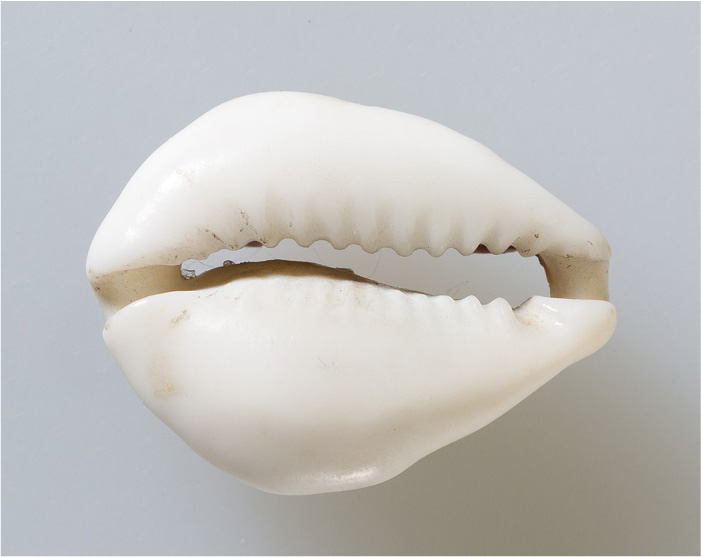
The primary sources of the Songhai Empire’s wealth continued to be agricultural production centered on the Niger floodplain and taxes on trade goods, especially gold and salt, both of which had also been key to the economy of the Mali Empire. Salt remained Songhai’s currency for external trade, while cowrie shells were used for internal trade (Figure 3.12). Cowrie shells were imported from the Indian Ocean. They were thus relatively scarce and could not be counterfeited. Gold remained the primary good transported along the trans-Saharan trade routes, but enslaved captives and kola nuts were also exported. The empire imported a variety of goods, including Saharan salt, luxury goods, horses, and cloth.
英語のヒント
ソンガイ帝国の富の主な源泉は、引き続きニジェール川の氾濫原を中心とする農業生産と、交易品、とりわけ金と塩への課税だった。どちらもマリ帝国の経済でも重要であった。域外との交易では塩が通貨として使われ、域内交易ではタカラガイの貝殻が用いられた(図3.12)。タカラガイはインド洋から輸入された。そのため比較的希少で、偽造することができなかった。サハラ交易路で運ばれる主要な商品は引き続き金だったが、奴隷化された捕虜やコーラの実も輸出された。帝国はサハラの塩、高級品、馬、布など、さまざまな品を輸入した。
Cowrie Shell.タカラガイの貝殻
(credit: modification of work “Cowrie shell” by Metropolitan Museum of Art/Wikimedia Commons, CC0 1.0) · CC0 1.0
Figure 3.12 Cowrie shells were used as currency and to adorn religious objects in several African societies. Cowrie shells served a similar function in South Asia and East Asia. This shell was found with an Egyptian mummy from the fourth century BCE. (credit: modification of work “Cowrie shell” by Metropolitan Museum of Art/Wikimedia Commons, CC0 1.0)
図3.12 アフリカの複数の社会では、タカラガイの貝殻が通貨や宗教的な品の装飾に用いられた。南アジアや東アジアでも同じような役割を果たした。この貝殻は、紀元前4世紀のエジプトのミイラとともに発見された。(出典:Metropolitan Museum of Art/Wikimedia Commons「Cowrie shell」を改変、CC0 1.0)
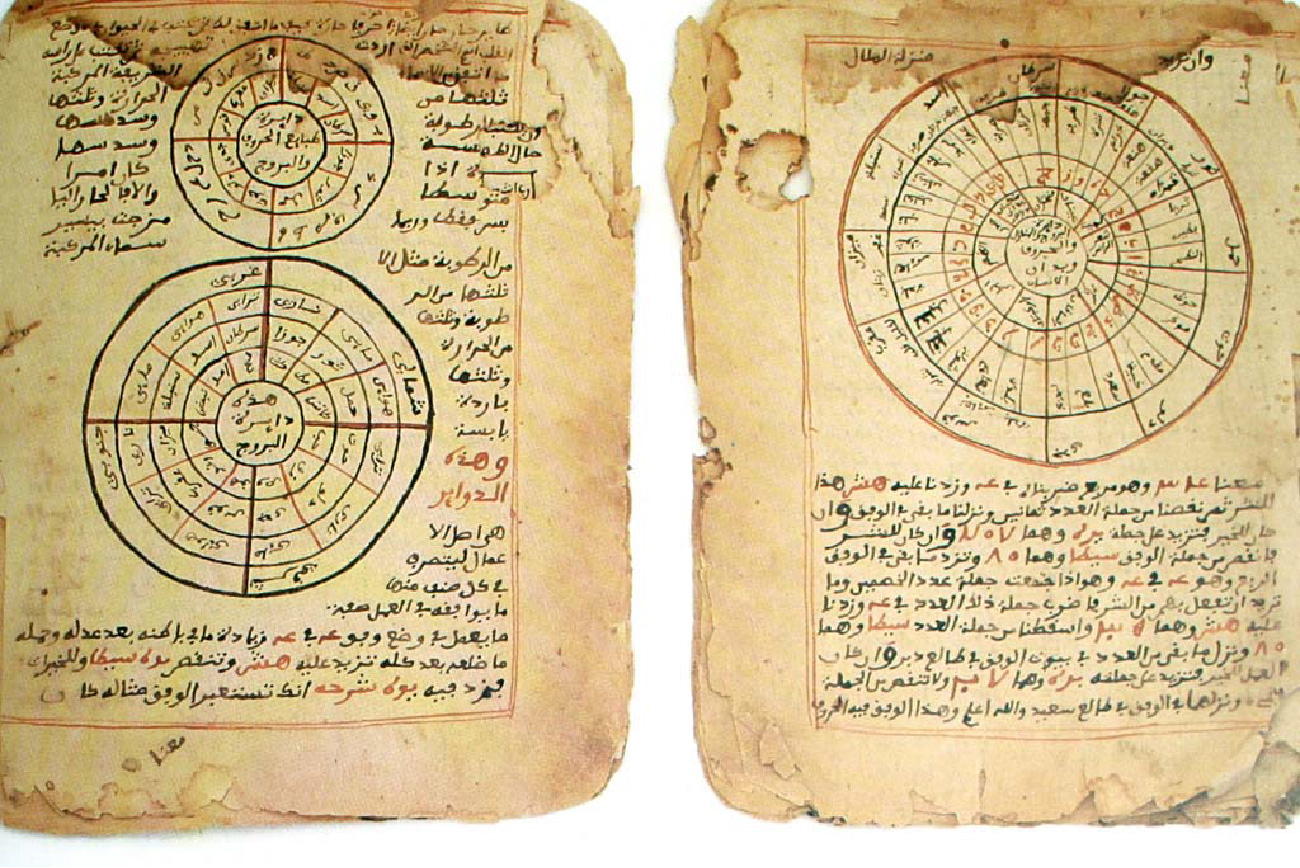
Timbuktu, which had been destroyed by Sunni Ali, revived during the rule of Askia the Great. Leo Africanus observed that the city was a prosperous one filled with artisans and wealthy merchants as well as many enslaved people. According to his sixteenth-century account, in Timbuktu there were “[Quotation omitted for rights reasons.]” By the mid-sixteenth century, public libraries had been established, and scribes and calligraphers had been hired to copy books (Figure 3.13). As Islamic scholarship once again flourished at Timbuktu, so too did higher learning. Students engaged in multiple tutorials in various fields of study with Islamic scholars and, when they achieved mastery of these subjects, went on to become teachers themselves.
英語のヒント
スンニ・アリに破壊されたトンブクトゥは、アスキア大王の治世に復興した。レオ・アフリカヌスは、そこには職人や裕福な商人に加えて多くの奴隷化された人々がおり、繁栄する都市だと観察した。彼の16世紀の記録は、トンブクトゥについて次のように述べる。〔権利の関係で割愛〕16世紀半ばまでには公共図書館が設けられ、書物を写すために書記や書道家が雇われた(図3.13)。イスラーム学問が再び栄えるのに伴い、高等教育も復興した。学生はイスラーム学者から、さまざまな分野で複数の個別指導を受けた。そしてそれらの分野を修めると、今度は自分たちが教師となった。
A Revival of Learning in Timbuktu.トンブクトゥの学問の復興
(credit: “Timbuktu manuscripts” by EurAstro/Elias Altmimi/Wikimedia Commons, Public Domain) · Public Domain
Figure 3.13 Handwritten and illuminated (containing painted decoration) manuscripts preserved at Timbuktu are among the great cultural treasures of Islam. Many thousands of these graced the shelves of the mosques and private libraries throughout the revitalized Timbuktu of the sixteenth century. (credit: “Timbuktu manuscripts” by EurAstro/Elias Altmimi/Wikimedia Commons, Public Domain)
図3.13 トンブクトゥに保存されてきた手書きの装飾写本、すなわち彩色装飾のある写本は、イスラームの偉大な文化財に数えられる。活気を取り戻した16世紀のトンブクトゥでは、数千に及ぶこうした写本が、町中のモスクや私設図書館の書棚を満たしていた。(出典:EurAstro/Elias Altmimi/Wikimedia Commons「Timbuktu manuscripts」、パブリックドメイン)