第3章近世アフリカと広域世界Early Modern Africa and the Wider World
Slavery on the Swahili Coastスワヒリ海岸の奴隷制
Enslaved people were also traded in the markets of East Africa, especially on the island of Zanzibar. East African societies such as the Yao, the Marava, and the Makua regularly made war upon one another and seized captives for sale. People captured in the interior were marched to the Swahili coast and held there until buyers for them could be found, although starvation, exhaustion, and disease killed nearly three-quarters before they could be sold. The primary buyers were Arab Muslims who wanted laborers but were not allowed to enslave fellow Muslims. Most of the enslaved Africans were destined for the Arabian Peninsula and elsewhere in the Middle East or North Africa, there to work as domestic servants or perform other types of labor. Some were sold as far away from their homes as India or China. Women and children were preferred for household service, but men might find themselves forced into service as soldiers, sailors, or agricultural workers.
英語のヒント
東アフリカ、とりわけザンジバル島の市場では、奴隷化された人々も取引された。ヤオ、マラヴァ、マクアなどの東アフリカ社会は互いに繰り返し戦争を行い、売るために捕虜を捕らえた。内陸で捕まった人々はスワヒリ海岸へ歩かされ、買い手が見つかるまでそこに留め置かれた。しかし売られる前に、飢え、疲労、病気によって、ほぼ4分の3が命を落とした。主な買い手は、労働者を求める一方、同じムスリムを奴隷にすることは許されない、アラブのムスリムだった。奴隷化されたアフリカ人の大部分は、アラビア半島、中東のほかの地域、北アフリカに送られ、家事使用人やほかの労働に従事させられた。故郷から遠く離れたインドや中国で売られた人もいた。家事労働には女性と子どもが好まれたが、男性は兵士、船乗り、農業労働者として強制的に使われることもあった。
By the seventeenth century, the slave trade on the Swahili coast had assumed enormous proportions, with an influx of traders from Oman on the Arabian Peninsula. This growth was due partly to the rise in power of European states, which prevented Muslims from capturing and enslaving people from Eastern Europe as they had often done in earlier centuries. Between the beginning and the end of the seventeenth century, the number of enslaved people sold on the Swahili coast quadrupled from roughly one thousand to four thousand per year. Some scholars report that twice that number were sold.
英語のヒント
17世紀までに、アラビア半島のオマーンから商人が流入し、スワヒリ海岸の奴隷交易は巨大な規模となった。拡大の一因はヨーロッパ諸国の勢力増大であった。それによってムスリムは、それ以前の数世紀にしばしば行っていたように、東ヨーロッパで人々を捕らえて奴隷にすることができなくなった。17世紀初めから末にかけて、スワヒリ海岸で売られた奴隷化された人の数は、年間およそ1,000人から4,000人へと4倍になった。その2倍が売られたとする研究者もいる。
The activities of European slave traders, who arrived in the region beginning in the seventeenth century, quickly dwarfed those of the Muslim slavers. The Dutch East India Company purchased approximately half a million enslaved people in the seventeenth and eighteenth centuries to work in Dutch colonies in the Indian Ocean. The Portuguese purchased enslaved people from the island of Mozambique from the sixteenth to the early nineteenth centuries (Figure 3.16). The French enslaved more than one hundred thousand people in their Indian Ocean colonies of Réunion, Mauritius, and the Mascarene Islands, of which they took control in the eighteenth century. Even after Britain abolished the slave trade in 1807 and sent its ships to patrol the Indian Ocean to halt other countries’ participation in the trade, the sale of enslaved people continued. People from East Africa were also sold into slavery in the Americas.
英語のヒント
17世紀からこの地域へやって来たヨーロッパの奴隷商人の活動は、ムスリム奴隷商人の活動を急速に大きく上回った。オランダ東インド会社は17~18世紀、インド洋のオランダ植民地で働かせるため、約50万人の奴隷化された人々を買った。ポルトガル人は16世紀から19世紀初頭にかけて、モザンビーク島で人々を購入した(図3.16)。フランス人は18世紀に支配下へ置いたインド洋のレユニオン、モーリシャス、マスカレン諸島の植民地で、10万人を超える人々を奴隷にした。イギリスが1807年に奴隷交易を廃止し、ほかの国による交易を止めるため、インド洋を巡回する船を派遣した後も、人々の売買は続いた。東アフリカの人々はアメリカ大陸でも奴隷として売られた。
The Enslaved in Zanzibar.ザンジバルで奴隷にされた人々
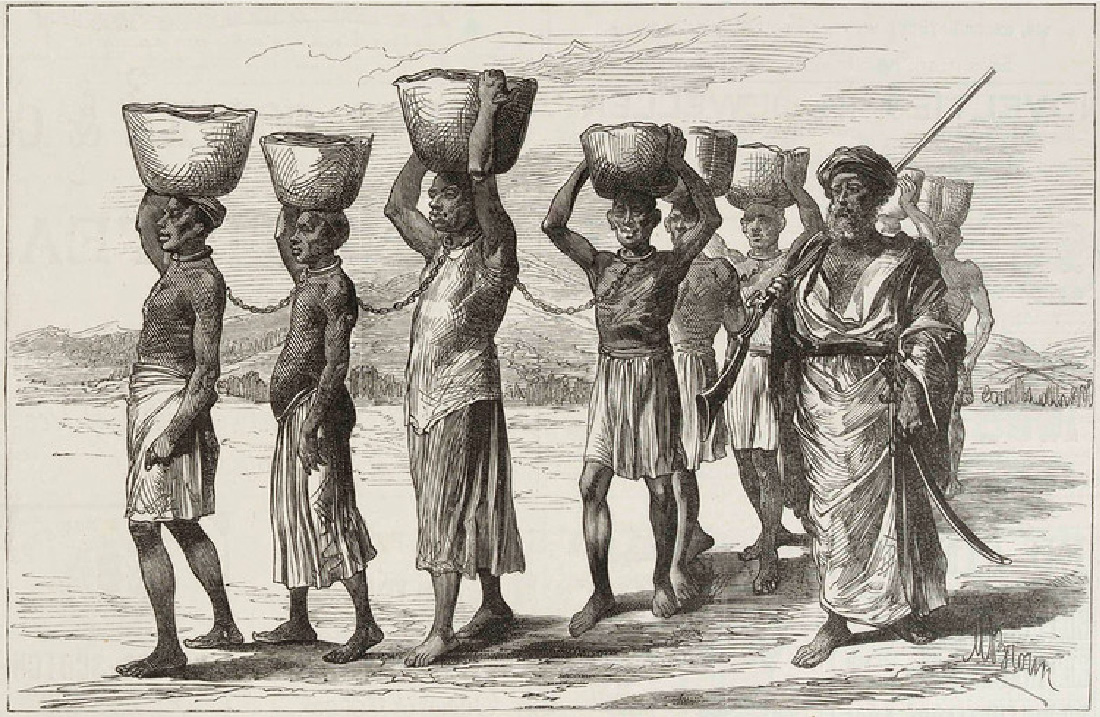
(credit: modification of work “‘A Slave Gang in Zanzibar’ by W.A. Churchill” by London News/Wikimedia Commons, Public Domain) · Public Domain
Figure 3.16 This London News illustration by the British artist William A. Churchill, brother of the British consul in Zanzibar, shows a group of enslaved people in Zanzibar in 1889, a common sight on the Swahili coast where the slave trade flourished from the seventeenth through the nineteenth centuries. (credit: modification of work “‘A Slave Gang in Zanzibar’ by W.A. Churchill” by London News/Wikimedia Commons, Public Domain)
図3.16 ザンジバル駐在イギリス領事の兄弟で、イギリスの画家ウィリアム・A・チャーチルが『ロンドン・ニュース』に描いたこの挿絵は、1889年のザンジバルで奴隷にされた人々の一団を示す。17~19世紀に奴隷交易が盛んだったスワヒリ海岸では、日常的な光景であった。(出典:London News/Wikimedia Commons「A Slave Gang in Zanzibar by W.A. Churchill」を改変、パブリックドメイン)
The Contest for the Swahili Coastスワヒリ海岸をめぐる争い
Kilwa, located on an island off the coast of what is now Tanzania, was the most powerful of the city-states of the Swahili coast. According to legend, it was founded in the tenth century by Ali ibn al-Hassan Shirazi, the son of a Persian noble and an enslaved Ethiopian woman. Ali supposedly settled the island after purchasing it from a local Bantu king. Kilwa’s location on an island made it better suited to engaging in the Indian Ocean trade than its rival city to the north, Mogadishu in today’s Somalia, and numerous Arab and Persian merchants came to settle in it.
英語のヒント
現在のタンザニアの沖に浮かぶ島のキルワは、スワヒリ海岸の都市国家の中で最も強大だった。伝説によれば、10世紀、ペルシアの貴族と、奴隷にされたエチオピア人女性の息子、アリー・イブン・アル=ハサン・シーラーズィーが創建したとされる。アリーは地元のバントゥーの王から島を買い、その後に定住したという。島にあるキルワは、北の競争相手である現在のソマリアのモガディシュよりもインド洋交易に適しており、多くのアラブ商人やペルシア商人が移り住んだ。
In the 1180s, the ruler of Kilwa gained control of the port city of Sofala, on the African mainland in what is now Mozambique. Gold from the mines of the Kingdom of Mutapa flowed through Sofala, making it both wealthy and powerful. Control of Sofala enabled the sultan of Kilwa to escape the dominance of Mogadishu, formerly the most powerful city on the East African coast. The gold also allowed Kilwa to establish or assume control of other cities and island states in East Africa, including Mombasa, Pemba, Mafia, Mozambique, Malindi, Imhambane, Comoro, and Zanzibar.
英語のヒント
1180年代、キルワの支配者は、アフリカ本土の現在のモザンビークにある港湾都市ソファラを支配下に置いた。ムタパ王国の鉱山からの金がソファラを通って流れ、町に富と力を与えた。ソファラの支配によって、キルワのスルタンは、それまで東アフリカ沿岸で最強だったモガディシュの支配的な立場から抜け出せた。金はまた、モンバサ、ペンバ、マフィア、モザンビーク、マリンディ、イニャンバネ、コモロ、ザンジバルなど、東アフリカのほかの都市や島の国家をキルワが建設したり、支配下に収めたりすることを可能にした。
In the early sixteenth century, Portugal attempted to seize the wealth of the Swahili coast, aided by internal dissent within the Sultanate of Kilwa. In 1495, Kilwa’s Emir Muhammad, the chief administrator of the city-state, had placed al-Fudail ibn Suleiman on the sultan’s throne. Shortly thereafter, Emir Muhammad died, and his successor Emir Ibrahim engineered the assassination of al-Fudail ibn Suleiman. Emir Ibrahim then seized power for himself, claiming to rule on behalf of an absent prince. The rulers of several cities within the Kilwa Sultanate were not willing to accept Ibrahim as their overlord, however, and regarded the Portuguese as potential allies in their attempts to claim their independence. The Sheikh of Malindi had already signed a trade agreement with Vasco da Gama, a Portuguese explorer, in 1498 in order to compete in trade with both Kilwa and the rival city of Mombasa. Sheikh Isuf, the ruler of Sofala, also signed an agreement with the Portuguese in 1502 in hopes of breaking free of Kilwa’s dominance. The Swahili coast city-states had long been trade rivals, and their history of competition with one another prevented them from unifying in the face of the threat of Portuguese domination.
英語のヒント
16世紀初頭、ポルトガルはキルワ・スルタン国の内紛に乗じて、スワヒリ海岸の富を奪おうとした。1495年、都市国家キルワの最高行政官、アミール・ムハンマドは、アル=フダイル・イブン・スライマーンをスルタンの位に就けた。そのまもなく後にムハンマドが死ぬと、後継のアミール・イブラーヒームはアル=フダイルの暗殺を画策した。イブラーヒームは不在の王子に代わって統治すると称し、自ら権力を握った。しかしスルタン国内のいくつかの都市の支配者は、イブラーヒームを上位の支配者として認めようとせず、独立を主張するための同盟相手としてポルトガルに期待した。マリンディのシャイフはすでに1498年、キルワと競合都市モンバサの両方に交易で対抗するため、ポルトガルの探検家ヴァスコ・ダ・ガマと通商協定を結んでいた。ソファラの支配者シャイフ・イスフも、キルワの支配から逃れることを願い、1502年にポルトガルと協定を結んだ。スワヒリ海岸の都市国家は長く交易の競争相手だった。その対立の歴史が、ポルトガルによる支配の脅威を前に団結することを妨げた。
Although counselors had encouraged Emir Ibrahim to agree to trade with the Portuguese, he initially rebuffed them. In 1505, Francisco de Almeida, another Portuguese explorer, landed five hundred Portuguese soldiers on the island of Kilwa and replaced Emir Ibrahim with a Kilwan aristocrat called Muhammad Arcone, who was more amenable to dealing with the Portuguese. The following year, Muhammad Arcone was assassinated by supporters of Emir Ibrahim and succeeded by a ruler whom they favored. Fearing that the new Sultan Micante would not be easy to control, the Portuguese removed him from power and gave the throne to Arcone’s son, Hussein ibn Muhammad.
英語のヒント
側近はイブラーヒームにポルトガルとの交易へ同意するよう勧めたが、彼は当初それを拒んだ。1505年、別のポルトガル人探検家フランシスコ・デ・アルメイダが、兵士500人をキルワ島へ上陸させた。そしてイブラーヒームを、ポルトガルとの取引により協力的な、ムハンマド・アルコーネというキルワの貴族に替えた。翌年、イブラーヒームの支持者がアルコーネを暗殺し、自分たちの支持する人物を後継者とした。新スルタンのミカンテを容易には操れないと恐れたポルトガル人は、彼を権力から追い、王位をアルコーネの息子フセイン・イブン・ムハンマドに与えた。
Many Kilwans resented Portuguese interference in the governing of their city-state. They also disliked Portugal’s requirement that Kilwans ship goods only on Portuguese-owned ships, a practice that financially harmed many Kilwan merchants. Supporters of Sultan Micante and embittered merchants rose up and did battle in the streets with Portuguese soldiers and followers of Sultan Hussein. Residents fled the city as gangs set fire to buildings. The Portuguese supported Hussein but also wisely chose to change the policy regarding shipping, and gradually merchants returned to the city.
英語のヒント
キルワの人々の多くは、都市国家の統治にポルトガルが介入することに反感を抱いた。キルワの品物をポルトガル所有の船だけで運ぶよう求める規則も嫌われた。それが多くの商人に経済的な損害を与えたからである。ミカンテの支持者と不満を募らせた商人たちは蜂起し、ポルトガル兵およびスルタン・フセインの支持者と街頭で戦った。集団が建物に火を放ち、住民は町を逃れた。ポルトガル人はフセインを支援しながらも、輸送政策を変更するという賢明な選択をした。その結果、商人たちは徐々に町へ戻った。
Portugal extended its control along the rest of the Swahili coast as well, establishing trading posts. Because the coastal city-states had never before experienced attacks from the sea, their ports were not fortified and could not easily defend against the Portuguese. The Portuguese were not interested in trading with East African merchants on equal terms, and as they had in India, they looted and sank the ships of rival traders, most of whom were Muslims. Many merchants left the region and moved northward, resulting in a decline in trade. On the southern part of the coast, the Portuguese hoped to exploit the wealth of Mutapa and took control of the kingdom in 1633, but the gold deposits were largely exhausted by this point, and their efforts to convert the population to Roman Catholicism resulted in conflict. Some individual Portuguese did well, marrying African women and receiving land and the right to trade from local African chiefs. For the most part, though, constant conflict with city-states and the effects of tropical diseases such as malaria made it difficult for Portugal to exploit the area.
英語のヒント
ポルトガルはスワヒリ海岸のほかの地域にも支配を広げ、交易拠点を設けた。沿岸の都市国家はそれまで海からの攻撃を経験していなかったため、港は防備がなく、ポルトガル人に容易には対抗できなかった。ポルトガル人は東アフリカ商人と対等な条件で取引することに関心がなく、インドで行ったのと同様に、競争相手の船を略奪して沈めた。その相手の大部分はムスリムだった。多くの商人が地域を離れて北へ移り、交易は衰退した。海岸の南部では、ポルトガル人はムタパの富を利用しようと考え、1633年に王国を支配下に収めた。しかし、その時点で金の埋蔵はほぼ尽きており、住民をローマ・カトリックへ改宗させようとした試みも争いを招いた。個々のポルトガル人には、アフリカ人女性と結婚し、現地の首長から土地と交易の権利を得て成功した者もいた。しかし全般に、都市国家との絶え間ない対立と、マラリアなどの熱帯病の影響によって、ポルトガルがこの地域から利益を得ることは難しかった。
Both the Ottomans and Somalis from the region of Mogadishu feared and resented Portuguese intrusion in East Africa. Joint Somali-Ottoman attacks beginning in the second half of the 1500s wreaked havoc on Portuguese efforts to control the region (Figure 3.19). These assaults were followed in the 1650s by attacks by the Omani Sultanate. Portugal had established control over the coast of Oman in 1507. However, in the 1650s, the Omani tribes united to drive the Portuguese out, and soon they began to challenge the Portuguese in East Africa as well. In 1698, Fort Jesus, the Portuguese garrison at Mombasa, fell to Omani forces. (Fort Jesus is now a UNESCO World Heritage site.) Soon thereafter, Portugal lost control of all its remaining colonies on the Swahili coast except Mozambique. The Omani Sultanate had brought the Portuguese attempt to dominate the region to an end.
英語のヒント
オスマン勢力とモガディシュ地方のソマリ人は、ともに東アフリカへのポルトガルの侵入を恐れ、憤った。1500年代後半に始まったソマリ人とオスマン勢力の共同攻撃は、地域を支配しようとするポルトガルの試みに大打撃を与えた(図3.19)。さらに1650年代には、オマーン・スルタン国の攻撃が続いた。ポルトガルは1507年にオマーン沿岸を支配下に置いていたが、1650年代、オマーンの諸部族が団結してポルトガル人を追い出した。まもなく彼らは、東アフリカでもポルトガルに挑むようになった。1698年、モンバサのポルトガル守備隊の拠点フォート・ジーザスが、オマーン軍の手に落ちた。フォート・ジーザスは現在、ユネスコ世界遺産である。そのまもなく後、ポルトガルはモザンビークを除き、スワヒリ海岸に残るすべての植民地の支配を失った。オマーン・スルタン国が、地域を支配しようとするポルトガルの試みに終止符を打ったのである。
Ottoman Fleet at Aden.アデンのオスマン艦隊
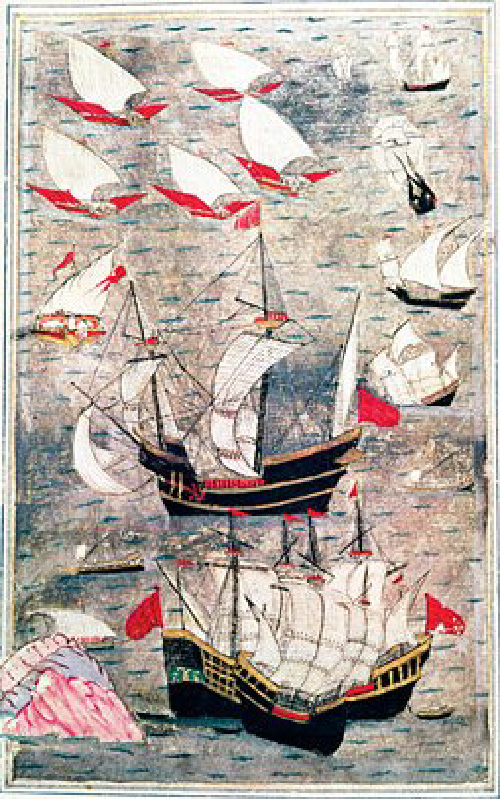
(credit: “Ottoman fleet Indian Ocean 16th century” by Aramco World/Wikimedia Commons, Public Domain) · Public Domain
Figure 3.19 An Ottoman fleet patrols the Gulf of Aden between Somalia and the Arabian Peninsula in this sixteenth-century Turkish painting, which shows Aden as the three hills in the lower left. The Somali inhabitants of cities on the northern Swahili coast turned to the Ottomans for help against the Portuguese. (credit: “Ottoman fleet Indian Ocean 16th century” by Aramco World/Wikimedia Commons, Public Domain)
図3.19 16世紀のこのトルコ絵画には、ソマリアとアラビア半島の間のアデン湾を巡回するオスマン艦隊が描かれている。左下の三つの丘はアデンを表す。スワヒリ海岸北部の都市に住むソマリ人は、ポルトガル人に対抗するため、オスマン勢力に助けを求めた。(出典:Aramco World/Wikimedia Commons「Ottoman fleet Indian Ocean 16th century」、パブリックドメイン)
With the arrival of the Omanis, the city-state of Zanzibar grew to even greater prominence. The Omanis continued the profitable slave trade as well as the thriving trade in elephant ivory that had long been part of Zanzibar’s economy. Land on the island was redistributed to Omani Arabs, and spice plantations growing primarily cloves were established, earning Zanzibar and the surrounding islands the nickname of Africa’s Spice Islands.
英語のヒント
オマーン人が到来すると、都市国家ザンジバルの重要性は一段と高まった。オマーン人は、以前からザンジバル経済の一部だった活発な象牙交易に加え、利益の大きい奴隷交易も続けた。島の土地はオマーンのアラブ人に再分配され、おもにクローブを栽培する香辛料のプランテーションが設けられた。そのためザンジバルと周辺の島々は、アフリカの「香料諸島」と呼ばれるようになった。