第7章実数の性質
7.3 Distributive Property7.3 分配法則
Learning Objectives学習目標
Learning Objectives学習目標
By the end of this section, you will be able to:
この節を終えると、次のことができるようになる。
- Simplify expressions using the distributive property分配法則を使って式を簡単にする
- Evaluate expressions using the distributive property分配法則を使って式の値を求める
Before You Begin (3)準備問題(3題)
Simplify Expressions Using the Distributive Property分配法則を使って式を簡単にする
Suppose three friends are going to the movies. They each need that is, dollars and quarter. How much money do they need all together? You can think about the dollars separately from the quarters.
3人の友人が映画に行くとしよう。1人につき、つまりドルと25セント硬貨枚が必要である。全部でいくら必要だろうか。ドルと25セント硬貨を分けて考えることができる。
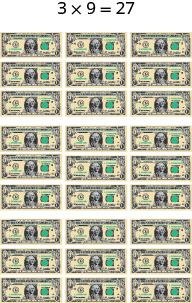
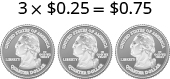
They need times so and times quarter, so cents. In total, they need
必要なのはの倍、つまりと、25セント硬貨枚の倍、つまりセントである。合計でが必要になる。
If you think about doing the math in this way, you are using the Distributive Property.
英語のヒント
このように考えて計算するとき、分配法則を使っている。
Back to our friends at the movies, we could show the math steps we take to find the total amount of money they need like this:
映画に行く友人たちの話に戻ろう。必要な金額の合計を求める計算の手順は、次のように示せる。
In algebra, we use the Distributive Property to remove parentheses as we simplify expressions. For example, if we are asked to simplify the expression the order of operations says to work in the parentheses first. But we cannot add and since they are not like terms. So we use the Distributive Property, as shown in Example 7.17.
英語のヒント
代数では、式を簡単にするとき、分配法則を使って括弧を外す。例えば、式を簡単にする場合、計算の順序では括弧の中を先に計算する。しかし、とは同類項ではないので足せない。そこで例題7.17のように分配法則を使う。
Example 7.17例題 7.17
Simplify:
次の式を簡単にする:
Solution解答
Distribute. 分配法則を使う。 |
|
Multiply. 掛ける。 |
Try It (2)確認問題(2題)
Some students find it helpful to draw in arrows to remind them how to use the Distributive Property. Then the first step in Example 7.17 would look like this:
分配法則の使い方を思い出すために、矢印を書き込むと役立つ人もいる。その場合、例題7.17の最初の手順は次のようになる。


Example 7.18例題 7.18
Simplify:
次の式を簡単にする:
Solution解答
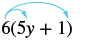 |
|
Distribute. 分配法則を使う。 |
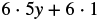 |
Multiply. 掛ける。 |
 |
Try It (2)確認問題(2題)
The distributive property can be used to simplify expressions that look slightly different from Here are two other forms.
分配法則は、とは少し異なる形の式を簡単にするためにも使える。ほかの2つの形を示す。
Example 7.19例題 7.19
Simplify:
次の式を簡単にする:
Solution解答
 |
|
Distribute. 分配法則を使う。 |
 |
Multiply. 掛ける。 |
 |
Try It (2)確認問題(2題)
Do you remember how to multiply a fraction by a whole number? We’ll need to do that in the next two examples.
分数に非負整数を掛ける方法を覚えているだろうか。次の2つの例では、その計算が必要になる。
Example 7.20例題 7.20
Simplify:
次の式を簡単にする:
Solution解答
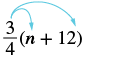 |
|
Distribute. 分配法則を使う。 |
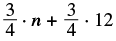 |
Simplify. 簡単にする。 |
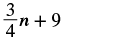 |
Try It (2)確認問題(2題)
Example 7.21例題 7.21
Simplify:
次の式を簡単にする:
Solution解答
Solution解答
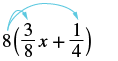 |
|
Distribute. 分配法則を使う。 |
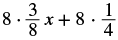 |
Multiply. 掛ける。 |
 |
Try It (2)確認問題(2題)
Using the Distributive Property as shown in the next example will be very useful when we solve money applications later.
次の例のように分配法則を使うと、後でお金に関する応用問題を解くときに大いに役立つ。
Example 7.22例題 7.22
Simplify:
次の式を簡単にする:
Solution解答
 |
|
Distribute. 分配法則を使う。 |
 |
Multiply. 掛ける。 |
 |
Try It (2)確認問題(2題)
In the next example we’ll multiply by a variable. We’ll need to do this in a later chapter.
次の例では、変数を掛ける。後の章でこの操作が必要になる。
Example 7.23例題 7.23
Simplify:
次の式を簡単にする:
Solution解答
 |
|
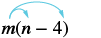
Distribute. 分配法則を使う。 |
 |
Multiply. 掛ける。 |
 |
Notice that we wrote We can do this because of the Commutative Property of Multiplication. When a term is the product of a number and a variable, we write the number first.
と書いたことに注目しよう。これは乗法の交換法則によってできる。項が数と変数の積であるときは、数を先に書く。
Try It (2)確認問題(2題)
The next example will use the ‘backwards’ form of the Distributive Property,
次の例では、分配法則の「逆向き」の形を使う。
Example 7.24例題 7.24
Simplify:
次の式を簡単にする:
Solution解答
 |
|
Distribute. 分配法則を使う。 |
 |
Try It (2)確認問題(2題)
When you distribute a negative number, you need to be extra careful to get the signs correct.
英語のヒント
負の数を分配するときには、符号を間違えないよう、特に注意が必要である。
Example 7.25例題 7.25
Simplify:
次の式を簡単にする:
Solution解答
 |
|
Distribute. 分配法則を使う。 |
 |
Simplify. 簡単にする。 |
 |
Try It (2)確認問題(2題)
Example 7.26例題 7.26
Simplify:
次の式を簡単にする:
Solution解答
 |
|
Distribute. 分配法則を使う。 |
 |
Multiply. 掛ける。 |
 |
Simplify. 簡単にする。 |
 |
You could also write the result as Do you know why?
結果はとも書ける。その理由はわかるだろうか。
Try It (2)確認問題(2題)
In the next example, we will show how to use the Distributive Property to find the opposite of an expression. Remember,
次の例では、分配法則を使って、式全体の符号を反対にする方法を示す。であることを思い出そう。
Example 7.27例題 7.27
Simplify:
次の式を簡単にする:
Solution解答
 |
|
Multiplying by −1 results in the opposite. −1を掛けると符号が反対になる。 |
 |
Distribute. 分配法則を使う。 |
 |
Simplify. 簡単にする。 |
 |
Simplify. 簡単にする。 |
 |
Try It (2)確認問題(2題)
Sometimes we need to use the Distributive Property as part of the order of operations. Start by looking at the parentheses. If the expression inside the parentheses cannot be simplified, the next step would be multiply using the distributive property, which removes the parentheses. The next two examples will illustrate this.
計算の順序の一部として、分配法則を使う必要があることもある。まず括弧の中を見る。その式を簡単にできない場合、次に分配法則を使って掛け算をし、括弧を外す。次の2つの例でこれを示す。
Example 7.28例題 7.28
Simplify:
次の式を簡単にする:
Solution解答
 |
|
Distribute. 分配法則を使う。 |
 |
Multiply. 掛ける。 |
 |
Combine like terms. 同類項をまとめる。 |
 |
Try It (2)確認問題(2題)
Example 7.29例題 7.29
Simplify:
次の式を簡単にする:
Solution解答
 |
|
Distribute. 分配法則を使う。 |
 |
Combine like terms. 同類項をまとめる。 |
 |