第7章実数の性質
7.2 Commutative and Associative Properties7.2 交換法則と結合法則
Learning Objectives学習目標
Learning Objectives学習目標
By the end of this section, you will be able to:
この節を終えると、次のことができるようになる。
- Use the commutative and associative properties交換法則と結合法則を使う
- Evaluate expressions using the commutative and associative properties交換法則と結合法則を使って式の値を求める
- Simplify expressions using the commutative and associative properties交換法則と結合法則を使って式を簡単にする
Before You Begin (3)準備問題(3題)
In the next few sections, we will take a look at the properties of real numbers. Many of these properties will describe things you already know, but it will help to give names to the properties and define them formally. This way we’ll be able to refer to them and use them as we solve equations in the next chapter.
英語のヒント
次のいくつかの節では、実数の性質を見ていく。その多くはすでに知っている内容だが、性質に名前を付けて正式に定義しておくと役に立つ。そうすれば、次の章で方程式を解くときに、その性質を参照して使える。
Use the Commutative and Associative Properties交換法則と結合法則を使う
Think about adding two numbers, such as and
となど、2つの数を足すことを考えよう。
The results are the same.
結果は同じである。
Notice, the order in which we add does not matter. The same is true when multiplying and
足す順序は結果に影響しないことに注目しよう。とを掛ける場合も同様である。
Again, the results are the same! The order in which we multiply does not matter.
ここでも結果は同じである。。掛ける順序は結果に影響しない。
These examples illustrate the commutative properties of addition and multiplication.
英語のヒント
これらの例は、加法と乗法の交換法則を示している。
The commutative properties have to do with order. If you change the order of the numbers when adding or multiplying, the result is the same.
英語のヒント
交換法則は順序に関する性質である。足したり掛けたりする数の順序を変えても、結果は同じになる。
Example 7.5例題 7.5
Use the commutative properties to rewrite the following expressions:
交換法則を使って、次の式を書き換えよ。
- ⓐ
- ⓑ
Solution解答
ⓐ |
|
Use the commutative property of addition to change the order. 加法の交換法則を使って順序を変える。 |
ⓑ |
|
Use the commutative property of multiplication to change the order. 乗法の交換法則を使って順序を変える。 |
Try It (2)確認問題(2題)
What about subtraction? Does order matter when we subtract numbers? Does give the same result as
引き算はどうだろうか。数を引くときには順序が関係するだろうか。との結果は同じだろうか。
Since changing the order of the subtraction did not give the same result, we can say that subtraction is not commutative.
英語のヒント
引き算の順序を変えると結果が同じにならなかったので、減法では交換法則が成り立たないと言える。
Let’s see what happens when we divide two numbers. Is division commutative?
2つの数を割るとどうなるかを見てみよう。除法で交換法則は成り立つだろうか。
Since changing the order of the division did not give the same result, division is not commutative.
割り算の順序を変えると結果が同じにならなかったので、除法では交換法則が成り立たない。
Addition and multiplication are commutative. Subtraction and division are not commutative.
加法と乗法では交換法則が成り立つ。減法と除法では成り立たない。
Suppose you were asked to simplify this expression.
次の式を簡単にするよう求められたとしよう。
How would you do it and what would your answer be?
どのように計算するだろうか。答えはいくらになるだろうか。
Some people would think and then Others might start with and then
、次にと考える人もいるだろう。から始めて、次にと考える人もいるだろう。
Both ways give the same result, as shown in Figure 7.3. (Remember that parentheses are grouping symbols that indicate which operations should be done first.)
英語のヒント
図7.3に示すように、どちらの方法でも結果は同じになる。(括弧は、どの計算を先に行うかを示す、まとめるための記号であることを思い出そう。)
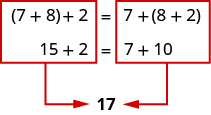
Figure 7.3図 7.3
When adding three numbers, changing the grouping of the numbers does not change the result. This is known as the Associative Property of Addition.
英語のヒント
3つの数を足すとき、数のまとめ方を変えても結果は変わらない。これを加法の結合法則という。
The same principle holds true for multiplication as well. Suppose we want to find the value of the following expression:
乗法にも同じ原則が成り立つ。次の式の値を求めたいとしよう。
Changing the grouping of the numbers gives the same result, as shown in Figure 7.4.
図7.4に示すように、数のまとめ方を変えても結果は同じになる。
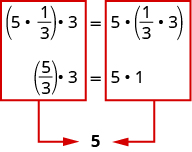
Figure 7.4図 7.4
When multiplying three numbers, changing the grouping of the numbers does not change the result. This is known as the Associative Property of Multiplication.
3つの数を掛けるとき、数のまとめ方を変えても結果は変わらない。これを乗法の結合法則という。
If we multiply three numbers, changing the grouping does not affect the product.
3つの数を掛けるとき、まとめ方を変えても積には影響しない。
You probably know this, but the terminology may be new to you. These examples illustrate the Associative Properties.
英語のヒント
このこと自体は知っていても、用語は初めてかもしれない。これらの例は結合法則を示している。
Example 7.6例題 7.6
Use the associative properties to rewrite the following:
結合法則を使って、次を書き換えよ。
- ⓐ
- ⓑ
Solution解答
ⓐ |
|
Change the grouping. まとめ方を変える。 |
Notice that is so the addition will be easier if we group as shown on the right.
はになることに注目しよう。右のようにまとめると、足し算が簡単になる。
ⓑ |
|
Change the grouping. まとめ方を変える。 |
Notice that is The multiplication will be easier if we group as shown on the right.
はになることに注目しよう。右のようにまとめると、掛け算が簡単になる。
Try It (2)確認問題(2題)
Besides using the associative properties to make calculations easier, we will often use it to simplify expressions with variables.
英語のヒント
結合法則は計算を簡単にするだけでなく、変数を含む式を簡単にするためにもよく使う。
Example 7.7例題 7.7
Use the Associative Property of Multiplication to simplify:
乗法の結合法則を使って、を簡単にせよ。
Solution解答
Change the grouping. まとめ方を変える。 |
|
Multiply in the parentheses. 括弧の中を掛ける。 |
Notice that we can multiply but we could not multiply without having a value for
は計算できるが、の値がなければは計算できないことに注目しよう。