第7章実数の性質
Irrational Numbers無理数
Are there any decimals that do not stop or repeat? Yes. The number (the Greek letter pi, pronounced ‘pie’), which is very important in describing circles, has a decimal form that does not stop or repeat.
終わらず、循環もしない小数はあるだろうか。ある。円を説明するうえで非常に重要な数(ギリシャ文字のパイ。英語では「パイ」と発音する)は、小数で表すと終わらず、循環もしない。
Similarly, the decimal representations of square roots of whole numbers that are not perfect squares never stop and never repeat. For example,
英語のヒント
同様に、平方数ではない非負整数の平方根を小数で表すと、終わることも循環することもない。例えば、
A decimal that does not stop and does not repeat cannot be written as the ratio of integers. We call this kind of number an irrational number.
英語のヒント
終わらず、循環もしない小数は、整数の比では表せない。この種類の数を無理数と呼ぶ。
Let's summarize a method we can use to determine whether a number is rational or irrational.
数が有理数か無理数かを判定する方法をまとめよう。
If the decimal form of a number
ある数の小数表示が、
- stops or repeats, the number is rational.有限小数または循環小数なら、その数は有理数である。
- does not stop and does not repeat, the number is irrational.終わらず、循環もしないなら、その数は無理数である。
Example 7.2例題 7.2
Identify each of the following as rational or irrational:
次の各数が有理数か無理数かを判定せよ。
- ⓐ
- ⓑ
- ⓒ
Solution解答
ⓐ
The bar above the indicates that it repeats. Therefore, is a repeating decimal, and is therefore a rational number.
The bar above the indicates that it repeats. Therefore, is a repeating decimal, and is therefore a rational number.
英語のヒント
ⓐ 。の上の横棒は、この数字が繰り返されることを示す。したがっては循環小数であり、有理数である。
ⓑ
This decimal stops after the , so it is a rational number.
This decimal stops after the , so it is a rational number.
ⓑ 。この小数はで終わるので、有理数である。
ⓒ
The ellipsis means that this number does not stop. There is no repeating pattern of digits. Since the number doesn't stop and doesn't repeat, it is irrational.
The ellipsis means that this number does not stop. There is no repeating pattern of digits. Since the number doesn't stop and doesn't repeat, it is irrational.
英語のヒント
ⓒ 。省略記号は、この数の小数表示が終わらないことを意味する。数字の繰り返しのパターンはない。終わらず、循環もしないので、無理数である。
Try It (2)確認問題(2題)
Let's think about square roots now. Square roots of perfect squares are always whole numbers, so they are rational. But the decimal forms of square roots of numbers that are not perfect squares never stop and never repeat, so these square roots are irrational.
次に平方根を考えよう。平方数の平方根は必ず非負整数になるので、有理数である。しかし、平方数ではない数の平方根の小数表示は終わらず、循環もしないので、その平方根は無理数である。
Example 7.3例題 7.3
Identify each of the following as rational or irrational:
次の各数が有理数か無理数かを判定せよ。
- ⓐ
- ⓑ
Solution解答
ⓐ The number is a perfect square, since So Therefore is rational.
ⓐ なので、は平方数である。したがってとなり、は有理数である。
ⓑ Remember that and so is not a perfect square.
ⓑ 、であることを思い出そう。したがって、は平方数ではない。
This means is irrational.
このことから、は無理数である。
Try It (2)確認問題(2題)
Classify Real Numbers実数を分類する
We have seen that all counting numbers are whole numbers, all whole numbers are integers, and all integers are rational numbers. Irrational numbers are a separate category of their own. When we put together the rational numbers and the irrational numbers, we get the set of real numbers.
英語のヒント
数える数はすべて非負整数であり、非負整数はすべて整数であり、整数はすべて有理数であると確認した。無理数は、それらとは別の種類の数である。有理数と無理数を合わせると、実数の集合になる。
Figure 7.2 illustrates how the number sets are related.
図7.2は、数の集合の関係を示している。
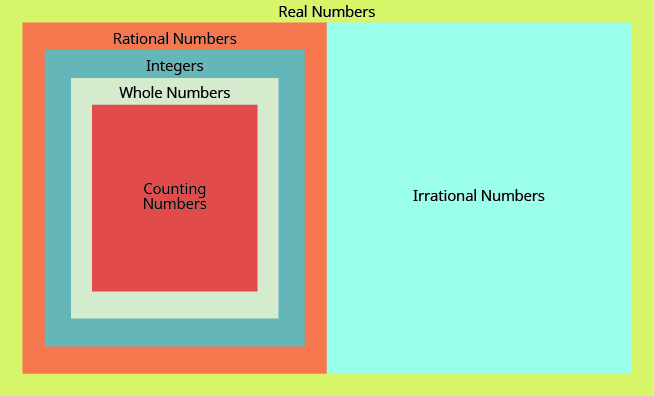
Figure 7.2図 7.2
This diagram illustrates the relationships between the different types of real numbers.
この図は、実数のさまざまな種類の関係を示している。
Does the term “real numbers” seem strange to you? Are there any numbers that are not “real”, and, if so, what could they be? For centuries, the only numbers people knew about were what we now call the real numbers. Then mathematicians discovered the set of imaginary numbers. You won't encounter imaginary numbers in this course, but you will later on in your studies of algebra.
英語のヒント
「実数」という言葉を不思議に感じるだろうか。「実」でない数もあるのだろうか。あるとすれば、どのような数だろう。何世紀もの間、人々が知っていた数は、今でいう実数だけだった。その後、数学者たちは虚数の集合を発見した。この授業では虚数は扱わないが、代数の学習を進めると後に出会うことになる。
Example 7.4例題 7.4
Determine whether each of the numbers in the following list is a ⓐ whole number, ⓑ integer, ⓒ rational number, ⓓ irrational number, and ⓔ real number.
次の一覧の各数が、ⓐ 非負整数、ⓑ 整数、ⓒ 有理数、ⓓ 無理数、ⓔ 実数であるかを判定せよ。
Solution解答
ⓐ The whole numbers are The number is the only whole number given.
ⓐ 非負整数はである。与えられた数の中で、非負整数はだけである。
ⓑ The integers are the whole numbers, their opposites, and From the given numbers, and are integers. Also, notice that is the square of so So the integers are
ⓑ 整数は、非負整数、それらの符号を反対にした数、およびである。与えられた数では、とが整数である。また、はの2乗なので、となる。したがって、整数はである。
ⓒ Since all integers are rational, the numbers are also rational. Rational numbers also include fractions and decimals that terminate or repeat, so are rational.
ⓒ 整数はすべて有理数なので、も有理数である。有理数には分数、有限小数、循環小数も含まれるため、も有理数である。
ⓓ The number is not a perfect square, so is irrational.
ⓓ は平方数ではないので、は無理数である。
ⓔ All of the numbers listed are real.
ⓔ 挙げられた数はすべて実数である。
We'll summarize the results in a table.
結果を表にまとめる。
Number 数 |
Whole 非負整数 |
Integer 整数 |
Rational 有理数 |
Irrational 無理数 |
Real 実数 |
|---|---|---|---|---|---|