第7章実数の性質
Evaluate Expressions using the Commutative and Associative Properties交換法則と結合法則を使って式の値を求める
The commutative and associative properties can make it easier to evaluate some algebraic expressions. Since order does not matter when adding or multiplying three or more terms, we can rearrange and re-group terms to make our work easier, as the next several examples illustrate.
英語のヒント
交換法則と結合法則を使うと、文字式の値を求めやすくなることがある。3つ以上の項を足したり掛けたりするとき、順序は結果に影響しないので、次の例に示すように、項を並べ替えたりまとめ直したりして計算を楽にできる。
Example 7.8例題 7.8
Evaluate each expression when
のとき、各式の値を求めよ。
- ⓐ
- ⓑ
Solution解答
ⓐ |
|
 |
|
Substitute for . にを代入する。 |
 |
Convert fractions to decimals. 分数を小数に直す。 |
 |
Add left to right. 左から右へ足す。 |
 |
Subtract. 引く。 |
 |
ⓑ |
|
 |
|
Substitute for x. xにを代入する。 |
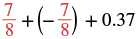 |
Add opposites first. 符号が反対の数どうしを先に足す。 |
 |
What was the difference between part ⓐ and part ⓑ ? Only the order changed. By the Commutative Property of Addition, But wasn’t part ⓑ much easier?
ⓐとⓑは何が違っただろうか。順序だけが変わった。加法の交換法則により、である。ⓑのほうがずっと簡単ではなかっただろうか。
Try It (2)確認問題(2題)
Let’s do one more, this time with multiplication.
もう1つ、今度は掛け算の例を見てみよう。
Example 7.9例題 7.9
Evaluate each expression when
のとき、各式の値を求めよ。
- ⓐ
- ⓑ
Solution解答
ⓐ |
|
 |
|
Substitute 17 for n. nに17を代入する。 |
 |
Multiply in the parentheses first. 括弧の中を先に掛ける。 |
 |
Multiply again. さらに掛ける。 |
 |
ⓑ |
|
 |
|
Substitute 17 for n. nに17を代入する。 |
 |
Multiply. The product of reciprocals is 1. 掛ける。互いに逆数である数の積は1になる。 |
 |
Multiply again. さらに掛ける。 |
 |
What was the difference between part ⓐ and part ⓑ here? Only the grouping changed. By the Associative Property of Multiplication, By carefully choosing how to group the factors, we can make the work easier.
ここでⓐとⓑは何が違っただろうか。まとめ方だけが変わった。乗法の結合法則により、である。因数のまとめ方をよく考えて選べば、計算を楽にできる。
Try It (2)確認問題(2題)
Simplify Expressions Using the Commutative and Associative Properties交換法則と結合法則を使って式を簡単にする
When we have to simplify algebraic expressions, we can often make the work easier by applying the Commutative or Associative Property first instead of automatically following the order of operations. Notice that in Example 7.8 part ⓑ was easier to simplify than part ⓐ because the opposites were next to each other and their sum is Likewise, part ⓑ in Example 7.9 was easier, with the reciprocals grouped together, because their product is In the next few examples, we’ll use our number sense to look for ways to apply these properties to make our work easier.
Example 7.10例題 7.10
Simplify:
次の式を簡単にする:
Solution解答
Notice the first and third terms are opposites, so we can use the commutative property of addition to reorder the terms.
第1項と第3項は符号が反対の数なので、加法の交換法則を使って項を並べ替えられる。
Re-order the terms. 項を並べ替える。 |
|
Add left to right. 左から右へ足す。 |
|
Add. 足す。 |
Try It (2)確認問題(2題)
Now we will see how recognizing reciprocals is helpful. Before multiplying left to right, look for reciprocals—their product is
英語のヒント
次に、逆数に気づくことがどう役立つかを見てみよう。左から右へ掛ける前に、互いに逆数である数を探そう。その積はになる。
Example 7.11例題 7.11
Simplify:
次の式を簡単にする:
Solution解答
Notice the first and third terms are reciprocals, so we can use the Commutative Property of Multiplication to reorder the factors.
第1項と第3項は互いに逆数なので、乗法の交換法則を使って因数を並べ替えられる。
Re-order the terms. 項を並べ替える。 |
|
Multiply left to right. 左から右へ掛ける。 |
|
Multiply. 掛ける。 |
Try It (2)確認問題(2題)
In expressions where we need to add or subtract three or more fractions, combine those with a common denominator first.
3つ以上の分数を足したり引いたりする式では、分母が同じものを先にまとめる。
Example 7.12例題 7.12
Simplify:
次の式を簡単にする:
Solution解答
Notice that the second and third terms have a common denominator, so this work will be easier if we change the grouping.
第2項と第3項は分母が同じなので、まとめ方を変えると計算が簡単になる。
Group the terms with a common denominator. 分母が同じ項をまとめる。 |
|
Add in the parentheses first. 括弧の中を先に足す。 |
|
Simplify the fraction. 分数を約分する。 |
|
Add. 足す。 |
|
Convert to an improper fraction. 仮分数に直す。 |
Try It (2)確認問題(2題)
When adding and subtracting three or more terms involving decimals, look for terms that combine to give whole numbers.
英語のヒント
小数を含む3つ以上の項を足し引きするときは、まとめると非負整数になる項を探す。
Example 7.13例題 7.13
Simplify:
次の式を簡単にする:
Solution解答
Notice that the sum of the second and third coefficients is a whole number.
英語のヒント
第2項と第3項の係数の和が非負整数になることに注目しよう。
Change the grouping. まとめ方を変える。 |
|
Add in the parentheses first. 括弧の中を先に足す。 |
|
Add. 足す。 |
Many people have good number sense when they deal with money. Think about adding cents and cent. Do you see how this applies to adding
お金を扱うときには、多くの人が数に対するよい感覚を発揮する。セントとセントを足すことを考えてみよう。これをの足し算にどう生かせるかわかるだろうか。
Try It (2)確認問題(2題)
No matter what you are doing, it is always a good idea to think ahead. When simplifying an expression, think about what your steps will be. The next example will show you how using the Associative Property of Multiplication can make your work easier if you plan ahead.
英語のヒント
何をしているときでも、先を考えるのはよいことである。式を簡単にするときには、どの手順で進めるかを考えよう。次の例では、先を考えて乗法の結合法則を使うことで、計算を楽にできる様子を示す。
Example 7.14例題 7.14
Simplify the expression:
式を簡単にせよ。
Solution解答
Notice that multiplying is easier than multiplying because it gives a whole number. (Think about having quarters—that makes
は非負整数になるため、を計算するより簡単である。(25セント硬貨が枚あれば、になると考えよう。)
Regroup. まとめ方を変える。 |
|
Multiply in the brackets first. 角括弧の中を先に掛ける。 |
|
Multiply. 掛ける。 |
Try It (2)確認問題(2題)
When simplifying expressions that contain variables, we can use the commutative and associative properties to re-order or regroup terms, as shown in the next pair of examples.
変数を含む式を簡単にするときも、次の2つの例に示すように、交換法則と結合法則を使って項を並べ替えたり、まとめ直したりできる。
Example 7.15例題 7.15
Simplify:
次の式を簡単にする:
Solution解答
Use the associative property of multiplication to re-group. 乗法の結合法則を使ってまとめ方を変える。 |
|
Multiply in the parentheses. 括弧の中を掛ける。 |
Try It (2)確認問題(2題)
In The Language of Algebra, we learned to combine like terms by rearranging an expression so the like terms were together. We simplified the expression by rewriting it as and then simplified it to We were using the Commutative Property of Addition.
「代数の言葉」では、同類項が隣り合うよう式を並べ替えてから、同類項をまとめる方法を学んだ。式をと書き換え、それからに簡単にした。このとき使っていたのが加法の交換法則である。
Example 7.16例題 7.16
Simplify:
次の式を簡単にする:
Solution解答
Use the Commutative Property of Addition to re-order so that like terms are together.
加法の交換法則を使い、同類項が隣り合うように並べ替える。
Re-order terms. 項を並べ替える。 |
|
Combine like terms. 同類項をまとめる。 |