第3章整数
3.5 Solve Equations Using Integers; The Division Property of Equality3.5 整数を使って方程式を解く:等式の除法の性質
Learning Objectives学習目標
Learning Objectives学習目標
By the end of this section, you will be able to:
この節を終えると、次のことができるようになる。
- Determine whether an integer is a solution of an equationある整数が方程式の解かどうかを判定する
- Solve equations with integers using the Addition and Subtraction Properties of Equality等式の加法と減法の性質を使い、整数を含む方程式を解く
- Model the Division Property of Equality等式の除法の性質をモデルで表す
- Solve equations using the Division Property of Equality等式の除法の性質を使って方程式を解く
- Translate to an equation and solve方程式に直して解く
Before You Begin (3)準備問題(3題)
Determine Whether a Number is a Solution of an Equationある数が方程式の解かどうかを判定する
In Solve Equations with the Subtraction and Addition Properties of Equality, we saw that a solution of an equation is a value of a variable that makes a true statement when substituted into that equation. In that section, we found solutions that were whole numbers. Now that we’ve worked with integers, we’ll find integer solutions to equations.
「等式の減法と加法の性質を使って方程式を解く」では、方程式の解とは、代入するとその等式を成り立たせる変数の値であると学んだ。その節では、非負整数の解を求めた。これで整数を扱えるようになったので、方程式の整数の解を求める。
The steps we take to determine whether a number is a solution to an equation are the same whether the solution is a whole number or an integer.
ある数が方程式の解かどうかを判定する手順は、解が非負整数でも整数でも同じである。
Example 3.60例題 3.60
Determine whether each of the following is a solution of
次の各数がの解かどうかを判定せよ。
- ⓐ
- ⓑ
- ⓒ
Solution解答
ⓐ Substitute 4 for x in the equation to determine if it is true. ⓐ 方程式のxに4を代入し、正しいかどうかを判定する。 |
|
 |
|
 |
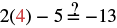 |
Multiply. 掛ける。 |
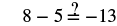 |
Subtract. 引く。 |
 |
Since does not result in a true equation, is not a solution to the equation.
では正しい等式にならないので、はこの方程式の解ではない。
ⓑ Substitute −4 for x in the equation to determine if it is true. ⓑ 方程式のxに−4を代入し、正しいかどうかを判定する。 |
 |
 |
 |
Multiply. 掛ける。 |
 |
Subtract. 引く。 |
 |
Since results in a true equation, is a solution to the equation.
では正しい等式になるので、はこの方程式の解である。
ⓒ Substitute −9 for x in the equation to determine if it is true. ⓒ 方程式のxに−9を代入し、正しいかどうかを判定する。 |
|
 |
|
Substitute −9 for x. xに−9を代入する。 |
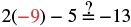 |
Multiply. 掛ける。 |
 |
Subtract. 引く。 |
 |
Since does not result in a true equation, is not a solution to the equation.
では正しい等式にならないので、はこの方程式の解ではない。
Try It (2)確認問題(2題)
Solve Equations with Integers Using the Addition and Subtraction Properties of Equality等式の加法と減法の性質を使い、整数を含む方程式を解く
In Solve Equations with the Subtraction and Addition Properties of Equality, we solved equations similar to the two shown here using the Subtraction and Addition Properties of Equality. Now we can use them again with integers.
「等式の減法と加法の性質を使って方程式を解く」では、ここに示す2つと似た方程式を、等式の減法と加法の性質で解いた。次は整数でも同じ性質を使える。
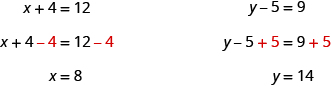
When you add or subtract the same quantity from both sides of an equation, you still have equality.
方程式の両辺に同じ量を足したり引いたりしても、等しさは保たれる。
Example 3.61例題 3.61
Solve:
次の方程式を解く:
Solution解答
 |
|
Subtract 9 from each side to undo the addition. 足し算を元に戻すために、両辺から9を引く。 |
 |
Simplify. 簡単にする。 |
 |
Check the result by substituting into the original equation.
元の方程式にを代入して、結果を確かめる。
Substitute −4 for y yに−4を代入する。 |
|
Since makes a true statement, we found the solution to this equation.
によってが正しい文になるので、この方程式の解が求まった。
Try It (2)確認問題(2題)
Example 3.62例題 3.62
Solve:
次の方程式を解く:
Solution解答
 |
|
Add 6 to each side to undo the subtraction. 引き算を元に戻すために、両辺に6を足す。 |
 |
Simplify. 簡単にする。 |
 |
Check the result by substituting into the original equation: 元の方程式にを代入して、結果を確かめる。 |
 |
Substitute for にを代入する。 |
 |
 |
The solution to is
の解はである。
Since makes a true statement, we found the solution to this equation.
によってが正しい文になるので、この方程式の解が求まった。
Try It (2)確認問題(2題)
Model the Division Property of Equality等式の除法の性質をモデルで表す
All of the equations we have solved so far have been of the form or We were able to isolate the variable by adding or subtracting the constant term. Now we’ll see how to solve equations that involve division.
ここまでに解いた方程式はすべて、またはという形だった。定数項を足したり引いたりして、変数だけを残すことができた。次は、割り算を使う方程式の解き方を見よう。
We will model an equation with envelopes and counters in Figure 3.21.
図3.21の封筒とカウンターで、方程式をモデルで表す。
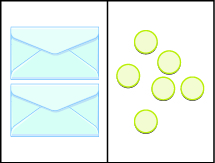
Figure 3.21図 3.21
Here, there are two identical envelopes that contain the same number of counters. Remember, the left side of the workspace must equal the right side, but the counters on the left side are “hidden” in the envelopes. So how many counters are in each envelope?
ここには、同じ個数のカウンターが入った同じ封筒が2枚ある。作業場所の左側と右側は等しくなければならないが、左のカウンターは封筒に「隠れている」ことを思い出そう。それぞれの封筒には、カウンターが何個入っているだろうか。
To determine the number, separate the counters on the right side into groups of the same size. So counters divided into groups means there must be counters in each group (since
個数を求めるには、右側のカウンターを同じ個数のグループに分ける。個をグループに分けると、各グループには個あるはずである(だからである)。
What equation models the situation shown in Figure 3.22? There are two envelopes, and each contains counters. Together, the two envelopes must contain a total of counters. So the equation that models the situation is
図3.22の状況を表す方程式は何か。封筒は2枚あり、それぞれにカウンターが個入っている。2枚を合わせると、全部で個のはずである。したがって、この状況を表す方程式はである。
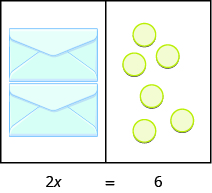
Figure 3.22図 3.22
We can divide both sides of the equation by as we did with the envelopes and counters.
封筒とカウンターで行ったように、方程式の両辺をで割れる。

We found that each envelope contains Does this check? We know so it works. Three counters in each of two envelopes does equal six.
各封筒にはあると分かった。検算は合うだろうか。なので合っている。2枚の封筒に3個ずつなら、確かに6個である。
Figure 3.23 shows another example.
図3.23に別の例を示す。
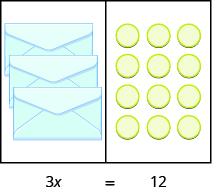
Figure 3.23図 3.23
Now we have identical envelopes and How many counters are in each envelope? We have to separate the into Since there must be in each envelope. See Figure 3.24.
今度は、同じ封筒枚とがある。各封筒にはカウンターが何個あるか。をに分ける必要がある。なので、各封筒にはあるはずである。図3.24を参照せよ。
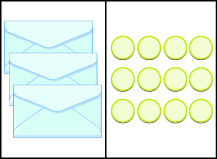
Figure 3.24図 3.24
The equation that models the situation is We can divide both sides of the equation by
この状況を表す方程式はである。両辺をで割れる。

Does this check? It does because
検算は合うだろうか。なので合っている。
Additional Resources追加教材
Example 3.63例題 3.63
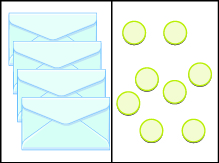
Write an equation modeled by the envelopes and counters, and then solve it.
封筒とカウンターをモデルとする方程式を書いて解け。
Solution解答
There are or unknown values, on the left that match the on the right. Let’s call the unknown quantity in the envelopes
左側には、すなわち個の未知の値があり、右側のに対応している。封筒の中の未知の量をと呼ぼう。
Write the equation. 方程式を書く。 |
 |
Divide both sides by 4. 両辺を4で割る。 |
 |
Simplify. 簡単にする。 |
 |
There are in each envelope.
各封筒にはある。