第3章整数
3.3 Subtract Integers3.3 整数を引く
Learning Objectives学習目標
Learning Objectives学習目標
By the end of this section, you will be able to:
この節を終えると、次のことができるようになる。
- Model subtraction of integers整数の引き算をモデルで表す
- Simplify expressions with integers整数を含む式を簡単にする
- Evaluate variable expressions with integers整数を使って変数を含む式の値を求める
- Translate words phrases to algebraic expressions言葉の表現を代数式に直す
- Subtract integers in applications応用問題で整数を引く
Before You Begin (3)準備問題(3題)
Model Subtraction of Integers整数の引き算をモデルで表す
Remember the story in the last section about the toddler and the cookies? Children learn how to subtract numbers through their everyday experiences. Real-life experiences serve as models for subtracting positive numbers, and in some cases, such as temperature, for adding negative as well as positive numbers. But it is difficult to relate subtracting negative numbers to common life experiences. Most people do not have an intuitive understanding of subtraction when negative numbers are involved. Math teachers use several different models to explain subtracting negative numbers.
英語のヒント
前の節の、幼児とクッキーの話を覚えているだろうか。子どもは日常の経験を通して数の引き算を学ぶ。実生活の経験は、正の数の引き算のモデルとなり、気温などの場合には、正の数と負の数の足し算のモデルにもなる。しかし、負の数の引き算を日常的な経験と結び付けるのは難しい。多くの人は、負の数を含む引き算を直感的には理解していない。数学の教師は、負の数の引き算を説明するために、さまざまなモデルを使う。
We will continue to use counters to model subtraction. Remember, the blue counters represent positive numbers and the red counters represent negative numbers.
引き続き、カウンターを使って引き算をモデルで表す。青いカウンターは正の数、赤いカウンターは負の数を表すことを思い出そう。
Perhaps when you were younger, you read as five take away three. When we use counters, we can think of subtraction the same way.
幼いころ、を「5から3を取り除く」と読んだことがあるかもしれない。カウンターを使うときも、引き算を同じように考えられる。
Additional Resources追加教材
We will model four subtraction facts using the numbers and
数とを使い、4つの引き算をモデルで表す。
Example 3.30例題 3.30
Model:
モデルで表す:
Solution解答
Interpret the expression. 式の意味を読み取る。 |
means take away . は、からを取り除くことを意味する。 |
Model the first number. Start with 5 positives. 最初の数をモデルで表す。正のカウンター5個から始める。 |
 |
Take away the second number. So take away 3 positives. 2番目の数を取り除く。つまり、正のカウンター3個を取り除く。 |
 |
Find the counters that are left. 残ったカウンターを調べる。 |
 |
. The difference between and is . 。との差はである。 |
Try It (2)確認問題(2題)
Example 3.31例題 3.31
Model:
モデルで表す:
Solution解答
Interpret the expression. 式の意味を読み取る。 |
means take away . は、からを取り除くことを意味する。 |
Model the first number. Start with 5 negatives. 最初の数をモデルで表す。負のカウンター5個から始める。 |
 |
Take away the second number. So take away 3 negatives. 2番目の数を取り除く。つまり、負のカウンター3個を取り除く。 |
 |
Find the number of counters that are left. 残ったカウンターの個数を求める。 |
 |
. The difference between and is . 。との差はである。 |
Try It (2)確認問題(2題)
Notice that Example 3.30 and Example 3.31 are very much alike.
- First, we subtracted positives from positives to get positives.最初に、正の個から正の個を引き、正の個を得た。
- Then we subtracted negatives from negatives to get negatives.次に、負の個から負の個を引き、負の個を得た。
Each example used counters of only one color, and the “take away” model of subtraction was easy to apply.
各例では1色のカウンターだけを使い、「取り除く」という引き算のモデルを簡単に適用できた。
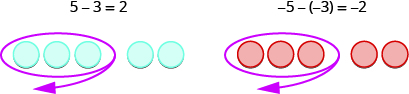
Now let’s see what happens when we subtract one positive and one negative number. We will need to use both positive and negative counters and sometimes some neutral pairs, too. Adding a neutral pair does not change the value.
英語のヒント
次に、正の数と負の数を1つずつ使って引き算をするとどうなるか見よう。正と負の両方のカウンターが必要になり、ときには打ち消し合う対も必要になる。打ち消し合う対を加えても、値は変わらない。
Example 3.32例題 3.32
Model:
モデルで表す:
Solution解答
Interpret the expression. 式の意味を読み取る。 |
means take away . は、からを取り除くことを意味する。 |
Model the first number. Start with 5 negatives. 最初の数をモデルで表す。負のカウンター5個から始める。 |
 |
Take away the second number. So we need to take away 3 positives. 2番目の数を取り除く。つまり、正のカウンター3個を取り除く必要がある。 |
|
But there are no positives to take away. Add neutral pairs until you have 3 positives. しかし、取り除ける正のカウンターがない。正のカウンターが3個になるまで、打ち消し合う対を加える。 |
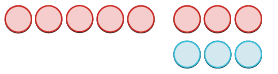 |
Now take away 3 positives. 次に、正のカウンター3個を取り除く。 |
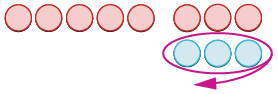 |
Count the number of counters that are left. 残ったカウンターの個数を数える。 |
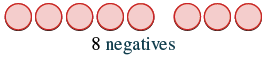 |
. The difference of and is . 。との差はである。 |
Try It (2)確認問題(2題)
Example 3.33例題 3.33
Model:
モデルで表す:
Solution解答
Interpret the expression. 式の意味を読み取る。 |
means take away . は、からを取り除くことを意味する。 |
Model the first number. Start with 5 positives. 最初の数をモデルで表す。正のカウンター5個から始める。 |
 |
Take away the second number, so take away 3 negatives. 2番目の数を取り除くので、負のカウンター3個を取り除く。 |
|
But there are no negatives to take away. Add neutral pairs until you have 3 negatives. しかし、取り除ける負のカウンターがない。負のカウンターが3個になるまで、打ち消し合う対を加える。 |
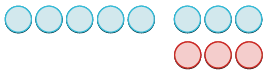 |
Then take away 3 negatives. その後、負のカウンター3個を取り除く。 |
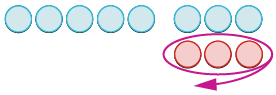 |
Count the number of counters that are left. 残ったカウンターの個数を数える。 |
 |
The difference of and is . との差はである。 |
Try It (2)確認問題(2題)
Example 3.34例題 3.34
Model each subtraction.
各引き算をモデルで表せ。
- ⓐ 8 − 2
- ⓑ −5 − 4
- ⓒ 6 − (−6)
- ⓓ −8 − (−3)
Solution解答
Solution解き方
ⓐ |
|
This means take away . 。これはからを取り除くことを意味する。 |
|
Start with 8 positives. 正のカウンター8個から始める。 |
 |
Take away 2 positives. 正のカウンター2個を取り除く。 |
 |
How many are left? 何個残るか。 |
|
ⓑ |
|
This means take away . 。これはからを取り除くことを意味する。 |
|
Start with 5 negatives. 負のカウンター5個から始める。 |
 |
You need to take away 4 positives. Add 4 neutral pairs to get 4 positives. 正のカウンター4個を取り除く必要がある。打ち消し合う対を4組加えて、正のカウンター4個を得る。 |
  |
Take away 4 positives. 正のカウンター4個を取り除く。 |
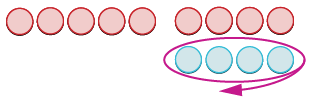 |
How many are left? 何個残るか。 |
 |
ⓒ |
|
This means take away . 。これはからを取り除くことを意味する。 |
|
Start with 6 positives. 正のカウンター6個から始める。 |
 |
Add 6 neutrals to get 6 negatives to take away. 打ち消し合う対を6組加えて、取り除く負のカウンター6個を得る。 |
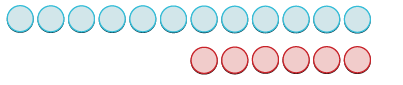 |
Remove 6 negatives. 負のカウンター6個を取り除く。 |
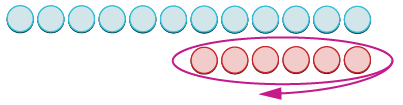 |
How many are left? 何個残るか。 |
 |
ⓓ |
|
This means take away . 。これはからを取り除くことを意味する。 |
|
Start with 8 negatives. 負のカウンター8個から始める。 |
 |
Take away 3 negatives. 負のカウンター3個を取り除く。 |
 |
How many are left? 何個残るか。 |
 |
Try It (2)確認問題(2題)
Example 3.35例題 3.35
Model each subtraction expression:
各引き算の式をモデルで表せ。
- ⓐ
- ⓑ
Solution解答
ⓐ We start with 2 positives. ⓐ 正のカウンター2個から始める。 |
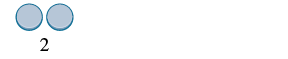 |
We need to take away 8 positives, but we have only 2. 英語のヒント正のカウンター8個を取り除く必要があるが、2個しかない。 |
|
Add neutral pairs until there are 8 positives to take away. 取り除く正のカウンターが8個になるまで、打ち消し合う対を加える。 |
 |
Then take away eight positives. その後、正のカウンター8個を取り除く。 |
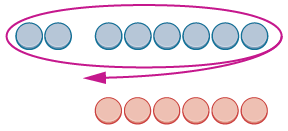 |
Find the number of counters that are left. There are 6 negatives. 残ったカウンターの個数を求める。負のカウンターが6個ある。 |
 |
ⓑ We start with 3 negatives. ⓑ 負のカウンター3個から始める。 |
 |
We need to take away 8 negatives, but we have only 3. 負のカウンター8個を取り除く必要があるが、3個しかない。 |
|
Add neutral pairs until there are 8 negatives to take away. 取り除く負のカウンターが8個になるまで、打ち消し合う対を加える。 |
 |
Then take away the 8 negatives. その後、負のカウンター8個を取り除く。 |
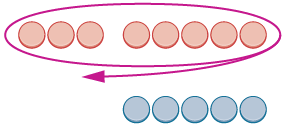 |
Find the number of counters that are left. There are 5 positives. 残ったカウンターの個数を求める。正のカウンターが5個ある。 |
 |