第3章整数
3.2 Add Integers3.2 整数を足す
Learning Objectives学習目標
Learning Objectives学習目標
By the end of this section, you will be able to:
この節を終えると、次のことができるようになる。
- Model addition of integers整数の足し算をモデルで表す
- Simplify expressions with integers整数を含む式を簡単にする
- Evaluate variable expressions with integers整数を使って変数を含む式の値を求める
- Translate word phrases to algebraic expressions言葉の表現を代数式に直す
- Add integers in applications応用問題で整数を足す
Before You Begin (3)準備問題(3題)
Model Addition of Integers整数の足し算をモデルで表す
Now that we have located positive and negative numbers on the number line, it is time to discuss arithmetic operations with integers.
数直線上に正の数と負の数を示せるようになったので、次は整数の算術演算を考える。
Most students are comfortable with the addition and subtraction facts for positive numbers. But doing addition or subtraction with both positive and negative numbers may be more difficult. This difficulty relates to the way the brain learns.
多くの学生は、正の数の基本的な足し算と引き算には慣れている。しかし、正の数と負の数の両方を使う足し算や引き算は、より難しいかもしれない。この難しさは、脳の学び方と関係している。
The brain learns best by working with objects in the real world and then generalizing to abstract concepts. Toddlers learn quickly that if they have two cookies and their older brother steals one, they have only one left. This is a concrete example of Children learn their basic addition and subtraction facts from experiences in their everyday lives. Eventually, they know the number facts without relying on cookies.
英語のヒント
脳は、現実の物を扱ってから抽象的な概念へ一般化すると、最もよく学ぶ。幼児は、クッキーが2枚あって兄が1枚取ってしまうと、残りは1枚だけになることをすぐに学ぶ。これはの具体例である。子どもは日常の経験から、基本的な足し算や引き算を学ぶ。やがて、クッキーに頼らなくても計算が分かるようになる。
Addition and subtraction of negative numbers have fewer real world examples that are meaningful to us. Math teachers have several different approaches, such as number lines, banking, temperatures, and so on, to make these concepts real.
負の数の足し算と引き算には、私たちにとって意味のある現実の例が比較的少ない。数学の教師は、数直線、銀行取引、気温など、さまざまな方法でこれらの概念を具体化する。
We will model addition and subtraction of negatives with two color counters. We let a blue counter represent a positive and a red counter will represent a negative.
2色のカウンターで、負の数の足し算と引き算をモデルで表す。青いカウンターを正、赤いカウンターを負とする。

If we have one positive and one negative counter, the value of the pair is zero. They form a neutral pair. The value of this neutral pair is zero as summarized in Figure 3.17.
英語のヒント
正のカウンターと負のカウンターが1個ずつある場合、その対の値は0である。これを打ち消し合う対という。図3.17にまとめたように、この対の値は0である。
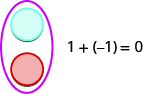
Figure 3.17図 3.17
A blue counter represents A red counter represents Together they add to zero.
青いカウンターは、赤いカウンターはを表す。合わせると0になる。
Additional Resources追加教材
We will model four addition facts using the numbers
という数を使い、4つの足し算をモデルで表す。
Example 3.14例題 3.14
Model:
モデルで表す:
Solution解答
Interpret the expression. 式の意味を読み取る。 |
means the sum of and . は、との和を意味する。 |
Model the first number. Start with 5 positives. 最初の数をモデルで表す。正のカウンター5個から始める。 |
 |
Model the second number. Add 3 positives. 2番目の数をモデルで表す。正のカウンター3個を加える。 |
 |
Count the total number of counters. カウンターの総数を数える。 |
 |
The sum of 5 and 3 is 8. 5と3の和は8である。 |
Try It (2)確認問題(2題)
Example 3.15例題 3.15
Model:
モデルで表す:
Solution解答
Interpret the expression. 式の意味を読み取る。 |
means the sum of and . は、との和を意味する。 |
Model the first number. Start with 5 negatives. 最初の数をモデルで表す。負のカウンター5個から始める。 |
 |
Model the second number. Add 3 negatives. 2番目の数をモデルで表す。負のカウンター3個を加える。 |
 |
Count the total number of counters. カウンターの総数を数える。 |
 |
The sum of −5 and −3 is −8. −5と−3の和は−8である。 |
Try It (2)確認問題(2題)
Example 3.14 and Example 3.15 are very similar. The first example adds positives and positives—both positives. The second example adds negatives and negatives—both negatives. In each case, we got a result of positives or negatives. When the signs are the same, the counters are all the same color.
Now let’s see what happens when the signs are different.
次に、符号が異なる場合を見よう。
Example 3.16例題 3.16
Model:
モデルで表す:
Solution解答
Interpret the expression. 式の意味を読み取る。 |
means the sum of and . は、との和を意味する。 |
Model the first number. Start with 5 negatives. 最初の数をモデルで表す。負のカウンター5個から始める。 |
 |
Model the second number. Add 3 positives. 2番目の数をモデルで表す。正のカウンター3個を加える。 |
 |
Remove any neutral pairs. 打ち消し合う対をすべて取り除く。 |
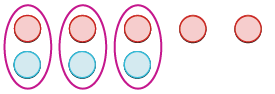 |
Count the result. 結果を数える。 |
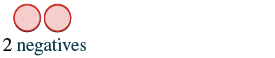 |
The sum of −5 and 3 is −2. −5と3の和は−2である。 |
Notice that there were more negatives than positives, so the result is negative.
負のカウンターの方が正より多かったため、結果が負になったことに注意しよう。
Try It (2)確認問題(2題)
Example 3.17例題 3.17
Model:
モデルで表す:
Solution解答
Interpret the expression. 式の意味を読み取る。 |
means the sum of and . は、との和を意味する。 |
Model the first number. Start with 5 positives. 最初の数をモデルで表す。正のカウンター5個から始める。 |
 |
Model the second number. Add 3 negatives. 2番目の数をモデルで表す。負のカウンター3個を加える。 |
 |
Remove any neutral pairs. 打ち消し合う対をすべて取り除く。 |
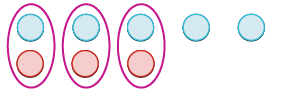 |
Count the result. 結果を数える。 |
 |
The sum of 5 and −3 is 2. 5と−3の和は2である。 |
Try It (2)確認問題(2題)
Example 3.18例題 3.18
Modeling Addition of Positive and Negative Integers正の整数と負の整数の足し算をモデルで表す
Model each addition.
各足し算をモデルで表せ。
- ⓐ 4 + 2
- ⓑ −3 + 6
- ⓒ 4 + (−5)
- ⓓ -2 + (−3)
Solution解答
Solution解き方
ⓐ |
|
Start with 4 positives. 正のカウンター4個から始める。 |
 |
Add two positives. 正のカウンター2個を加える。 |
 |
How many do you have? 何個あるか。 |
ⓑ |
|
Start with 3 negatives. 負のカウンター3個から始める。 |
 |
Add 6 positives. 正のカウンター6個を加える。 |
 |
Remove neutral pairs. 打ち消し合う対を取り除く。 |
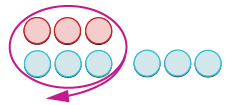 |
How many are left? 何個残るか。 |
 |
. |
ⓒ |
|
Start with 4 positives. 正のカウンター4個から始める。 |
 |
Add 5 negatives. 負のカウンター5個を加える。 |
 |
Remove neutral pairs. 打ち消し合う対を取り除く。 |
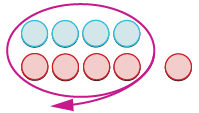 |
How many are left? 何個残るか。 |
 |
. |
ⓓ |
|
Start with 2 negatives. 負のカウンター2個から始める。 |
 |
Add 3 negatives. 負のカウンター3個を加える。 |
 |
How many do you have? 何個あるか。 |
. |