第7章認識論Epistemology
7.5 Applied Epistemology7.5 応用認識論
Learning Objectives学習目標
By the end of this section, you will be able to:
この節を読み終えると、次のことができるようになる。
Define applied epistemology.
応用認識論を定義する。
Describe the social aspect of knowledge and justification.
知識と正当化の社会的側面を説明する。
Describe standpoint epistemology.
立場の認識論を説明する。
Identify examples of epistemic injustice.
認識的不正義の例を挙げる。
Applied epistemology, like other areas of applied philosophy, takes the tools of philosophy and applies them to areas of practical concern. Specifically, it applies philosophical methods and theories particular to epistemology to current social issues and practices. Applied epistemology often approaches epistemological questions on a collective or systems level. When looking at systems, applied epistemology investigates whether the systems of investigation (like those in the sciences) are structured in the best way to lead to true beliefs. When applied to collectives, applied epistemology examines whether and how groups of people conduct deliberation that leads to reliably true and justified beliefs. The groups focused on can range from small groups, such as a jury, to large collectives, such as a democracy.
英語のヒント
応用認識論は、応用哲学のほかの分野と同じく、哲学の道具を、実践的な問題の領域に適用する。具体的には、認識論に特有の哲学的方法と理論を、現在の社会的課題や実践に適用する。応用認識論は、認識論の問いに、しばしば集団や制度の水準で取り組む。制度を見るときには、例えば科学における探究の制度が、真なる信念へ導くために、最善の仕方で組み立てられているかを調べる。集団に適用されるときには、人々の集団が、信頼できる仕方で真かつ正当化された信念へ導く熟議を行っているか、行っているならどのように行っているかを検討する。対象となる集団は、陪審のような小集団から、民主主義社会のような大きな集団まで、幅広い。
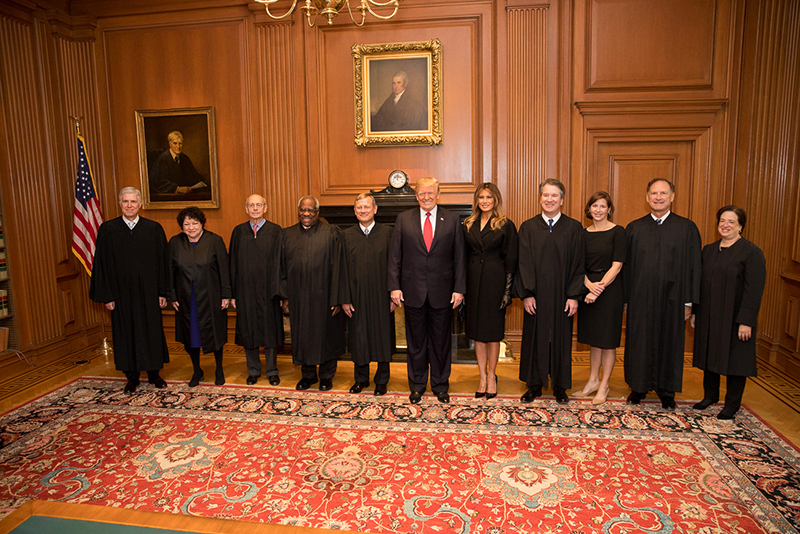
Figure 7.10 We often attribute beliefs to the Supreme Court, even though it is a collection of people that has changed over time. In this photo, former president Donald Trump and first lady Melania Trump stand with members of the US Supreme Court in 2018. (credit: “President Donald J. Trump and First Lady Melania Trump at the Supreme Court of the United States” by Trump White House Archived/Flickr, Public Domain)
図7.10 最高裁判所は、構成員が時とともに入れ替わる人々の集まりだが、私たちはしばしば、最高裁判所に信念を帰属させる。2018年のこの写真では、ドナルド・トランプ前大統領とファーストレディーのメラニア・トランプが、アメリカ連邦最高裁判所の判事たちと並んでいる。 (credit: “President Donald J. Trump and First Lady Melania Trump at the Supreme Court of the United States” by Trump White House Archived/Flickr, Public Domain)
Social Epistemology社会認識論
The traditional epistemology that most of this chapter has covered is singularly focused on individuals. Theories are focused on what a person can know or when a subject is justified. For the most part, gaining knowledge is often treated as an individual effort. Social epistemology instead investigates how groups pursue knowledge and justification and how an individual can best seek justification and knowledge in a social world. Social epistemology takes seriously the fact that humans are, by and large, social animals that rely on others for belief formation. Because humans are social creatures, we rely on others for much of what we come to know. Our dependence on others for true beliefs eases knowledge acquisition, but it also complicates the task due to concerns regarding the reliability of others.
英語のヒント
この章の大半で扱ってきた伝統的な認識論は、専ら個人に焦点を当てる。理論が扱うのは、一人の人が何を知りうるか、ある主体がいつ正当化されるかである。知識の獲得は、多くの場合、個人の努力として扱われる。これに対して社会認識論は、集団がどのように知識と正当化を追求するか、また個人が社会的世界の中で、どうすれば最もよく正当化と知識を探せるかを研究する。人間は概して社会的動物であり、信念の形成を他者に頼っているという事実を、重く受け止めるのである。人間は社会的存在なので、知るようになることの多くを他者に頼る。真なる信念を得るために他者へ依存することは、知識の獲得を容易にする。しかし、他者の信頼性をめぐる問題によって、その仕事を複雑にもする。
How much of your knowledge was gained strictly from independent investigation conducted only by yourself? Very little, most likely. We rely on other humans from the past and present for a very large proportion of our knowledge. Scientific endeavors consist of amending and adding to the work of others over the course of centuries. The propositional knowledge learned in school is gained through layers upon layers of individuals trusting the testimony of others—students trusting the testimony of teachers, teachers trusting the testimony of books, the writers of the books trusting the testimony of sources, and so on. The news we view, the books we read, the conversations we overhear—all of these are social means of gaining knowledge.
英語のヒント
あなたの知識のうち、自分一人で行った独立の探究だけから得たものは、どのくらいあるだろうか。おそらく、ごくわずかだろう。私たちは、知識の非常に大きな部分を、過去と現在のほかの人々に頼っている。科学の営みは、何世紀にもわたり、他者の仕事を修正し、付け加えることからなる。学校で学ぶ命題知は、人が他者の証言を信頼するという、幾重もの積み重ねを通じて得られる。生徒は教師の証言を信頼し、教師は本の証言を信頼し、本の著者は資料の証言を信頼する、といった具合である。私たちが見るニュース、読む本、耳にする会話は、すべて知識を得る社会的な手段なのである。
Testimony証言
Social means of gaining knowledge are called testimony. Any time you believe something because you read it or heard it somewhere, you believe based on testimony. Of course, people are not always reliable. People sometimes use poor reasoning, misremember, or even lie. Hence, testimony is also sometimes unreliable. And this raises the question, When is testimony justified?
英語のヒント
知識を得る社会的な手段は、証言と呼ばれる。何かをどこかで読んだり聞いたりしたために信じるときは、いつでも証言に基づいて信じている。もちろん、人は常に信頼できるわけではない。推論を誤り、記憶違いをし、さらには嘘をつくこともある。したがって、証言も時には信頼できない。そこで、証言はどのような場合に正当化されるのか、という問いが生じる。
Testimony is clearly of importance to social epistemology. In determining whether to believe what others tell us, we ask whether they are trustworthy. A trustworthy source of testimony is honest, unbiased, rational, well-informed, and clearheaded. We further look for an expert or authority. An expert or authority is a person whose experience, education, and knowledge in an area make them more reliable. Questions surrounding testimony are questions about justification. When are we justified in believing others? Who are we justified in believing in particular situations? When and how does testimony give us justification for a belief? And what do we do when the testimony of others conflicts with our already held beliefs?
英語のヒント
証言が社会認識論にとって重要であることは明らかである。他者の言うことを信じるかどうかを決める際には、その人が信頼に値するかを問う。信頼に値する証言者は、正直で、偏見がなく、合理的で、十分な情報を持ち、判断が明晰である。さらに、私たちは専門家や権威を探す。専門家・権威とは、ある領域での経験、教育、知識によって、より信頼できる人のことである。証言をめぐる問いは、正当化をめぐる問いである。他者を信じることが正当化されるのは、どのような場合か。特定の状況では、誰を信じることが正当化されるのか。証言は、いつ、どのように信念の正当化を与えるのか。そして、他者の証言がすでに持っている信念と衝突するときには、どうすればよいのだろうか。

Figure 7.11 All of the information contained in libraries is a form of testimonial knowledge. This is one of the public reading rooms in the New York Public Library. (credit: “New York Public Library” by soomness/Flickr, CC BY 2.0)
図7.11 図書館に収められた情報は、すべて証言による知識の一形態である。これは、ニューヨーク公共図書館の一般閲覧室の一つ。 (credit: “New York Public Library” by soomness/Flickr, CC BY 2.0)
Peer Disagreement認識上の同等者との意見の不一致
When the testimony of another contradicts your own belief, what should you do? In cases where the other person is an expert and you are not, then the testimony ought to weaken your confidence in your belief. You should either change your belief or withhold from believing either way until you can get further justification. But what should you do when the person is not an expert but an epistemic peer? An epistemic peer is a person who is in an equal epistemic position relative to some domain—that is, they have the same cognitive ability, evidence, and background knowledge in that domain. A person can be an epistemic peer with respect to one domain but not another. You may know that you are on level epistemic ground with regard to the subject of baseball with your best friend but that they are an authority compared to you on the subject of baking.
英語のヒント
他者の証言が自分の信念と矛盾するとき、どうすべきだろうか。相手は専門家だが自分はそうではない場合、その証言は、自分の信念への確信を弱めるはずである。信念を変えるか、さらに正当化を得られるまで、どちらを信じることも控えるべきだ。しかし、相手が専門家ではなく、認識上の同等者である場合は、どうすべきだろうか。認識上の同等者とは、ある領域について認識上の立場が同じ人、つまり、その領域で同じ認知能力、証拠、背景知識を持つ人である。ある領域では認識上の同等者でも、別の領域ではそうでない場合がある。例えば、親友とは野球については認識上の立場が対等だが、パンや菓子を焼くことでは、その友人のほうが自分より詳しい専門家だと分かっているかもしれない。
Social epistemologists theorize about how peer disagreement ought to function in justification and belief. Some theorists argue that you should always modify your conviction in some way in the face of peer disagreement, though they disagree about exactly how you ought to modify your view. Others maintain that peer disagreement does not always give you reason to think you are mistaken (Frances and Matheson 2018).
英語のヒント
社会認識論者は、認識上の同等者との意見の不一致が、正当化と信念にどう作用すべきかを理論化する。不一致に直面したら、自分の確信を必ず何らかの仕方で修正すべきだと論じる理論家もいる。ただし、具体的にどう修正すべきかについては、彼らの間でも意見が分かれる。同等者との不一致が、常に自分は間違っていると考える理由を与えるわけではない、と主張する人もいる(Frances and Matheson 2018)。