第7章認識論Epistemology
Things You Can Know: Types of Knowledge何を知ることができるのか――知識の種類
Philosophers classify knowledge not only by source but also by type. Propositional knowledge is knowledge of propositions or statements. A proposition or statement is a declarative sentence with a truth value—that is, a sentence that is either true or false. If one knows a statement, that means that the statement is true. And true statements about the world are usually called facts. Hence, propositional knowledge is best thought of as knowledge of facts. Facts about the world are infinite. It is a fact that the square root of 9 is 3. It is a fact that Earth is round. It is a fact that the author of this chapter is five feet, one inch tall, and it is a fact that Nairobi is the capital of Kenya. Often, philosophers describe propositional knowledge as “knowledge that,” and if you look at the structure of the previous sentences, you can see why. Someone can know that Nairobi is the capital of Kenya, and “Nairobi is the capital of Kenya” is a true proposition. Propositional knowledge can be a priori or a posteriori. Knowledge of our own height is clearly a posteriori because we cannot know this without measuring ourselves. But knowing that 3 is the square root of 9 is a priori, given that it’s possible for a person to reason their way to this belief. Propositional knowledge is the primary focus of traditional epistemology. In the following sections of this chapter, keep in mind that knowledge refers to propositional knowledge.
英語のヒント
哲学者は、知識をその源だけでなく、種類によっても分類する。命題知とは、命題または言明についての知識である。命題または言明とは、真理値を持つ平叙文、すなわち真か偽のいずれかである文である。ある言明を知っているなら、その言明は真であることになる。そして、世界についての真なる言明は、通常、事実と呼ばれる。したがって、命題知は事実についての知識と考えるのが最もよい。世界についての事実は無限にある。9の平方根は3であることは事実である。地球が丸いことは事実である。この章の著者の身長が5フィート1インチであることも、ナイロビがケニアの首都であることも事実である。哲学者は、命題知をしばしば knowledge that「~ということを知ること」と表現する。これまでの文の構造を見れば、その理由が分かる。ある人は、ナイロビがケニアの首都であると知ることができ、「ナイロビはケニアの首都である」は真なる命題である。命題知には、アプリオリなものもアポステリオリなものもある。自分の身長についての知識は、測定なしには知りえないため、明らかにアポステリオリである。しかし、3が9の平方根であると知ることは、その信念へ理性によって到達できるため、アプリオリである。命題知は、伝統的な認識論の主要な焦点である。この章の以降の節では、「知識」は命題知を指すことを覚えておいてほしい。
While traditional epistemology focuses on propositional knowledge, other types of knowledge exist. Procedural knowledge is best understood as know-how. Procedural knowledge involves the ability to perform some task successfully. While a person may know that a bicycle stays erect using centrifugal force and forward momentum caused by peddling, and that the forces of friction and air resistance will affect their speed, this does not mean that they know how to ride a bicycle. Having propositional knowledge concerning a task does not guarantee that one has procedural knowledge of that task. Indeed, one could be a physicist who studies the forces involved in keeping a bike upright, and therefore know many facts about bicycles, but still not know how to ride a bike.
英語のヒント
伝統的な認識論は命題知に焦点を当てるが、知識にはほかの種類もある。手続き的知識は、know-how、すなわちやり方の知識と捉えるのが最もよい。手続き的知識には、何らかの課題をうまく遂行する能力が含まれる。例えば、遠心力と、ペダルをこぐことで生じる前向きの運動量によって自転車が立ったまま進み、摩擦と空気抵抗の力が速度に影響すると知っている人がいるかもしれない。しかし、それはその人が自転車の乗り方を知っていることを意味しない。ある課題に関する命題知を持つことは、その課題についての手続き的知識を持つことを保証しない。実際、自転車を直立させておく力を研究する物理学者で、自転車について多くの事実を知っていても、自転車の乗り方は知らないということがありうる。
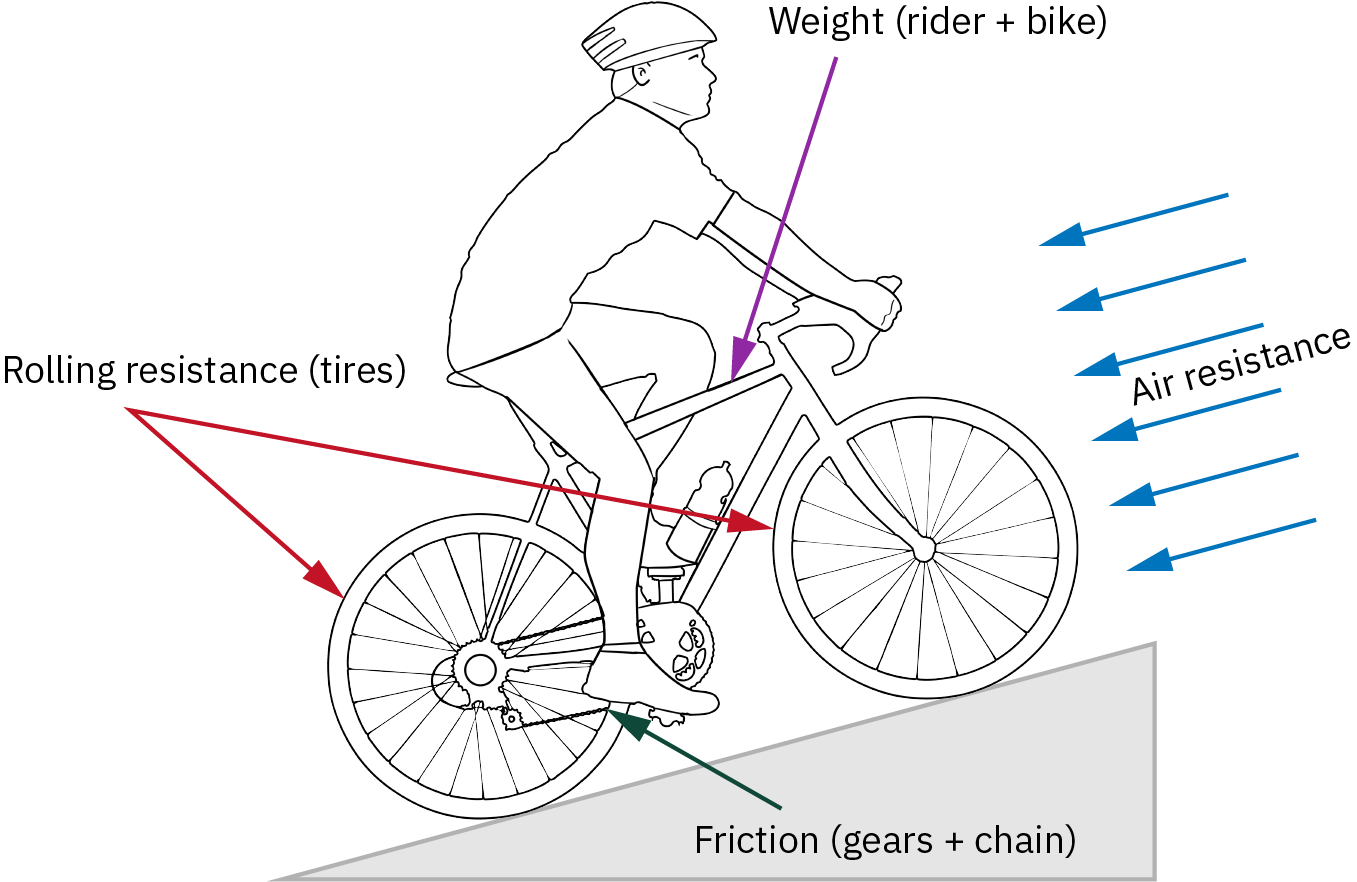
Figure 7.3 Several forces are at work when a person rides a bicycle. Understanding the physics of cycling does not guarantee that one knows how to ride a bicycle. (attribution: Copyright Rice University, OpenStax, under CC BY 4.0 license)
図7.3 自転車に乗るときには、いくつもの力が働く。自転車走行の物理学を理解していても、自転車の乗り方を知っているとは限らない。 (attribution: Copyright Rice University, OpenStax, under CC BY 4.0 license)
Knowledge by acquaintance is knowledge gained from direct experience. A person knows something by acquaintance when they are directly aware of that thing. This awareness comes from direct perception using one’s senses. For example, I have knowledge by acquaintance of pain when I am in pain. I am directly aware of the pain, so I cannot be mistaken about the existence of the pain.
英語のヒント
見知りによる知識とは、直接の経験から得られる知識である。あるものを直接に意識しているとき、その人は、それを見知りによって知っている。この意識は、感覚を用いる直接的な知覚から生じる。例えば、痛みを感じているとき、私は痛みについて見知りによる知識を持つ。私はその痛みを直接に意識しているので、その痛みが存在することについて間違うことはない。
British philosopher Bertrand Russell (1872–1970) is credited with first articulating a distinction between knowledge by acquaintance and propositional knowledge, which he called knowledge by description (Russell 1910–1911). According to Russell, knowledge by acquaintance is a direct form of knowledge. A person has knowledge by acquaintance when they have direct cognitive awareness of it, which is awareness absent of inference. That knowledge by acquaintance is not the product of inference is very important. Inference is a stepwise process of reasoning that moves from one idea to another. When I feel pain, I am acquainted with that pain without thinking to myself, “I am in pain.” No inference is required on my part for me to know of my pain. I am simply aware of it. It is the directness of this knowledge that differentiates it from all other a posteriori knowledge. All knowledge by acquaintance is a posteriori, but not all a posteriori knowledge is knowledge by acquaintance. My awareness of pain is knowledge by acquaintance, yet when I infer that “something is causing me pain,” this belief is propositional.
英語のヒント
イギリスの哲学者バートランド・ラッセル(1872~1970年)は、見知りによる知識と、彼が記述による知識と呼んだ命題知との区別を、初めて明確にした人物とされる(Russell 1910–1911)。ラッセルによれば、見知りによる知識は、直接的な知識の形である。対象を直接に認知的に意識しているとき、人は見知りによる知識を持つ。この意識には推論が介在しない。見知りによる知識が推論の産物ではないという点は、非常に重要である。推論とは、一つの観念から別の観念へと段階を踏んで進む思考の過程である。痛みを感じるとき、私は「私は痛みを感じている」と心の中で考えることなしに、その痛みを見知っている。自分の痛みを知るために、私の側で推論をする必要はない。私はただ、それを意識している。この知識をほかのすべてのアポステリオリな知識から区別するのは、その直接性である。見知りによる知識はすべてアポステリオリだが、アポステリオリな知識がすべて見知りによる知識なのではない。私が痛みを意識していることは見知りによる知識である。しかし、「何かが私に痛みを引き起こしている」と推論するとき、その信念は命題的である。
Russell’s distinction between knowledge by acquaintance and propositional knowledge, if accurate, has important implications in epistemology. It shows that inference is used even in cases of beliefs that people think are obvious: ordinary beliefs based on perception. Russell thought that one can only have knowledge by acquaintance of one’s sensations and cannot have direct awareness of the objects that could be the cause of those sensations. This is a significant point. When I see the bird on a branch outside my office window, I am not immediately aware of the bird itself. Rather, I am directly aware of my perceptual experience of the bird—what philosophers call sense data. Sense data are sensations gained from perceptual experience; they are the raw data obtained through the senses (seeing, smelling, feeling, etc.). One’s perceptual experience is of sense data, not of the objects that could be causing that sense data. People infer the existence of external objects that they believe cause their perceptual experiences. Russell’s view implies that people always use reasoning to access the external world. I have knowledge by acquaintance of my perceptual experience of seeing a bird; I then infer ever so quickly (and often unconsciously) that there is a bird on the branch, which is propositional knowledge.
英語のヒント
見知りによる知識と命題知についてのラッセルの区別が正確なら、それは認識論上の重要な含意を持つ。この区別は、人々が明白だと思う信念、すなわち知覚に基づく日常的な信念においてさえ、推論が用いられていることを示す。ラッセルは、自分の感覚についてのみ見知りによる知識を持つことができ、その感覚の原因かもしれない対象を直接に意識することはできないと考えた。これは重要な点である。仕事部屋の窓の外の枝にいる鳥を見るとき、私は鳥そのものを直接に意識しているのではない。むしろ、鳥についての自分の知覚経験、すなわち哲学者が「感覚与件」と呼ぶものを、直接に意識している。感覚与件とは、知覚経験から得られる感覚であり、見る、嗅ぐ、触れて感じるなどの感覚を通じて得られる、生の資料である。人の知覚経験は、感覚与件の経験であって、その感覚与件を生じさせているかもしれない対象そのものの経験ではない。人々は、自分の知覚経験を引き起こしていると信じる外的対象の存在を、推論するのである。ラッセルの見方は、人々が外部世界に接するためには、常に推論を用いていることを意味する。私は鳥を見るという自分の知覚経験について、見知りによる知識を持つ。そして、非常に素早く、しばしば無意識に、枝に鳥がいると推論する。後者が命題知である。
Not all philosophers think that experience of the external world is mediated through sense data. Some philosophers contend that people can directly perceive objects in the external world. But Russell’s theory introduces an important possibility in epistemological thinking: that there is a gap between one’s experience of the world and the world itself. This potential gap opens up the possibility for error. The gap between experience and the world is used by some thinkers to argue that knowledge of the external world is impossible.
英語のヒント
外部世界の経験が感覚与件を介してなされると、すべての哲学者が考えているわけではない。外部世界の対象を直接に知覚できると主張する哲学者もいる。しかし、ラッセルの理論は、認識論的思考に重要な可能性を持ち込む。それは、世界についての自分の経験と、世界そのものとの間に隔たりがある、という可能性である。この隔たりがありうることによって、誤りの可能性が開かれる。ある思想家たちは、経験と世界との隔たりを用いて、外部世界の知識は不可能だと論じる。
Type 種類 |
Description 説明 |
Examples 例 |
|---|---|---|
Propositional knowledge 命題知 |
Knowledge of propositions or statements; knowledge of facts 命題または言明についての知識。事実についての知識。 |
Examples are infinite: “I know that…” the Earth is round, two is an even number, lions are carnivores, grass is green, etc. 例は無限にある。「私は~ということを知っている」――地球は丸い、2は偶数である、ライオンは肉食動物である、草は緑色である、など。 |
Procedural knowledge 手続き的知識 |
“Know-how”; understanding how to perform some task or procedure know-how、すなわちやり方の知識。何らかの課題や手順を、どのように遂行するかについての理解。 |
Knowing how to ride a bicycle, do a cartwheel, knit, fix a flat tire, dribble a basketball, plant a tree, etc. 自転車に乗る、側転をする、編み物をする、パンクしたタイヤを直す、バスケットボールをドリブルする、木を植える、といったことのやり方を知っていること。 |
Knowledge by acquaintance 見知りによる知識 |
Knowledge gained from direct experience 直接の経験から得られる知識。 |
Perception of physical sensations, such as pain, heat, cold, hunger; important to differentiate between the knowledge by acquaintance that is the sensation (e.g., a physical sensation of feeling cold) and related inferences, such as “the air temperature must be dropping,” which is propositional knowledge. 痛み、熱さ、寒さ、空腹などの身体感覚を知覚すること。感覚そのものである見知りによる知識、例えば寒さを感じる身体感覚と、それに関連した「気温が下がっているに違いない」というような推論を区別することが重要である。後者は命題知である。 |