第7章認識論Epistemology
Coherence整合性
Coherentism is the view that justification, and thus knowledge, is structured not like a house but instead like a web. More precisely, coherentism argues that a belief is justified if it is embedded in a network of coherent, mutually supported beliefs. Think of a web. Each strand in a web is not that strong by itself, but when the strands are connected to multiple other strands and woven together, the result is a durable network. Similarly, a subject’s justification for individual beliefs, taken alone, is not that strong. But when those beliefs are situated in a system of many mutually supporting beliefs, the justification grows stronger. Justification emerges from the structure of a belief system (BonJour 1985).
英語のヒント
整合主義は、正当化、したがって知識の構造を、家のようなものではなく、網のようなものと考える見方である。より正確には、信念は、互いに整合し、支え合う信念のネットワークに組み込まれているなら正当化される、と主張する。網を考えてみよう。網を作る1本1本の糸は、それ自体ではそれほど強くない。しかし、複数のほかの糸とつながり、織り合わされると、丈夫な網になる。同じように、個々の信念に対する主体の正当化は、単独で取り出せば、それほど強くない。しかし、それらの信念が、多数の信念が互いに支え合う体系の中に置かれると、正当化は強まる。正当化は、信念体系の構造から生まれるのである(BonJour 1985)。
Within foundationalism, the justifications for some beliefs can proceed in a completely linear fashion. Ella believes the Battle of Hastings occurred in 1066 because her professor told her, and she believes that her professor told her because she remembers it and thinks her memory is justifiable. One belief justifies another, which justifies another, and so on, until the foundation is reached. Yet very few beliefs are actually structured in this manner. People often look for support for their beliefs in multiple other beliefs while making sure that they are also consistent. Figure 7.5 offers a simplified visual of the two different structures of belief.
英語のヒント
基礎づけ主義では、ある信念の正当化は、完全に一直線に進みうる。エラは、教授が教えたからヘイスティングズの戦いは1066年に起きたと信じる。また、彼女はそれを覚えていて、自分の記憶は正当化されると考えるため、教授がそう教えたと信じる。一つの信念が別の信念を正当化し、それがさらに別の信念を正当化する。このように、土台に達するまで続く。しかし、実際にこのような構造を持つ信念は、ごく少ない。人々は、自分の信念が互いに矛盾しないことを確かめながら、複数のほかの信念に、その支えを探すことが多い。図7.5は、この2種類の信念の構造を、簡略化して視覚的に示したものである。
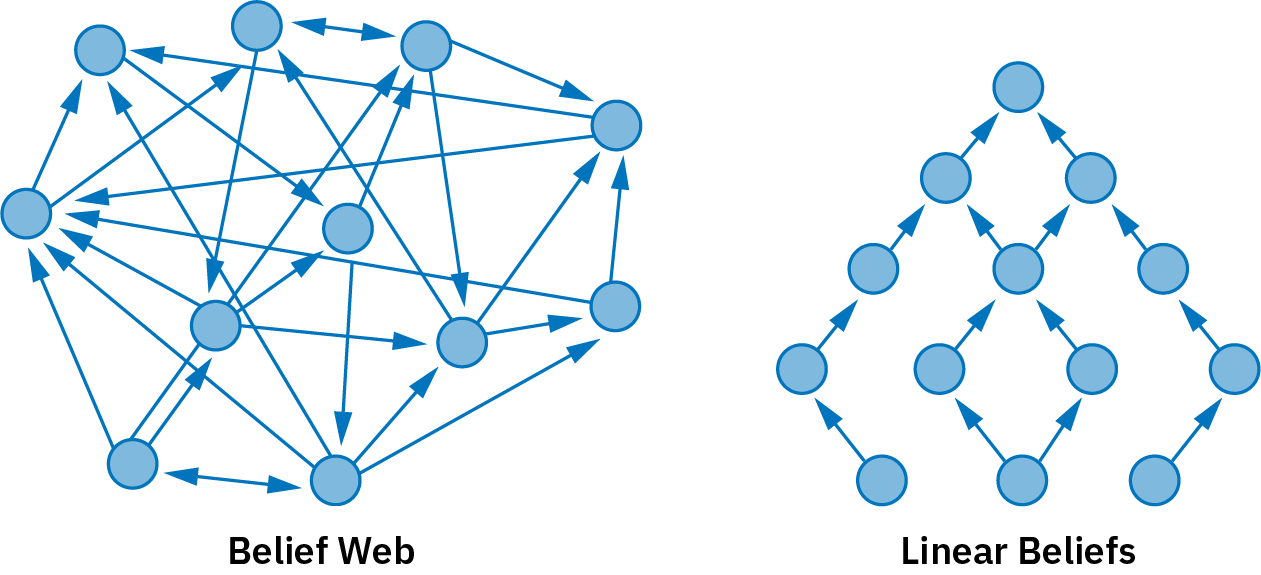
Figure 7.5 There are two different ways of conceptualizing belief structures: as a web of interconnected beliefs (left) and as a linear structure (right) in which foundational beliefs justify other beliefs, one after the other in a line. (attribution: Copyright Rice University, OpenStax, under CC BY 4.0 license)
図7.5 信念の構造を概念化するには、2つの異なる方法がある。互いに結びついた信念の網として捉える方法(左)と、基礎的信念がほかの信念を、一列に順々に正当化していく、直線的な構造として捉える方法(右)である。 (attribution: Copyright Rice University, OpenStax, under CC BY 4.0 license)
Often, when we think of the justification for our beliefs, we don’t just consider the original source of a belief. We also think about how that belief fits into our other beliefs. If a belief does not cohere with other beliefs, then its justification appears weak, even if the initial justification for the belief seemed strong. Suppose you need to go to the bank, and on your way out the door, your roommate tells you not to waste your time because they drove by the bank earlier and it was closed. Your roommate’s testimony seems like enough reason to believe the bank is closed. However, it is a weekday, and the bank is always open during the week. Furthermore, it is not a holiday. You check the bank’s website, and it states that the bank is open. Hence, the belief that the bank is closed does not cohere with your other beliefs. The lack of coherence with other beliefs weakens the justification for believing what your otherwise reliable roommate tells you.
英語のヒント
自分の信念の正当化を考えるとき、私たちは、信念のもともとの源だけを考慮するわけではない。その信念がほかの信念とどう合うのかも考える。ある信念がほかの信念と整合しなければ、最初の正当化が強く見えたとしても、その正当化は弱く見える。銀行へ行く必要があり、出かけようとすると、同居人が時間を無駄にしないようにと言ったとしよう。さきほど車で銀行の前を通ったところ、閉まっていたという。同居人の証言は、銀行が閉まっていると信じる十分な理由に見える。しかし、今日は平日であり、銀行は平日にはいつも開いている。しかも、祝日でもない。銀行のウェブサイトを確認すると、営業中と書かれている。したがって、銀行が閉まっているという信念は、ほかの信念と整合しない。この整合性の欠如は、普段は信頼できる同居人の言うことを信じるための正当化を弱める。
To be fair, foundationalists also consider coherence of beliefs in determining justification. However, as long as a belief is consistent with other beliefs and rests on the foundation, it is justified. But consistency is not the same thing as logical support. The beliefs that there is a bird in that tree, it is November, and a person is hungry are all consistent with one another, but they do not support one another. And for coherentists, logical consistency alone does not make a system of belief justified. Justification arises from a system of beliefs that mutually reinforce one another. Support can happen in many ways: beliefs can deductively entail one another, they can inductively entail one another, and they can cohere by explaining one another. Suppose I am trying to remember where my friend Faruq is from. I believe he is from Tennessee but am not sure. But then I remember that Faruq often wears a University of Tennessee hat and has a Tennessee Titans sticker on this car. He also speaks with a slight southern twang and has told stories about hiking in the Smoky Mountains, which are partially in Tennessee. That Faruq is from Tennessee can explain these further beliefs. Note that I can get more assurance for my belief that Faruq is from Tennessee by considering my other beliefs about him. When beliefs mutually reinforce one another, they acquire more justification.
英語のヒント
公平を期すなら、基礎づけ主義者も、正当化を判定する際には信念の整合性を考慮する。ただ、その立場では、信念がほかの信念と矛盾せず、土台に依拠していれば、正当化される。しかし、無矛盾性は、論理的な支えと同じものではない。あの木に鳥がいる、いまは11月である、ある人がお腹をすかせている、という信念は、すべて互いに矛盾しないが、互いを支えてはいない。整合主義者にとっては、論理的に無矛盾であるだけでは、信念体系は正当化されない。正当化は、互いを強め合う信念の体系から生じる。支え合いは、さまざまな仕方で起こりうる。信念は、互いを演繹的に導いたり、帰納的に導いたりすることができる。また、互いを説明することで整合することもできる。友人のファルークの出身地を思い出そうとしているとしよう。私はテネシー州出身だと信じているが、確かではない。そこで、彼がよくテネシー大学の帽子をかぶり、車にはテネシー・タイタンズのステッカーを貼っていることを思い出す。また彼は、少し南部なまりで話し、一部がテネシー州にあるスモーキー山脈をハイキングした話もしていた。ファルークがテネシー州出身であることは、これらの追加の信念を説明できる。彼についてのほかの信念を考慮すると、テネシー州出身だという信念への、より強い確信を得られることに注意しよう。信念が互いを強め合うとき、それらはより多くの正当化を得る。
Coherentism more naturally reflects the actual structure of belief systems, and it does so without relying on the notion of basic, justified, non-inferential beliefs. However, coherentism has weaknesses. One objection to coherentism is that it can result in circularity. Within a system of beliefs, any belief can play a roundabout role in its own justification. Figure 7.6 illustrates this problem.
英語のヒント
整合主義は、基本的で、正当化され、推論によらない信念という考えに頼ることなく、信念体系の実際の構造を、より自然に反映する。しかし、整合主義にも弱点がある。異論の一つは、循環を生じさせることがあるという点である。信念体系の中では、どの信念も、回り道を通して自分自身の正当化に関わりうる。図7.6は、この問題を示している。
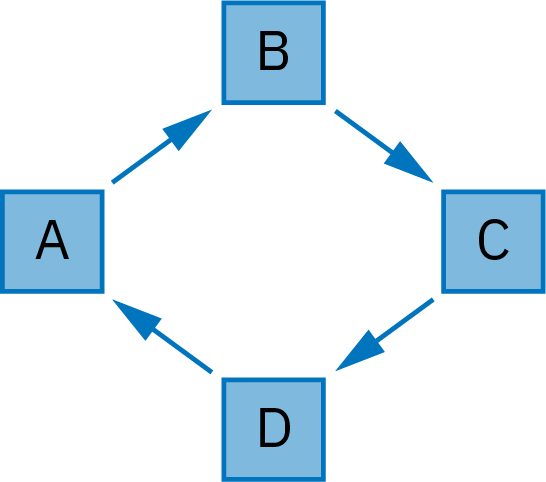
Figure 7.6 The circularly problem: Belief A entails belief B, and belief B entails belief C. Belief C entails belief D, and belief D entails belief A. The beliefs are coherent, and all support one another. However, each plays a role in its own justification. D justifies A, but A justifies D through B and C. Circularity results in the beliefs not having any support at all. If D essentially justifies itself, then it has no justification. (attribution: Copyright Rice University, OpenStax, under CC BY 4.0 license)
図7.6 循環の問題。信念Aは信念Bを含意し、信念Bは信念Cを含意する。信念Cは信念Dを含意し、信念Dは信念Aを含意する。信念は整合しており、すべて互いを支えている。しかし、それぞれが自分自身の正当化に関わっている。DはAを正当化するが、AもBとCを介してDを正当化する。循環の結果、信念にはまったく支えがなくなる。Dが実質的に自分自身を正当化しているなら、Dには正当化がない。 (attribution: Copyright Rice University, OpenStax, under CC BY 4.0 license)
Another objection to coherentism is called the isolation objection. A network of beliefs can mutually explain and support one another, thus giving them justification. However, it is not guaranteed that these beliefs are connected to reality. Imagine a person, Dinah, who is trapped in a highly detailed virtual reality. Dinah has been trapped for so long that she believes her experiences are of the real world. Because of the detailed nature of Dinah’s virtual reality, most of her beliefs are consistent with and support one another, just as your beliefs about the real world do. As long as Dinah’s beliefs are consistent and coherent, she will be justified in believing that her experience is of real objects and real people. So Dinah has justification even though all her beliefs concerning the reality of her world are false. Dinah’s situation reveals an important feature of justification: while justification makes beliefs more likely to be true, it does not always guarantee that they are true. Justification is often fallible.
英語のヒント
整合主義へのもう一つの異論は、孤立の異論と呼ばれる。信念のネットワークでは、信念が互いを説明し、支え合い、それによって正当化を与え合うことができる。しかし、それらの信念が現実と結びついていることは、保証されない。ディナという人が、非常に精巧な仮想現実に閉じ込められていると想像してみよう。あまりにも長く閉じ込められているため、彼女は自分の経験が現実世界の経験だと信じている。仮想現実が精巧であるため、彼女の信念の大半は、あなたの現実世界についての信念と同じように、互いに矛盾せず、支え合っている。ディナの信念が無矛盾で整合している限り、彼女は自分の経験が現実の物や人についての経験だと信じることを、正当化される。したがって、自分の世界が現実であることについての信念がすべて偽であるにもかかわらず、彼女には正当化がある。ディナの状況は、正当化の重要な特徴を明らかにする。正当化は信念が真である可能性を高めるが、常に真であることを保証するわけではない。正当化は、しばしば誤りうるのである。