第7章認識論Epistemology
The Fallible Nature of Justification正当化が誤りうるという性格
The sources of beliefs are varied. Perception, reason, hope, faith, and wishful thinking can all result in belief. Yet just because something results in belief, that does not mean that the belief is justified. Beliefs that result from wishful thinking are not justified because wishful thinking does not make a belief more likely to be true. A source of justification is a reliable basis for belief. Yet while justification is a reliable source, notice that this does not mean that the belief is true; it just makes it more likely. Justified beliefs can turn out to be false. In order to drive this point home, we will briefly look at four different sources of belief. As you will see, each source is fallible.
英語のヒント
信念の源は多様である。知覚、理性、希望、信仰、願望的思考は、すべて信念を生み出しうる。しかし、何かが信念を生み出すというだけで、その信念が正当化されるわけではない。願望的思考から生じる信念は、正当化されない。願望的思考は、信念が真である可能性を高めないからである。正当化の源は、信念のための信頼できる基盤である。しかし、正当化が信頼できる源であるということは、信念が真であることを意味するわけではない。真である可能性を高めるだけである。正当化された信念も、偽であると判明することがある。この点をはっきり理解するために、信念の4つの異なる源を簡単に見ていこう。どの源も誤りうることが分かるだろう。
One source of belief is memory. Memory is not always reliable. First of all, that you do not remember something in your past does not mean that it did not happen. Second, when you do remember something, does that guarantee that it happened the way you remember it? Because people can misremember, philosophers distinguish between remembering and seeming to remember. When you actually remember P, then this justifies believing P. When you seem to remember P, this does not justify believing P. The problem is that remembering and seeming to remember often feel the same to the person trying to remember.
英語のヒント
信念の源の一つは記憶である。記憶は、常に信頼できるわけではない。第一に、過去の何かを覚えていないことは、それが起きなかったことを意味しない。第二に、何かを覚えているとしても、そのことは、覚えているとおりに出来事が起きたことを保証するだろうか。人は記憶違いをすることがあるため、哲学者は、覚えていることと、覚えているように思うことを区別する。実際にPを覚えているなら、それはPを信じることを正当化する。Pを覚えているように思うだけなら、それはPを信じることを正当化しない。問題は、思い出そうとする本人にとって、覚えていることと、覚えているように思うことが、しばしば同じように感じられる点である。
Most beliefs are the product of inference. When you use reason to come to belief, the justification you have is inferential; hence, inferential justification is equivalent to logical justification. But as discussed in the chapter on logic, not all forms of inference can guarantee truth. Inductive reasoning, which is the most common source of beliefs, is only probable even when done well. Furthermore, people often make mistakes in reasoning. Just because someone reasoned their way to a belief doesn’t mean they reasoned well. But assume for a moment that a person comes to a belief using deductive reasoning, which can guarantee truth, and they reason well. Is it still possible that their belief is false? Yes. Deductive reasoning takes as its input other beliefs to then derive conclusions. In good inductive reasoning, if the premises are true (the input beliefs), then the conclusion is true. If the input beliefs are false, then even good deductive reasoning cannot guarantee true beliefs.
英語のヒント
信念の大半は推論の産物である。理性を用いて信念に至るとき、持っている正当化は推論的である。したがって、推論的な正当化は論理的な正当化と同じである。しかし、論理学の章で論じたように、どの形式の推論でも真理を保証できるわけではない。信念の最も一般的な源である帰納的推論は、適切に行われても、蓋然性を与えるだけである。さらに、人はしばしば推論を間違える。推論によって信念に至ったというだけで、適切に推論したことにはならない。しかし、ある人が、真理を保証しうる演繹的推論を用いて信念に至り、推論も適切に行ったと、ひとまず仮定しよう。それでも信念が偽である可能性はあるだろうか。ある。演繹的推論は、ほかの信念を入力として受け取り、それから結論を導く。適切な帰納的推論では、前提、すなわち入力となる信念が真なら、結論は真である。入力となる信念が偽なら、適切な演繹的推論でも、真なる信念を保証できない。
Another source of belief is testimony. When you gain beliefs based on the stated beliefs of others, you rely on testimony. Testimony is usually considered something that happens only in a court of law, but in philosophy, the term testimony is used much more broadly. Testimony is any utterance, spoken or written, occurring in normal communication conditions. Instances of testimony include news magazines, nonfiction books, personal blogs, professors’ lectures, and opinions volunteered in casual conversation. Often, testimony is a reliable source of information and so can be justified. When you form beliefs based on the testimony of experts, it is justified. But even when justified, those beliefs could be false because experts are vulnerable to all of the weaknesses of justification covered in this section. More will be said about testimony in the section on social epistemology.
英語のヒント
信念のもう一つの源は証言である。他者が述べた信念に基づいて信念を得るとき、あなたは証言に依拠している。証言は法廷でだけ行われるものだと考えられがちだが、哲学では、この語ははるかに広く用いられる。証言とは、通常の意思疎通の条件下で行われる、話し言葉または書き言葉による発言のすべてである。その例には、ニュース雑誌、ノンフィクションの本、個人のブログ、教授の講義、気軽な会話の中で自発的に述べられた意見などがある。証言は、多くの場合、信頼できる情報源であり、それに基づく信念は正当化されうる。専門家の証言に基づいて信念を形成するとき、それは正当化される。しかし、正当化されていても、それらの信念は偽でありうる。専門家も、この節で扱った、正当化のあらゆる弱点の影響を受けうるからである。証言については、社会認識論の節でさらに論じる。
Last, perception can be used as a source of justification. Perception includes the information received from the senses (smell, taste, touch, sight, hearing). People often automatically form beliefs based on perception. However, not all beliefs that follow from perception are guaranteed to be true, as the possibility of knowledge by acquaintance shows. As discussed earlier, Russell maintained that the only automatically justified beliefs gained from perception are about the existence of sense data (Russell 1948). When looking at the bird outside of my office window, I only have knowledge by acquaintance of the experience of seeing the bird on a branch in my visual field. I know that it seems to me that there’s a bird. But how do I get from those sense data to the justified belief that there really is bird on the branch? I must rely on another belief about the reliability of my perception—a belief that I can only get by inference, specifically induction. I reason from past instances where I believe my perception is reliable to the general belief that it is reliable. And of course, induction is fallible. Whenever one moves from knowledge by acquaintance to further beliefs—such as the belief that sense data is caused by actually existing objects—there is room for error.
英語のヒント
最後に、知覚も正当化の源として用いることができる。知覚には、嗅覚、味覚、触覚、視覚、聴覚という感覚から受け取る情報が含まれる。人々は、しばしば知覚に基づいて自動的に信念を形成する。しかし、見知りによる知識の可能性が示すように、知覚から生じる信念がすべて真だと保証されるわけではない。先に論じたように、ラッセルは、知覚から得られ、自動的に正当化される信念は、感覚与件の存在に関するものだけだと主張した(Russell 1948)。仕事部屋の窓の外にいる鳥を見るとき、私が見知りによって知っているのは、自分の視野の中で、枝にいる鳥を見るという経験だけである。鳥がいるように私には見える、ということを知っているのである。しかし、その感覚与件から、枝に本当に鳥がいるという正当化された信念へ、どう進めばよいのだろうか。私は、自分の知覚の信頼性についての、別の信念に頼らなければならない。その信念は、推論、とりわけ帰納によってしか得られない。知覚が信頼できると思う過去の事例から、知覚は一般に信頼できるという信念へ推論するのである。そして、もちろん帰納は誤りうる。見知りによる知識から、感覚与件が実際に存在する対象によって生じるという信念など、さらに先の信念へ進むときには、必ず誤りの余地がある。
Not all philosophers agree that all perceptual beliefs are mediated through sense data (Crane and French 2021). The view called direct realism states that people have direct access to objects in the external world via perception. While direct realism holds that one can directly perceive the external world, it still cannot guarantee that beliefs about it are true, for both hallucinations and illusions are still possible. Figure 7.7 is an example of an illusion.
英語のヒント
すべての知覚的信念が感覚与件を介していると、すべての哲学者が同意しているわけではない(Crane and French 2021)。直接実在論と呼ばれる見方は、人々が知覚を通じて外部世界の対象に直接アクセスできるとする。直接実在論は、外部世界を直接に知覚できるとするが、それでも外部世界についての信念が真であることを保証できない。幻覚も錯覚も、なお起こりうるからである。図7.7は錯覚の一例である。
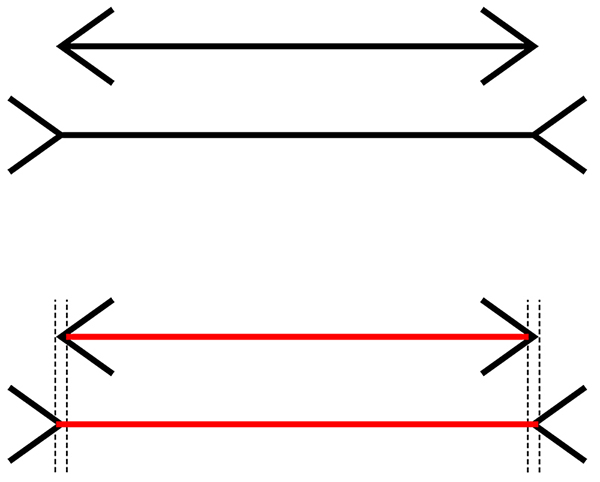
Figure 7.7 In the Müller-Lyer illusion, the top two lines appear to be different lengths, but the bottom two lines illustrate that the lines are in fact of equal length. (credit: “Müller-Lyer Counter-Illusion” by Subsidiary account/Wikimedia, Public Domain)
図7.7 ミュラー・リヤー錯視では、上の2本の線は長さが異なるように見える。しかし、下の2本の線によって、実際には長さが等しいことが示される。 (credit: “Müller-Lyer Counter-Illusion” by Subsidiary account/Wikimedia, Public Domain)
If you focus only on the top two lines, it appears as though they are of different lengths. Yet the bottom two lines indicate that this appearance is illusory—the lines are actually of equal length. Illusions function as evidence that perception sometimes misrepresents reality. Even direct realists have to contend with the possibility that beliefs gained through sense perception could be wrong. Hence, sources of beliefs, even when they are usually justified, are nevertheless fallible. The possibility that the subject could be wrong is what gives rise to philosophical skepticism—the view that knowledge in some or all domains is impossible.
英語のヒント
上の2本の線だけに注目すると、長さが異なるように見える。しかし下の2本の線は、この見え方が錯覚であり、実際には長さが等しいことを示す。錯覚は、知覚が時に現実を誤って表すという証拠になる。直接実在論者でさえ、感覚知覚から得た信念が誤っている可能性に向き合わなければならない。したがって、信念の源は、通常は正当化されるものであっても、それでも誤りうる。主体が誤っている可能性こそが、哲学的懐疑主義を生み出す。これは、一部またはすべての領域で知識は不可能だという見方である。