第7章認識論Epistemology
7.2 Knowledge7.2 知識
Learning Objectives学習目標
By the end of this section, you will be able to:
この節を読み終えると、次のことができるようになる。
Identify and explain the elements of Plato’s traditional account of knowledge.
プラトンによる伝統的な知識の説明の構成要素を挙げ、説明する。
Describe the Gettier problem.
ゲティア問題を説明する。
Recall a Gettier case and explain how it is a counterexample to the traditional account of knowledge.
ゲティア事例を一つ挙げ、それが伝統的な知識の説明に対する反例となる理由を説明する。
Identify and explain a way of thinking that attempts to solve the Gettier problem.
ゲティア問題を解決しようとする考え方を一つ挙げ、説明する。
What does it mean to say that one knows something? Knowledge is an important concept in all areas of thought. Knowledge is the goal and therefore enjoys a special status. Investigating the nature of knowledge reveals the importance of other concepts that are key to epistemological theorizing—justification in particular.
英語のヒント
ある人が何かを知っていると言うのは、どういう意味だろうか。知識は、思考のあらゆる領域で重要な概念である。知識は目標であり、それゆえ特別な地位を持つ。知識の本性を探究すると、認識論の理論化で鍵となるほかの概念、特に正当化の重要性が明らかになる。
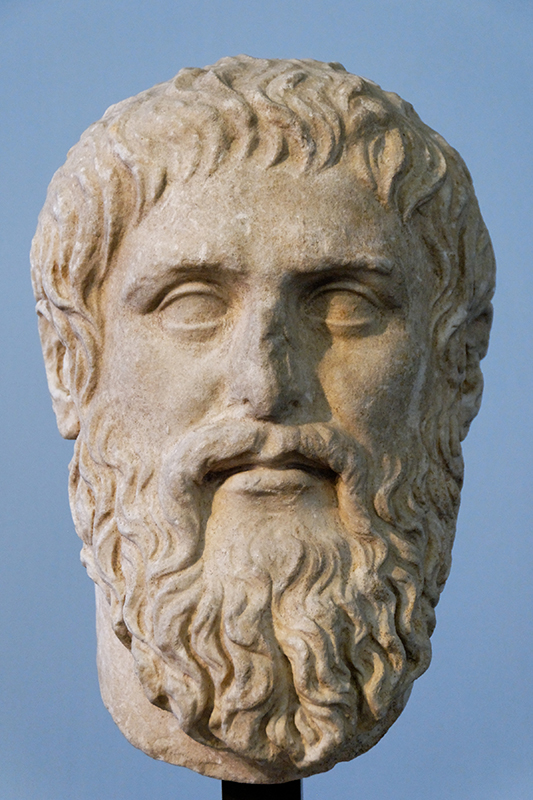
Figure 7.4 This is a copy of a sculpture of Plato completed in approximately 370 BCE. Plato is credited with what is termed the traditional account of knowledge, which explains knowledge as justified true belief. (credit: "Plato Silanion Musei Capitolini MC1377" by Marie-Lan Nguyen/Wikimedia Commons, CC BY 2.5)
図7.4 紀元前370年頃に完成したプラトン像の複製。プラトンは、知識を「正当化された真なる信念」と説明する、伝統的な知識の説明を提示した人物とされる。 (credit: "Plato Silanion Musei Capitolini MC1377" by Marie-Lan Nguyen/Wikimedia Commons, CC BY 2.5)
Plato and the Traditional Account of Knowledgeプラトンと伝統的な知識の説明
Plato, one of the most important of the Greek philosophers, hypothesized that knowledge is justified true belief. Plato’s analysis is known as the traditional account of knowledge. Plato’s definition is that a person S knows proposition P if and only if
英語のヒント
ギリシアの最も重要な哲学者の一人であるプラトンは、知識とは正当化された真なる信念である、と仮定した。彼の分析は、伝統的な知識の説明として知られる。プラトンの定義では、人Sが命題Pを知っているのは、次の条件が満たされるとき、かつそのときに限る。
P is true,
Pは真である。
S believes P, and
SはPを信じている。そして、
S is justified in believing P (Plato 1997b).
SがPを信じることは正当化されている(Plato 1997b)。
Plato’s hypothesis on knowledge, often referred to as the JTB account (because it is “justified true belief”), is highly intuitive. To say “John knows P, but he does not believe P” sounds wrong. In order to know something, a subject must first believe it. And one also cannot say “Ali knows P, but P is false.” A person simply cannot have knowledge of false things. Knowledge requires truth. Last, someone should not claim to know P if they have no reason to believe P (a reason to believe being justification for P).
英語のヒント
プラトンの知識についての仮説は、justified true belief「正当化された真なる信念」の頭文字から、しばしばJTB説と呼ばれる。この説は非常に直感に合う。「ジョンはPを知っているが、Pを信じていない」と言うと、おかしく聞こえる。何かを知るには、主体はまずそれを信じていなければならない。また、「アリはPを知っているが、Pは偽である」と言うこともできない。人は、偽であることについて知識を持つことはできないのである。知識は真理を必要とする。最後に、Pを信じる理由がないなら、Pを知っていると主張すべきではない。信じる理由があることが、Pに対する正当化となる。
Problems with the Traditional Account of Knowledge伝統的な知識の説明の問題点
Amazingly, Plato’s view that knowledge is justified true belief was generally accepted until the 20th century (over 2,000 years!). But once this analysis was questioned, a flurry of developments occurred within epistemology in the latter half of the 20th century. This section discusses the counterexample method at play in the dialectic concerning what knowledge is. Plato’s JTB analysis was the first to come under scrutiny.
英語のヒント
驚くべきことに、知識は正当化された真なる信念だというプラトンの見方は、20世紀まで、つまり2000年以上も、広く受け入れられていた。しかし、この分析が一度疑問に付されると、20世紀後半の認識論には、相次ぐ展開が生まれた。この節では、知識とは何かをめぐる対話的な論争のなかで、反例を用いる方法がどう働くかを論じる。最初に精査の対象となったのは、プラトンのJTB分析だった。
In 1963, American philosopher Edmund Gettier (1927–2021) published a short paper titled “Is Justified True Belief Knowledge?,” which upended the JTB canon in Western philosophy. Gettier presents two counterexamples to Plato’s analysis of knowledge. In these counterexamples, a person seems to have a justified true belief, yet they do not seem to have knowledge. While Gettier is credited with the first popular counterexample to the JTB account, he was not the first philosopher to articulate a counterexample that calls into question Plato’s analysis. But because Gettier published the first influential account, any example that seems to undermine Plato’s JTB account of knowledge is called a Gettier case. Gettier cases illustrate the inadequacy of the JTB account—a problem referred to as the Gettier problem.
英語のヒント
1963年、アメリカの哲学者エドマンド・ゲティア(1927~2021年)は、「正当化された真なる信念は知識か」(“Is Justified True Belief Knowledge?”)という短い論文を発表し、西洋哲学におけるJTB説の定説としての地位を覆した。ゲティアは、プラトンの知識の分析に対して、2つの反例を提示する。これらの反例では、ある人が正当化された真なる信念を持っているように見えるが、それでも知識を持つようには見えない。ゲティアは、JTB説への反例を初めて広く知らしめた人物とされるが、プラトンの分析を疑問に付す反例を述べた最初の哲学者ではなかった。しかし、最初に影響力の大きい説明を発表したのが彼だったため、プラトンのJTB説を崩すように見える例は、どれもゲティア事例と呼ばれる。ゲティア事例は、JTB説の不十分さを示す。この問題は、ゲティア問題と呼ばれる。
Dharmakīrti’s Mirageダルマキールティの蜃気楼
The earliest known Gettier case, long predating the term, was conceived by the eighth century Indian Buddhist philosopher Dharmakīrti. Dharmakīrti’s case asks one to imagine a weary nomad traveling across the desert in search of water (Dreyfus 1997). The traveler crests a mountain and sees what appears to be an oasis in the valley below, and so comes to believe that there is water in the valley. However, the oasis is just a mirage. Yet there is water in the valley, but it is just beneath the surface of the land where the mirage is. The traveler is justified in believing there is water in the valley due to sensory experience. Furthermore, it is true that there is water in the valley. However, the traveler’s belief does not seem to count as knowledge. Dharmakīrti’s conclusion is that the traveler cannot be said to know there is water in the valley because the traveler’s reason for believing that there is water in the valley is an illusory mirage.
英語のヒント
知られている最も古いゲティア事例は、この呼び名ができるはるか以前、8世紀のインド仏教哲学者ダルマキールティによって考案された。彼の事例では、水を求めて砂漠を旅する、疲れ果てた遊牧民を想像する(Dreyfus 1997)。旅人は山の頂上に達し、下の谷にオアシスらしきものを見る。そこで、谷に水があると信じるようになる。しかし、オアシスは単なる蜃気楼である。とはいえ、谷には実際に水がある。ただし、それは蜃気楼の見える場所の地表のすぐ下にある。旅人は感覚経験によって、谷に水があると信じることを正当化されている。さらに、谷に水があることは真である。それでも、その信念は知識とは見なせないように思える。ダルマキールティの結論は、旅人は谷に水があると知っているとはいえない、というものである。谷に水があると信じる理由が、実在しない蜃気楼だからである。
Russell’s Caseラッセルの事例
Perhaps you’ve heard the phrase “Even a broken clock is right twice a day.” The next case relies on this fact about broken clocks. In 1948, Bertrand Russell offered a case in which a man looks up at a stopped clock at exactly the correct time:
英語のヒント
「壊れた時計でも、1日に2度は正しい」という言い回しを、聞いたことがあるかもしれない。次の事例は、壊れた時計についてのこの事実に基づいている。1948年、バートランド・ラッセルは、ある男性が止まった時計を、ちょうど正しい時刻に見上げるという事例を示した。
There is the man who looks at a clock which is not going, though he thinks it is, and who happens to look at it at the moment when it is right; this man acquires a true belief as to the time of day, but cannot be said to have knowledge. (Russell 1948, 154)
英語のヒント
動いていない時計を、動いていると思って見る人がいて、しかもちょうどその時計が正しい時刻を示す瞬間に、たまたま見るとしよう。この人は、その時刻について真なる信念を得るが、知識を持つとはいえない。(Russell 1948, 154)
Imagine that the clock the man looks at is known for its reliability. Hence, the man is justified in believing that the time is, for example, 4:30. And, as the cases supposes, it is true that it is 4:30. However, given that the clock is not working and that the man happens to look up at one of the two times a day that the clock is correct, it is only a matter of luck that his belief happens to be true. Hence, Russell concludes that the man cannot be said to know the correct time.
英語のヒント
この男性が見る時計は、信頼性が高いことで知られているとしよう。したがって、男性が、時刻は例えば4時30分だと信じることは正当化されている。そして、この事例で想定されているとおり、4時30分であることは真である。しかし、時計は動いておらず、男性は、その時計が正しい時刻を示す1日2回のうちの1回に、偶然それを見上げた。したがって、彼の信念がたまたま真であるのは、運がよかっただけである。ゆえにラッセルは、この男性は正しい時刻を知っているとはいえないと結論する。