第7章認識論Epistemology
Putnam’s Brain in a Vatパトナムの水槽の中の脳
If you don’t like evil demons, then consider a more modern version of a skeptical hypothesis: the “brain in a vat” conceived of by American philosopher and mathematician Hilary Putnam (1926–2016). Imagine that while you were asleep last night, a group of scientists kidnapped you and took you to their lab. There, they surgically removed your brain and placed it in a vat of nutrients. The scientists then hooked up your brain to a sophisticated new computer system. They were able to download your memories so as to create new experiences. The result is a seamless experience of consciousness between yesterday and today. When you woke this morning, your life seemed to proceed without disruption. Can you prove that you are not a brain in a vat? No, you cannot. The scenario stipulates that your experience will seem exactly the same whether you are a brain in a vat or not. Other, similar skeptical scenarios are easy to come up with. Consider the possibility that you are caught in a virtual reality world or that you are trapped in the Matrix.
英語のヒント
悪霊が気に入らなければ、より現代的な懐疑的仮説を考えよう。アメリカの哲学者・数学者ヒラリー・パトナム(1926~2016年)が考案した「水槽の中の脳」である。昨夜、あなたが眠っている間に、科学者たちがあなたを誘拐して研究室へ連れ去ったと想像してみよう。そこで手術によって脳を取り出し、栄養液の入った水槽に置いた。科学者たちは次に、あなたの脳を、高度な新しいコンピューターシステムにつないだ。そして、新たな経験を作るために、あなたの記憶をダウンロードすることができた。その結果、昨日と今日の意識の経験は、継ぎ目なくつながる。今朝目覚めたとき、あなたの生活は何の中断もなく続いているように思えた。自分が水槽の中の脳ではないと証明できるだろうか。できない。この想定では、水槽の中の脳であってもなくても、経験はまったく同じように感じられると定められているからである。同じような懐疑的な状況は、ほかにも容易に考えられる。仮想現実の世界に捕らわれている、あるいはマトリックスに閉じ込められている可能性を考えてみよう。
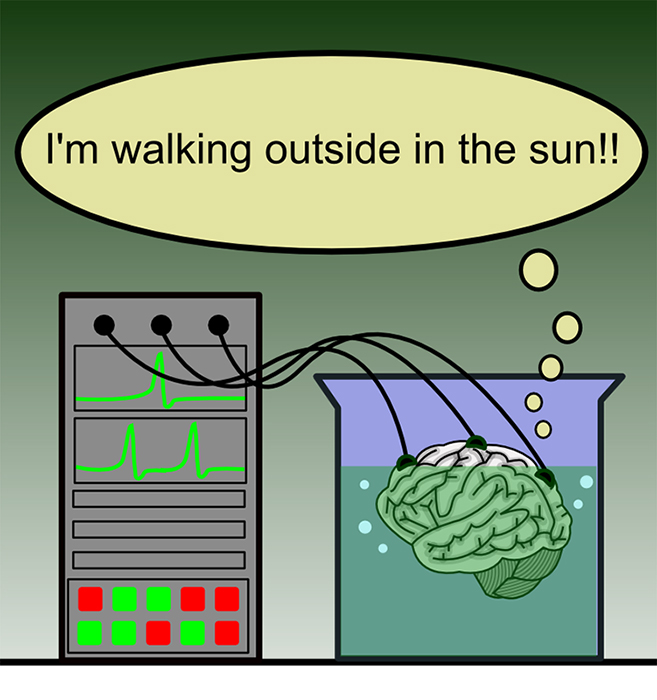
Figure 7.9 The “brain in a vat” scenario asks us to consider the possibility that our experiences are the result of deliberate manipulation of our mental processes. (credit: “Brain in a Vat” by Was a bee/Wikimedia, Public Domain)
図7.9 「水槽の中の脳」という想定は、私たちの経験が、心的過程を意図的に操作した結果であるかもしれないという可能性を、考えるよう求める。 (credit: “Brain in a Vat” by Was a bee/Wikimedia, Public Domain)
General Structure of Global Skeptical Arguments全面的懐疑論の論証の一般的な構造
Skeptical hypotheses and the arguments that they inspire all have a similar structure:
懐疑的仮説と、それに触発される論証は、すべて同じような構造を持つ。
If I cannot rule out the possibility of SH, then I cannot be justified in believing that P.
懐疑的仮説SHの可能性を排除できないなら、私はPと信じることを正当化されえない。
I cannot rule out the possibility of SH.
私はSHの可能性を排除できない。
Therefore, I cannot be justified in believing that P.
したがって、私はPと信じることを正当化されえない。
SH is a skeptical hypothesis. P is any proposition about the external world. Premise 1 is the skeptic’s challenge—that you must rule out skeptical hypotheses. Premise 2 relies on limitations within your perspective. The skeptic claims that you can rule out the possibility of whatever skeptical hypothesis is at hand only if you are able to construct an argument that defeats that hypothesis using the evidence you have (and a priori knowledge). As demonstrated, this is difficult to do. The nature of the skeptical hypotheses used for global skepticism limits your evidence to the contents of your thoughts. What you take to be evidence of the external world (that you perceive things that seem to be separate from yourself) is effectively neutralized by the possibility of a skeptical hypothesis.
英語のヒント
SHは懐疑的仮説であり、Pは外部世界についての任意の命題である。前提1は、懐疑的仮説を排除しなければならない、という懐疑主義者からの課題である。前提2は、あなたの視点の限界に基づいている。懐疑主義者によれば、いま問題となっている懐疑的仮説がどのようなものであれ、その可能性を排除できるのは、自分が持つ証拠とアプリオリな知識を用い、その仮説を退ける論証を構成できる場合に限られる。すでに見たように、これは難しい。全面的懐疑主義で用いられる懐疑的仮説は、その性質上、あなたの証拠を、自分の思考の内容に限定する。外部世界の証拠だと受け取っているもの、すなわち、自分とは別のものに見える対象を知覚しているということは、懐疑的仮説の可能性によって、実質的に無効化される。
Responses to Global Skepticism全面的懐疑主義への応答
The philosopher who wishes to overcome philosophical skepticism must find reasonable grounds for rejecting the skeptic’s argument. The different skeptical arguments reveal a specific conception of the level of justification required for knowledge. Skeptical arguments rely on the existence of doubt. Doubt exists when we cannot rule out a possibility. If we have doubt, we are not certain. We cannot be certain that we are not, say, a brain in a vat. And if we cannot be certain, then we cannot know anything that implies we are not a brain in a vat. Certainty is a very strict measure of justification. One clear possible response is to simply deny that one needs certainty in order to be considered justified. This section looks at some of the classical responses to the skeptic’s argument that we cannot know anything.
英語のヒント
哲学的懐疑主義を克服しようとする哲学者は、懐疑主義者の論証を退ける合理的な根拠を見つけなければならない。さまざまな懐疑的論証は、知識に必要な正当化の水準について、ある特定の考え方を示している。懐疑的論証は、疑いが存在することに依拠する。ある可能性を排除できなければ、疑いは存在する。疑いがあれば、確実ではない。例えば、自分が水槽の中の脳ではないことを、私たちは確実には知りえない。そして、それが確実でないなら、水槽の中の脳ではないことを含意する、いかなる事柄も知ることができない。確実性は、正当化を測る非常に厳しい基準である。考えられる明確な応答の一つは、正当化されていると見なされるために確実性が必要だという主張を、単に否定することだ。この節では、私たちは何も知りえないという懐疑主義者の論証に対する、古典的な応答をいくつか見る。
Mooreムーア
British philosopher G. E. Moore (1873–1958) presented an argument against skepticism that relies on common sense. In his famous paper “Proof of an External World,” Moore begins by raising his right hand and claiming, “Here is one hand,” then raising his left hand and claiming, “Here is another hand” (Moore 1939). Therefore, he concludes that skepticism is false. At first glance, this argument may seem flippant. It is not. Moore means to replace the second premise in the skeptical argument with his own premise: I know I have hands. The skeptical argument starts with the premise that if you cannot rule out a skeptical hypothesis, then you do not have knowledge of some proposition pertaining to the external world. Moore uses “I have two hands” as his proposition about the external world. In effect, he accepts the skeptic’s first premise, then uses his commonsense belief in the truth of “I have two hands” to defeat the skeptical hypothesis. Here is the argument’s structure:
英語のヒント
イギリスの哲学者G・E・ムーア(1873~1958年)は、常識に依拠した、懐疑主義への反論を提示した。有名な論文「外部世界の証明」では、まず右手を上げて「ここに一つの手がある」と述べ、続いて左手を上げて「ここにもう一つの手がある」と述べる(Moore 1939)。それゆえ、懐疑主義は誤りだと結論する。一見すると、この論証はふざけているように見えるかもしれない。そうではない。ムーアは、懐疑的論証の第2前提を、「私は自分に手があると知っている」という自らの前提に置き換えようとしている。懐疑的論証は、懐疑的仮説を排除できなければ、外部世界に関するある命題について知識を持てない、という前提から始まる。ムーアは、「私には2本の手がある」を外部世界についての命題とする。事実上、彼は懐疑主義者の第1前提を受け入れたうえで、「私には2本の手がある」が真だという常識的な信念を用い、懐疑的仮説を退ける。論証の構造は次のとおりである。
If I cannot rule out the possibility of SH, then I cannot be justified in believing that P.
SHの可能性を排除できないなら、私はPと信じることを正当化されえない。
I am justified in believing that P.
私はPと信じることを正当化されている。
Therefore, I can rule out the possibility of SH.
したがって、私はSHの可能性を排除できる。
In claiming that he has two hands, Moore claims that he is justified in believing propositions about the external world. And if he is justified, then he can rule out the skeptical hypothesis. The skeptic’s argument takes the form of what is called modus ponens, meaning a valid inference where the antecedent of a conditional is affirmed. Moore’s argument takes the form of what is known as modus tollens, meaning a valid inference where the consequence of a conditional is denied.
英語のヒント
ムーアは、自分には2本の手があると主張することで、外部世界についての命題を信じることが正当化されていると主張する。そして正当化されているなら、懐疑的仮説を排除できる。懐疑主義者の論証は、モドゥス・ポネンスと呼ばれる形式を取る。これは、条件文の前件を肯定する、妥当な推論である。ムーアの論証は、モドゥス・トレンスと呼ばれる形式を取る。これは、条件文の後件を否定する、妥当な推論である。
But notice that the two arguments contradict each other. If we accept the first premise, then either Moore’s or the skeptic’s second premise must be false. So why did Moore think his second premise is better? The choice is between thinking you are justified in believing that you have two hands and thinking you are justified in believing the skeptical hypothesis might be true. Moore thinks he has better reason to believe that he has two hands than he does for believing the skeptical hypothesis is true. For Moore, it is just common sense. You have reason to believe that you have two hands—you can see them and feel them—while you have no reason to believe the skeptical hypothesis is true.
英語のヒント
ただし、この2つの論証は互いに矛盾することに注意しよう。第1前提を受け入れるなら、ムーアか懐疑主義者の、どちらかの第2前提は偽でなければならない。では、ムーアはなぜ、自分の第2前提のほうがよいと考えたのだろうか。選ぶのは、自分に2本の手があると信じることが正当化されていると考えるか、それとも、懐疑的仮説が真であるかもしれないと信じることが正当化されていると考えるか、ということである。ムーアは、懐疑的仮説が真であると信じるより、自分に2本の手があると信じるほうに、よりよい理由があると考える。ムーアにとって、これは常識にすぎない。自分に2本の手があると信じる理由はある。見えるし、触って感じられるからだ。しかし、懐疑的仮説が真であると信じる理由はない。
Many philosophers remain unconvinced by Moore’s argument. Any person who accepts the possibility of the skeptical hypothesis will disagree with his premise 2. The possibility of the skeptical hypothesis effectively undermines justification in the belief that you have two hands.
英語のヒント
多くの哲学者は、なおムーアの論証に納得していない。懐疑的仮説の可能性を認める人は、誰でも彼の前提2に反対するだろう。懐疑的仮説の可能性は、自分に2本の手があるという信念の正当化を、実質的に崩すのである。