第2章批判的思考と調査・読解・論文執筆Critical Thinking, Research, Reading, and Writing
2.4 Gathering Information, Evaluating Sources, and Understanding Evidence2.4 情報を集め、情報源を評価し、証拠を理解する
Learning Objectives学習目標
By the end of this section, you will be able to:
この節を学び終えると、次のことができるようになる。
Identify four moves for fact-checking.
ファクトチェックの四つの行動を挙げる。
Apply fact-checking to specific exercises.
具体的な練習問題にファクトチェックを適用する。
Start with a Strong Foundationしっかりした基盤から始める
When you are learning a new concept or writing a paper, you probably do some internet research to locate information about the topic. However, as you probably know, not all internet sources are reliable. Philosophy students are fortunate to have two online philosophy encyclopedias that provide excellent information about a wide array of topics. The Internet Encyclopedia of Philosophy provides good general topic coverage of the major areas of philosophy. The IEP is a traditional encyclopedia, and its articles are written for new students without a lot of prior knowledge. The Stanford Encyclopedia of Philosophy provides in-depth, up-to-date articles on a wide range of topics and includes both general and specific coverage. The articles in the Stanford Encyclopedia of Philosophy are well written, but they typically go into greater depth and sometimes include technical terms or information you will have to look up. These articles provide an excellent, free introduction to a wide range of specific topics in philosophy. As with all encyclopedia entries, students should start with the article itself and then move on to sources cited in the article. Think of these articles as an entry point into research.
英語のヒント
新しい概念を学んだり、レポートを書いたりするとき、その話題の情報を得るために、インターネットで調べることがあるだろう。しかし、知っているとおり、ネット上の情報源がすべて信頼できるわけではない。哲学を学ぶ人には幸いなことに、幅広い話題について優れた情報を提供する、二つのオンライン哲学百科事典がある。Internet Encyclopedia of Philosophyは、哲学の主要領域について、よい概説を提供する。IEPは伝統的な百科事典であり、その項目は、予備知識のあまりない初学者向けに書かれている。Stanford Encyclopedia of Philosophyは、幅広い話題について、掘り下げた最新の記事を提供し、一般的な概説と個別的な解説の両方を含む。その記事はよく書かれているが、通常はより深く掘り下げており、調べる必要のある専門用語や情報が含まれることもある。これらの記事は、哲学の幅広い個別の話題について、無料の優れた入門となる。百科事典の項目全般にいえることだが、まず記事そのものから始め、次に記事で引用されている資料へと進んでほしい。これらの記事を調査の入口として考えよう。
Wherever possible, read articles and books written by philosophers on the topics you are interested in. You can usually find these resources at your college or university library. You may want to cast a wider net on the internet itself by tapping into YouTube channels, podcasts, and other websites that can help you understand philosophical issues or provide information for philosophy papers. However, be discriminating when selecting material. In this section, we will outline some tools and habits that can make you a better, more critically engaged online researcher.
英語のヒント
可能なかぎり、関心のある話題について、哲学者自身が書いた論文や本を読んでほしい。通常、こうした資料は大学の図書館で見つかる。YouTubeチャンネル、ポッドキャスト、そのほかのウェブサイトを利用して、インターネットにさらに広く網を投げ、哲学の問題を理解したり、哲学のレポートの情報を得たりしたいと思うかもしれない。しかし、資料はよく吟味して選んでほしい。この節では、よりよく、批判的に考えながらオンライン調査を行う人になるための、いくつかの道具と習慣を概説する。
Finally, many instructors in philosophy will encourage their students to engage only with the assigned texts in the class. This can be a valuable technique for learning philosophy since philosophical thinking is cultivated by serious, critical engagement with good philosophical writing. If you can learn to engage directly with primary sources (texts written by philosophers about philosophy), you will be a better philosophy student. However, we acknowledge that most students are accustomed to using the internet for research when they are learning something new. So this section is intended to provide some guidance for students who want to supplement their class readings with information gleaned from online sources.
英語のヒント
最後に、哲学の教員の多くは、授業で指定されたテキストだけに取り組むよう学生に勧める。これは、哲学を学ぶうえで価値ある方法になりうる。優れた哲学の文章に、真剣かつ批判的に取り組むことで、哲学的思考が養われるからである。一次資料、つまり哲学者が哲学について書いたテキストに直接取り組むことを学べれば、よりよく哲学を学べるようになる。とはいえ、多くの学生が、新しいことを学ぶときにインターネットで調べるのに慣れていることも承知している。そこでこの節では、授業の読書課題を、ネット上の情報源から集めた情報で補いたい学生のために、いくらかの指針を示す。
The SIFT Method (Four Moves for Student Fact Checkers)SIFT法:学生のためのファクトチェックの四つの行動
Information literacy scholar Michael Caulfield came to realize that the methods of research taught by librarians and information literacy educators often did not work well for students. Typically, students are encouraged to assess the quality of information using an acronym like CRAAP: currency, relevancy, authority, accuracy, and purpose. But these criteria are not always useful in spotting misinformation turned up through search engines. After all, many sources that provide misinformation appear current and relevant and are generated by organizations that appear to be authoritative while they conceal a hidden agenda.
英語のヒント
情報リテラシー研究者マイケル・コールフィールドは、図書館員や情報リテラシーの教育者が教える調査法は、学生にとってうまく機能しないことが多いと気づいた。学生は通常、CRAAPのような頭字語を使って情報の質を評価するよう促される。これは、currency(新しさ)、relevancy(関連性)、authority(権威)、accuracy(正確さ)、purpose(目的)の頭文字である。しかし、検索エンジンで見つかる誤情報を見抜くうえで、これらの基準がいつも役立つとは限らない。実際、誤情報を提供する多くの情報源も、新しく関連性があるように見えるし、隠れた意図を伏せながら権威があるように見える組織によって作られているのだ。
To find out how students evaluate sources they find on Google, Caulfield relies on the empirical research of Sam Wineburg and Sarah Mcgrew (2016). The researchers compared the behavior of Stanford University students to trained fact-checkers at newspapers and magazines. Not surprisingly, the online fact-checkers used search engines more effectively. Based on this research, Caulfield developed his own protocol to make students better researchers.
英語のヒント
学生がGoogleで見つけた情報源をどう評価しているかを知るために、コールフィールドは、サム・ワインバーグとサラ・マグルー(2016)の実証研究を手掛かりにしている。この研究者たちは、スタンフォード大学の学生の行動と、新聞や雑誌の訓練されたファクトチェッカーの行動を比較した。予想どおり、オンラインで調べるファクトチェッカーのほうが、検索エンジンを有効に使っていた。この研究に基づき、コールフィールドは、学生がよりよく調査できるようにするための独自の手順を開発した。
The first thing to know about using a search engine like Google is that results are not ranked by authority, accuracy, or relevance. Internet companies are notoriously secretive about the algorithms (mathematical procedural rules) they use to generate search engine results, but we know that they prioritize paid advertisements, popularity, and web interconnectivity (the degree to which key words and links from a website are shared with other websites). Thus, websites interested in sharing misinformation can use the same search engine optimization tools that legitimate companies or media sources use to move up the ranks of search results. So you need to learn to use the search engine to your advantage. Caulfield recommends using the acronym SIFT, or the “four moves” of student fact checkers.
英語のヒント
Googleのような検索エンジンを使う際に、まず知っておくべきことは、検索結果が権威・正確さ・関連性によって順位づけられているわけではない、ということである。インターネット企業は、検索結果の生成に使うアルゴリズム、つまり数学的な手順の規則を秘密にすることで知られている。しかし、有料広告、人気、ウェブ上の相互接続性を優先していることは分かっている。相互接続性とは、あるウェブサイトのキーワードやリンクが、ほかのウェブサイトとどれだけ共有されているかということである。そのため、誤情報を広めたいウェブサイトも、正当な企業やメディアが使うのと同じ検索エンジン最適化の道具を使って、検索順位を上げられる。そこで、検索エンジンを自分に有利に使う方法を学ぶ必要がある。コールフィールドは、SIFTという頭字語、すなわち学生のファクトチェッカーの「四つの行動」を使うことを勧めている。
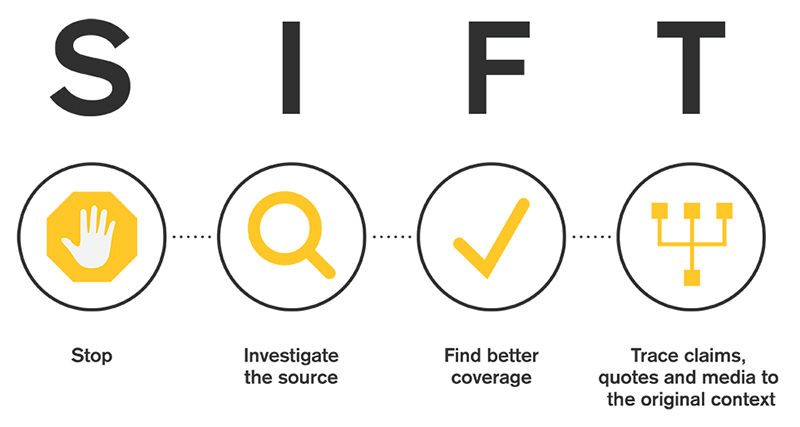
Figure 2.6 The four moves for student fact checkers: stop; investigate the source; find better coverage; and trace the claims to the original context. (credit: “SIFT (The Four Moves)” by Michael Caulfield/hapgood.us, CC BY 4.0)
図2.6 学生のためのファクトチェックの四つの行動:立ち止まる、情報源を調べる、よりよい報道・解説を探す、主張を元の文脈までたどる。(クレジット:Michael Caulfield/hapgood.us「SIFT (The Four Moves)」、CC BY 4.0)
Stop立ち止まる
The first move reiterates something we have already discussed: to become a better critical thinker, slow down the quick and efficient thinking that leads to errors and engage in critical reflection and metacognition. By stopping, slowing down, or taking your time to allow for critical reflection, you will be using rational and reflective thinking to assess claims. Additionally, after some searching, you will want stop, return to your original source, and check its claims again. When you circle back after going down a bit of a rabbit hole, you will have a new perspective from which to evaluate these claims.
英語のヒント
最初の行動は、すでに論じたことの繰り返しである。批判的に考える力を高めるには、誤りにつながる素早く効率的な思考を減速させ、批判的省察とメタ認知に取り組む。立ち止まり、速度を落とし、あるいは批判的に省察する時間を取ることで、合理的で省察的な思考によって主張を評価することになる。また、しばらく調べたら、いったん止まり、元の情報源に戻って、その主張を再確認したくなるだろう。調べ物の脇道に少し入り込んだ後で戻ってくると、その主張を評価するための新しい視点が得られている。
Investigate the Source情報源を調べる
Next, investigate the source of your information. Internet searches will often lead you through a series of links, in which you jump from one document to another. Strive to understand this electronic paper trail. Who wrote each document? What are their credentials? You can prioritize academic sources, such as web pages of philosophy faculty members, and you can discount sites that aggregate student papers or provide content without clear authorship. But investigating authorship does not mean that you should just read the “About” page on a website. Rather, Wineburg and Mcgrew (2016) found that fact-checkers used search tools to check the reputation of the sites they were investigating, a move they called “reading laterally.” You do not have to spend a lot of time on the site itself. Instead, search reviews or critiques of the website and the authors on the site. Find out what other authoritative sources say about the site. Is this a website that is approved by other people you trust? Or do people you trust indicate that the website or its information are questionable?
英語のヒント
次に、情報の出どころを調べる。ネット検索では、リンクをたどり、一つの文書から別の文書へと移ることがよくある。この電子的な記録のつながりを理解するよう努めてほしい。各文書を書いたのは誰か。その人にはどのような資格や経歴があるか。哲学の大学教員のウェブページなど、学術的な情報源を優先し、学生のレポートを寄せ集めたサイトや、執筆者のはっきりしないコンテンツを提供するサイトは、重く見ないようにできる。しかし、執筆者を調べるとは、ウェブサイトの「About(このサイトについて)」ページを読むだけ、という意味ではない。ワインバーグとマグルー(2016)が見いだしたのは、ファクトチェッカーが検索の道具を使って、調べているサイトの評判を確認するということだった。二人はこの行動を「横断的な読み」と呼んだ。そのサイト自体に長い時間を費やす必要はない。代わりに、サイトとその執筆者についての評価や批評を検索してほしい。ほかの権威ある情報源が、そのサイトについて何と言っているかを調べる。あなたが信頼するほかの人々から認められているサイトだろうか。それとも、信頼する人々が、そのサイトや情報は疑わしいと指摘しているか。