第1章哲学入門Introduction to Philosophy
“The Life Which Is Unexamined Is Not Worth Living”「吟味されない生は、生きるに値しない」
After Socrates is convicted and has a chance to address the jury to persuade them to offer him a sentence or punishment other than death, he considers and then rejects the idea of exile. If he lived in exile, Socrates believed he would no longer be able to carry on his work as a philosopher because a foreign city would be even less welcoming of his strange questioning than his hometown. In speaking about this alternative, he says the following:
英語のヒント
有罪判決のあと、ソクラテスは陪審に向けて話し、死刑以外の判決や処罰を与えるよう説得する機会を得る。そこで彼は追放という案を検討し、退ける。ソクラテスは、追放されて暮らすことになれば、哲学者としての仕事を続けられなくなると考えた。よその都市は、彼の風変わりな問いかけを、故郷の都市以上に歓迎しないだろうからである。この選択肢について語るとき、彼は次のように言う。
Someone will say: “Yes, Socrates, but cannot you hold your tongue, and then you may go into a foreign city, and no one will interfere with you?” Now I have great difficulty in making you understand my answer to this. For if I tell you that this would be a disobedience to a divine command, and therefore that I cannot hold my tongue, you will not believe that I am serious; and if I say again that the greatest good of man is daily to converse about virtue, and all that concerning which you hear me examining myself and others, and that the life which is unexamined is not worth living—that you are still less likely to believe. (Plato, Apology)
英語のヒント
ある人はこう言うだろう。「そうだ、ソクラテス。しかし、黙っていることはできないのか。そうすればよその都市へ行けるし、誰も君の邪魔をしないだろう」。さて、この問いに対する私の答えを諸君にわかってもらうのは、非常に難しい。というのも、黙ることは神の命令に背くことになるので、私は黙っていられないのだ、と言っても、諸君は私が本気だとは信じないだろうからだ。さらに、人間にとって最大の善は、日々、徳について語り合うことであり、私が自分や他人を吟味しているのを諸君が聞く、あらゆる事柄について語り合うことなのだ、そして、吟味されない生は生きるに値しないのだ、と言えば――そのことは、諸君にいっそう信じてもらえないだろう。(プラトン『ソクラテスの弁明』)
This idea—that a life that is “unexamined” is not worth living—strikes at the heart of what Socrates tells us motivates him to live a philosophical life. The statement ought to make us pause and reflect, not only because Socrates himself demonstrates his commitment to a particular kind of life, to the point of accepting death, but also because the charge that an unexamined life is not worth living rightly seems like such a serious thing. To have lived a life that is not worth living: What could be worse? Given the stakes, we ought to wonder, what does Socrates mean by an unexamined life? Or, alternatively, what would it look like to examine one’s life in the appropriate way?
英語のヒント
「吟味されない」生は生きるに値しない、というこの考えは、哲学的な生を送るよう自分を動かしているものについて、ソクラテスが私たちに語ることの核心に触れている。この言葉を前に、私たちは立ち止まり、考えるべきである。その理由は、ソクラテス自身が死を受け入れるほど、一つの生き方を貫く姿勢を示しているからだけではない。吟味されない生は生きるに値しないという指摘は、当然ながら、それほど重大なことに思えるからでもある。生きるに値しない生を送ってしまったとしたら、それより悪いことがあるだろうか。これほど重大なものが懸かっている以上、問わなければならない。ソクラテスは、吟味されない生によって何を意味しているのか。あるいは逆に、自分の生を適切な仕方で吟味するとは、どのようなことなのか。
Examination of the Self自己を吟味する
The first form of examination that Socrates clearly advises is self-examination. At the temple to the oracle at Delphi, one of three maxims engraved in stone is the phrase “know thyself.” Like most oracular statements, it is not clear what is meant by this phrase. Plato suggests it may be a kind of warning to those who enter the oracle: “Know your position relative to the gods!” Alternatively, it may be a command to understand your own nature and your own mind before you seek to understand other people or the things of the world. Based on our reading of Socrates’s life and works, we can assume that he considers this saying to be a command to investigate our beliefs and knowledge, to appreciate the limits of our own knowledge, and to strive to eliminate inconsistencies. After all, Socrates’s method of questioning as it is described in Plato’s dialogues (and as Socrates himself describes in the excerpted passage) is exactly such an inquiry.
英語のヒント
ソクラテスが明確に勧める最初の吟味の形は、自己吟味である。デルフォイの神託所の神殿で、石に刻まれた三つの格言の一つが「汝自身を知れ」という言葉だ。神託の多くがそうであるように、この言葉の意味は明確ではない。プラトンは、神託を求めて入ってくる人々に対する「神々との関係で、自分の立場を知れ」という警告の一種かもしれないと示唆する。あるいは、ほかの人々や世界の物事を理解しようとする前に、自分自身の本性や心を理解せよ、という命令かもしれない。ソクラテスの生涯と活動について読んだことを踏まえると、彼はこの言葉を、自分たちの信念と知識を調べ、自分の知識の限界を理解し、矛盾をなくすよう努めよ、という命令と考えていたと推測できる。結局、プラトンの対話篇で描かれ、先ほどの抜粋でソクラテス自身も述べている問答の方法は、まさにそのような探究だからである。
Socrates questions others about whether their beliefs are consistent and whether they have adequate justification for the beliefs they hold. This line of questioning suggests that Socrates holds such consistency and internal justification in high regard. We can imagine that Socrates considers an unexamined life to be one in which a person holds beliefs without justification or holds beliefs that are inconsistent with one another. We may then speculate that an unexamined is not worth living because it is dictated by beliefs and ideas that have never been tested, justified, or accounted for. You might respond that endless questioning is boring or difficult, or you may respond that “ignorance is bliss.” For a philosopher, this attitude is not only undesirable, but it also approaches irrationality. It seems that, whatever makes life worth living for creatures capable of rational thought, a minimum requirement is that we believe things worth believing in, hold positions we can defend, and understand why we do what we do. To do that, we need to engage in self-examination.
英語のヒント
ソクラテスは相手に、その信念は一貫しているか、抱いている信念には十分な正当化があるかを問う。この問いかけ方から、彼がそうした一貫性と内部からの正当化を高く評価していることがうかがえる。ソクラテスにとって吟味されない生とは、正当化のないまま信念を抱き、あるいは互いに矛盾する信念を抱く生だと考えられる。そうすると、吟味されない生が生きるに値しないのは、一度も検証も正当化も説明もされていない信念や考えに、左右されているからだと推測できる。あなたは、果てしなく問い続けるのは退屈だ、難しい、あるいは「知らぬが仏」だと答えるかもしれない。哲学者にとって、この態度は望ましくないだけでなく、不合理に近づくものでもある。合理的に考えることのできる生き物にとって、何が生を生きるに値するものにするにせよ、最低限必要なのは、信じるに値することを信じ、擁護できる立場を持ち、自分がすることをなぜするのか理解することだろう。そのためには、自己吟味に取り組む必要がある。
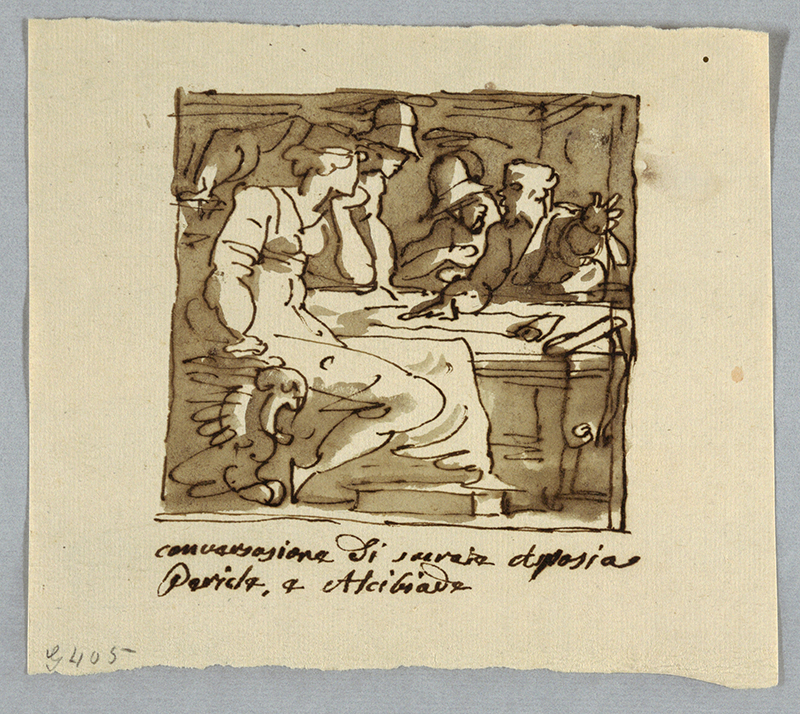
Figure 1.9 This image depicts Socrates in deep conversation with Athenian statesman Alciabiades, Athenian politician and orator Pericles, and Aspasia, a well-known Milesian woman who gained political and philosophical influence as Pericles’ romantic partner. (credit: “Drawing, Socrates, Pericles, Alcibiades, Aspasia in Discussion” by Felice Giani/Cooper Hewitt Smithsonian Design Museum, Public Domain)
図1.9 ソクラテスが、アテナイの政治家アルキビアデス、政治家で弁論家のペリクレス、そしてアスパシアと、深い対話を交わしている。アスパシアは、ペリクレスの伴侶として政治的・哲学的な影響力を得た、著名なミレトス出身の女性である。 (credit: “Drawing, Socrates, Pericles, Alcibiades, Aspasia in Discussion” by Felice Giani/Cooper Hewitt Smithsonian Design Museum, Public Domain)
Examination of Nature自然を吟味する
Even though Socrates himself did not develop an account of nature and the cosmos like many of the pre-Socratic philosophers, we may imagine that living an examined life requires us to understand the world around us. Socrates himself was well aware of the various natural philosophical accounts that were prominent in his day. Plato frequently records Socrates quoting or citing another philosopher’s account of the planets and stars, natural change, or other natural phenomenon when he is questioning others. Indeed, several of the dialogues place Socrates in conversations about the nature of the soul, the nature of causality, the classification of animals and plants, and so forth, all of which could fall under the examination of nature. Why might such a process of examination be important for a life worth living? We might speculate that it is important for us remain curious. The capacity to reason gives human beings the ability to investigate how things work—to discover truths about the world around them. Neglecting that drive to understand the world around us is like neglecting a natural skill. Methods of philosophical reflection can help us make sense of the world around us. Such investigation is characteristic of the ancient philosophers and may be considered part of a life worth living.
英語のヒント
ソクラテス自身は、多くのソクラテス以前の哲学者のように自然や宇宙の説明を展開したわけではない。それでも、吟味された生を送るには、周囲の世界を理解する必要があると考えられる。ソクラテスは、当時広く知られていた、さまざまな自然哲学の説明をよく知っていた。プラトンは、ソクラテスが他人に問いかける際、惑星や星、自然の変化、そのほかの自然現象について、別の哲学者の説明を引用したり引き合いに出したりする姿を、たびたび記録している。実際、いくつかの対話篇では、魂の本性、因果の本性、動植物の分類などについての会話に、ソクラテスが登場する。これらはすべて、自然を吟味することに含められる。このような吟味の過程は、生きるに値する生にとって、なぜ重要なのだろうか。私たちが好奇心を持ち続けることは重要だと考えられる。推論する能力によって、人間は物事がどう働くかを調べ、周囲の世界について真理を発見できる。周囲の世界を理解しようとするこの衝動を顧みないことは、生まれ持った能力を顧みないことに似ている。哲学的な省察の方法は、周囲の世界を理解する助けになる。このような探究は古代の哲学者の特徴であり、生きるに値する生の一部と考えられる。