第1章哲学入門Introduction to Philosophy
Beginnings of Natural Philosophy自然哲学の始まり
The sage tradition is a largely prehistoric tradition that provides a narrative about how intellect, wisdom, piety, and virtue led to the innovations central to flourishing of ancient civilizations. Particularly in Greece, the sage tradition blends into a period of natural philosophy, where ancient scientists or philosophers try to explain nature using rational methods. Several of the early Greek schools of philosophy were centered on their respective views of nature. Followers of Thales, known as the Milesians, were particularly interested in the underlying causes of natural change. Why does water turn to ice? What happens when winter passes into spring? Why does it seem like the stars and planets orbit Earth in predictable patterns? From Aristotle we know that Thales thought there was a difference between material elements that participate in change and elements that contain their own source of motion. This early use of the term element did not have the same meaning as the scientific meaning of the word today in a field like chemistry. But Thales thought material elements bear some fundamental connection to water in that they have the capacity to move and alter their state. By contrast, other elements had their own internal source of motion, of which he cites the magnet and amber (which exhibits forces of static electricity when rubbed against other materials). He said that these elements have “soul.” This notion of soul, as a principle of internal motion, was influential across ancient and medieval natural philosophy. In fact, the English language words animal and animation are derived from the Latin word for soul (anima).
英語のヒント
賢者の伝統は、その大部分が先史時代に属する伝統であり、知性、知恵、敬虔さ、徳が、古代文明の繁栄の中核をなす革新へと、どのようにつながったかを物語る。とりわけギリシャでは、この伝統は自然哲学の時代へと連続している。そこでは古代の科学者や哲学者が、合理的な方法によって自然を説明しようとした。ギリシャの初期の哲学の学派のいくつかは、それぞれの自然観を中心としていた。ミレトス学派と呼ばれるタレスの後継者たちは、自然の変化の根底にある原因に、とくに関心を持っていた。水はなぜ氷になるのか。冬から春へ移るとき、何が起きるのか。星や惑星はなぜ、予測できる型に従って地球を巡っているように見えるのか。アリストテレスの記述から、タレスは、変化に関わる物質的な要素と、自らの内に運動の源を持つ要素との間に違いがあると考えていたことがわかる。この初期のelementという言葉の使い方は、今日の化学などの分野でいう「元素」という科学的な意味とは同じではない。それでもタレスは、物質的な要素は動き、状態を変える能力を持つという点で、水と何らかの根本的なつながりがあると考えた。これに対して、ほかの要素には内部に固有の運動の源があると考え、磁石と琥珀を例に挙げた。琥珀は、ほかの物質でこすると静電気の力を示す。彼はこれらの要素に「魂」があると述べた。内部から生じる運動の原理として魂を捉えるこの考えは、古代から中世にかけての自然哲学に広く影響した。実際、英語のanimalとanimationは、魂を意味するラテン語animaに由来している。
Similarly, early thinkers like Xenophanes began to formulate explanations for natural phenomena. For instance, he explained rainbows, the sun, the moon, and St. Elmo’s fire (luminous, electrical discharges) as apparitions of the clouds. This form of explanation, describing some apparent phenomenon as the result of an underlying mechanism, is paradigmatic of scientific explanation even today. Parmenides, the founder of the Eleatic school of philosophy, used logic to conclude that whatever fundamentally exists must be unchanging because if it ever did change, then at least some aspect of it would cease to exist. But that would imply that what exists could not exist—which seems to defy logic. Parmenides is not saying that there is no change, but that the changes we observe are a kind of illusion. Indeed, this point of view was highly influential, not only for Plato and Aristotle, but also for the early atomists, like Democritus, who held that all perceived qualities are merely human conventions. Underlying all these appearances, Democritus reasoned, are only atomic, unchanging bits of matter flowing through a void. While this ancient Greek view of atoms is quite different from the modern model of atoms, the very idea that every observable phenomenon has a basis in underlying pieces of matter in various configurations clearly connects modern science to the earliest Greek philosophers.
英語のヒント
同じように、クセノパネスなど初期の思想家は、自然現象の説明を組み立て始めた。例えば彼は、虹、太陽、月、そしてセントエルモの火、すなわち光を発する放電を、雲の現れとして説明した。見えている現象を、その背後にある仕組みの結果として記述するこの説明形式は、今日でも科学的な説明の典型である。エレア学派の創始者パルメニデスは、根本的に存在するものは何であれ変化しないはずだと、論理を用いて結論づけた。もしそれが変化するなら、少なくともその一側面は存在しなくなるからである。しかし、そうなると存在するものが存在しないこともありうることになり、それは論理に反するように思われる。パルメニデスが述べているのは、変化がないということではなく、私たちが観察する変化は一種の錯覚だということである。この見方は、プラトンやアリストテレスだけでなく、デモクリトスのような初期の原子論者にも、きわめて大きな影響を与えた。デモクリトスは、知覚される性質はすべて、人間が取り決めたものにすぎないと考えた。彼の推論によれば、これらすべての現れの根底にあるのは、空虚の中を流れる、分割不可能で変化しない微小な物質だけである。原子についてのこの古代ギリシャの見方は、現代の原子モデルとは大きく異なる。それでも、観察できる現象のすべてには、さまざまな配置をとる物質の断片が根底にある、という発想そのものが、現代科学と最初期のギリシャの哲学者を明らかに結びつけている。
Along these lines, the Pythagoreans provide a very interesting example of a community of philosophers engaged in understanding the natural world and how best to live in it. You may be familiar with Pythagoras from his Pythagorean theorem, a key principle in geometry establishing a relationship between the sides of a right-angled triangle. Specifically, the square formed by the hypotenuse (the side opposite the right angle) is equal to the sum of the two squares formed by the remaining two sides. In the figure below, the area of the square formed by c is equal to the sum of the areas of the squares formed by a and b. The figure represents how Pythagoras would have conceptualized the theorem.
英語のヒント
このような流れの中で、ピュタゴラス学派は、自然界を理解し、その中でどう生きるのが最善かを探究する哲学者の共同体として、非常に興味深い例を示している。ピュタゴラスについては、直角三角形の辺どうしの関係を定める、幾何学の重要な原理であるピュタゴラスの定理で知っているかもしれない。具体的には、斜辺、すなわち直角の向かい側の辺を一辺とする正方形の面積は、残りの二つの辺をそれぞれ一辺とする正方形の面積の和に等しい。下の図では、cを一辺とする正方形の面積が、aとbをそれぞれ一辺とする正方形の面積の和に等しい。この図は、ピュタゴラスがその定理をどのように捉えていたと考えられるかを表している。
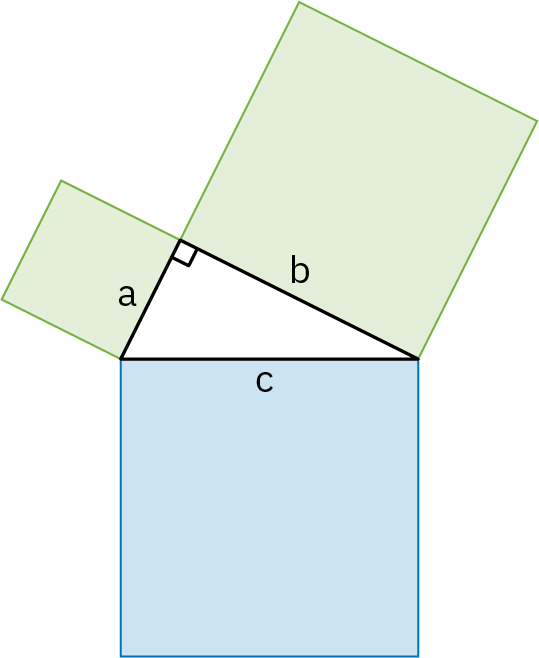
Figure 1.5 The Pythagorean Theorem describes the relationship between the sides of a right-angled triangle as demonstrated by the ancient Greek philosopher, Pythagoras. (credit: modification of "Pythagorean right angle" by Marianov/Wikimedia Commons, CC0)
図1.5 ピュタゴラスの定理は、古代ギリシャの哲学者ピュタゴラスが示した、直角三角形の辺どうしの関係を記述する。 (credit: modification of "Pythagorean right angle" by Marianov/Wikimedia Commons, CC0)
The Pythagoreans were excellent mathematicians, but they were more interested in how mathematics explained the natural world. In particular, Pythagoras recognized relationships between line segments and shapes, such as the Pythagorean theorem describes, but also between numbers and sounds, by virtue of harmonics and the intervals between notes. Similar regularities can be found in astronomy. As a result, Pythagoras reasoned that all of nature is generated according to mathematical regularities. This view led the Pythagoreans to believe that there was a unified, rational structure to the universe, that the planets and stars exhibit harmonic properties and may even produce music, that musical tones and harmonies could have healing powers, that the soul is immortal and continuously reincarnated, and that animals possess souls that ought to be respected and valued. As a result, the Pythagorean community was defined by serious scholarship as well as strict rules about diet, clothing, and behavior.
英語のヒント
ピュタゴラス学派の人々は優れた数学者だったが、より強い関心を抱いていたのは、数学が自然界をどのように説明するかということだった。とくにピュタゴラスは、ピュタゴラスの定理が記述するような線分と図形の関係だけでなく、倍音や音と音の間隔を通じて、数と音との関係も認めた。同様の規則性は天文学にも見いだせる。その結果、ピュタゴラスは自然のすべてが数学的な規則性に従って生み出されると考えた。この見方から、ピュタゴラス学派は、宇宙には統一的で合理的な構造がある、惑星や星には調和的な性質があり、音楽さえ生み出しているかもしれない、音や和音には治癒する力があるかもしれない、魂は不死で絶えず生まれ変わる、そして動物は尊重され大切にされるべき魂を持つ、と信じるようになった。そのため、ピュタゴラス学派の共同体は、真剣な学究とともに、食事、服装、振る舞いについての厳格な規則によって特徴づけられていた。
Additionally, in the early Pythagorean communities, it was possible for women to participate and contribute to philosophical thought and discovery. Pythagoras himself was said to have been inspired to study philosophy by the Delphic priestess Themistoclea. His wife Theano is credited with contributing to important discoveries in the realms of numbers and optics. She is said to have written a treatise, On Piety, which further applies Pythagorean philosophy to various aspects of practical life (Waithe 1987). Myia, the daughter of this illustrious couple, was also an active and productive part of the community. At least one of her letters has survived in which she discusses the application of Pythagorean philosophy to motherhood. The Pythagorean school is an example of how early philosophical and scientific thinking combines with religious, cultural, and ethical beliefs and practices to embrace many different aspects of life.
英語のヒント
さらに、初期のピュタゴラス学派の共同体では、女性も参加し、哲学的な思考や発見に貢献することができた。ピュタゴラス自身も、デルフォイの巫女テミストクレイアに刺激を受けて哲学を学ぶようになったといわれる。妻テアノは、数や光学の分野で重要な発見に貢献したとされる。彼女は『敬虔について』(On Piety)という論考を著したといわれ、そこではピュタゴラス派の哲学が、実生活のさまざまな側面へとさらに応用されている(Waithe 1987)。この著名な夫妻の娘ミュイアも、共同体の活発で実りある一員だった。少なくとも一通の手紙が残されており、その中で彼女は、母として子を育てることへのピュタゴラス派の哲学の応用を論じている。ピュタゴラス学派は、初期の哲学的・科学的な思考が、宗教的・文化的・倫理的な信念や実践と結びつき、生活の多くの異なる側面を包み込んでいたことを示す例である。