第9章気体
9.6 Non-Ideal Gas Behavior9.6 気体の非理想的な振る舞い
Learning Objectives学習目標
By the end of this section, you will be able to:
この節を終えると、次のことができるようになる。
- Describe the physical factors that lead to deviations from ideal gas behavior理想気体の振る舞いからのずれを生じさせる物理的な要因を説明する。
- Explain how these factors are represented in the van der Waals equationこれらの要因がファン・デル・ワールスの状態方程式でどのように表されるかを説明する。
- Define compressibility (Z) and describe how its variation with pressure reflects non-ideal behavior圧縮係数Zを定義し、その圧力による変化が非理想的な振る舞いをどのように反映するかを説明する。
- Quantify non-ideal behavior by comparing computations of gas properties using the ideal gas law and the van der Waals equation理想気体の状態方程式とファン・デル・ワールスの状態方程式を用いた気体の性質の計算結果を比較し、非理想的な振る舞いを定量化する。
Thus far, the ideal gas law, PV = nRT, has been applied to a variety of different types of problems, ranging from reaction stoichiometry and empirical and molecular formula problems to determining the density and molar mass of a gas. As mentioned in the previous modules of this chapter, however, the behavior of a gas is often non-ideal, meaning that the observed relationships between its pressure, volume, and temperature are not accurately described by the gas laws. In this section, the reasons for these deviations from ideal gas behavior are considered.
英語のヒント
これまで、理想気体の状態方程式PV = nRTを、反応の化学量論、組成式や分子式の問題から、気体の密度やモル質量の決定まで、さまざまな種類の問題に適用してきた。しかし、この章の前の節で述べたように、気体の振る舞いはしばしば非理想的である。つまり、観測される圧力、体積、温度の関係を、気体の法則では正確に記述できないことがある。この節では、理想気体の振る舞いからこのようにずれる理由を考える。
One way in which the accuracy of PV = nRT can be judged is by comparing the actual volume of 1 mole of gas (its molar volume, Vm) to the molar volume of an ideal gas at the same temperature and pressure. This ratio is called the compressibility factor (Z) with:
英語のヒント
PV = nRTの正確さを判断する方法の一つは、気体1 molの実際の体積(モル体積Vm)を、同じ温度と圧力での理想気体のモル体積と比較することである。この比を圧縮係数(Z)といい、次式で表す。
Ideal gas behavior is therefore indicated when this ratio is equal to 1, and any deviation from 1 is an indication of non-ideal behavior. Figure 9.35 shows plots of Z over a large pressure range for several common gases.
したがって、この比が1に等しいときは理想気体として振る舞うことを示し、1からのずれは非理想的な振る舞いを示す。図9.35には、よく見られるいくつかの気体について、広い圧力範囲にわたるZのグラフを示す。
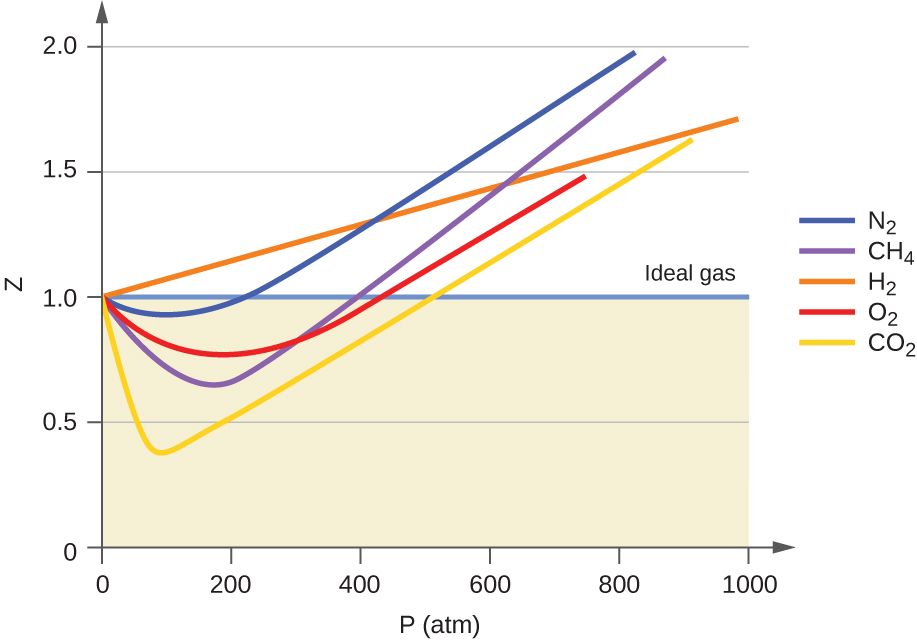
Figure 9.35図 9.35
A graph of the compressibility factor (Z) vs. pressure shows that gases can exhibit significant deviations from the behavior predicted by the ideal gas law.
圧縮係数Zを圧力に対して描くと、気体は理想気体の状態方程式が予測する振る舞いから大きくずれる場合があることがわかる。
As is apparent from Figure 9.35, the ideal gas law does not describe gas behavior well at relatively high pressures. To determine why this is, consider the differences between real gas properties and what is expected of a hypothetical ideal gas.
英語のヒント
図9.35から明らかなように、比較的高い圧力では、理想気体の状態方程式は気体の振る舞いを十分に記述しない。その理由を考えるために、実在気体の性質と、仮想的な理想気体に期待される性質との違いを検討しよう。
Particles of a hypothetical ideal gas have no significant volume and do not attract or repel each other. In general, real gases approximate this behavior at relatively low pressures and high temperatures. However, at high pressures, the molecules of a gas are crowded closer together, and the amount of empty space between the molecules is reduced. At these higher pressures, the volume of the gas molecules themselves becomes appreciable relative to the total volume occupied by the gas. The gas therefore becomes less compressible at these high pressures, and although its volume continues to decrease with increasing pressure, this decrease is not proportional as predicted by Boyle’s law.
英語のヒント
仮想的な理想気体の粒子は、無視できる体積しか持たず、互いに引き合ったり反発したりしない。一般に、実在気体は比較的低い圧力と高い温度で、この振る舞いに近づく。しかし高圧では、気体分子がより密に集まり、分子間の空いている空間が減る。このような高圧では、気体全体が占める体積に対して、分子自体の体積が無視できない大きさになる。そのため気体は圧縮されにくくなり、圧力の増加に伴って体積は減り続けるものの、その減り方はボイルの法則が予測する比例関係には従わない。
At relatively low pressures, gas molecules have practically no attraction for one another because they are (on average) so far apart, and they behave almost like particles of an ideal gas. At higher pressures, however, the force of attraction is also no longer insignificant. This force pulls the molecules a little closer together, slightly decreasing the pressure (if the volume is constant) or decreasing the volume (at constant pressure) (Figure 9.36). This change is more pronounced at low temperatures because the molecules have lower KE relative to the attractive forces, and so they are less effective in overcoming these attractions after colliding with one another.
英語のヒント
比較的低い圧力では、気体分子は平均して非常に遠く離れているため、分子間の引力は実質的に存在せず、理想気体の粒子とほとんど同じように振る舞う。しかし圧力が高くなると、引力も無視できなくなる。この力は分子を少し近くへ引き寄せ、体積一定なら圧力をわずかに下げ、圧力一定なら体積を小さくする(図9.36)。この変化は低温でより顕著になる。低温では、引力に比べて分子の運動エネルギーが小さいため、衝突した後に引力を振り切る能力が低くなるからである。
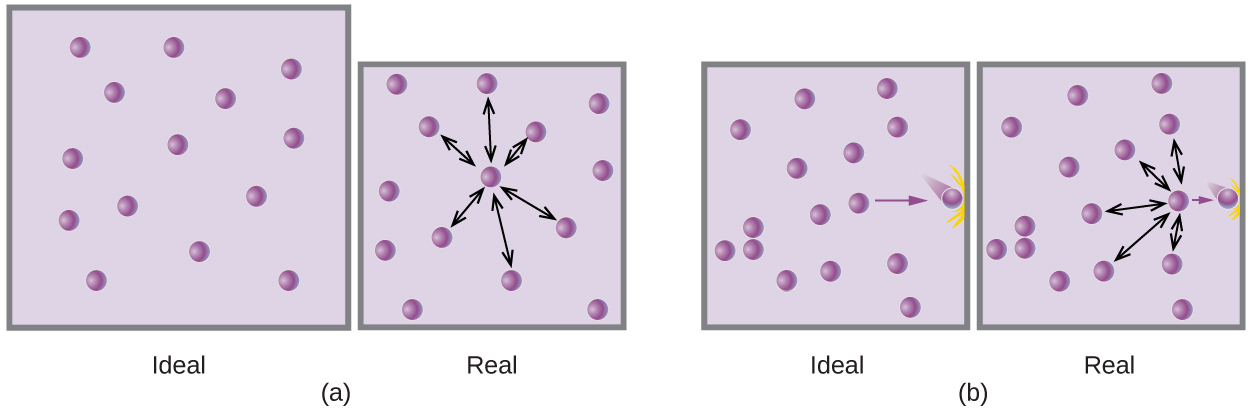
Figure 9.36図 9.36
(a) Attractions between gas molecules serve to decrease the gas volume at constant pressure compared to an ideal gas whose molecules experience no attractive forces. (b) These attractive forces will decrease the force of collisions between the molecules and container walls, therefore reducing the pressure exerted at constant volume compared to an ideal gas.
(a) 気体分子間の引力は、圧力一定のとき、分子が引力を受けない理想気体に比べて気体の体積を減らす働きをする。(b) これらの引力は、分子と容器の壁との衝突力を弱めるため、体積一定では理想気体と比べて圧力を低くする。
There are several different equations that better approximate gas behavior than does the ideal gas law. The first, and simplest, of these was developed by the Dutch scientist Johannes van der Waals in 1879. The van der Waals equation improves upon the ideal gas law by adding two terms: one to account for the volume of the gas molecules and another for the attractive forces between them.
英語のヒント
気体の振る舞いを、理想気体の状態方程式よりよく近似する式はいくつかある。その最初で最も単純な式は、1879年にオランダの科学者ヨハネス・ファン・デル・ワールスが考案した。ファン・デル・ワールスの状態方程式は、気体分子の体積を考慮する項と、分子間の引力を考慮する項という二つの項を加えることで、理想気体の状態方程式を改良する。



The constant a corresponds to the strength of the attraction between molecules of a particular gas, and the constant b corresponds to the size of the molecules of a particular gas. The “correction” to the pressure term in the ideal gas law is and the “correction” to the volume is nb. Note that when V is relatively large and n is relatively small, both of these correction terms become negligible, and the van der Waals equation reduces to the ideal gas law, PV = nRT. Such a condition corresponds to a gas in which a relatively low number of molecules is occupying a relatively large volume, that is, a gas at a relatively low pressure. Experimental values for the van der Waals constants of some common gases are given in Table 9.3.
英語のヒント
定数aは、その気体の分子間の引力の強さに対応し、定数bはその気体の分子の大きさに対応する。理想気体の状態方程式の圧力項への「補正」は、体積への「補正」はnbである。Vが比較的大きくnが比較的小さい場合には、両方の補正項が無視できるようになり、ファン・デル・ワールスの状態方程式は理想気体の状態方程式PV = nRTに帰着する。この条件は、比較的少ない分子が比較的大きな体積を占める気体、すなわち比較的低圧の気体に対応する。よく見られる気体について、実験で得られたファン・デル・ワールス定数の値を表9.3に示す。
Values of van der Waals Constants for Some Common Gases よく見られる気体のファン・デル・ワールス定数 |
||
|---|---|---|
Gas 気体 |
a (L2 atm/mol2) a(L2 atm/mol2) |
b (L/mol) b(L/mol) |
N2 |
1.39 |
0.0391 |
O2 |
1.36 |
0.0318 |
CO2 |
3.59 |
0.0427 |
H2O |
5.46 |
0.0305 |
He |
0.0342 |
0.0237 |
CCl4 |
20.4 |
0.1383 |
At low pressures, the correction for intermolecular attraction, a, is more important than the one for molecular volume, b. At high pressures and small volumes, the correction for the volume of the molecules becomes important because the molecules themselves are incompressible and constitute an appreciable fraction of the total volume. At some intermediate pressure, the two corrections have opposing influences and the gas appears to follow the relationship given by PV = nRT over a small range of pressures. This behavior is reflected by the “dips” in several of the compressibility curves shown in Figure 9.35. The attractive force between molecules initially makes the gas more compressible than an ideal gas, as pressure is raised (Z decreases with increasing P). At very high pressures, the gas becomes less compressible (Z increases with P), as the gas molecules begin to occupy an increasingly significant fraction of the total gas volume.
英語のヒント
低圧では、分子間引力に対する補正aのほうが、分子体積に対する補正bより重要である。高圧で体積が小さい場合は、分子自体が圧縮できず、全体積の無視できない割合を占めるため、分子体積の補正が重要になる。ある中間の圧力では、二つの補正が逆向きの影響を持ち、狭い圧力範囲では気体がPV = nRTの関係に従うように見える。この振る舞いは、図9.35に示すいくつかの圧縮係数の曲線の「くぼみ」に表れている。圧力を上げていくと、はじめは分子間引力によって気体は理想気体より圧縮されやすくなる(Pの増加に伴いZが減少する)。非常に高い圧力では、分子が気体の全体積のうち次第に大きな割合を占めるようになり、気体は圧縮されにくくなる(PとともにZが増加する)。
Strictly speaking, the ideal gas equation functions well when intermolecular attractions between gas molecules are negligible and the gas molecules themselves do not occupy an appreciable part of the whole volume. These criteria are satisfied under conditions of low pressure and high temperature. Under such conditions, the gas is said to behave ideally, and deviations from the gas laws are small enough that they may be disregarded—this is, however, very often not the case.
英語のヒント
厳密にいえば、理想気体の状態方程式がよく成り立つのは、気体分子間の引力が無視でき、分子自体が全体積の無視できない部分を占めていない場合である。この条件は、低圧・高温で満たされる。このような条件下では、気体は理想的に振る舞うといい、気体の法則からのずれは無視できるほど小さい。しかし、そうでない場合も非常に多い。
Example 9.24例題 9.24
Comparison of Ideal Gas Law and van der Waals Equation理想気体の状態方程式とファン・デル・ワールスの状態方程式の比較
A 4.25-L flask contains 3.46 mol CO2 at 229 °C. Calculate the pressure of this sample of CO2:
4.25 Lのフラスコに、229 °Cで3.46 molのCO2が入っている。このCO2試料の圧力を求めなさい。
(a) from the ideal gas law
(a) 理想気体の状態方程式から求める。
(b) from the van der Waals equation
(b) ファン・デル・ワールスの状態方程式から求める。
(c) Explain the reason(s) for the difference.
(c) 差が生じる理由を説明しなさい。
Solution解法
(a) From the ideal gas law:
(a) 理想気体の状態方程式より、
(b) From the van der Waals equation:
(b) ファン・デル・ワールスの状態方程式より、
This finally yields P = 32.4 atm.
最終的に、P = 32.4 atmを得る。
(c) This is not very different from the value from the ideal gas law because the pressure is not very high and the temperature is not very low. The value is somewhat different because CO2 molecules do have some volume and attractions between molecules, and the ideal gas law assumes they do not have volume or attractions.
(c) 圧力はそれほど高くなく、温度もそれほど低くないので、理想気体の状態方程式から得られる値と大きくは異ならない。多少異なるのは、CO2分子には実際に体積と分子間引力があるのに、理想気体の状態方程式ではどちらもないと仮定しているためである。
Check your Learning理解度の確認
A 560-mL flask contains 21.3 g N2 at 145 °C. Calculate the pressure of N2:
560 mLのフラスコに、145 °Cで21.3 gのN2が入っている。N2の圧力を求めなさい。
(a) from the ideal gas law
(a) 理想気体の状態方程式から求める。
(b) from the van der Waals equation
(b) ファン・デル・ワールスの状態方程式から求める。
(c) Explain the reason(s) for the difference.
(c) 差が生じる理由を説明しなさい。