第9章気体
The Pressure of a Mixture of Gases: Dalton’s Law混合気体の圧力:ドルトンの法則
Unless they chemically react with each other, the individual gases in a mixture of gases do not affect each other’s pressure. Each individual gas in a mixture exerts the same pressure that it would exert if it were present alone in the container (Figure 9.20). The pressure exerted by each individual gas in a mixture is called its partial pressure. This observation is summarized by Dalton’s law of partial pressures: The total pressure of a mixture of ideal gases is equal to the sum of the partial pressures of the component gases:
英語のヒント
気体混合物の各気体は、互いに化学反応を起こさないかぎり、互いの圧力に影響を与えない。混合物中の各気体は、その気体だけが容器内に存在するとした場合と同じ圧力を及ぼす(図9.20)。混合物中の各気体が及ぼす圧力を、その気体の分圧という。この観測結果は、ドルトンの分圧の法則としてまとめられる。すなわち、理想気体の混合物の全圧は、各成分気体の分圧の和に等しい。
In the equation PTotal is the total pressure of a mixture of gases, PA is the partial pressure of gas A; PB is the partial pressure of gas B; PC is the partial pressure of gas C; and so on.
この式で、PTotalは混合気体の全圧、PAは気体Aの分圧、PBは気体Bの分圧、PCは気体Cの分圧であり、以下同様である。
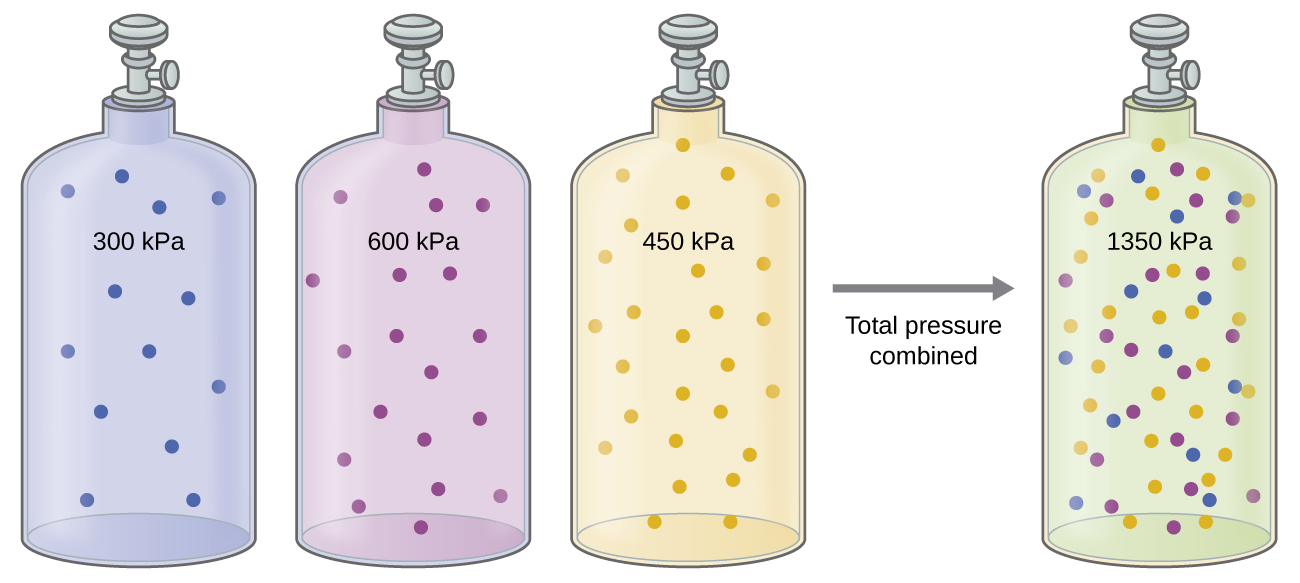
Figure 9.20図 9.20
If equal-volume cylinders containing gasses at pressures of 300 kPa, 450 kPa, and 600 kPa are all combined in the same-size cylinder, the total pressure of the gas mixture is 1350 kPa.
同じ体積のボンベにそれぞれ300 kPa、450 kPa、600 kPaで入っている気体を、すべて同じ大きさの1本のボンベに移して混合すると、混合気体の全圧は1350 kPaになる。
The partial pressure of gas A is related to the total pressure of the gas mixture via its mole fraction (X), a unit of concentration defined as the number of moles of a component of a solution divided by the total number of moles of all components:
英語のヒント
気体Aの分圧は、そのモル分率(X)を介して混合気体の全圧と関係付けられる。モル分率は濃度を表す量であり、溶液のある成分のモル数を、すべての成分の総モル数で割った値と定義される。
where PA, XA, and nA are the partial pressure, mole fraction, and number of moles of gas A, respectively, and nTotal is the number of moles of all components in the mixture.
ここで、PA、XA、nAはそれぞれ気体Aの分圧、モル分率、モル数であり、nTotalは混合物中のすべての成分の総モル数である。
Example 9.14例題 9.14
The Pressure of a Mixture of Gases混合気体の圧力
A 10.0-L vessel contains 2.50 10−3 mol of H2, 1.00 10−3 mol of He, and 3.00 10−4 mol of Ne at 35 °C.
10.0 Lの容器に、35 °Cで、2.50 10−3 molのH2、1.00 10−3 molのHe、3.00 10−4 molのNeが入っている。
(a) What are the partial pressures of each of the gases?
(a) 各気体の分圧はいくらか。
(b) What is the total pressure in atmospheres?
(b) 全圧をatmで求めなさい。
Solution解法
The gases behave independently, so the partial pressure of each gas can be determined from the ideal gas equation, using :
気体はそれぞれ独立に振る舞うので、を用いれば、各気体の分圧を理想気体の状態方程式から求められる。
The total pressure is given by the sum of the partial pressures:
全圧は分圧の和で与えられる。
Check Your Learning理解度の確認
A 5.73-L flask at 25 °C contains 0.0388 mol of N2, 0.147 mol of CO, and 0.0803 mol of H2. What is the total pressure in the flask in atmospheres?
25 °C、5.73 Lのフラスコに、0.0388 molのN2、0.147 molのCO、0.0803 molのH2が入っている。フラスコ内の全圧をatmで求めなさい。
Here is another example of this concept, but dealing with mole fraction calculations.
同じ概念を扱う別の例題として、今度はモル分率の計算を取り上げる。
Example 9.15例題 9.15
The Pressure of a Mixture of Gases混合気体の圧力
A gas mixture used for anesthesia contains 2.83 mol oxygen, O2, and 8.41 mol nitrous oxide, N2O. The total pressure of the mixture is 192 kPa.
麻酔用の混合気体には、2.83 molの酸素O2と、8.41 molの亜酸化窒素N2Oが含まれている。この混合気体の全圧は192 kPaである。
(a) What are the mole fractions of O2 and N2O?
(a) O2とN2Oのモル分率はいくらか。
(b) What are the partial pressures of O2 and N2O?
(b) O2とN2Oの分圧はいくらか。
Solution解法
The mole fraction is given by and the partial pressure is PA = XA PTotal.
モル分率はで与えられ、分圧はPA = XA PTotalである。
For O2,
O2について、
and
また、
For N2O,
N2Oについて、
and
また、
Check Your Learning理解度の確認
What is the pressure of a mixture of 0.200 g of H2, 1.00 g of N2, and 0.820 g of Ar in a container with a volume of 2.00 L at 20 °C?
20 °C、体積2.00 Lの容器に、0.200 gのH2、1.00 gのN2、0.820 gのArを混合して入れたとき、圧力はいくらか。
Collection of Gases over Water水上置換による気体の捕集
A simple way to collect gases that do not react with water is to capture them in a bottle that has been filled with water and inverted into a dish filled with water. The pressure of the gas inside the bottle can be made equal to the air pressure outside by raising or lowering the bottle. When the water level is the same both inside and outside the bottle (Figure 9.21), the pressure of the gas is equal to the atmospheric pressure, which can be measured with a barometer.
英語のヒント
水と反応しない気体を簡単に集める方法は、水で満たした瓶を、水を入れた容器の中に逆さに立て、その瓶の中に気体を捕集することである。瓶を上げ下げすれば、瓶の中の気体の圧力を外の空気の圧力と等しくできる。瓶の内側と外側の水面の高さが同じになると(図9.21)、気体の圧力は大気圧に等しくなり、その大気圧は気圧計で測定できる。
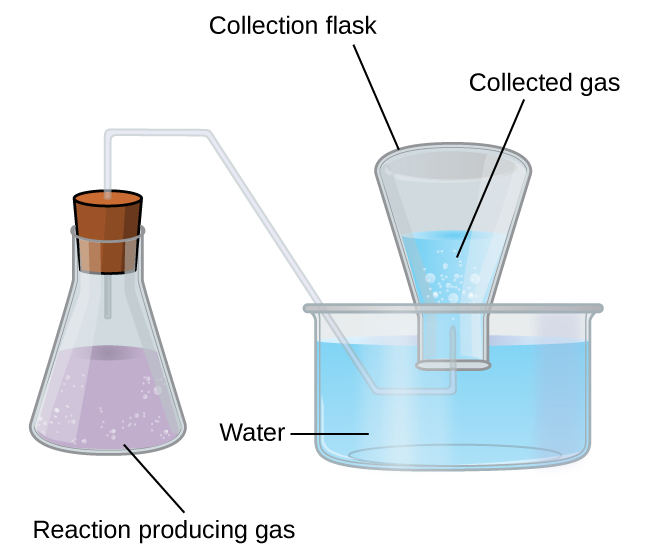
Figure 9.21図 9.21
When a reaction produces a gas that is collected above water, the trapped gas is a mixture of the gas produced by the reaction and water vapor. If the collection flask is appropriately positioned to equalize the water levels both within and outside the flask, the pressure of the trapped gas mixture will equal the atmospheric pressure outside the flask (see the earlier discussion of manometers).
英語のヒント
反応によって生じた気体を水上置換で集めると、閉じ込められた気体は、反応による生成気体と水蒸気の混合物になる。捕集フラスコの位置を適切に調整して、内外の水面を同じ高さにすると、閉じ込めた混合気体の圧力はフラスコの外の大気圧と等しくなる(前述の圧力計の説明を参照)。
However, there is another factor we must consider when we measure the pressure of the gas by this method. Water evaporates and there is always gaseous water (water vapor) above a sample of liquid water. As a gas is collected over water, it becomes saturated with water vapor and the total pressure of the mixture equals the partial pressure of the gas plus the partial pressure of the water vapor. The pressure of the pure gas is therefore equal to the total pressure minus the pressure of the water vapor—this is referred to as the “dry” gas pressure, that is, the pressure of the gas only, without water vapor. The vapor pressure of water, which is the pressure exerted by water vapor in equilibrium with liquid water in a closed container, depends on the temperature (Figure 9.22); more detailed information on the temperature dependence of water vapor can be found in Table 9.2, and vapor pressure will be discussed in more detail in the next chapter on liquids.
英語のヒント
しかし、この方法で気体の圧力を測定するときには、もう一つ考慮すべき要因がある。水は蒸発するため、液体の水の上には常に気体の水(水蒸気)が存在する。水上置換で気体を集めると、その気体は水蒸気で飽和し、混合気体の全圧は、捕集した気体の分圧と水蒸気の分圧の和になる。したがって、純粋な気体の圧力は、全圧から水蒸気の圧力を引いた値に等しい。この圧力を「乾燥気体」の圧力、すなわち水蒸気を含まない、その気体だけの圧力という。水の蒸気圧とは、密閉容器中で液体の水と平衡にある水蒸気が及ぼす圧力のことであり、温度に依存する(図9.22)。水蒸気の温度依存性についての詳しい値を表9.2に示す。蒸気圧は、液体を扱う次の章でさらに詳しく説明する。
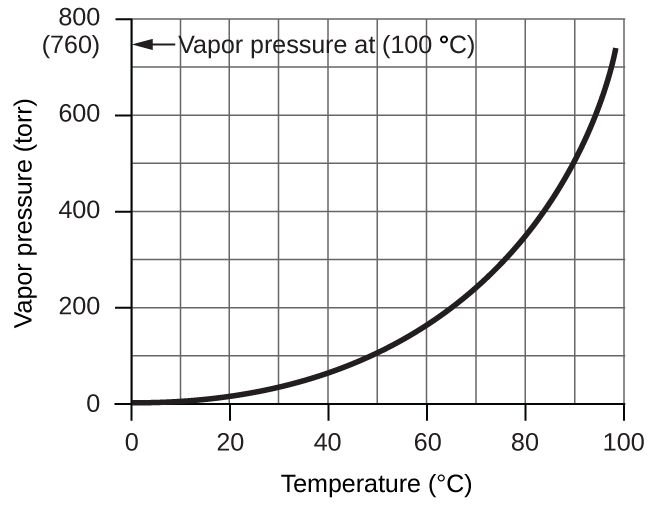


Figure 9.22図 9.22
This graph shows the vapor pressure of water at sea level as a function of temperature.
海面高度における水の蒸気圧を温度の関数として示したグラフ。
Vapor Pressure of Ice and Water in Various Temperatures at Sea Level 海面高度における各温度での氷と水の蒸気圧 |
|||||
|---|---|---|---|---|---|
Temperature (°C) 温度(°C) |
Pressure (torr) 圧力(torr) |
Temperature (°C) 温度(°C) |
Pressure (torr) 圧力(torr) |
Temperature (°C) 温度(°C) |
Pressure (torr) 圧力(torr) |
–10 |
1.95 |
18 |
15.5 |
30 |
31.8 |
–5 |
3.0 |
19 |
16.5 |
35 |
42.2 |
–2 |
3.9 |
20 |
17.5 |
40 |
55.3 |
0 |
4.6 |
21 |
18.7 |
50 |
92.5 |
2 |
5.3 |
22 |
19.8 |
60 |
149.4 |
4 |
6.1 |
23 |
21.1 |
70 |
233.7 |
6 |
7.0 |
24 |
22.4 |
80 |
355.1 |
8 |
8.0 |
25 |
23.8 |
90 |
525.8 |
10 |
9.2 |
26 |
25.2 |
95 |
633.9 |
12 |
10.5 |
27 |
26.7 |
99 |
733.2 |
14 |
12.0 |
28 |
28.3 |
100.0 |
760.0 |
16 |
13.6 |
29 |
30.0 |
101.0 |
787.6 |
Example 9.16例題 9.16
Pressure of a Gas Collected Over Water水上置換で捕集した気体の圧力
If 0.200 L of argon is collected over water at a temperature of 26 °C and a pressure of 750 torr in a system like that shown in Figure 9.21, what is the partial pressure of argon?
図9.21のような装置を用い、温度26 °C、圧力750 torrでアルゴン0.200 Lを水上置換によって捕集した。アルゴンの分圧はいくらか。
Solution解法
According to Dalton’s law, the total pressure in the bottle (750 torr) is the sum of the partial pressure of argon and the partial pressure of gaseous water:
ドルトンの法則によれば、瓶内の全圧(750 torr)はアルゴンの分圧と水蒸気の分圧の和である。
Rearranging this equation to solve for the pressure of argon gives:
この式をアルゴンの圧力について解くと、次式が得られる。
The pressure of water vapor above a sample of liquid water at 26 °C is 25.2 torr (Appendix E), so:
26 °Cで液体の水の上に存在する水蒸気の圧力は25.2 torrなので(付録E)、
Check Your Learning理解度の確認
A sample of oxygen collected over water at a temperature of 29.0 °C and a pressure of 764 torr has a volume of 0.560 L. What volume would the dry oxygen from this sample have under the same conditions of temperature and pressure?
温度29.0 °C、圧力764 torrで水上置換により捕集した酸素の試料の体積は0.560 Lだった。この試料から得られる乾燥酸素の体積は、同じ温度と圧力ではいくらになるか。