第9章気体
9.2 Relating Pressure, Volume, Amount, and Temperature: The Ideal Gas Law9.2 圧力・体積・物質量・温度の関係:理想気体の状態方程式
Learning Objectives学習目標
By the end of this section, you will be able to:
この節を終えると、次のことができるようになる。
- Identify the mathematical relationships between the various properties of gases気体のさまざまな性質の間にある数学的関係を見いだす。
- Use the ideal gas law, and related gas laws, to compute the values of various gas properties under specified conditions理想気体の状態方程式と関連する気体の法則を用いて、指定された条件での気体のさまざまな性質の値を計算する。
During the seventeenth and especially eighteenth centuries, driven both by a desire to understand nature and a quest to make balloons in which they could fly (Figure 9.9), a number of scientists established the relationships between the macroscopic physical properties of gases, that is, pressure, volume, temperature, and amount of gas. Although their measurements were not precise by today’s standards, they were able to determine the mathematical relationships between pairs of these variables (e.g., pressure and temperature, pressure and volume) that hold for an ideal gas—a hypothetical construct that real gases approximate under certain conditions. Eventually, these individual laws were combined into a single equation—the ideal gas law—that relates gas quantities for gases and is quite accurate for low pressures and moderate temperatures. We will consider the key developments in individual relationships (for pedagogical reasons not quite in historical order), then put them together in the ideal gas law.
英語のヒント
17世紀から、とりわけ18世紀にかけて、自然を理解したいという願いと、人が乗って飛べる気球を作ろうという探究心(図9.9)に促され、多くの科学者が、気体の巨視的な物理的性質、すなわち圧力、体積、温度、物質量の関係を明らかにした。当時の測定は今日の基準では精密ではなかったが、これらの変数の対(たとえば圧力と温度、圧力と体積)の間に成り立つ数学的関係を見いだすことができた。これは理想気体に対して成立する関係である。理想気体は仮想的な構成物だが、実在気体もある条件下ではその振る舞いに近づく。最終的に個々の法則は、気体の諸量を結び付ける一つの式、理想気体の状態方程式にまとめられた。この式は低圧で適度な温度ではかなり正確である。まず各関係の重要な発展を取り上げ(学習上の理由で、完全には歴史順にしない)、その後で理想気体の状態方程式にまとめる。
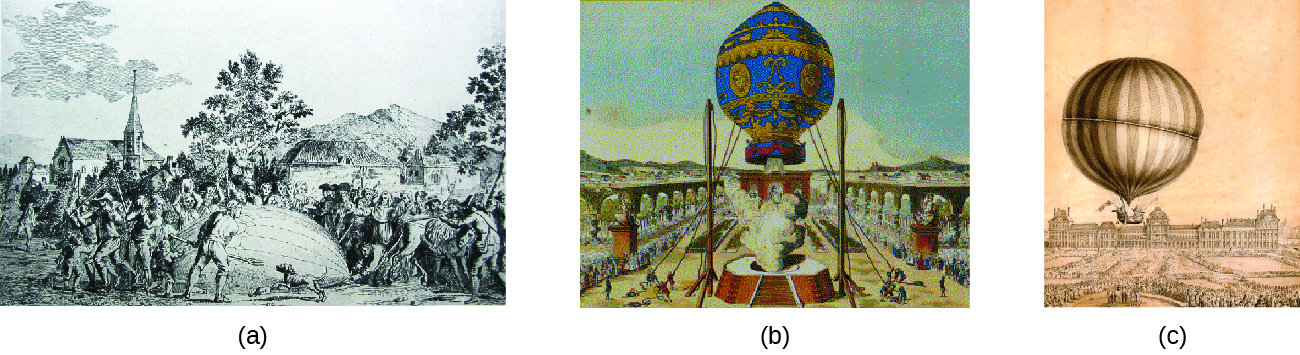
Figure 9.9図 9.9
In 1783, the first (a) hydrogen-filled balloon flight, (b) manned hot air balloon flight, and (c) manned hydrogen-filled balloon flight occurred. When the hydrogen-filled balloon depicted in (a) landed, the frightened villagers of Gonesse reportedly destroyed it with pitchforks and knives. The launch of the latter was reportedly viewed by 400,000 people in Paris.
英語のヒント
1783年、初めての(a)水素を満たした気球の飛行、(b)有人熱気球の飛行、(c)有人水素気球の飛行が行われた。(a)の水素気球が着陸した際、恐れたゴネス村の住民たちが干し草用フォークとナイフで破壊したと伝えられる。後者の気球の打ち上げは、パリで40万人が見物したという。
Pressure and Temperature: Amontons’s Law圧力と温度:アモントンの法則
Imagine filling a rigid container attached to a pressure gauge with gas and then sealing the container so that no gas may escape. If the container is cooled, the gas inside likewise gets colder and its pressure is observed to decrease. Since the container is rigid and tightly sealed, both the volume and number of moles of gas remain constant. If we heat the sphere, the gas inside gets hotter (Figure 9.10) and the pressure increases.
英語のヒント
圧力計の付いた剛体容器に気体を入れ、漏れないよう密閉するところを想像しよう。容器を冷やすと、中の気体も冷え、圧力の低下が観測される。容器は形が変わらず密閉されているので、気体の体積とモル数はどちらも一定である。球形容器を加熱すると、中の気体は熱くなり(図9.10)、圧力が上がる。
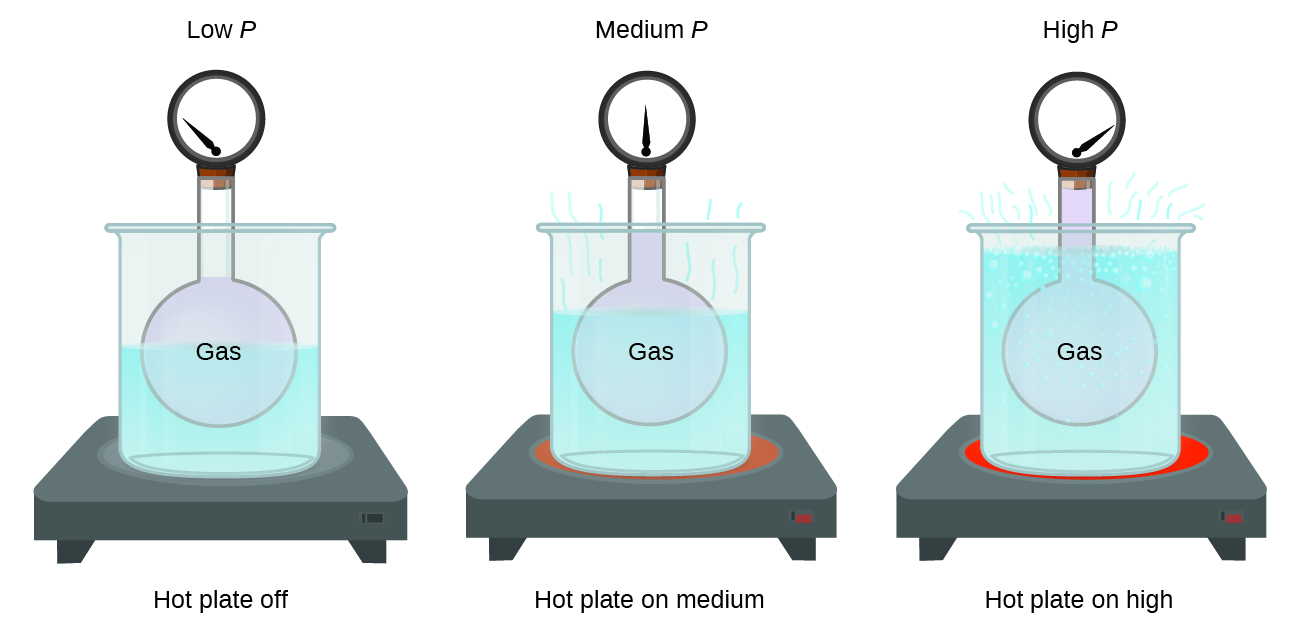
Figure 9.10図 9.10
The effect of temperature on gas pressure: When the hot plate is off, the pressure of the gas in the sphere is relatively low. As the gas is heated, the pressure of the gas in the sphere increases.
温度が気体の圧力に与える影響。ホットプレートを切っていると、球内の気体の圧力は比較的低い。気体を加熱するにつれて、球内の圧力は増す。
This relationship between temperature and pressure is observed for any sample of gas confined to a constant volume. An example of experimental pressure-temperature data is shown for a sample of air under these conditions in Figure 9.11. We find that temperature and pressure are linearly related, and if the temperature is on the kelvin scale, then P and T are directly proportional (again, when volume and moles of gas are held constant); if the temperature on the kelvin scale increases by a certain factor, the gas pressure increases by the same factor.
英語のヒント
この温度と圧力の関係は、体積を一定に保って閉じ込めたどの気体試料でも観測される。図9.11に、この条件での空気試料の圧力と温度の実験データの例を示す。温度と圧力は直線的な関係にあり、温度をケルビンで表すとPとTは正比例することがわかる(ここでも気体の体積とモル数は一定とする)。ケルビンで表した温度がある倍率で増加すると、気体の圧力も同じ倍率で増加する。
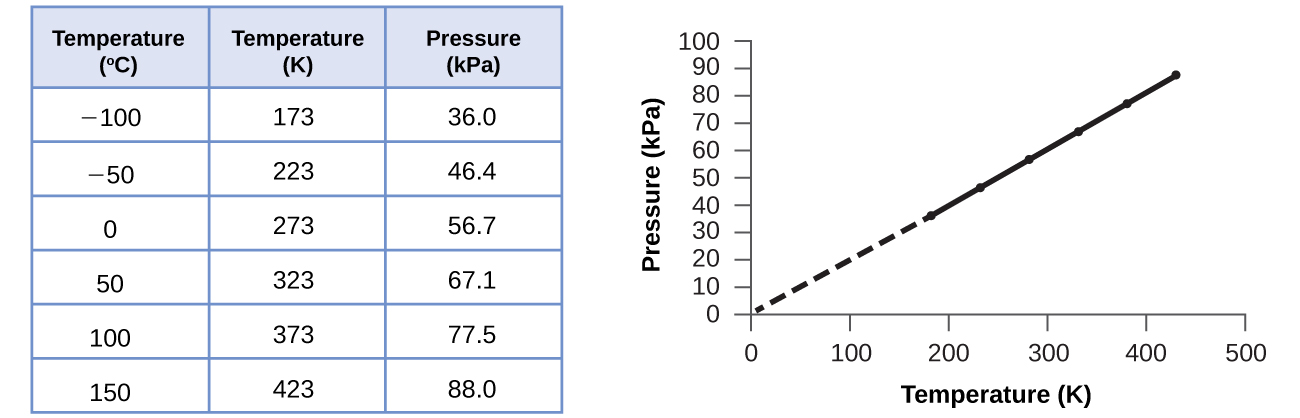


Figure 9.11図 9.11
For a constant volume and amount of air, the pressure and temperature are directly proportional, provided the temperature is in kelvin. (Measurements cannot be made at lower temperatures because of the condensation of the gas.) When this line is extrapolated to lower pressures, it reaches a pressure of 0 at –273 °C, which is 0 on the kelvin scale and the lowest possible temperature, called absolute zero.
英語のヒント
空気の体積と物質量が一定なら、温度をケルビンで表すことを条件として、圧力と温度は正比例する。(さらに低い温度では気体が凝縮するため測定できない。)この直線を低圧側へ外挿すると、−273 °Cで圧力が0となる。これはケルビン目盛の0であり、絶対零度と呼ばれる、可能な最低温度である。
Guillaume Amontons was the first to empirically establish the relationship between the pressure and the temperature of a gas (~1700), and Joseph Louis Gay-Lussac determined the relationship more precisely (~1800). Because of this, the P-T relationship for gases is known as either Amontons’s law or Gay-Lussac’s law. Under either name, it states that the pressure of a given amount of gas is directly proportional to its temperature on the kelvin scale when the volume is held constant. Mathematically, this can be written:
英語のヒント
ギヨーム・アモントンは、気体の圧力と温度の関係を初めて実験的に確立した(1700年ごろ)。ジョゼフ・ルイ・ゲイ=リュサックは、その関係をさらに精密に求めた(1800年ごろ)。このため、気体のP–T関係はアモントンの法則ともゲイ=リュサックの法則とも呼ばれる。どちらの名称でも、体積が一定なら、一定量の気体の圧力はケルビン温度に正比例する、という内容である。数学的には次のように書ける。
where ∝ means “is proportional to,” and k is a proportionality constant that depends on the identity, amount, and volume of the gas.
英語のヒント
ここで、∝は「〜に比例する」を意味し、kは気体の種類、物質量、体積に依存する比例定数である。
For a confined, constant volume of gas, the ratio is therefore constant (i.e., ). If the gas is initially in “Condition 1” (with P = P1 and T = T1), and then changes to “Condition 2” (with P = P2 and T = T2), we have that and which reduces to This equation is useful for pressure-temperature calculations for a confined gas at constant volume. Note that temperatures must be on the kelvin scale for any gas law calculations (0 on the kelvin scale and the lowest possible temperature is called absolute zero). (Also note that there are at least three ways we can describe how the pressure of a gas changes as its temperature changes: We can use a table of values, a graph, or a mathematical equation.)
英語のヒント
したがって、一定体積に閉じ込められた気体では、比は一定である(すなわち)。気体が最初に「状態1」(P = P1、T = T1)にあり、その後「状態2」(P = P2、T = T2)へ変化すると、およびが成り立ち、整理するととなる。この式は、一定体積に閉じ込めた気体の圧力と温度の計算に役立つ。どの気体の法則の計算でも、温度はケルビンで表さなければならないことに注意しよう(ケルビン目盛の0であり、可能な最低温度を絶対零度という)。(また、温度による気体圧力の変化は、数値の表、グラフ、数式という少なくとも三つの方法で表せることにも注意しよう。)
Example 9.5例題 9.5
Predicting Change in Pressure with Temperature温度による圧力変化の予測
A can of hair spray is used until it is empty except for the propellant, isobutane gas.
英語のヒント
ヘアスプレー缶を、噴射剤のイソブタンガス以外は空になるまで使った。
(a) On the can is the warning “Store only at temperatures below 120 °F (48.8 °C). Do not incinerate.” Why?
英語のヒント
(a)缶には「120 °F(48.8 °C)未満でのみ保管すること。焼却しないこと」と警告がある。なぜか。
(b) The gas in the can is initially at 24 °C and 360 kPa, and the can has a volume of 350 mL. If the can is left in a car that reaches 50 °C on a hot day, what is the new pressure in the can?
(b)缶内の気体は最初24 °C、360 kPaであり、缶の体積は350 mLである。暑い日に缶を車内に置き、車内温度が50 °Cになった場合、缶内の新しい圧力はいくらか。
Solution解法
(a) The can contains an amount of isobutane gas at a constant volume, so if the temperature is increased by heating, the pressure will increase proportionately. High temperature could lead to high pressure, causing the can to burst. (Also, isobutane is combustible, so incineration could cause the can to explode.)
英語のヒント
(a)缶には一定体積のイソブタンガスが入っているので、加熱して温度が上がると圧力も比例して上がる。高温によって高圧となり、缶が破裂する可能性がある。(また、イソブタンは可燃性なので、焼却すると缶が爆発する可能性がある。)
(b) We are looking for a pressure change due to a temperature change at constant volume, so we will use Amontons’s/Gay-Lussac’s law. Taking P1 and T1 as the initial values, T2 as the temperature where the pressure is unknown and P2 as the unknown pressure, and converting °C to K, we have:
(b)一定体積で温度変化による圧力変化を求めるので、アモントン/ゲイ=リュサックの法則を用いる。P1とT1を初期値、T2を圧力が未知であるときの温度、P2を未知の圧力とし、°CをKに換算すると、次のようになる。
Rearranging and solving gives:
式を変形して解くと、。
Check Your Learning理解を確かめよう
A sample of nitrogen, N2, occupies 45.0 mL at 27 °C and 600 torr. What pressure will it have if cooled to –73 °C while the volume remains constant?
窒素N2の試料は、27 °C、600 torrで45.0 mLを占める。体積を一定に保ったまま−73 °Cまで冷却すると、圧力はいくらになるか。