第9章気体
Volume and Pressure: Boyle’s Law体積と圧力:ボイルの法則
If we partially fill an airtight syringe with air, the syringe contains a specific amount of air at constant temperature, say 25 °C. If we slowly push in the plunger while keeping temperature constant, the gas in the syringe is compressed into a smaller volume and its pressure increases; if we pull out the plunger, the volume increases and the pressure decreases. This example of the effect of volume on the pressure of a given amount of a confined gas is true in general. Decreasing the volume of a contained gas will increase its pressure, and increasing its volume will decrease its pressure. In fact, if the volume increases by a certain factor, the pressure decreases by the same factor, and vice versa. Volume-pressure data for an air sample at room temperature are graphed in Figure 9.13.
英語のヒント
気密な注射器に途中まで空気を入れると、一定量の空気が一定の温度、たとえば25 °Cで入っている。温度を一定にしながらピストンをゆっくり押すと、注射器内の気体は小さい体積に圧縮され、圧力が上がる。ピストンを引くと体積が増し、圧力が下がる。一定量の閉じ込めた気体で、体積が圧力に及ぼすこの影響は一般に成り立つ。容器内の気体の体積を減らすと圧力は増し、体積を増やすと圧力は減る。実際、体積をある倍率に増やすと、圧力は同じ倍率の逆数に減り、その逆も成り立つ。室温の空気試料の体積と圧力のデータを、図9.13にグラフで示す。
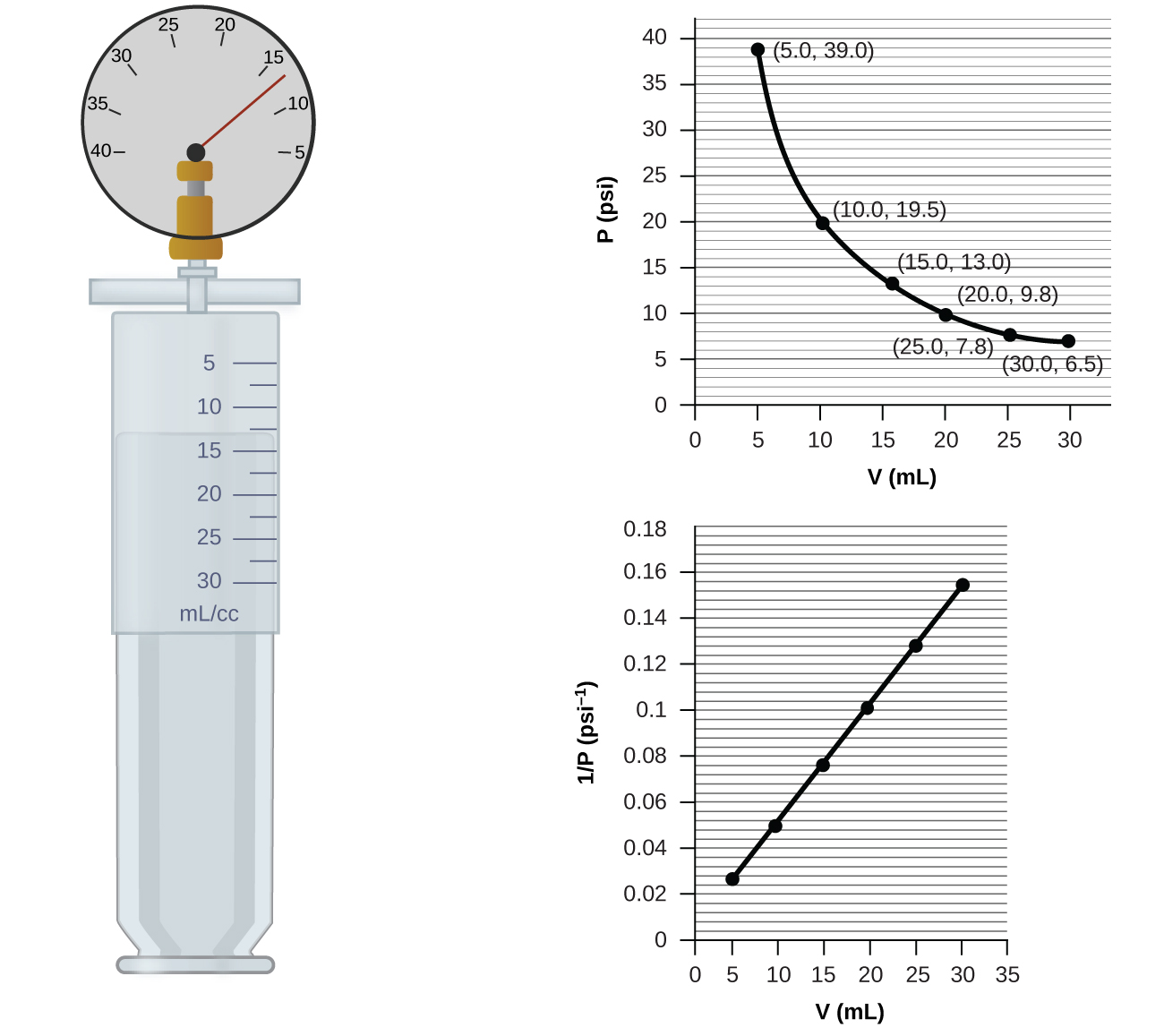
Figure 9.13図 9.13
When a gas occupies a smaller volume, it exerts a higher pressure; when it occupies a larger volume, it exerts a lower pressure (assuming the amount of gas and the temperature do not change). Since P and V are inversely proportional, a graph of vs. V is linear.
気体は、小さい体積を占めるときには高い圧力を、大きい体積を占めるときには低い圧力を及ぼす(気体の量と温度が変わらないとする)。PとVは反比例するため、をVに対して描いたグラフは直線となる。
Unlike the P-T and V-T relationships, pressure and volume are not directly proportional to each other. Instead, P and V exhibit inverse proportionality: Increasing the pressure results in a decrease of the volume of the gas. Mathematically this can be written:
P–T関係やV–T関係とは異なり、圧力と体積は互いに正比例しない。PとVが示すのは反比例であり、圧力を上げると気体の体積は減少する。数学的には、次のように書ける。
with k being a constant. Graphically, this relationship is shown by the straight line that results when plotting the inverse of the pressure versus the volume (V), or the inverse of volume versus the pressure (P). Graphs with curved lines are difficult to read accurately at low or high values of the variables, and they are more difficult to use in fitting theoretical equations and parameters to experimental data. For those reasons, scientists often try to find a way to “linearize” their data. If we plot P versus V, we obtain a hyperbola (see Figure 9.14).
英語のヒント
ここでkは定数である。この関係をグラフにすると、圧力の逆数を体積Vに対して、または体積の逆数を圧力Pに対して描いたときに直線となる。曲線のグラフは、変数の小さい値や大きい値のところを正確に読み取りにくく、理論式やパラメーターを実験データに合わせる際にも扱いにくい。そのため科学者は、データを「直線化」する方法を探すことが多い。PをVに対して描くと双曲線が得られる(図9.14)。
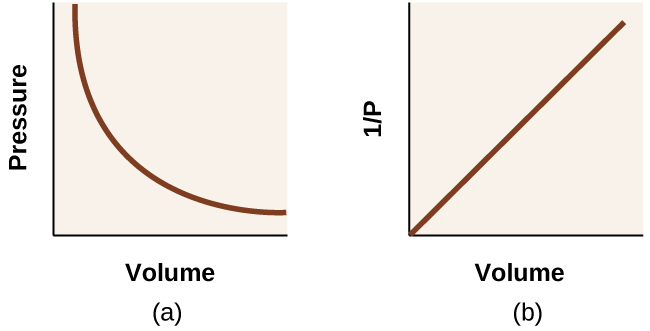


Figure 9.14図 9.14
The relationship between pressure and volume is inversely proportional. (a) The graph of P vs. V is a hyperbola, whereas (b) the graph of vs. V is linear.
圧力と体積の関係は反比例である。(a)PをVに対して描いたグラフは双曲線である一方、(b)をVに対して描いたグラフは直線である。
The relationship between the volume and pressure of a given amount of gas at constant temperature was first published by the English natural philosopher Robert Boyle over 300 years ago. It is summarized in the statement now known as Boyle’s law: The volume of a given amount of gas held at constant temperature is inversely proportional to the pressure under which it is measured.
英語のヒント
一定温度での一定量の気体の体積と圧力の関係は、300年以上前、英国の自然哲学者ロバート・ボイルによって初めて公表された。現在ボイルの法則と呼ばれる次の記述にまとめられる。一定温度に保たれた一定量の気体の体積は、その体積を測るときの圧力に反比例する。
Example 9.8例題 9.8
Volume of a Gas Sample気体試料の体積
The sample of gas in Figure 9.13 has a volume of 15.0 mL at a pressure of 13.0 psi. Determine the pressure of the gas at a volume of 7.5 mL, using:
図9.13の気体試料は、13.0 psiで15.0 mLの体積をもつ。次の方法を使い、体積が7.5 mLのときの圧力を求めなさい。
(a) the P-V graph in Figure 9.13
(a)図9.13のP–Vグラフ
(b) the vs. V graph in Figure 9.13
(b)図9.13の対Vグラフ
(c) the Boyle’s law equation
(c)ボイルの法則の式
Comment on the likely accuracy of each method.
各方法で見込まれる精度について述べなさい。
Solution解法
(a) Estimating from the P-V graph gives a value for P somewhere around 27 psi.
(a)P–Vグラフから見積もると、Pはおよそ27 psiとなる。
(b) Estimating from the versus V graph give a value of about 26 psi.
(b)対Vグラフから見積もると、約26 psiとなる。
(c) From Boyle’s law, we know that the product of pressure and volume (PV) for a given sample of gas at a constant temperature is always equal to the same value. Therefore we have P1V1 = k and P2V2 = k which means that P1V1 = P2V2.
(c)ボイルの法則から、一定温度の気体試料について、圧力と体積の積PVは常に一定だとわかる。したがって、P1V1 = kおよびP2V2 = kであり、これはP1V1 = P2V2を意味する。
Using P1 and V1 as the known values 13.0 psi and 15.0 mL, P2 as the pressure at which the volume is unknown, and V2 as the unknown volume, we have:
P1とV1を既知の値13.0 psiと15.0 mLとし、P2を体積が未知であるときの圧力、V2を未知の体積とすると、次のようになる。
Solving:
解くと、
It was more difficult to estimate well from the P-V graph, so (a) is likely more inaccurate than (b) or (c). The calculation will be as accurate as the equation and measurements allow.
P–Vグラフから正確に見積もるのは難しいため、(a)は(b)や(c)より不正確である可能性が高い。計算の精度は、式と測定値が許す範囲のものとなる。
Check Your Learning理解を確かめよう
The sample of gas in Figure 9.13 has a volume of 30.0 mL at a pressure of 6.5 psi. Determine the volume of the gas at a pressure of 11.0 psi, using:
図9.13の気体試料は、6.5 psiで30.0 mLの体積をもつ。次の方法を使い、11.0 psiでの気体の体積を求めなさい。
(a) the P-V graph in Figure 9.13
(a)図9.13のP–Vグラフ
(b) the vs. V graph in Figure 9.13
(b)図9.13の対Vグラフ
(c) the Boyle’s law equation
(c)ボイルの法則の式
Comment on the likely accuracy of each method.
各方法で見込まれる精度について述べなさい。