第9章気体
9.1 Gas Pressure9.1 気体の圧力
Learning Objectives学習目標
By the end of this section, you will be able to:
この節を学ぶと、次のことができるようになる。
- Define the property of pressure圧力という性質を定義する
- Define and convert among the units of pressure measurements圧力測定の単位を定義し、相互に換算する
- Describe the operation of common tools for measuring gas pressure気体の圧力を測る一般的な器具の仕組みを説明する
- Calculate pressure from manometer dataマノメーターのデータから圧力を計算する
The earth’s atmosphere exerts a pressure, as does any other gas. Although we do not normally notice atmospheric pressure, we are sensitive to pressure changes—for example, when your ears “pop” during take-off and landing while flying, or when you dive underwater. Gas pressure is caused by the force exerted by gas molecules colliding with the surfaces of objects (Figure 9.2). Although the force of each collision is very small, any surface of appreciable area experiences a large number of collisions in a short time, which can result in a high pressure. In fact, normal air pressure is strong enough to crush a metal container when not balanced by equal pressure from inside the container.
英語のヒント
地球の大気は、他のどの気体と同じく圧力を及ぼす。普段、大気圧を意識することはないが、その変化には敏感である。たとえば飛行機の離着陸時に耳が「ポン」としたり、水中に潜ったりしたときに感じる。気体の圧力は、気体分子が物体表面に衝突するときに及ぼす力によって生じる(図9.2)。一回の衝突の力は非常に小さいが、無視できない面積の表面には短時間に膨大な数の衝突が起きるため、高い圧力が生じうる。実際、通常の大気圧でも、容器内部からの等しい圧力で釣り合っていなければ、金属容器を押しつぶすほど強い。
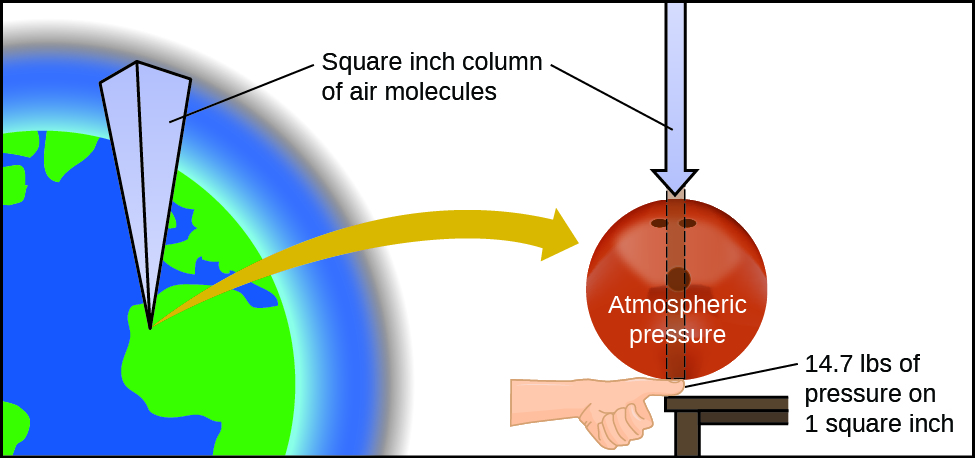
Figure 9.2図 9.2
The atmosphere above us exerts a large pressure on objects at the surface of the earth, roughly equal to the weight of a bowling ball pressing on an area the size of a human thumbnail.
私たちの上にある大気は、地表の物体に大きな圧力を及ぼす。その大きさはおよそ、人間の親指の爪ほどの面積を、ボウリング球の重さで押す圧力に等しい。
Atmospheric pressure is caused by the weight of the column of air molecules in the atmosphere above an object, such as the tanker car. At sea level, this pressure is roughly the same as that exerted by a full-grown African elephant standing on a doormat, or a typical bowling ball resting on your thumbnail. These may seem like huge amounts, and they are, but life on earth has evolved under such atmospheric pressure. If you actually perch a bowling ball on your thumbnail, the pressure experienced is twice the usual pressure, and the sensation is unpleasant.
英語のヒント
大気圧は、タンク車などの物体の上にある、大気中の空気分子の柱の重さによって生じる。海面では、その圧力は、玄関マットの上に立つ成長したアフリカゾウ、または親指の爪の上に載せた一般的なボウリング球が及ぼす圧力とおよそ同じである。非常に大きな値に思えるだろうし、実際にそうなのだが、地球の生命はこの大気圧のもとで進化してきた。もし本当に親指の爪にボウリング球を載せると、受ける圧力は普段の2倍になり、不快に感じる。
In general, pressure is defined as the force exerted on a given area: Note that pressure is directly proportional to force and inversely proportional to area. Thus, pressure can be increased either by increasing the amount of force or by decreasing the area over which it is applied; pressure can be decreased by decreasing the force or increasing the area.
英語のヒント
一般に圧力は、一定の面積に及ぼされる力として定義される。 圧力は力に正比例し、面積に反比例することに注意しよう。したがって、力を大きくするか、力が及ぶ面積を小さくすると圧力は増す。力を小さくするか、面積を大きくすると圧力は減る。
Let’s apply this concept to determine which exerts a greater pressure in Figure 9.3—the elephant or the figure skater? A large African elephant can weigh 7 tons, supported on four feet, each with a diameter of about 1.5 ft (footprint area of 250 in2), so the pressure exerted by each foot is about 14 lb/in2:
この考え方を使い、図9.3のゾウとフィギュアスケート選手のどちらが大きな圧力を及ぼすか考えよう。大きなアフリカゾウの体重は7トンにもなり、直径約1.5フィート(足跡の面積250 in2)の四つの足で支えられるので、各足の圧力は約14 lb/in2となる。
The figure skater weighs about 120 lbs, supported on two skate blades, each with an area of about 2 in2, so the pressure exerted by each blade is about 30 lb/in2:
英語のヒント
フィギュアスケート選手の体重は約120ポンドで、面積約2 in2ずつの二つのスケートの刃で支えられる。したがって、各刃が及ぼす圧力は約30 lb/in2となる。
Even though the elephant is more than one hundred-times heavier than the skater, it exerts less than one-half of the pressure. On the other hand, if the skater removes their skates and stands with bare feet (or regular footwear) on the ice, the larger area over which their weight is applied greatly reduces the pressure exerted:
英語のヒント
ゾウは選手の100倍以上重いにもかかわらず、及ぼす圧力は半分未満である。一方、選手がスケート靴を脱ぎ、裸足(または普通の靴)で氷上に立つと、体重がかかる面積が広がり、圧力は大幅に低下する。
Image omitted because its reuse rights could not be verified.権利の確認ができないため画像を割愛。
Figure 9.3図 9.3
Although (a) an elephant’s weight is large, creating a very large force on the ground, (b) the figure skater exerts a much higher pressure on the ice due to the small surface area of the skates. (credit a: modification of work by Guido da Rozze; credit b: modification of work by Ryosuke Yagi)
(a)ゾウは重く、地面に非常に大きな力を及ぼすが、(b)フィギュアスケート選手は、スケートの接触面積が小さいため、氷にずっと高い圧力を及ぼす。(出典a:Guido da Rozzeの作品を改変。出典b:Ryosuke Yagiの作品を改変)
The SI unit of pressure is the pascal (Pa), with 1 Pa = 1 N/m2, where N is the newton, a unit of force defined as 1 kg m/s2. One pascal is a small pressure; in many cases, it is more convenient to use units of kilopascal (1 kPa = 1000 Pa) or bar (1 bar = 100,000 Pa). In the United States, pressure is often measured in pounds of force on an area of one square inch—pounds per square inch (psi)—for example, in car tires. Pressure can also be measured using the unit atmosphere (atm), which originally represented the average sea level air pressure at the approximate latitude of Paris (45°). Table 9.1 provides some information on these and a few other common units for pressure measurements
英語のヒント
圧力のSI単位はパスカル(Pa)で、1 Pa = 1 N/m2である。Nは力の単位ニュートンで、1 kg m/s2と定義される。1パスカルは小さな圧力なので、多くの場合、キロパスカル(1 kPa = 1000 Pa)やバール(1 bar = 100,000 Pa)の単位を使うほうが便利である。米国では、自動車のタイヤなどの圧力を、1平方インチの面積あたりのポンド重、すなわちポンド毎平方インチ(psi)で測ることが多い。圧力は気圧(atm)という単位でも測れる。これはもともと、パリのおよその緯度(45°)の海面における平均気圧を表していた。表9.1に、これらの単位と、圧力測定でよく用いる他のいくつかの単位の情報を示す。
Pressure Units 圧力の単位 |
|
|---|---|
Unit Name and Abbreviation 単位名と略号 |
Definition or Relation to Other Unit 定義または他の単位との関係 |
pascal (Pa) パスカル(Pa) |
1 Pa = 1 N/m2 recommended IUPAC unit 1 Pa = 1 N/m2。IUPACの推奨単位 |
kilopascal (kPa) キロパスカル(kPa) |
1 kPa = 1000 Pa |
pounds per square inch (psi) ポンド毎平方インチ(psi) |
air pressure at sea level is ~14.7 psi 海面の気圧は約14.7 psi |
atmosphere (atm) 気圧(atm) |
1 atm = 101,325 Pa = 760 torr air pressure at sea level is ~1 atm 1 atm = 101,325 Pa = 760 torr。海面の気圧は約1 atm |
bar (bar, or b) バール(barまたはb) |
1 bar = 100,000 Pa (exactly) commonly used in meteorology 1 bar = 100,000 Pa(正確に)。気象学でよく用いられる |
millibar (mbar, or mb) ミリバール(mbarまたはmb) |
1000 mbar = 1 bar |
inches of mercury (in. Hg) 水銀柱インチ(in. Hg) |
1 in. Hg = 3386 Pa used by aviation industry, also some weather reports 1 in. Hg = 3386 Pa。航空業界や一部の気象報告で用いられる |
torr トル |
named after Evangelista Torricelli, inventor of the barometer 。気圧計の発明者エヴァンジェリスタ・トリチェリにちなんだ名称 |
millimeters of mercury (mm Hg) 水銀柱ミリメートル(mm Hg) |
1 mm Hg ~1 torr 1 mm Hg ≈ 1 torr |
Example 9.1例題 9.1
Conversion of Pressure Units圧力単位の換算
The United States National Weather Service reports pressure in both inches of Hg and millibars. Convert a pressure of 29.2 in. Hg into:
米国国立気象局は、水銀柱インチとミリバールの両方で気圧を報告する。29.2 in. Hgの圧力を、次の単位に換算しなさい。
(a) torr
(a)torr
(b) atm
(b)atm
(c) kPa
(c)kPa
(d) mbar
(d)mbar
Solution解法
(a)
(a)
(b)
(b)
(c)
(c)
(d)
(d)
Check Your Learning理解を確かめよう
A typical barometric pressure in Kansas City is 740 torr. What is this pressure in atmospheres, in millimeters of mercury, in kilopascals, and in bar?
英語のヒント
カンザスシティの典型的な気圧は740 torrである。この圧力は、気圧、水銀柱ミリメートル、キロパスカル、バールでそれぞれいくらか。
We can measure atmospheric pressure, the force exerted by the atmosphere on the earth’s surface, with a barometer (Figure 9.4). A barometer is a glass tube that is closed at one end, filled with a nonvolatile liquid such as mercury, and then inverted and immersed in a container of that liquid. The atmosphere exerts pressure on the liquid outside the tube, the column of liquid exerts pressure inside the tube, and the pressure at the liquid surface is the same inside and outside the tube. The height of the liquid in the tube is therefore proportional to the pressure exerted by the atmosphere.
英語のヒント
大気が地表に及ぼす力である大気圧は、気圧計(図9.4)で測定できる。気圧計は、一端を閉じ、水銀などの不揮発性液体を満たしてから逆さにし、その液体の入った容器に浸したガラス管である。大気は管の外の液体に圧力を及ぼし、液柱は管の内部に圧力を及ぼす。液面の高さでの圧力は、管の内外で等しい。そのため、管内の液柱の高さは、大気が及ぼす圧力に比例する。
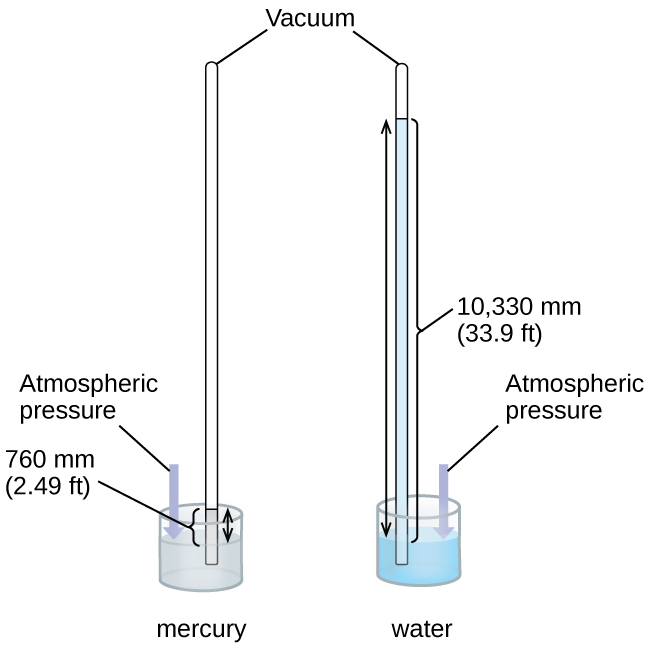
Figure 9.4図 9.4
In a barometer, the height, h, of the column of liquid is used as a measurement of the air pressure. Using very dense liquid mercury (left) permits the construction of reasonably sized barometers, whereas using water (right) would require a barometer more than 30 feet tall.
気圧計では液柱の高さhを気圧の測定値として用いる。密度の非常に大きい液体水銀(左)を使えば扱いやすい大きさにできるが、水(右)を使うと、高さ30フィートを超える気圧計が必要になる。
If the liquid is water, normal atmospheric pressure will support a column of water over 10 meters high, which is rather inconvenient for making (and reading) a barometer. Because mercury (Hg) is about 13.6-times denser than water, a mercury barometer only needs to be as tall as a water barometer—a more suitable size. Standard atmospheric pressure of 1 atm at sea level (101,325 Pa) corresponds to a column of mercury that is about 760 mm (29.92 in.) high. The torr was originally intended to be a unit equal to one millimeter of mercury, but it no longer corresponds exactly. The pressure exerted by a fluid due to gravity is known as hydrostatic pressure, p:
英語のヒント
液体が水なら、通常の大気圧は高さ10メートルを超える水柱を支えるため、気圧計の製作にも読み取りにもかなり不便である。水銀(Hg)は水の約13.6倍の密度をもつので、水銀気圧計に必要な高さは水の気圧計ので済み、より適切な大きさになる。海面での標準大気圧1 atm(101,325 Pa)は、高さ約760 mm(29.92 in.)の水銀柱に対応する。トルはもともと水銀柱1ミリメートルに等しい単位を意図したものだったが、現在は厳密には一致しない。重力のために流体が及ぼす圧力を、静水圧pという。
where h is the height of the fluid, ρ (lowercase Greek letter rho) is the density of the fluid, and g is acceleration due to gravity.
ここで、hは流体の高さ、ρ(ギリシャ文字ローの小文字)は流体の密度、gは重力加速度である。
Example 9.2例題 9.2
Calculation of Barometric Pressure気圧の計算
Show the calculation supporting the claim that atmospheric pressure near sea level corresponds to the pressure exerted by a column of mercury that is about 760 mm high. The density of mercury = 13.6 g/cm3.
海面付近の大気圧は高さ約760 mmの水銀柱が及ぼす圧力に相当する、という説明を裏付ける計算を示しなさい。水銀の密度は13.6 g/cm3である。
Solution解法
The hydrostatic pressure is given by p = hρg, with h = 760 mm, ρ = 13.6 g/cm3, and g = 9.81 m/s2. Plugging these values into the equation and doing the necessary unit conversions will give us the value we seek. (Note: We are expecting to find a pressure of ~101,325 Pa.)
英語のヒント
静水圧はp = hρgで与えられ、h = 760 mm、ρ = 13.6 g/cm3、g = 9.81 m/s2である。これらの値を式に代入して必要な単位換算を行うと、求める値が得られる。(注意:約101,325 Paの圧力が得られると予想している。)
Check Your Learning理解を確かめよう
Calculate the height of a column of water at 25 °C that corresponds to normal atmospheric pressure. The density of water at this temperature is 1.0 g/cm3.
通常の大気圧に相当する、25 °Cの水柱の高さを計算しなさい。この温度での水の密度は1.0 g/cm3である。
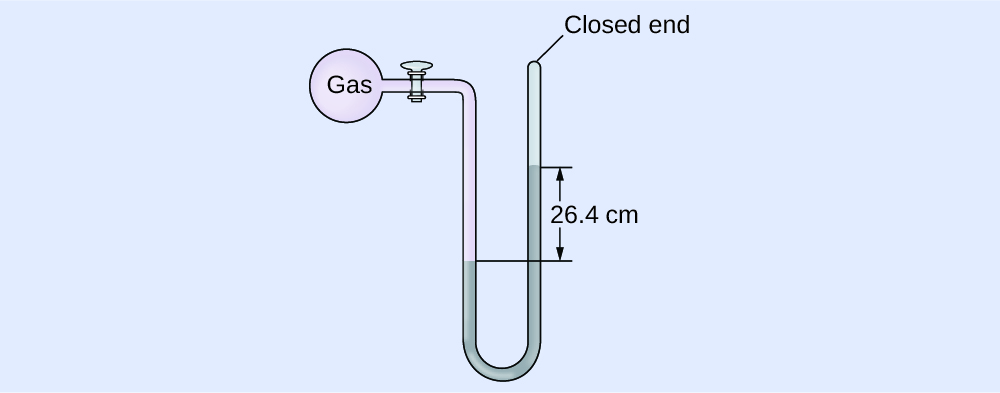
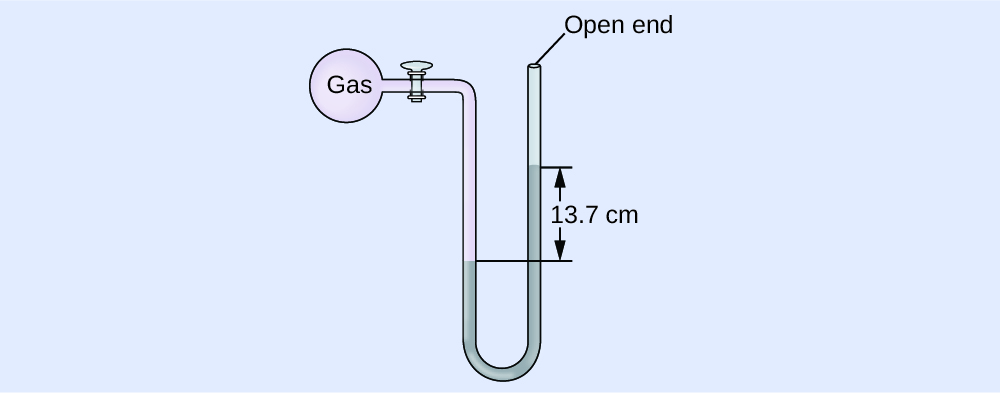
A manometer is a device similar to a barometer that can be used to measure the pressure of a gas trapped in a container. A closed-end manometer is a U-shaped tube with one closed arm, one arm that connects to the gas to be measured, and a nonvolatile liquid (usually mercury) in between. As with a barometer, the distance between the liquid levels in the two arms of the tube (h in the diagram) is proportional to the pressure of the gas in the container. An open-end manometer (Figure 9.5) is the same as a closed-end manometer, but one of its arms is open to the atmosphere. In this case, the distance between the liquid levels corresponds to the difference in pressure between the gas in the container and the atmosphere.
英語のヒント
マノメーターは気圧計に似た装置で、容器内に閉じ込められた気体の圧力を測るために使える。閉管式マノメーターはU字管で、一方の端が閉じ、他方の端が測定対象の気体につながり、間には不揮発性液体(通常は水銀)が入っている。気圧計と同様、管の両側の液面の高低差(図のh)は、容器内の気体の圧力に比例する。開管式マノメーター(図9.5)は閉管式と同じだが、一方の端が大気に開かれている。この場合、液面の高低差は、容器内の気体と大気との圧力差に対応する。
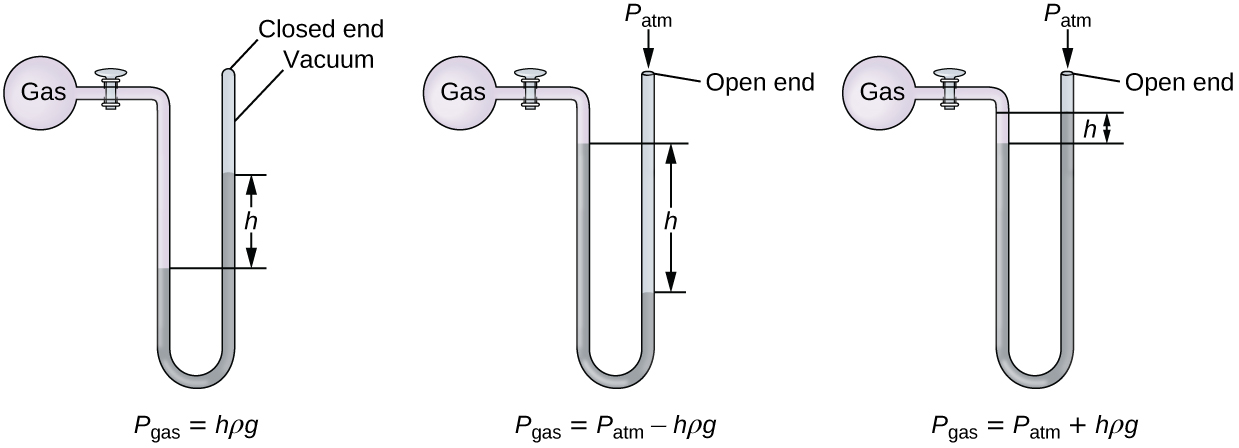
Figure 9.5図 9.5
A manometer can be used to measure the pressure of a gas. The (difference in) height between the liquid levels (h) is a measure of the pressure. Mercury is usually used because of its large density.
マノメーターは気体の圧力を測るために使える。液面の高さの差hが圧力の尺度となる。密度が大きいため、通常は水銀を用いる。
Example 9.3例題 9.3
Calculation of Pressure Using a Closed-End Manometer閉管式マノメーターによる圧力の計算
The pressure of a sample of gas is measured with a closed-end manometer, as shown to the right. The liquid in the manometer is mercury. Determine the pressure of the gas in:
右図のように、閉管式マノメーターで気体試料の圧力を測定する。管内の液体は水銀である。気体の圧力を、次の単位で求めなさい。
(a) torr
(a)torr
(b) Pa
(b)Pa
(c) bar
(c)bar
Solution解法
The pressure of the gas is equal to a column of mercury of height 26.4 cm. (The pressure at the bottom horizontal line is equal on both sides of the tube. The pressure on the left is due to the gas and the pressure on the right is due to 26.4 cm Hg, or mercury.) We could use the equation p = hρg as in Example 9.2, but it is simpler to just convert between units using Table 9.1.
(a)
(a)
(b)
(b)
(c)
(c)
Check Your Learning理解を確かめよう
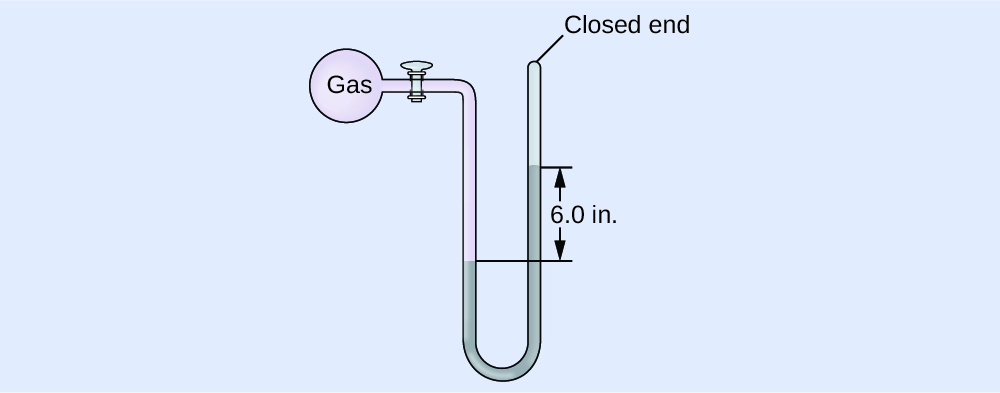
The pressure of a sample of gas is measured with a closed-end manometer. The liquid in the manometer is mercury. Determine the pressure of the gas in:
閉管式マノメーターで気体試料の圧力を測定する。管内の液体は水銀である。気体の圧力を、次の単位で求めなさい。
(a) torr
(a)torr
(b) Pa
(b)Pa
(c) bar
(c)bar
Example 9.4例題 9.4
Calculation of Pressure Using an Open-End Manometer開管式マノメーターによる圧力の計算
The pressure of a sample of gas is measured at sea level with an open-end Hg (mercury) manometer, as shown to the right. Determine the pressure of the gas in:
右図のように、海面で開管式のHg(水銀)マノメーターを使って気体試料の圧力を測る。気体の圧力を、次の単位で求めなさい。
(a) mm Hg
(a)mm Hg
(b) atm
(b)atm
(c) kPa
(c)kPa
Solution解法
The pressure of the gas equals the hydrostatic pressure due to a column of mercury of height 13.7 cm plus the pressure of the atmosphere at sea level. (The pressure at the bottom horizontal line is equal on both sides of the tube. The pressure on the left is due to the gas and the pressure on the right is due to 13.7 cm of Hg plus atmospheric pressure.)
気体の圧力は、高さ13.7 cmの水銀柱による静水圧に、海面の大気圧を加えた値に等しい。(下側の水平線の位置では、管の左右の圧力は等しい。左は気体による圧力、右は13.7 cmのHgによる圧力と大気圧の和である。)
(a) In mm Hg, this is: 137 mm Hg + 760 mm Hg = 897 mm Hg
(a)mm Hgでは、137 mm Hg + 760 mm Hg = 897 mm Hg。
(b)
(b)
(c)
(c)
Check Your Learning理解を確かめよう
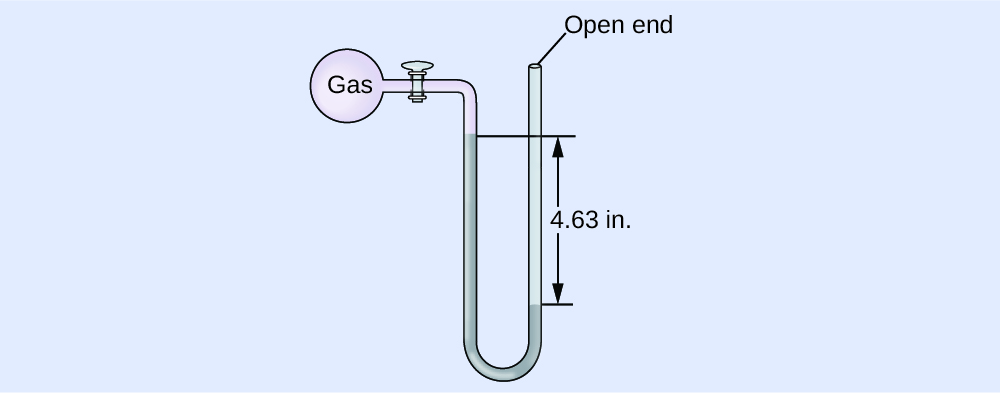
The pressure of a sample of gas is measured at sea level with an open-end Hg manometer, as shown to the right. Determine the pressure of the gas in:
右図のように、海面で開管式のHgマノメーターを使って気体試料の圧力を測る。気体の圧力を、次の単位で求めなさい。
(a) mm Hg
(a)mm Hg
(b) atm
(b)atm
(c) kPa
(c)kPa