第9章気体
9.3 Stoichiometry of Gaseous Substances, Mixtures, and Reactions9.3 気体物質・混合物・反応の化学量論
Learning Objectives学習目標
By the end of this section, you will be able to:
この節を終えると、次のことができるようになる。
- Use the ideal gas law to compute gas densities and molar masses理想気体の状態方程式を用いて、気体の密度とモル質量を計算する。
- Perform stoichiometric calculations involving gaseous substances気体物質を含む化学量論計算を行う。
- State Dalton’s law of partial pressures and use it in calculations involving gaseous mixturesドルトンの分圧の法則を述べ、気体混合物を含む計算に利用する。
The study of the chemical behavior of gases was part of the basis of perhaps the most fundamental chemical revolution in history. French nobleman Antoine Lavoisier, widely regarded as the “father of modern chemistry,” changed chemistry from a qualitative to a quantitative science through his work with gases. He discovered the law of conservation of matter, discovered the role of oxygen in combustion reactions, determined the composition of air, explained respiration in terms of chemical reactions, and more. He was a casualty of the French Revolution, guillotined in 1794. Of his death, mathematician and astronomer Joseph-Louis Lagrange said, “It took the mob only a moment to remove his head; a century will not suffice to reproduce it.” “Quotations by Joseph-Louis Lagrange,” last modified February 2006, accessed February 10, 2015, http://www-history.mcs.st-andrews.ac.uk/Quotations/Lagrange.html Much of the knowledge we do have about Lavoisier's contributions is due to his wife, Marie-Anne Paulze Lavoisier, who worked with him in his lab. A trained artist fluent in several languages, she created detailed illustrations of the equipment in his lab, and translated texts from foreign scientists to complement his knowledge. After his execution, she was instrumental in publishing Lavoisier's major treatise, which unified many concepts of chemistry and laid the groundwork for significant further study.
英語のヒント
気体の化学的な振る舞いの研究は、歴史上おそらく最も根本的な化学の革命の土台の一部となった。「近代化学の父」と広く認められているフランスの貴族アントワーヌ・ラボアジエは、気体の研究を通して、化学を定性的な科学から定量的な科学へと変えた。彼は物質の保存の法則を発見し、燃焼反応における酸素の役割を発見し、空気の組成を決定し、呼吸を化学反応によって説明するなど、多くの業績を残した。彼はフランス革命の犠牲者となり、1794年にギロチンで処刑された。その死について、数学者で天文学者のジョゼフ=ルイ・ラグランジュはこう語った。「群衆が彼の首を落とすのには一瞬しかかからなかった。だが、それを再び生み出すには1世紀あっても足りないだろう」。出典:「ジョゼフ=ルイ・ラグランジュの言葉」、最終更新2006年2月、閲覧2015年2月10日、http://www-history.mcs.st-andrews.ac.uk/Quotations/Lagrange.htmlラボアジエの貢献について今日私たちが知る多くのことは、彼と実験室で働いた妻マリー=アンヌ・ポールズ・ラボアジエのおかげである。彼女は絵画の訓練を受け、数か国語に堪能で、実験室の器具の詳細な図を描き、夫の知識を補うために外国の科学者の文献を翻訳した。夫の処刑後は、化学の多くの概念を統一し、その後の重要な研究の基礎を築いたラボアジエの主著の出版に、大きな役割を果たした。
As described in an earlier chapter of this text, we can turn to chemical stoichiometry for answers to many of the questions that ask “How much?” The essential property involved in such use of stoichiometry is the amount of substance, typically measured in moles (n). For gases, molar amount can be derived from convenient experimental measurements of pressure, temperature, and volume. Therefore, these measurements are useful in assessing the stoichiometry of pure gases, gas mixtures, and chemical reactions involving gases. This section will not introduce any new material or ideas, but will provide examples of applications and ways to integrate concepts already discussed.
英語のヒント
本書の前の章で述べたように、「どれだけか」を問う多くの疑問には、化学量論によって答えられる。化学量論をこのように利用する際に欠かせない性質が物質量であり、通常はモル(n)で測る。気体の場合、モル数は圧力、温度、体積という実験で測定しやすい量から導くことができる。したがって、これらの測定は、純粋な気体、気体混合物、気体の関わる化学反応の化学量論を検討するのに役立つ。この節では新しい内容や考え方は導入せず、すでに扱った概念の応用例と、それらを組み合わせる方法を示す。
Gas Density and Molar Mass気体の密度とモル質量
The ideal gas law described previously in this chapter relates the properties of pressure P, volume V, temperature T, and molar amount n. This law is universal, relating these properties in identical fashion regardless of the chemical identity of the gas:
英語のヒント
この章の前半で述べた理想気体の状態方程式は、圧力P、体積V、温度T、モル数nという性質を結び付ける。この法則は普遍的なものであり、気体の化学的な種類によらず、これらの性質を同じ形で関係付ける。
The density d of a gas, on the other hand, is determined by its identity. As described in another chapter of this text, the density of a substance is a characteristic property that may be used to identify the substance.
一方、気体の密度dは、その気体の種類によって決まる。本書の別の章で述べたように、物質の密度はその物質に特徴的な性質であり、物質の同定に利用できる。
Rearranging the ideal gas equation to isolate V and substituting into the density equation yields
英語のヒント
理想気体の状態方程式をVについて解き、それを密度の式に代入すると、次式が得られる。
The ratio m/n is the definition of molar mass, ℳ:
比m/nは、モル質量ℳの定義である。
The density equation can then be written
したがって、密度の式は次のように書ける。
This relation may be used for calculating the densities of gases of known identities at specified values of pressure and temperature as demonstrated in Example 9.11.
この関係は、例題9.11で示すように、種類のわかっている気体の密度を、指定された圧力と温度で計算するのに利用できる。
Example 9.11例題 9.11
Measuring Gas Density気体の密度の測定
What is the density of molecular nitrogen gas at STP?
標準状態における窒素分子の気体の密度はいくらか。
Solution解法
The molar mass of molecular nitrogen, N2, is 28.01 g/mol. Substituting this value along with standard temperature and pressure into the gas density equation yields
窒素分子N2のモル質量は28.01 g/molである。この値を標準温度、標準圧力とともに気体の密度の式に代入すると、次のようになる。
Check Your Learning理解度の確認
What is the density of molecular hydrogen gas at 17.0 °C and a pressure of 760 torr?
17.0 °C、圧力760 torrでの水素分子の気体の密度はいくらか。
When the identity of a gas is unknown, measurements of the mass, pressure, volume, and temperature of a sample can be used to calculate the molar mass of the gas (a useful property for identification purposes). Combining the ideal gas equation
気体の種類がわからない場合は、試料の質量、圧力、体積、温度の測定値から、気体のモル質量(同定に役立つ性質)を計算できる。理想気体の状態方程式
and the definition of molar mass
と、モル質量の定義
yields the following equation:
を組み合わせると、次の式が得られる。
Determining the molar mass of a gas via this approach is demonstrated in Example 9.12.
この方法で気体のモル質量を求める手順を、例題9.12に示す。
Example 9.12例題 9.12
Determining the Molecular Formula of a Gas from its Molar Mass and Empirical Formulaモル質量と組成式から気体の分子式を求める
Cyclopropane, a gas once used with oxygen as a general anesthetic, is composed of 85.7% carbon and 14.3% hydrogen by mass. Find the empirical formula. If 1.56 g of cyclopropane occupies a volume of 1.00 L at 0.984 atm and 50 °C, what is the molecular formula for cyclopropane?
英語のヒント
シクロプロパンは、かつて酸素とともに全身麻酔薬として用いられた気体であり、質量で85.7%の炭素と14.3%の水素からなる。組成式を求めなさい。シクロプロパン1.56 gが0.984 atm、50 °Cで1.00 Lの体積を占める場合、その分子式は何か。
Solution解法
First determine the empirical formula of the gas. Assume 100 g and convert the percentage of each element into grams. Determine the number of moles of carbon and hydrogen in the 100-g sample of cyclopropane. Divide by the smallest number of moles to relate the number of moles of carbon to the number of moles of hydrogen. In the last step, realize that the smallest whole number ratio is the empirical formula:
まず、気体の組成式を求める。試料を100 gと仮定し、各元素の百分率をグラムに換算する。シクロプロパンの100 gの試料中の炭素と水素のモル数を求める。最も小さいモル数で割り、炭素と水素のモル数の比を求める。最後に、その最も簡単な整数比が組成式を表すことを用いる。
Empirical formula is CH2 [empirical mass (EM) of 14.03 g/empirical unit].
組成式はCH2である[組成式1単位あたりの質量(EM)は14.03 g]。
Next, use the provided values for mass, pressure, temperature and volume to compute the molar mass of the gas:
次に、与えられた質量、圧力、温度、体積を用いて気体のモル質量を計算する。
Comparing the molar mass to the empirical formula mass shows how many empirical formula units make up a molecule:
英語のヒント
モル質量を組成式量と比較すると、組成式で表される単位が何個集まって1分子を構成するかがわかる。
The molecular formula is thus derived from the empirical formula by multiplying each of its subscripts by three:
したがって、組成式の各添字を3倍することで分子式が得られる。
Check Your Learning理解度の確認
Acetylene, a fuel used in welding torches, is composed of 92.3% C and 7.7% H by mass. Find the empirical formula. If 1.10 g of acetylene occupies of volume of 1.00 L at 1.15 atm and 59.5 °C, what is the molecular formula for acetylene?
英語のヒント
溶接トーチの燃料に使われるアセチレンは、質量で92.3%のCと7.7%のHからなる。組成式を求めなさい。アセチレン1.10 gが1.15 atm、59.5 °Cで1.00 Lの体積を占める場合、その分子式は何か。
Example 9.13例題 9.13
Determining the Molar Mass of a Volatile Liquid揮発性液体のモル質量の測定
The approximate molar mass of a volatile liquid can be determined by:
英語のヒント
揮発性液体のおおよそのモル質量は、次の手順で求められる。
- Heating a sample of the liquid in a flask with a tiny hole at the top, which converts the liquid into gas that may escape through the hole上部に小さな穴のあるフラスコに液体試料を入れて加熱する。これにより液体は気体になり、穴から外へ出ることができる。
- Removing the flask from heat at the instant when the last bit of liquid becomes gas, at which time the flask will be filled with only gaseous sample at ambient pressure
英語のヒント
液体の最後の一滴が気体になった瞬間にフラスコを熱源から離す。このとき、フラスコは周囲の圧力にある気体試料だけで満たされている。 - Sealing the flask and permitting the gaseous sample to condense to liquid, and then weighing the flask to determine the sample’s mass (see Figure 9.19)フラスコを密封し、気体試料を凝縮させて液体に戻す。次にフラスコを秤量して、試料の質量を求める(図9.19)。
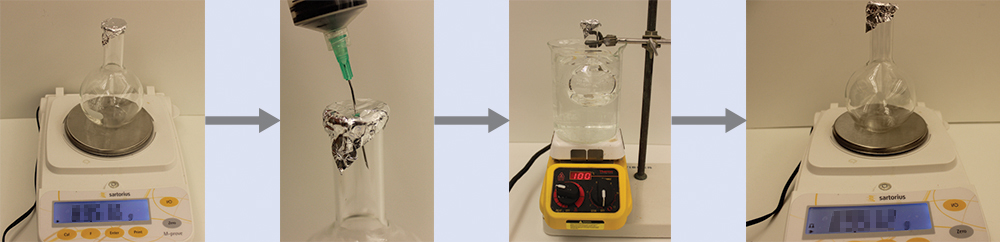
Figure 9.19図 9.19
When the volatile liquid in the flask is heated past its boiling point, it becomes gas and drives air out of the flask. At the flask is filled with volatile liquid gas at the same pressure as the atmosphere. If the flask is then cooled to room temperature, the gas condenses and the mass of the gas that filled the flask, and is now liquid, can be measured. (credit: modification of work by Mark Ott)
英語のヒント
フラスコ内の揮発性液体を沸点より高い温度まで加熱すると、気体となってフラスコ内の空気を追い出す。では、フラスコは大気と同じ圧力の揮発性液体の蒸気で満たされている。その後フラスコを室温まで冷やすと気体は凝縮し、フラスコを満たしていた気体の質量を、液体になった状態で測定できる。(クレジット:Mark Ottの作品を改変)
Using this procedure, a sample of chloroform gas weighing 0.494 g is collected in a flask with a volume of 129 cm3 at 99.6 °C when the atmospheric pressure is 742.1 mm Hg. What is the approximate molar mass of chloroform?
この手順を用いて、大気圧742.1 mm Hg、99.6 °Cの条件で、体積129 cm3のフラスコに質量0.494 gのクロロホルム気体試料を採取した。クロロホルムのおおよそのモル質量はいくらか。
Solution解法
Since and substituting and rearranging gives
およびなので、代入して整理するととなる。
then
したがって、
Check Your Learning理解度の確認
A sample of phosphorus that weighs 3.243 10−2 g exerts a pressure of 31.89 kPa in a 56.0-mL bulb at 550 °C. What are the molar mass and molecular formula of phosphorus vapor?
英語のヒント
質量3.243 10−2 gのリンの試料が、550 °C、56.0 mLの球状容器内で31.89 kPaの圧力を示す。リン蒸気のモル質量と分子式は何か。