第9章気体
Chemical Stoichiometry and Gases化学量論と気体
Chemical stoichiometry describes the quantitative relationships between reactants and products in chemical reactions.
化学量論は、化学反応における反応物と生成物の量的関係を記述する。
We have previously measured quantities of reactants and products using masses for solids and volumes in conjunction with the molarity for solutions; now we can also use gas volumes to indicate quantities. If we know the volume, pressure, and temperature of a gas, we can use the ideal gas equation to calculate how many moles of the gas are present. If we know how many moles of a gas are involved, we can calculate the volume of a gas at any temperature and pressure.
英語のヒント
これまでは、反応物と生成物の量を、固体では質量によって、溶液では体積とモル濃度を組み合わせて測ってきた。今後は気体の体積によっても量を表せる。気体の体積、圧力、温度がわかれば、理想気体の状態方程式を用いて存在する気体のモル数を計算できる。関わる気体のモル数がわかれば、どのような温度と圧力でも、その気体の体積を計算できる。
Avogadro’s Law Revisitedアボガドロの法則を再び考える
Sometimes we can take advantage of a simplifying feature of the stoichiometry of gases that solids and solutions do not exhibit: All gases that show ideal behavior contain the same number of molecules in the same volume (at the same temperature and pressure). Thus, the ratios of volumes of gases involved in a chemical reaction are given by the coefficients in the equation for the reaction, provided that the gas volumes are measured at the same temperature and pressure.
英語のヒント
気体の化学量論には、固体や溶液にはない、計算を簡単にする性質があり、それを利用できる場合がある。理想気体として振る舞うすべての気体は、同じ温度と圧力で同じ体積を取れば、同じ数の分子を含んでいる。したがって、気体の体積を同じ温度と圧力で測るという条件のもとでは、化学反応に関わる気体の体積比は、反応式の係数で与えられる。
We can extend Avogadro’s law (that the volume of a gas is directly proportional to the number of moles of the gas) to chemical reactions with gases: Gases combine, or react, in definite and simple proportions by volume, provided that all gas volumes are measured at the same temperature and pressure. For example, since nitrogen and hydrogen gases react to produce ammonia gas according to a given volume of nitrogen gas reacts with three times that volume of hydrogen gas to produce two times that volume of ammonia gas, if pressure and temperature remain constant.
英語のヒント
アボガドロの法則(気体の体積は、その気体のモル数に正比例する)を、気体を含む化学反応に拡張できる。すべての気体の体積を同じ温度と圧力で測るならば、気体は一定の簡単な体積比で結合、つまり反応する。例えば、窒素気体と水素気体はに従って反応してアンモニア気体を生じるので、圧力と温度が一定に保たれていれば、ある体積の窒素気体はその3倍の体積の水素気体と反応し、もとの窒素の2倍の体積のアンモニア気体を生じる。
The explanation for this is illustrated in Figure 9.23. According to Avogadro’s law, equal volumes of gaseous N2, H2, and NH3, at the same temperature and pressure, contain the same number of molecules. Because one molecule of N2 reacts with three molecules of H2 to produce two molecules of NH3, the volume of H2 required is three times the volume of N2, and the volume of NH3 produced is two times the volume of N2.
このことを図9.23で説明する。アボガドロの法則によれば、同じ温度と圧力で等しい体積のN2、H2、NH3の各気体には、同じ数の分子が含まれる。N2の1分子はH2の3分子と反応してNH3の2分子を生じるので、必要なH2の体積はN2の体積の3倍であり、生成するNH3の体積はN2の体積の2倍である。
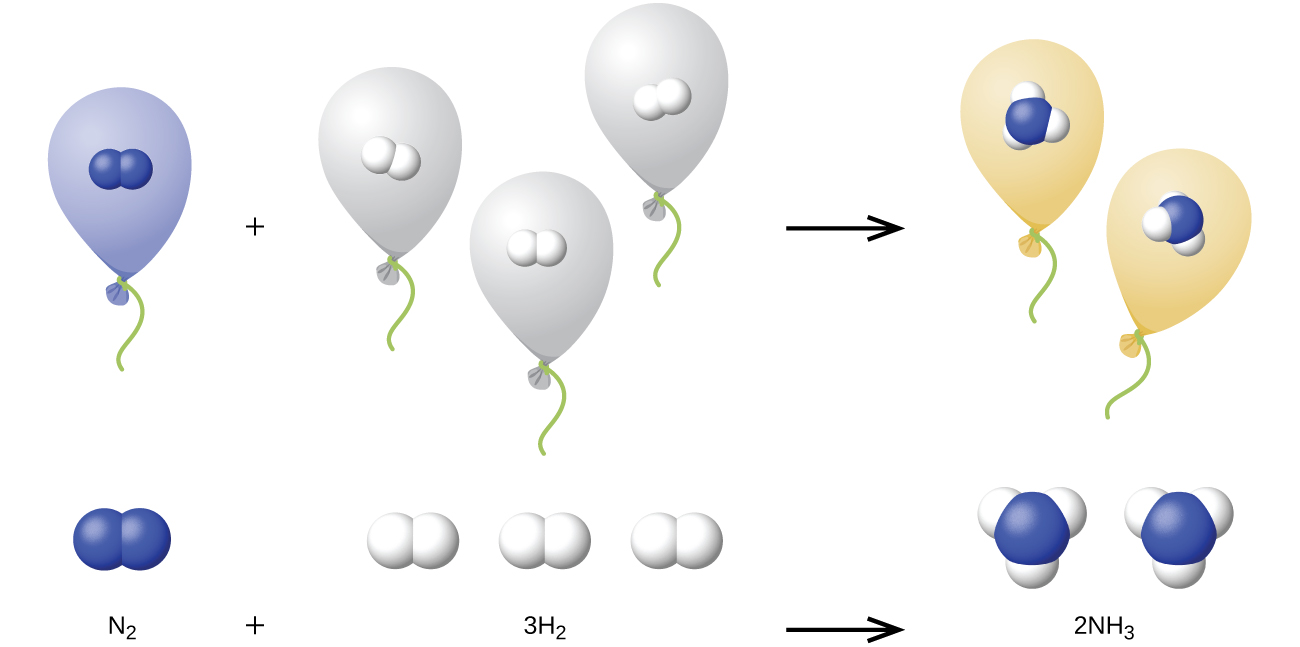

Figure 9.23図 9.23
One volume of N2 combines with three volumes of H2 to form two volumes of NH3.
N2の1体積はH2の3体積と結合して、NH3の2体積を生じる。
Example 9.17例題 9.17
Reaction of Gases気体の反応
Propane, C3H8(g), is used in gas grills to provide the heat for cooking. What volume of O2(g) measured at 25 °C and 760 torr is required to react with 2.7 L of propane measured under the same conditions of temperature and pressure? Assume that the propane undergoes complete combustion.
英語のヒント
プロパンC3H8(g)はガスグリルで調理用の熱を供給する燃料として使われる。25 °C、760 torrで測定したO2(g)は、同じ温度と圧力で測定した2.7 Lのプロパンとの反応に何L必要か。プロパンは完全燃焼するものとする。
Solution解法
The ratio of the volumes of C3H8 and O2 will be equal to the ratio of their coefficients in the balanced equation for the reaction:
C3H8とO2の体積比は、係数をそろえた反応式における両者の係数の比に等しい。
From the equation, we see that one volume of C3H8 will react with five volumes of O2:
反応式から、C3H8の1体積がO2の5体積と反応することがわかる。
A volume of 13.5 L of O2 will be required to react with 2.7 L of C3H8.
2.7 LのC3H8を反応させるには、13.5 LのO2が必要である。
Check Your Learning理解度の確認
An acetylene tank for an oxyacetylene welding torch provides 9340 L of acetylene gas, C2H2, at 0 °C and 1 atm. How many tanks of oxygen, each providing 7.00 103 L of O2 at 0 °C and 1 atm, will be required to burn the acetylene?
酸素アセチレン溶接トーチ用のアセチレンボンベ1本からは、0 °C、1 atmで9340 Lのアセチレン気体C2H2を取り出せる。酸素ボンベ1本から0 °C、1 atmで7.00 103 LのO2を取り出せるとすると、このアセチレンを燃焼させるのに酸素ボンベは何本分必要か。
Example 9.18例題 9.18
Volumes of Reacting Gases反応する気体の体積
Ammonia is an important fertilizer and industrial chemical. Suppose that a volume of 683 billion cubic feet of gaseous ammonia, measured at 25 °C and 1 atm, was manufactured. What volume of H2(g), measured under the same conditions, was required to prepare this amount of ammonia by reaction with N2?
アンモニアは重要な肥料であり、工業薬品でもある。25 °C、1 atmで測定して6830億立方フィートのアンモニア気体を製造したとする。この量のアンモニアをN2との反応で製造するには、同じ条件で測ったH2(g)がどれだけの体積必要だったか。
Solution解法
Because equal volumes of H2 and NH3 contain equal numbers of molecules and each three molecules of H2 that react produce two molecules of NH3, the ratio of the volumes of H2 and NH3 will be equal to 3:2. Two volumes of NH3, in this case in units of billion ft3, will be formed from three volumes of H2:
等しい体積のH2とNH3には等しい数の分子が含まれ、H2の3分子が反応するごとにNH3の2分子が生じるので、H2とNH3の体積比は3:2になる。H2の3体積からNH3の2体積が生成する。ここでは体積を10億ft3の単位で扱う。
The manufacture of 683 billion ft3 of NH3 required 1020 billion ft3 of H2. (At 25 °C and 1 atm, this is the volume of a cube with an edge length of approximately 1.9 miles.)
6830億ft3のNH3の製造には、1兆200億ft3のH2が必要だった。(25 °C、1 atmでは、これは一辺約1.9マイルの立方体の体積にあたる。)
Check Your Learning理解度の確認
What volume of O2(g) measured at 25 °C and 760 torr is required to react with 17.0 L of ethylene, C2H4(g), measured under the same conditions of temperature and pressure? The products are CO2 and water vapor.
25 °C、760 torrで測定したO2(g)は、同じ温度と圧力で測定した17.0 LのエチレンC2H4(g)との反応に何L必要か。生成物はCO2と水蒸気である。
Example 9.19例題 9.19
Volume of Gaseous Product気体生成物の体積
What volume of hydrogen at 27 °C and 723 torr may be prepared by the reaction of 8.88 g of gallium with an excess of hydrochloric acid?
8.88 gのガリウムと過剰の塩酸との反応によって得られる水素の体積は、27 °C、723 torrでいくらか。
Solution解法
Convert the provided mass of the limiting reactant, Ga, to moles of hydrogen produced:
限定反応物Gaの与えられた質量を、生成する水素のモル数に換算する。
Convert the provided temperature and pressure values to appropriate units (K and atm, respectively), and then use the molar amount of hydrogen gas and the ideal gas equation to calculate the volume of gas:
与えられた温度と圧力の値を適切な単位(それぞれKとatm)に換算し、水素気体のモル数と理想気体の状態方程式を用いて気体の体積を求める。
Check Your Learning理解度の確認
Sulfur dioxide is an intermediate in the preparation of sulfuric acid. What volume of SO2 at 343 °C and 1.21 atm is produced by burning 1.00 kg of sulfur in excess oxygen?
英語のヒント
二酸化硫黄は硫酸を製造する際の中間体である。過剰の酸素中で1.00 kgの硫黄を燃やすと、343 °C、1.21 atmで何LのSO2が生じるか。