第9章気体
Volume and Temperature: Charles’s Law体積と温度:シャルルの法則
If we fill a balloon with air and seal it, the balloon contains a specific amount of air at atmospheric pressure, let’s say 1 atm. If we put the balloon in a refrigerator, the gas inside gets cold and the balloon shrinks (although both the amount of gas and its pressure remain constant). If we make the balloon very cold, it will shrink a great deal, and it expands again when it warms up.
英語のヒント
風船に空気を入れて口を閉じると、一定量の空気が大気圧、たとえば1 atmで入っている。風船を冷蔵庫に入れると、内部の気体が冷え、風船は縮む(ただし気体の量も圧力も一定のままである)。風船を非常に冷たくすると大きく縮み、温まると再び膨張する。
These examples of the effect of temperature on the volume of a given amount of a confined gas at constant pressure are true in general: The volume increases as the temperature increases, and decreases as the temperature decreases. Volume-temperature data for a 1-mole sample of methane gas at 1 atm are listed and graphed in Figure 9.12.
一定量の閉じ込められた気体について、圧力を一定にしたときに温度が体積に及ぼすこれらの影響は、一般に成り立つ。温度が上がると体積は増加し、温度が下がると体積は減少する。1 atmにおける1モルのメタンガスの体積と温度のデータを、図9.12の表とグラフに示す。
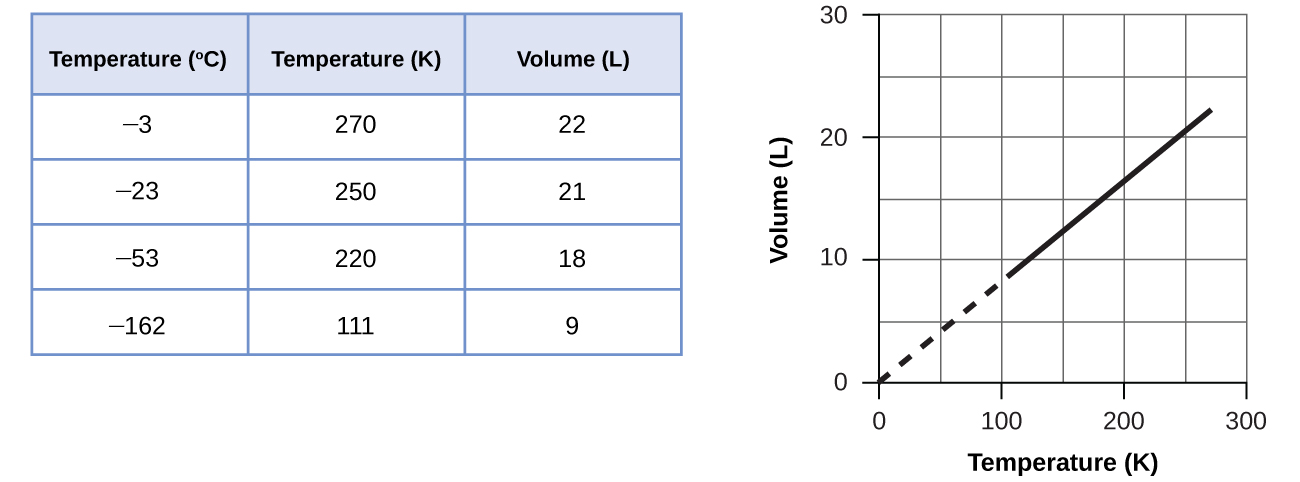

Figure 9.12図 9.12
The volume and temperature are linearly related for 1 mole of methane gas at a constant pressure of 1 atm. If the temperature is in kelvin, volume and temperature are directly proportional. The line stops at 111 K because methane liquefies at this temperature; when extrapolated, it intersects the graph’s origin, representing a temperature of absolute zero.
英語のヒント
1 atmの一定圧力下で、1モルのメタンガスの体積と温度は直線的な関係にある。温度をケルビンで表すと、体積と温度は正比例する。メタンが液化するため、直線は111 Kで止まっている。外挿すると、絶対零度の温度を表すグラフの原点を通る。
The relationship between the volume and temperature of a given amount of gas at constant pressure is known as Charles’s law in recognition of the French scientist and balloon flight pioneer Jacques Alexandre César Charles. Charles’s law states that the volume of a given amount of gas is directly proportional to its temperature on the kelvin scale when the pressure is held constant.
英語のヒント
一定圧力における一定量の気体の体積と温度の関係は、フランスの科学者で気球飛行の先駆者、ジャック・アレクサンドル・セザール・シャルルの功績をたたえ、シャルルの法則と呼ばれる。シャルルの法則は、圧力を一定に保つとき、一定量の気体の体積はケルビン温度に正比例する、と述べる。
Mathematically, this can be written as:
数学的には、次のように書ける。
with k being a proportionality constant that depends on the amount and pressure of the gas.
ここでkは、気体の物質量と圧力に依存する比例定数である。
For a confined, constant pressure gas sample, is constant (i.e., the ratio = k), and as seen with the P-T relationship, this leads to another form of Charles’s law:
閉じ込めた気体試料の圧力が一定なら、は一定(すなわち比がk)であり、P–T関係で見たのと同じように、シャルルの法則の別の形が得られる。
Example 9.6例題 9.6
Predicting Change in Volume with Temperature温度による体積変化の予測
A sample of carbon dioxide, CO2, occupies 0.300 L at 10 °C and 750 torr. What volume will the gas have at 30 °C and 750 torr?
二酸化炭素CO2の試料は、10 °C、750 torrで0.300 Lを占める。30 °C、750 torrでの体積はいくらか。
Solution解法
Because we are looking for the volume change caused by a temperature change at constant pressure, this is a job for Charles’s law. Taking V1 and T1 as the initial values, T2 as the temperature at which the volume is unknown and V2 as the unknown volume, and converting °C into K we have:
一定圧力で、温度変化によって生じる体積変化を求めるので、シャルルの法則を使う。V1とT1を初期値、T2を体積が未知であるときの温度、V2を未知の体積とし、°CをKに換算すると、次のようになる。
Rearranging and solving gives:
式を変形して解くと、。
This answer supports our expectation from Charles’s law, namely, that raising the gas temperature (from 283 K to 303 K) at a constant pressure will yield an increase in its volume (from 0.300 L to 0.321 L).
英語のヒント
この答えは、一定圧力で気体の温度を上げると(283 Kから303 Kへ)、体積が増加する(0.300 Lから0.321 Lへ)という、シャルルの法則からの予想を裏付ける。
Check Your Learning理解を確かめよう
A sample of oxygen, O2, occupies 32.2 mL at 30 °C and 452 torr. What volume will it occupy at –70 °C and the same pressure?
酸素O2の試料は、30 °C、452 torrで32.2 mLを占める。同じ圧力で−70 °Cにすると、体積はいくらか。
Example 9.7例題 9.7
Measuring Temperature with a Volume Change体積変化を使う温度測定
Temperature is sometimes measured with a gas thermometer by observing the change in the volume of the gas as the temperature changes at constant pressure. The hydrogen in a particular hydrogen gas thermometer has a volume of 150.0 cm3 when immersed in a mixture of ice and water (0.00 °C). When immersed in boiling liquid ammonia, the volume of the hydrogen, at the same pressure, is 131.7 cm3. Find the temperature of boiling ammonia on the kelvin and Celsius scales.
英語のヒント
気体温度計では、圧力を一定にし、温度変化に伴う気体の体積変化を観測して温度を測定することがある。ある水素気体温度計の水素は、氷と水の混合物(0.00 °C)に浸すと150.0 cm3の体積をもつ。沸騰する液体アンモニアに浸すと、同じ圧力で水素の体積が131.7 cm3になる。沸騰するアンモニアの温度を、ケルビンとセルシウスの尺度で求めなさい。
Solution解法
When immersed in an ice-water bath at 0.00 °C (T1), the thermometer’s gas volume is 150.0 cm3 (V1). When immersed in boiling liquid ammonia (T2), the thermometer’s gas volume is 131.7 cm3. The relation between volume and temperature at constant pressure is provided by Charles’s Law:
0.00 °C(T1)の氷水浴に浸したとき、温度計の気体の体積は150.0 cm3(V1)である。沸騰する液体アンモニア(T2)に浸すと、気体体積は131.7 cm3となる。一定圧力での体積と温度の関係は、シャルルの法則で与えられる。
Rearrangement gives
式を変形すると、。
Subtracting 273.15 from 239.8 K, we find that the temperature of the boiling ammonia on the Celsius scale is –33.4 °C.
239.8 Kから273.15を引くと、沸騰するアンモニアのセルシウス温度は−33.4 °Cとわかる。
Check Your Learning理解を確かめよう
What is the volume of a sample of ethane at 467 K and 1.1 atm if it occupies 405 mL at 298 K and 1.1 atm?
298 K、1.1 atmで405 mLを占めるエタンの試料は、467 K、1.1 atmでどれだけの体積をもつか。