第9章気体
Key Concepts and Summary重要な概念とまとめ
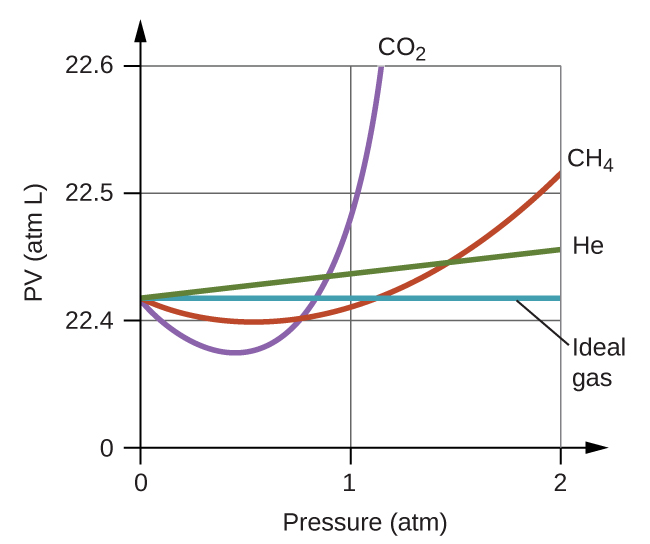
Gas molecules possess a finite volume and experience forces of attraction for one another. Consequently, gas behavior is not necessarily described well by the ideal gas law. Under conditions of low pressure and high temperature, these factors are negligible, the ideal gas equation is an accurate description of gas behavior, and the gas is said to exhibit ideal behavior. However, at lower temperatures and higher pressures, corrections for molecular volume and molecular attractions are required to account for finite molecular size and attractive forces. The van der Waals equation is a modified version of the ideal gas law that can be used to account for the non-ideal behavior of gases under these conditions.
気体分子は有限の体積を持ち、互いに引力を及ぼす。そのため、気体の振る舞いは必ずしも理想気体の状態方程式でうまく記述されるとは限らない。低圧・高温ではこれらの要因は無視でき、理想気体の状態方程式が気体の振る舞いを正確に記述し、このとき気体は理想的に振る舞うという。しかし、温度が低く圧力が高くなると、分子の有限の大きさと引力を考慮するために、分子体積と分子間引力の補正が必要になる。ファン・デル・ワールスの状態方程式は、これらの条件における気体の非理想的な振る舞いを扱うために用いられる、理想気体の状態方程式の修正版である。
Key Equations重要な式
Chemistry End of Chapter Exercises章末演習
Exercises 99–105練習問題 99–105
Exercise 99問題 99
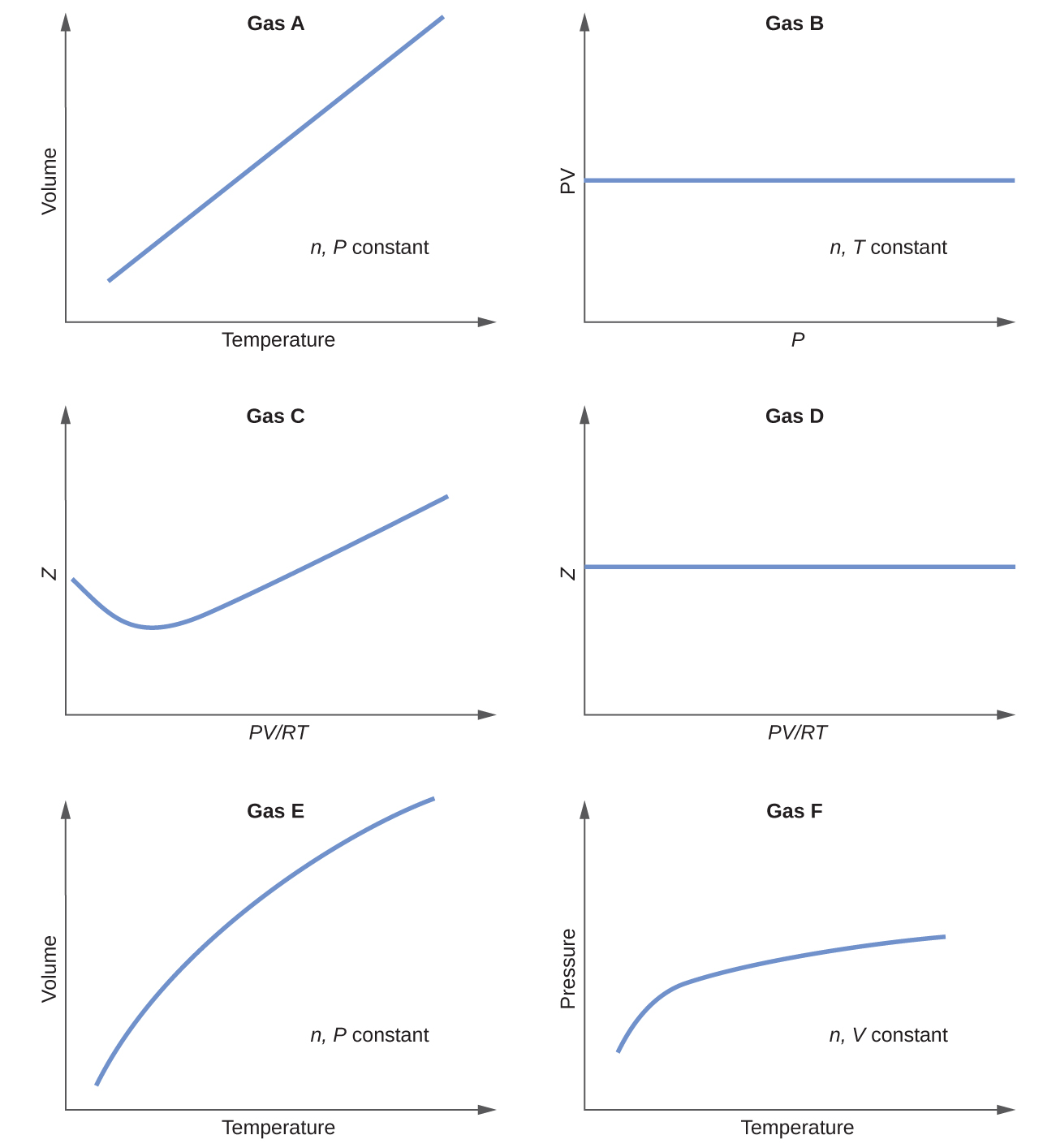
Graphs showing the behavior of several different gases follow. Which of these gases exhibit behavior significantly different from that expected for ideal gases?
いくつかの異なる気体の振る舞いを示すグラフを以下に示す。このうち、理想気体に期待される振る舞いと大きく異なるものはどれか。
Solution解き方
Gases C, E, and F
気体C、E、F。
Exercise 100問題 100


Exercise 101問題 101
Under which of the following sets of conditions does a real gas behave most like an ideal gas, and for which conditions is a real gas expected to deviate from ideal behavior? Explain.
次の条件のうち、実在気体が理想気体に最も近く振る舞うのはどれか。また、理想的な振る舞いからのずれが予想されるのはどれか。説明しなさい。
(a) high pressure, small volume
(a) 高圧、小体積。
(b) high temperature, low pressure
(b) 高温、低圧。
(c) low temperature, high pressure
(c) 低温、高圧。
Solution解き方
The gas behavior most like an ideal gas will occur under the conditions that minimize the chances of significant interactions between the gaseous atoms/molecules, namely, low pressures (fewer atoms/molecules per unit volume) and high temperatures (greater kinetic energies of atoms/molecules make them less susceptible to attractive forces). The conditions described in (b), high temperature and low pressure, are therefore most likely to yield ideal gas behavior.
英語のヒント
気体が最も理想気体に近く振る舞うのは、気体の原子・分子間に大きな相互作用が生じる可能性を最小にする条件、すなわち低圧(単位体積あたりの原子・分子が少ない)と高温(原子・分子の運動エネルギーが大きく、引力の影響を受けにくい)である。したがって、(b) の高温・低圧という条件が、最も理想気体の振る舞いをもたらしやすい。
Exercise 102問題 102
Describe the factors responsible for the deviation of the behavior of real gases from that of an
実在気体の振る舞いが、理想気体の振る舞いからずれる原因となる要因を
ideal gas.
説明しなさい。
Exercise 103問題 103
For which of the following gases should the correction for the molecular volume be largest:
次の気体のうち、分子体積の補正が最も大きいと考えられるものはどれか。
CO, CO2, H2, He, NH3, SF6?
CO、CO2、H2、He、NH3、SF6。
Solution解き方
SF6
SF6
Exercise 104問題 104
A 0.245-L flask contains 0.467 mol CO2 at 159 °C. Calculate the pressure:
0.245 Lのフラスコに、159 °Cで0.467 molのCO2が入っている。圧力を求めなさい。
(a) using the ideal gas law
(a) 理想気体の状態方程式を用いる。
(b) using the van der Waals equation
(b) ファン・デル・ワールスの状態方程式を用いる。
(c) Explain the reason for the difference.
(c) 差が生じる理由を説明しなさい。
(d) Identify which correction (that for P or V) is dominant and why.
(d) PとVのどちらの補正が支配的かを示し、その理由を説明しなさい。
Exercise 105問題 105
Answer the following questions:
次の問いに答えなさい。
(a) If XX behaved as an ideal gas, what would its graph of Z vs. P look like?
(a) XXが理想気体として振る舞うとしたら、ZをPに対して描いたグラフはどのようになるか。
(b) For most of this chapter, we performed calculations treating gases as ideal. Was this justified?
(b) この章の大部分では、気体を理想気体として扱って計算した。これは正当だったか。
(c) What is the effect of the volume of gas molecules on Z? Under what conditions is this effect small? When is it large? Explain using an appropriate diagram.
(c) 気体分子の体積はZにどのような影響を与えるか。この影響が小さいのはどのような条件か。大きいのはどのようなときか。適切な図を用いて説明しなさい。
(d) What is the effect of intermolecular attractions on the value of Z? Under what conditions is this effect small? When is it large? Explain using an appropriate diagram.
(d) 分子間引力はZの値にどのような影響を与えるか。この影響が小さいのはどのような条件か。大きいのはどのようなときか。適切な図を用いて説明しなさい。
(e) In general, under what temperature conditions would you expect Z to have the largest deviations from the Z for an ideal gas?
(e) 一般に、どのような温度条件で、Zが理想気体のZから最も大きくずれると予想されるか。
Solution解き方
(a) A straight horizontal line at 1.0; (b) When real gases are at low pressures and high temperatures, they behave close enough to ideal gases that they are approximated as such; however, in some cases, we see that at a high pressure and temperature, the ideal gas approximation breaks down and is significantly different from the pressure calculated by the ideal gas equation. (c) The greater the compressibility, the more the volume matters. At low pressures, the correction factor for intermolecular attractions is more significant, and the effect of the volume of the gas molecules on Z would be a small lowering compressibility. At higher pressures, the effect of the volume of the gas molecules themselves on Z would increase compressibility (see Figure 9.35). (d) Once again, at low pressures, the effect of intermolecular attractions on Z would be more important than the correction factor for the volume of the gas molecules themselves, though perhaps still small. At higher pressures and low temperatures, the effect of intermolecular attractions would be larger. See Figure 9.35. (e) Low temperatures
(a) 1.0を通る水平な直線。(b) 実在気体は低圧・高温では理想気体に十分近く振る舞うので、理想気体として近似できる。しかし場合によっては、高い圧力と温度で理想気体近似が成り立たなくなり、理想気体の状態方程式で計算した圧力から大きく異なることがわかる。(c) 圧縮性が大きいほど、体積が重要になる。低圧では、分子間引力の補正因子のほうが重要であり、気体分子の体積がZに及ぼす影響は、圧縮性をわずかに低下させるものとなる。高圧では、気体分子自体の体積がZに及ぼす影響は、圧縮性を増大させる(図9.35)。(d) 同様に、低圧では分子間引力がZに及ぼす影響のほうが、分子自体の体積の補正因子より重要だが、それでも小さい場合がある。高圧・低温では分子間引力の影響が大きくなる。図9.35を参照。(e) 低温。
compressibility factor (Z)
圧縮係数(Z)
ratio of the experimentally measured molar volume for a gas to its molar volume as computed from the ideal gas equation
実験で測定した気体のモル体積と、理想気体の状態方程式で計算したモル体積との比。
van der Waals equation
ファン・デル・ワールスの状態方程式
modified version of the ideal gas equation containing additional terms to account for non-ideal gas behavior
気体の非理想的な振る舞いを考慮する項を加えた、理想気体の状態方程式の修正版。