第9章気体
Standard Conditions of Temperature and Pressure標準温度・標準圧力の条件
We have seen that the volume of a given quantity of gas and the number of molecules (moles) in a given volume of gas vary with changes in pressure and temperature. Chemists sometimes make comparisons against a standard temperature and pressure (STP) for reporting properties of gases: 273.15 K and 1 atm (101.325 kPa). The IUPAC definition of standard pressure was changed from 1 atm to 1 bar (100 kPa) in 1982, but the prior definition remains in use by many literature resources and will be used in this text. At STP, one mole of an ideal gas has a volume of about 22.4 L—this is referred to as the standard molar volume (Figure 9.18).
英語のヒント
一定量の気体の体積も、一定体積の気体に含まれる分子数(モル数)も、圧力や温度の変化に伴って変わることを見てきた。化学者は気体の性質を報告する際、標準温度・標準圧力(STP)、すなわち273.15 K、1 atm(101.325 kPa)を基準として比較することがある。IUPACによる標準圧力の定義は1982年に1 atmから1 bar(100 kPa)へ変更されたが、以前の定義は今も多くの文献で使われており、本書でもそれを用いる。STPでは、理想気体1モルの体積は約22.4 Lであり、これを標準モル体積という(図9.18)。
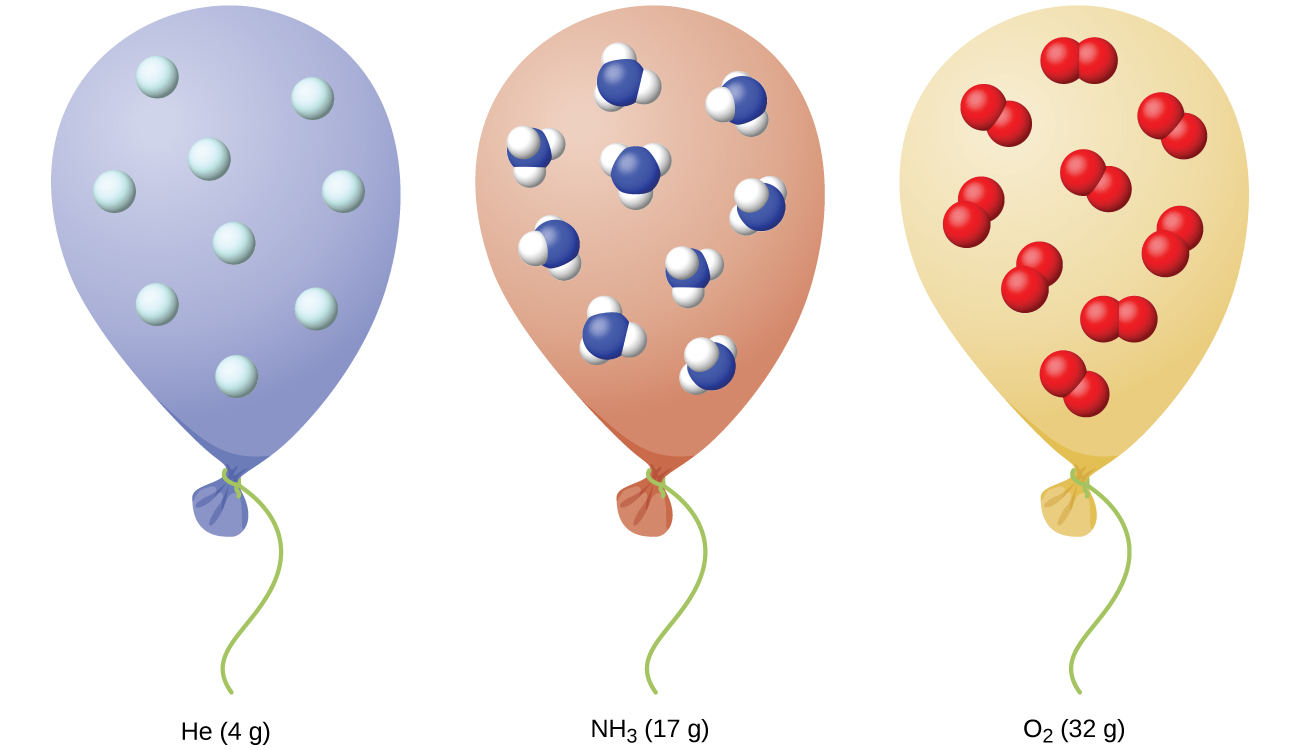
Figure 9.18図 9.18
Regardless of its chemical identity, one mole of gas behaving ideally occupies a volume of ~22.4 L at STP.
理想的に振る舞う気体1モルは、化学的な種類にかかわらず、STPで約22.4 Lを占める。
Key Concepts and Summary重要概念とまとめ
The behavior of gases can be described by several laws based on experimental observations of their properties. The pressure of a given amount of gas is directly proportional to its absolute temperature, provided that the volume does not change (Amontons’s law). The volume of a given gas sample is directly proportional to its absolute temperature at constant pressure (Charles’s law). The volume of a given amount of gas is inversely proportional to its pressure when temperature is held constant (Boyle’s law). Under the same conditions of temperature and pressure, equal volumes of all gases contain the same number of molecules (Avogadro’s law).
気体の振る舞いは、性質の実験的観測に基づくいくつかの法則で記述できる。一定量の気体の圧力は、体積が変わらないという条件で、絶対温度に正比例する(アモントンの法則)。一定の気体試料の体積は、一定圧力では絶対温度に正比例する(シャルルの法則)。一定量の気体の体積は、温度が一定なら圧力に反比例する(ボイルの法則)。同じ温度と圧力では、同じ体積のすべての気体は同じ数の分子を含む(アボガドロの法則)。
The equations describing these laws are special cases of the ideal gas law, PV = nRT, where P is the pressure of the gas, V is its volume, n is the number of moles of the gas, T is its kelvin temperature, and R is the ideal (universal) gas constant.
これらの法則を表す式は、理想気体の状態方程式PV = nRTの特別な場合である。ここでPは気体の圧力、Vは体積、nは気体のモル数、Tはケルビン温度、Rは理想(普遍)気体定数である。
Key Equations重要な式
PV = nRT |
Chemistry End of Chapter Exercises章末演習
Exercises 18–47練習問題 18–47
Exercise 18問題 18
Sometimes leaving a bicycle in the sun on a hot day will cause a blowout. Why?
暑い日に自転車を日なたに放置すると、タイヤが破裂することがある。なぜか。
Exercise 19問題 19
Explain how the volume of the bubbles exhausted by a scuba diver (Figure 9.16) change as they rise to the surface, assuming that they remain intact.
英語のヒント
スキューバダイバーが吐いた気泡(図9.16)が、壊れずに水面へ上昇すると仮定する。その体積がどのように変わるか説明しなさい。
Solution解き方
As the bubbles rise, the pressure decreases, so their volume increases as suggested by Boyle’s law.
気泡が上昇すると圧力が低下するため、ボイルの法則が示すように体積は増加する。
Exercise 20問題 20
One way to state Boyle’s law is “All other things being equal, the pressure of a gas is inversely proportional to its volume.” (a) What is the meaning of the term “inversely proportional?” (b) What are the “other things” that must be equal?
ボイルの法則は「他のすべての条件が等しければ、気体の圧力は体積に反比例する」と表すこともできる。(a)「反比例する」とはどのような意味か。(b)等しく保つべき「他の条件」とは何か。
Exercise 21問題 21
An alternate way to state Avogadro’s law is “All other things being equal, the number of molecules in a gas is directly proportional to the volume of the gas.” (a) What is the meaning of the term “directly proportional?” (b) What are the “other things” that must be equal?
アボガドロの法則は「他のすべての条件が等しければ、気体中の分子数は気体の体積に正比例する」と表すこともできる。(a)「正比例する」とはどのような意味か。(b)等しく保つべき「他の条件」とは何か。
Solution解き方
(a) The number of particles in the gas increases as the volume increases. (b) temperature, pressure
(a)体積が増えると、気体中の粒子数が増える。(b)温度と圧力。
Exercise 22問題 22
How would the graph in Figure 9.12 change if the number of moles of gas in the sample used to determine the curve were doubled?
曲線を求めるのに用いた試料の気体モル数を2倍にすると、図9.12のグラフはどのように変わるか。
Exercise 23問題 23
How would the graph in Figure 9.13 change if the number of moles of gas in the sample used to determine the curve were doubled?
曲線を求めるのに用いた試料の気体モル数を2倍にすると、図9.13のグラフはどのように変わるか。
Solution解き方
The curve would be farther to the right and higher up, but the same basic shape.
曲線はさらに右上へ移るが、基本的な形は変わらない。
Exercise 24問題 24
In addition to the data found in Figure 9.13, what other information do we need to find the mass of the sample of air used to determine the graph?
グラフ作成に使った空気試料の質量を求めるには、図9.13のデータのほかに、どの情報が必要か。
Exercise 25問題 25
Determine the volume of 1 mol of CH4 gas at 150 K and 1 atm, using Figure 9.12.
図9.12を使い、150 K、1 atmにおける1 molのCH4気体の体積を求めなさい。
Solution解き方
About 12.5 L
約12.5 L。
Exercise 26問題 26
Determine the pressure of the gas in the syringe shown in Figure 9.13 when its volume is 12.5 mL, using:
図9.13の注射器内の気体の体積が12.5 mLのとき、次の方法で圧力を求めなさい。
(a) the appropriate graph
(a)適切なグラフ
(b) Boyle’s law
(b)ボイルの法則
Exercise 27問題 27
A spray can is used until it is empty except for the propellant gas, which has a pressure of 1344 torr at 23 °C. If the can is thrown into a fire (T = 475 °C), what will be the pressure in the hot can?
スプレー缶を、噴射剤の気体以外は空になるまで使った。その気体の圧力は23 °Cで1344 torrである。缶を火の中(T = 475 °C)に投げ入れた場合、熱くなった缶内の圧力はいくらになるか。
Solution解き方
3.40 103 torr
3.40 103 torr
Exercise 28問題 28
What is the temperature of an 11.2-L sample of carbon monoxide, CO, at 744 torr if it occupies 13.3 L at 55 °C and 744 torr?
55 °C、744 torrで13.3 Lを占める一酸化炭素COの試料が、744 torrで11.2 Lを占めるとき、温度はいくらか。
Exercise 29問題 29
A 2.50-L volume of hydrogen measured at –196 °C is warmed to 100 °C. Calculate the volume of the gas at the higher temperature, assuming no change in pressure.
−196 °Cで測定した体積2.50 Lの水素を100 °Cに温める。圧力は変わらないとして、高温での気体の体積を計算しなさい。
Solution解き方
12.1 L
12.1 L
Exercise 30問題 30
A balloon inflated with three breaths of air has a volume of 1.7 L. At the same temperature and pressure, what is the volume of the balloon if five more same-sized breaths are added to the balloon?
息を3回吹き込んで膨らませた風船の体積は1.7 Lである。同じ温度と圧力で、同じ量の息をさらに5回加えると、風船の体積はいくらになるか。
Exercise 31問題 31
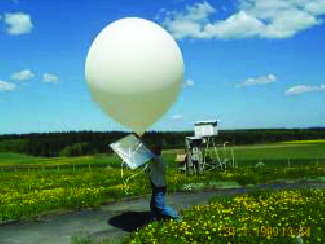
A weather balloon contains 8.80 moles of helium at a pressure of 0.992 atm and a temperature of 25 °C at ground level. What is the volume of the balloon under these conditions?
地上で圧力0.992 atm、温度25 °Cの気象観測用気球に、8.80モルのヘリウムが入っている。この条件で気球の体積はいくらか。
Solution解き方
217 L
217 L
Exercise 32問題 32
The volume of an automobile air bag was 66.8 L when inflated at 25 °C with 77.8 g of nitrogen gas. What was the pressure in the bag in kPa?
自動車のエアバッグを77.8 gの窒素ガスで25 °Cにおいて膨らませると、体積は66.8 Lになった。バッグ内の圧力はkPaでいくらだったか。
Exercise 33問題 33
How many moles of gaseous boron trifluoride, BF3, are contained in a 4.3410-L bulb at 788.0 K if the pressure is 1.220 atm? How many grams of BF3?
英語のヒント
788.0 Kで4.3410 Lの球形容器に、三フッ化ホウ素BF3の気体が1.220 atmで入っている。何モル含まれるか。またBF3は何グラムか。
Solution解き方
8.190 10–2 mol; 5.553 g
8.190 10–2 mol、5.553 g。
Exercise 34問題 34
Iodine, I2, is a solid at room temperature but sublimes (converts from a solid into a gas) when warmed. What is the temperature in a 73.3-mL bulb that contains 0.292 g of I2 vapor at a pressure of 0.462 atm?
英語のヒント
ヨウ素I2は室温では固体だが、温めると昇華する(固体から気体へ変わる)。73.3 mLの球形容器に0.292 gのI2蒸気が入り、圧力が0.462 atmであるとき、温度はいくらか。
Exercise 35問題 35
How many grams of gas are present in each of the following cases?
次の各場合、気体は何グラム存在するか。
(a) 0.100 L of CO2 at 307 torr and 26 °C
(a)307 torr、26 °CのCO2 0.100 L
(b) 8.75 L of C2H4, at 378.3 kPa and 483 K
(b)378.3 kPa、483 KのC2H4 8.75 L
(c) 221 mL of Ar at 0.23 torr and –54 °C
(c)0.23 torr、−54 °CのAr 221 mL
Solution解き方
(a) 7.24 10–2 g; (b) 23.1 g; (c) 1.5 10–4 g
(a)7.24 10–2 g。(b)23.1 g。(c)1.5 10–4 g。
Exercise 36問題 36
A high altitude balloon is filled with 1.41 104 L of hydrogen at a temperature of 21 °C and a pressure of 745 torr. What is the volume of the balloon at a height of 20 km, where the temperature is –48 °C and the pressure is 63.1 torr?
高高度気球に、21 °C、745 torrで1.41 104 Lの水素を入れる。温度−48 °C、圧力63.1 torrの高度20 kmでは、気球の体積はいくらになるか。
Exercise 37問題 37
A cylinder of medical oxygen has a volume of 35.4 L, and contains O2 at a pressure of 151 atm and a temperature of 25 °C. What volume of O2 does this correspond to at normal body conditions, that is, 1 atm and 37 °C?
体積35.4 Lの医療用酸素ボンベに、151 atm、25 °CでO2が入っている。これは通常の体内条件、すなわち1 atm、37 °Cで、どれだけの体積のO2に相当するか。
Solution解き方
5561 L
5561 L
Exercise 38問題 38
A large scuba tank (Figure 9.16) with a volume of 18 L is rated for a pressure of 220 bar. The tank is filled at 20 °C and contains enough air to supply 1860 L of air to a diver at a pressure of 2.37 atm (a depth of 45 feet). Was the tank filled to capacity at 20 °C?
英語のヒント
体積18 Lの大型スキューバタンク(図9.16)は、定格圧力220 barである。タンクは20 °Cで充填され、圧力2.37 atm(深さ45フィート)のダイバーに1860 Lの空気を供給できる量を含む。20 °Cでタンクの容量いっぱいまで充填されていたか。
Exercise 39問題 39
A 20.0-L cylinder containing 11.34 kg of butane, C4H10, was opened to the atmosphere. Calculate the mass of the gas remaining in the cylinder if it were opened and the gas escaped until the pressure in the cylinder was equal to the atmospheric pressure, 0.983 atm, and a temperature of 27 °C.
11.34 kgのブタンC4H10を含む20.0 Lのボンベを大気に開放した。気体が流出し、ボンベ内の圧力が大気圧0.983 atmに等しく、温度が27 °Cになるまで開放した場合、残る気体の質量を計算しなさい。
Solution解き方
46.4 g
46.4 g
Exercise 40問題 40
While resting, the average 70-kg human male consumes 14 L of pure O2 per hour at 25 °C and 100 kPa. How many moles of O2 are consumed by a 70 kg man while resting for 1.0 h?
平均的な体重70 kgの男性は、安静時に25 °C、100 kPaの純粋なO2を毎時14 L消費する。70 kgの男性が1.0 h安静にするとき、何モルのO2を消費するか。
Exercise 41問題 41
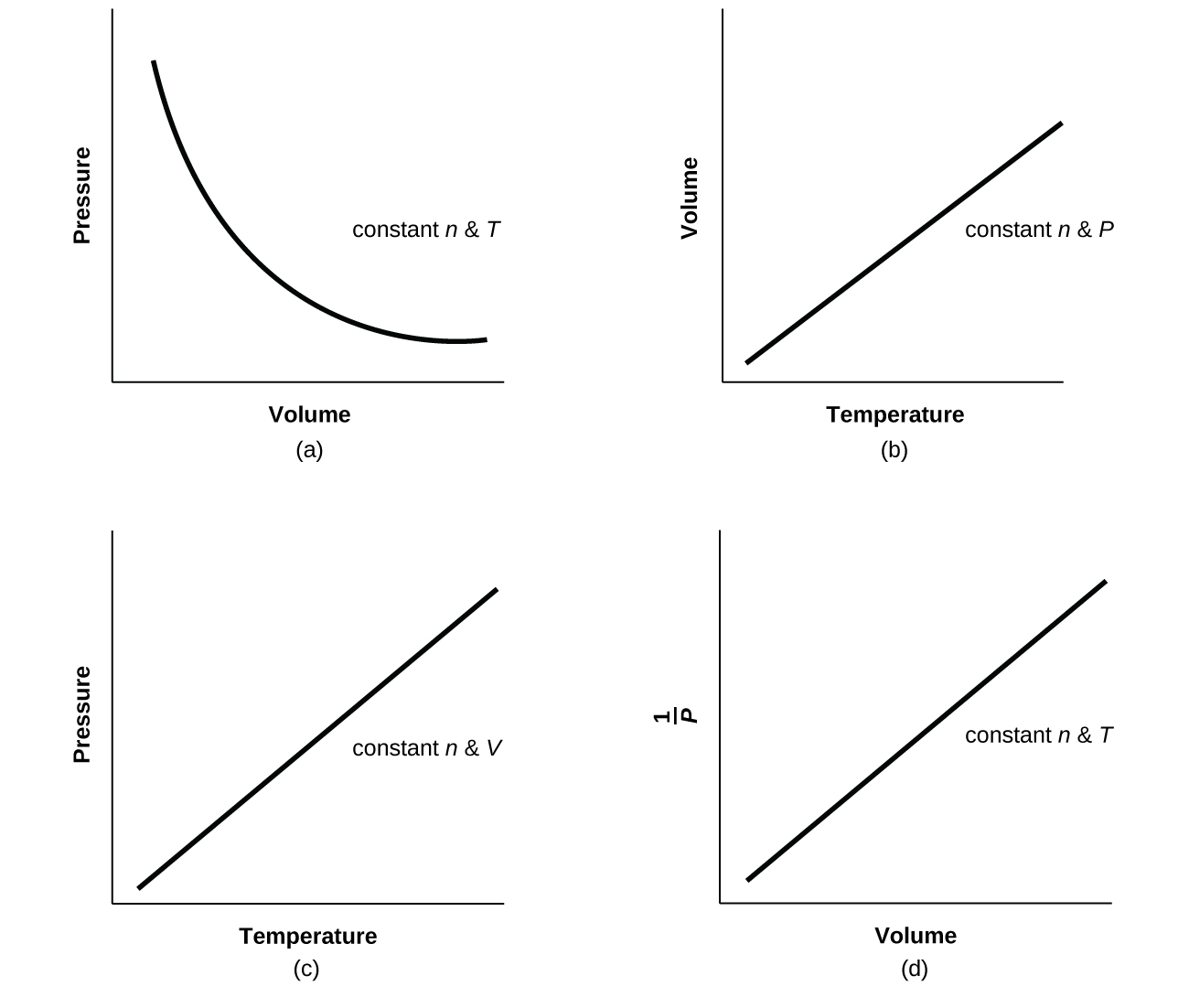
For a given amount of gas showing ideal behavior, draw labeled graphs of:
理想的に振る舞う一定量の気体について、次の関係を表す、軸名を付けたグラフを描きなさい。
(a) the variation of P with V
(a)VによるPの変化
(b) the variation of V with T
(b)TによるVの変化
(c) the variation of P with T
(c)TによるPの変化
(d) the variation of with V
(d)Vによるの変化


Exercise 42問題 42
A liter of methane gas, CH4, at STP contains more atoms of hydrogen than does a liter of pure hydrogen gas, H2, at STP. Using Avogadro’s law as a starting point, explain why.
標準状態のメタン気体CH4 1 Lには、標準状態の純粋な水素気体H2 1 Lより多くの水素原子が含まれる。アボガドロの法則を出発点として、その理由を説明しなさい。
Exercise 43問題 43
The effect of chlorofluorocarbons (such as CCl2F2) on the depletion of the ozone layer is well known. The use of substitutes, such as CH3CH2F(g), for the chlorofluorocarbons, has largely corrected the problem. Calculate the volume occupied by 10.0 g of each of these compounds at STP:
英語のヒント
クロロフルオロカーボン(CCl2F2など)がオゾン層の破壊に及ぼす影響はよく知られている。クロロフルオロカーボンの代わりにCH3CH2F(g)などの代替物質を用いることによって、この問題は大きく改善された。次の各化合物10.0 gが標準状態で占める体積を求めなさい。
(a) CCl2F2(g)
(a) CCl2F2(g)
(b) CH3CH2F(g)
(b) CH3CH2F(g)
Solution解き方
(a) 1.85 L CCl2F2; (b) 4.66 L CH3CH2F
(a) 1.85 LのCCl2F2;(b) 4.66 LのCH3CH2F
Exercise 44問題 44
As 1 g of the radioactive element radium decays over 1 year, it produces 1.16 1018 alpha particles (helium nuclei). Each alpha particle becomes an atom of helium gas. What is the pressure in pascal of the helium gas produced if it occupies a volume of 125 mL at a temperature of 25 °C?
英語のヒント
放射性元素ラジウム1 gが1年間に崩壊すると、1.16 1018個のアルファ粒子(ヘリウム原子核)が生じる。各アルファ粒子はヘリウム気体の原子になる。生成したヘリウム気体が温度25 °Cで125 mLの体積を占める場合、その圧力をパスカルで求めなさい。
Exercise 45問題 45
A balloon with a volume of 100.21 L at 21 °C and 0.981 atm is released and just barely clears the top of Mount Crumpit in British Columbia. If the final volume of the balloon is 144.53 L at a temperature of 5.24 °C, what is the pressure experienced by the balloon as it clears Mount Crumpit?
英語のヒント
21 °C、0.981 atmで体積100.21 Lの気球を放すと、ブリティッシュコロンビア州のクランピット山の頂をぎりぎり越えた。気球の最終体積が温度5.24 °Cで144.53 Lになったとすると、クランピット山を越えるときに気球にかかっている圧力はいくらか。
Solution解き方
0.644 atm
0.644 atm
Exercise 46問題 46
If the temperature of a fixed amount of a gas is doubled at constant volume, what happens to the pressure?
一定量の気体の温度を、体積一定のまま2倍にすると、圧力はどうなるか。
Exercise 47問題 47
If the volume of a fixed amount of a gas is tripled at constant temperature, what happens to the pressure?
一定量の気体の体積を、温度一定のまま3倍にすると、圧力はどうなるか。
Solution解き方
The pressure decreases by a factor of 3.
圧力は3分の1になる。
absolute zero
絶対零度
temperature at which the volume of a gas would be zero according to Charles’s law.
シャルルの法則によれば気体の体積がゼロになる温度。
Amontons’s law
アモントンの法則
(also, Gay-Lussac’s law) pressure of a given number of moles of gas is directly proportional to its kelvin temperature when the volume is held constant
(ゲイ=リュサックの法則ともいう)一定のモル数の気体では、体積を一定に保つと圧力はケルビン温度に正比例する。
Avogadro’s law
アボガドロの法則
volume of a gas at constant temperature and pressure is proportional to the number of gas molecules
温度と圧力が一定の気体の体積は、気体分子の数に比例する。
Boyle’s law
ボイルの法則
volume of a given number of moles of gas held at constant temperature is inversely proportional to the pressure under which it is measured
一定のモル数の気体を温度一定に保つと、その体積は測定時の圧力に反比例する。
Charles’s law
シャルルの法則
volume of a given number of moles of gas is directly proportional to its kelvin temperature when the pressure is held constant
一定のモル数の気体では、圧力を一定に保つと体積はケルビン温度に正比例する。
ideal gas
理想気体
hypothetical gas whose physical properties are perfectly described by the gas laws
物理的性質が気体の法則で完全に記述される、仮想的な気体。
ideal gas constant (R)
気体定数(R)
constant derived from the ideal gas equation R = 0.08206 L atm mol–1 K–1 or 8.314 L kPa mol–1 K–1
理想気体の状態方程式から導かれる定数。R = 0.08206 L atm mol–1 K–1、または8.314 L kPa mol–1 K–1。
ideal gas law
理想気体の状態方程式
relation between the pressure, volume, amount, and temperature of a gas under conditions derived by combination of the simple gas laws
単純な気体の法則を組み合わせて得られる条件のもとでの、気体の圧力、体積、物質量、温度の関係。
standard conditions of temperature and pressure (STP)
標準温度・標準圧力(標準状態、STP)
273.15 K (0 °C) and 1 atm (101.325 kPa)
273.15 K(0 °C)および1 atm(101.325 kPa)
standard molar volume
標準モル体積
volume of 1 mole of gas at STP, approximately 22.4 L for gases behaving ideally
標準状態における気体1 molの体積。理想気体として振る舞う気体では約22.4 L。