第9章気体
9.4 Effusion and Diffusion of Gases9.4 気体の噴出と拡散
Learning Objectives学習目標
By the end of this section, you will be able to:
この節を終えると、次のことができるようになる。
- Define and explain effusion and diffusion噴出と拡散を定義し、説明する。
- State Graham’s law and use it to compute relevant gas propertiesグレアムの法則を述べ、それを用いて関連する気体の性質を計算する。
If you have ever been in a room when a piping hot pizza was delivered, you have been made aware of the fact that gaseous molecules can quickly spread throughout a room, as evidenced by the pleasant aroma that soon reaches your nose. Although gaseous molecules travel at tremendous speeds (hundreds of meters per second), they collide with other gaseous molecules and travel in many different directions before reaching the desired target. At room temperature, a gaseous molecule will experience billions of collisions per second. The mean free path is the average distance a molecule travels between collisions. The mean free path increases with decreasing pressure; in general, the mean free path for a gaseous molecule will be hundreds of times the diameter of the molecule
英語のヒント
熱々のピザが届けられた部屋にいたことがあるなら、すぐ鼻に届くよい香りによって、気体分子が部屋全体に素早く広がることを実感したはずである。気体分子は毎秒数百メートルというものすごい速さで動くが、ほかの気体分子と衝突し、さまざまな方向に進んでから目的の場所に達する。室温では、気体分子は1秒間に何十億回も衝突する。平均自由行程とは、分子が衝突と衝突の間に移動する距離の平均である。平均自由行程は圧力が低下するほど大きくなる。一般に、気体分子の平均自由行程は、その分子の直径の数百倍になる。
In general, we know that when a sample of gas is introduced to one part of a closed container, its molecules very quickly disperse throughout the container; this process by which molecules disperse in space in response to differences in concentration is called diffusion (shown in Figure 9.27). The gaseous atoms or molecules are, of course, unaware of any concentration gradient, they simply move randomly—regions of higher concentration have more particles than regions of lower concentrations, and so a net movement of species from high to low concentration areas takes place. In a closed environment, diffusion will ultimately result in equal concentrations of gas throughout, as depicted in Figure 9.27. The gaseous atoms and molecules continue to move, but since their concentrations are the same in both bulbs, the rates of transfer between the bulbs are equal (no net transfer of molecules occurs).
英語のヒント
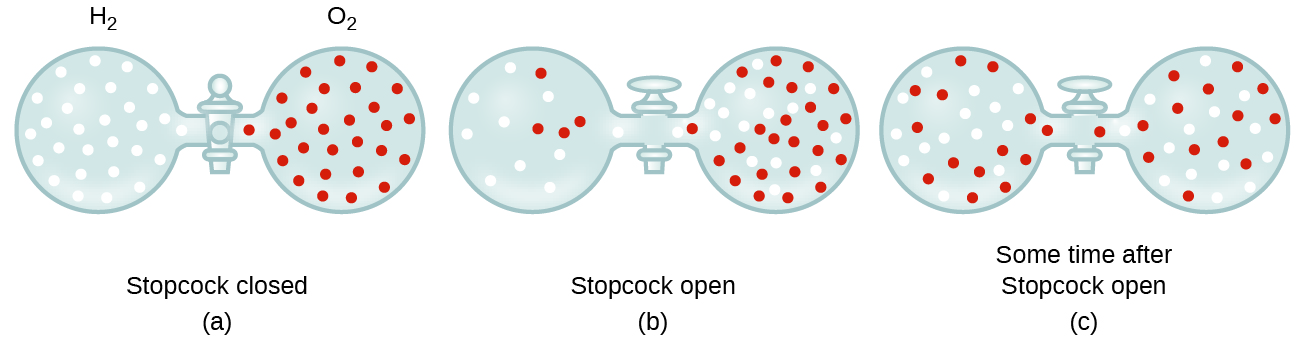
Figure 9.27図 9.27
(a) Two gases, H2 and O2, are initially separated. (b) When the stopcock is opened, they mix together. The lighter gas, H2, passes through the opening faster than O2, so just after the stopcock is opened, more H2 molecules move to the O2 side than O2 molecules move to the H2 side. (c) After a short time, both the slower-moving O2 molecules and the faster-moving H2 molecules have distributed themselves evenly on both sides of the vessel.
(a) H2とO2の二つの気体は、最初は分離されている。(b) コックを開くと混ざり合う。軽い気体H2はO2より速く開口部を通り抜けるので、コックを開けた直後は、O2分子がH2側へ移る数よりも、H2分子がO2側へ移る数のほうが多い。(c) 少し時間がたつと、動きの遅いO2分子も、動きの速いH2分子も、容器の両側に均等に分布する。
We are often interested in the rate of diffusion, the amount of gas passing through some area per unit time:
ある面を単位時間あたりに通過する気体の量である、拡散速度に関心を持つことが多い。
The diffusion rate depends on several factors: temperature; the mass of the atoms or molecules; the concentration gradient (the increase or decrease in concentration from one point to another); the amount of surface area available for diffusion; and the distance the gas particles must travel. Note also that the time required for diffusion to occur is inversely proportional to the rate of diffusion, as shown in the rate of diffusion equation.
拡散速度は、温度、原子や分子の質量、濃度勾配(ある地点から別の地点への濃度の増減)、拡散が起こりうる面の面積、気体粒子が移動しなければならない距離という、いくつかの要因に依存する。拡散速度の式が示すように、拡散に必要な時間は拡散速度に反比例することにも注意しよう。
A process involving movement of gaseous species similar to diffusion is effusion, the escape of gas molecules through a tiny hole such as a pinhole in a balloon into a vacuum (Figure 9.28). Although diffusion and effusion rates both depend on the molar mass of the gas involved, their rates are not equal; however, the ratios of their rates are the same.
英語のヒント
拡散と似た気体粒子の移動過程に、噴出がある。これは、風船の針穴のような非常に小さい穴を通って、気体分子が真空中へ抜け出すことである(図9.28)。拡散速度と噴出速度はいずれも気体のモル質量に依存するが、両者の速度そのものは等しくない。ただし、それぞれの速度の比は同じになる。
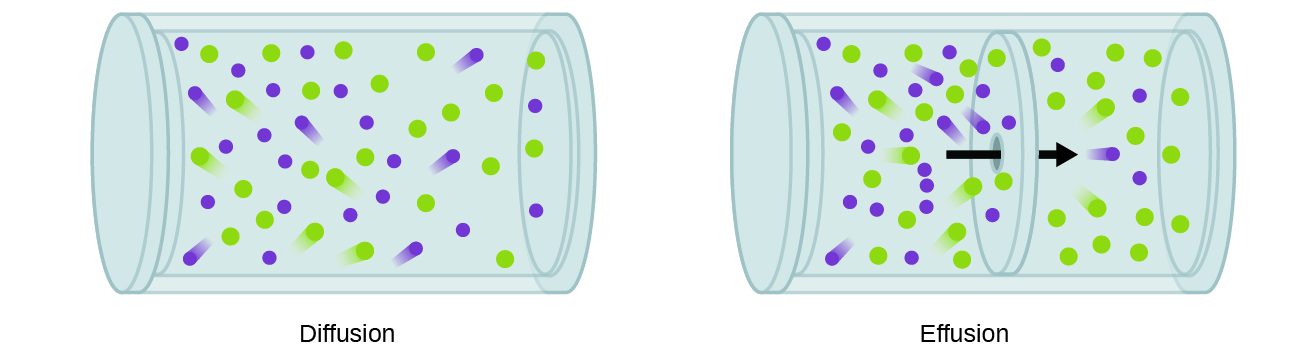
Figure 9.28図 9.28
Diffusion involves the unrestricted dispersal of molecules throughout space due to their random motion. When this process is restricted to passage of molecules through very small openings in a physical barrier, the process is called effusion.
英語のヒント
拡散は、分子が無作為に動くことによって、空間全体へ制限なく散らばる過程である。この過程が、物理的な隔壁にある非常に小さい穴を分子が通り抜けることに制限される場合、その過程を噴出という。
If a mixture of gases is placed in a container with porous walls, the gases effuse through the small openings in the walls. The lighter gases pass through the small openings more rapidly (at a higher rate) than the heavier ones (Figure 9.29). In 1832, Thomas Graham studied the rates of effusion of different gases and formulated Graham’s law of effusion: The rate of effusion of a gas is inversely proportional to the square root of its molar mass:
英語のヒント
壁が多孔質の容器に混合気体を入れると、各気体は壁の小さな穴から噴出する。軽い気体は、重い気体よりも速く(大きな速度で)小さな穴を通り抜ける(図9.29)。1832年、トーマス・グレアムはさまざまな気体の噴出速度を調べ、グレアムの噴出の法則を定式化した。すなわち、気体の噴出速度は、そのモル質量の平方根に反比例する。
This means that if two gases A and B are at the same temperature and pressure, the ratio of their effusion rates is inversely proportional to the ratio of the square roots of their molar masses:
これは、二つの気体AとBが同じ温度と圧力にある場合、両者の噴出速度の比は、モル質量の平方根の比に反比例することを意味する。
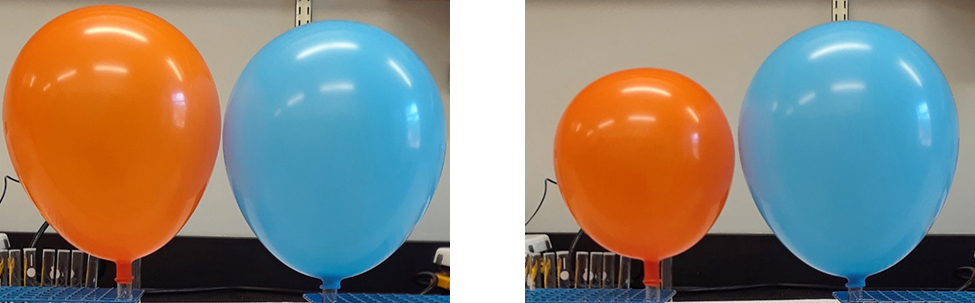


Figure 9.29図 9.29
The left photograph shows two balloons inflated with different gases, helium (orange) and argon (blue).The right-side photograph shows the balloons approximately 12 hours after being filled, at which time the helium balloon has become noticeably more deflated than the argon balloon, due to the greater effusion rate of the lighter helium gas. (credit: modification of work by Paul Flowers)
英語のヒント
左の写真は、それぞれヘリウム(オレンジ色)とアルゴン(青色)という異なる気体で膨らませた風船を示す。右の写真は気体を入れてから約12時間後の様子であり、ヘリウムの風船はアルゴンの風船より明らかにしぼんでいる。これは、軽いヘリウム気体の噴出速度のほうが大きいためである。(クレジット:Paul Flowersの作品を改変)
Example 9.20例題 9.20
Applying Graham’s Law to Rates of Effusionグレアムの法則を噴出速度に適用する
Calculate the ratio of the rate of effusion of hydrogen to the rate of effusion of oxygen.
酸素の噴出速度に対する水素の噴出速度の比を求めなさい。
Solution解法
From Graham’s law, we have:
グレアムの法則より、
Hydrogen effuses four times as rapidly as oxygen.
水素は酸素の4倍の速さで噴出する。
Check Your Learning理解度の確認
At a particular pressure and temperature, nitrogen gas effuses at the rate of 79 mL/s. Under the same conditions, at what rate will sulfur dioxide effuse?
ある圧力と温度で、窒素気体は79 mL/sの速度で噴出する。同じ条件で、二酸化硫黄はどのくらいの速度で噴出するか。
Example 9.21例題 9.21
Effusion Time Calculations噴出にかかる時間の計算
It takes 243 s for 4.46 10−5 mol Xe to effuse through a tiny hole. Under the same conditions, how long will it take 4.46 10−5 mol Ne to effuse?
4.46 10−5 molのXeが小さな穴から噴出するのに243 sかかる。同じ条件で、4.46 10−5 molのNeが噴出するにはどれだけの時間がかかるか。
Solution解法
It is important to resist the temptation to use the times directly, and to remember how rate relates to time as well as how it relates to mass. Recall the definition of rate of effusion:
英語のヒント
時間の値をそのまま式に使いたくなっても、それを避け、速度と質量との関係だけでなく、速度と時間との関係も思い出すことが重要である。噴出速度の定義を思い出そう。
and combine it with Graham’s law:
これをグレアムの法則と組み合わせる。
To get:
すると、次式が得られる。
Noting that amount of A = amount of B, and solving for time for Ne:
Aの量 = Bの量であることに注意して、Neにかかる時間について解くと、
and substitute values:
値を代入する。
Finally, solve for the desired quantity:
最後に、求める量について解く。
Note that this answer is reasonable: Since Ne is lighter than Xe, the effusion rate for Ne will be larger than that for Xe, which means the time of effusion for Ne will be smaller than that for Xe.
英語のヒント
この答えが妥当であることを確認しよう。NeはXeより軽いので、Neの噴出速度はXeの噴出速度より大きくなり、そのためNeの噴出にかかる時間はXeより短くなる。
Check Your Learning理解度の確認
A party balloon filled with helium deflates to of its original volume in 8.0 hours. How long will it take an identical balloon filled with the same number of moles of air (ℳ = 28.2 g/mol) to deflate to of its original volume?
ヘリウムを入れたパーティー用の風船は、8.0時間で最初の体積のまでしぼむ。同じ形の風船に、同じモル数の空気(ℳ = 28.2 g/mol)を入れると、最初の体積のまでしぼむのにどれだけの時間がかかるか。
Example 9.22例題 9.22
Determining Molar Mass Using Graham’s Lawグレアムの法則を用いてモル質量を求める
An unknown gas effuses 1.66 times more rapidly than CO2. What is the molar mass of the unknown gas? Can you make a reasonable guess as to its identity?
英語のヒント
ある未知の気体はCO2の1.66倍の速さで噴出する。この気体のモル質量はいくらか。その種類を妥当に推測できるか。
Solution解法
From Graham’s law, we have:
グレアムの法則より、
Plug in known data:
英語のヒント
既知の値を代入する。
Solve:
解くと、
The gas could well be CH4, the only gas with this molar mass.
このモル質量を持つ気体は一つだけなので、この気体はCH4である可能性が高い。
Check Your Learning理解度の確認
Hydrogen gas effuses through a porous container 8.97-times faster than an unknown gas. Estimate the molar mass of the unknown gas.
水素気体は、多孔質容器を通って、ある未知の気体の8.97倍の速さで噴出する。未知の気体のモル質量を推定しなさい。