第9章気体
9.5 The Kinetic-Molecular Theory9.5 気体分子運動論
Learning Objectives学習目標
- State the postulates of the kinetic-molecular theory気体分子運動論の仮定を述べる。
- Use this theory’s postulates to explain the gas laws気体分子運動論の仮定を用いて、気体の法則を説明する。
The gas laws that we have seen to this point, as well as the ideal gas equation, are empirical, that is, they have been derived from experimental observations. The mathematical forms of these laws closely describe the macroscopic behavior of most gases at pressures less than about 1 or 2 atm. Although the gas laws describe relationships that have been verified by many experiments, they do not tell us why gases follow these relationships.
英語のヒント
これまで見てきた気体の法則も、理想気体の状態方程式も、経験的なものである。つまり、実験による観測結果から導かれている。これらの法則の数学的な形は、約1〜2 atmより低い圧力での、ほとんどの気体の巨視的な振る舞いをよく記述する。気体の法則は多くの実験で確かめられた関係を記述しているが、なぜ気体がこれらの関係に従うのかは説明していない。
The kinetic molecular theory (KMT) is a simple microscopic model that effectively explains the gas laws described in previous modules of this chapter. This theory is based on the following five postulates described here. (Note: The term “molecule” will be used to refer to the individual chemical species that compose the gas, although some gases are composed of atomic species, for example, the noble gases.)
英語のヒント
気体分子運動論(KMT)は、この章の前の節で述べた気体の法則をうまく説明する、単純な微視的モデルである。この理論は、次に示す五つの仮定に基づいている。(注:希ガスのように原子からなる気体もあるが、ここでは気体を構成する個々の化学種を指して「分子」という語を用いる。)
- Gases are composed of molecules that are in continuous motion, travelling in straight lines and changing direction only when they collide with other molecules or with the walls of a container.気体は絶えず運動する分子からなる。分子は直線に沿って移動し、ほかの分子または容器の壁と衝突するときだけ向きを変える。
- The molecules composing the gas are negligibly small compared to the distances between them.
英語のヒント
気体を構成する分子の大きさは、分子間の距離に比べて無視できるほど小さい。 - The pressure exerted by a gas in a container results from collisions between the gas molecules and the container walls.容器内の気体が及ぼす圧力は、気体分子と容器の壁との衝突から生じる。
- Gas molecules exert no attractive or repulsive forces on each other or the container walls; therefore, their collisions are elastic (do not involve a loss of energy).
英語のヒント
気体分子は、互いにも容器の壁にも引力や斥力を及ぼさない。したがって、その衝突は弾性衝突である(エネルギーの損失を伴わない)。 - The average kinetic energy of the gas molecules is proportional to the kelvin temperature of the gas.気体分子の平均運動エネルギーは、気体のケルビン温度に比例する。
The test of the KMT and its postulates is its ability to explain and describe the behavior of a gas. The various gas laws can be derived from the assumptions of the KMT, which have led chemists to believe that the assumptions of the theory accurately represent the properties of gas molecules. We will first look at the individual gas laws (Boyle’s, Charles’s, Amontons’s, Avogadro’s, and Dalton’s laws) conceptually to see how the KMT explains them. Then, we will more carefully consider the relationships between molecular masses, speeds, and kinetic energies with temperature, and explain Graham’s law.
英語のヒント
気体分子運動論とその仮定は、気体の振る舞いを説明し、記述できるかどうかによって検証される。気体分子運動論の仮定からさまざまな気体の法則を導けるため、化学者は、この理論の仮定が気体分子の性質を正確に表していると考えてきた。まず、ボイル、シャルル、アモントン、アボガドロ、ドルトンの各法則を概念的に見直し、気体分子運動論によってどのように説明できるかを確かめる。その後、分子の質量、速さ、運動エネルギーと温度との関係をさらに詳しく考え、グレアムの法則を説明する。
The Kinetic-Molecular Theory Explains the Behavior of Gases, Part I気体分子運動論による気体の振る舞いの説明:その1
Recalling that gas pressure is exerted by rapidly moving gas molecules and depends directly on the number of molecules hitting a unit area of the wall per unit of time, we see that the KMT conceptually explains the behavior of a gas as follows:
気体の圧力は素早く動く気体分子が及ぼすものであり、壁の単位面積に単位時間あたりに衝突する分子の数に直接依存する。このことを思い出すと、気体分子運動論が次のように気体の振る舞いを概念的に説明できることがわかる。
- Amontons’s law. If the temperature is increased, the average speed and kinetic energy of the gas molecules increase. If the volume is held constant, the increased speed of the gas molecules results in more frequent and more forceful collisions with the walls of the container, therefore increasing the pressure (Figure 9.31).
英語のヒント
アモントンの法則。温度を上げると、気体分子の平均の速さと運動エネルギーが増す。体積を一定に保つと、分子の速さが増すことによって、容器の壁への衝突は頻繁で強くなり、その結果、圧力が高くなる(図9.31)。 - Charles’s law. If the temperature of a gas is increased, a constant pressure may be maintained only if the volume occupied by the gas increases. This will result in greater average distances traveled by the molecules to reach the container walls, as well as increased wall surface area. These conditions will decrease both the frequency of molecule-wall collisions and the number of collisions per unit area, the combined effects of which balance the effect of increased collision forces due to the greater kinetic energy at the higher temperature.
英語のヒント
シャルルの法則。気体の温度を上げるとき、圧力を一定に保つには、気体が占める体積を増やさなければならない。すると、分子が容器の壁に達するまでに移動する平均距離が長くなり、壁の表面積も大きくなる。この条件では、分子と壁との衝突の頻度も、単位面積あたりの衝突回数も減少する。この二つの効果が組み合わさって、高温で運動エネルギーが大きくなることによる衝突力の増大を打ち消す。 - Boyle’s law. If the gas volume of a given amount of gas at a given temperature is decreased (that is, if the gas is compressed), the molecules will be exposed to a decreased container wall area. Collisions with the container wall will therefore occur more frequently and the pressure exerted by the gas will increase (Figure 9.31).ボイルの法則。ある温度にある一定量の気体の体積を減らすと(つまり気体を圧縮すると)、分子が接する容器の壁の面積が小さくなる。したがって、容器の壁との衝突がより頻繁に起こり、気体が及ぼす圧力が高くなる(図9.31)。
- Avogadro’s law. At constant pressure and temperature, the frequency and force of molecule-wall collisions are constant. Under such conditions, increasing the number of gaseous molecules will require a proportional increase in the container volume in order to yield a decrease in the number of collisions per unit area to compensate for the increased frequency of collisions (Figure 9.31).
英語のヒント
アボガドロの法則。圧力と温度が一定ならば、分子と壁との衝突の頻度と力は一定である。この条件で気体分子の数を増やすには、容器の体積をそれに比例して増やす必要がある。これは、単位面積あたりの衝突回数を減らし、衝突頻度の増加を埋め合わせるためである(図9.31)。 - Dalton’s Law. Because of the large distances between them, the molecules of one gas in a mixture bombard the container walls with the same frequency whether other gases are present or not, and the total pressure of a gas mixture equals the sum of the (partial) pressures of the individual gases.
英語のヒント
ドルトンの法則。分子間の距離が大きいため、混合物中のある気体の分子は、ほかの気体が存在してもしなくても、同じ頻度で容器の壁に衝突する。混合気体の全圧は、個々の気体の圧力(分圧)の和に等しい。
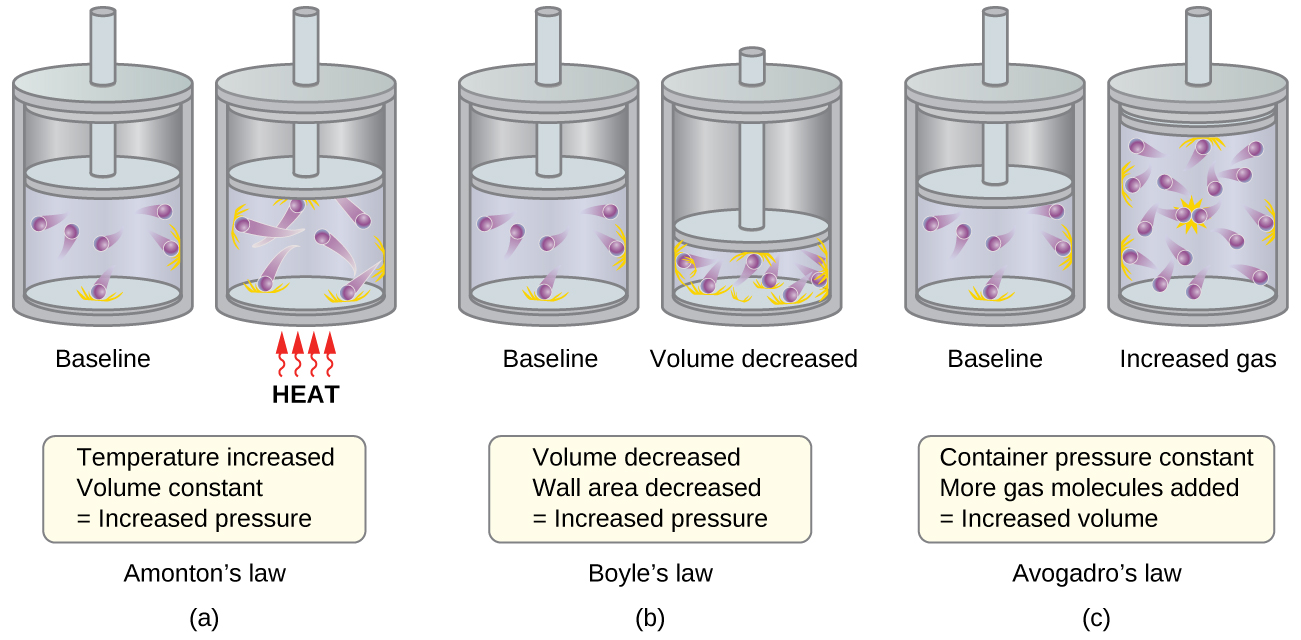

Figure 9.31図 9.31
(a) When gas temperature increases, gas pressure increases due to increased force and frequency of molecular collisions. (b) When volume decreases, gas pressure increases due to increased frequency of molecular collisions. (c) When the amount of gas increases at a constant pressure, volume increases to yield a constant number of collisions per unit wall area per unit time.
(a) 気体の温度が上がると、分子衝突の力と頻度が増すため、気体の圧力は高くなる。(b) 体積が減少すると、分子衝突の頻度が増すため、気体の圧力は高くなる。(c) 圧力一定で気体の量が増えると、単位時間・単位壁面積あたりの衝突回数を一定にするように体積が増える。