第9章気体
Molecular Speeds and Kinetic Energy分子の速さと運動エネルギー
The previous discussion showed that the KMT qualitatively explains the behaviors described by the various gas laws. The postulates of this theory may be applied in a more quantitative fashion to derive these individual laws. To do this, we must first look at speeds and kinetic energies of gas molecules, and the temperature of a gas sample.
ここまでの説明では、さまざまな気体の法則が記述する振る舞いを、気体分子運動論で定性的に説明できることを示した。この理論の仮定をより定量的に適用すれば、個々の法則を導ける。そのためには、まず気体分子の速さと運動エネルギー、および気体試料の温度を考えなければならない。
In a gas sample, individual molecules have widely varying speeds; however, because of the vast number of molecules and collisions involved, the molecular speed distribution and average speed are constant. This molecular speed distribution is known as a Maxwell-Boltzmann distribution, and it depicts the relative numbers of molecules in a bulk sample of gas that possesses a given speed (Figure 9.32).
英語のヒント
気体試料の中では、個々の分子の速さは大きく異なる。しかし、関わる分子と衝突の数が非常に多いため、分子の速さの分布と平均の速さは一定である。この分子の速さの分布をマクスウェル=ボルツマン分布といい、あるまとまった気体試料の中で、特定の速さを持つ分子がどれだけの割合を占めるかを表す(図9.32)。
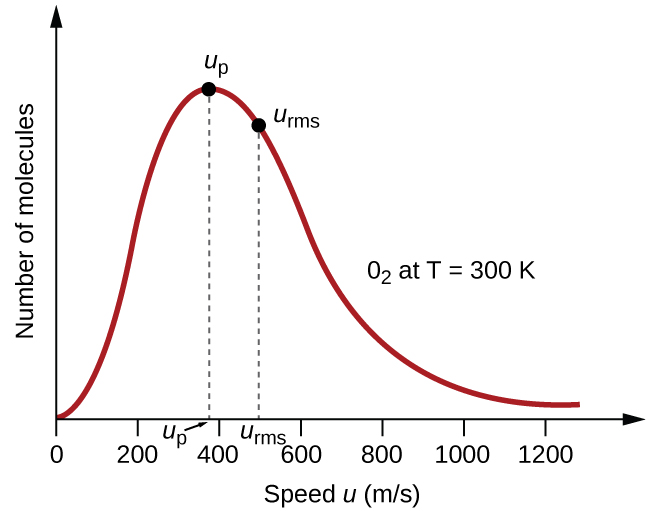
Figure 9.32図 9.32
The molecular speed distribution for oxygen gas at 300 K is shown here. Very few molecules move at either very low or very high speeds. The number of molecules with intermediate speeds increases rapidly up to a maximum, which is the most probable speed, then drops off rapidly. Note that the most probable speed, νp, is a little less than 400 m/s, while the root mean square speed, urms, is closer to 500 m/s.
英語のヒント
300 Kでの酸素気体の分子の速さの分布。非常に遅い、または非常に速い分子はごく少ない。中間の速さを持つ分子の数は、最確速さで最大になるまで急増し、その後急減する。最確速さνpは400 m/sより少し小さいのに対し、二乗平均平方根速度urmsは500 m/sに近いことに注意しよう。
The kinetic energy (KE) of a particle of mass (m) and speed (u) is given by:
質量m、速さuの粒子の運動エネルギー(KE)は、次式で与えられる。
Expressing mass in kilograms and speed in meters per second will yield energy values in units of joules (J = kg m2 s–2). To deal with a large number of gas molecules, we use averages for both speed and kinetic energy. In the KMT, the root mean square speed of a particle, urms, is defined as the square root of the average of the squares of the speeds with n = the number of particles:
英語のヒント
質量をキログラム、速さをメートル毎秒で表すと、エネルギーはジュール(J = kg m2 s–2)の単位で得られる。多数の気体分子を扱うために、速さと運動エネルギーの両方について平均を用いる。気体分子運動論では、粒子の二乗平均平方根速度urmsを、速さの二乗の平均の平方根として定義する。ここでnは粒子の数である。
The average kinetic energy for a mole of particles, KEavg, is then equal to:
このとき、粒子1 molあたりの平均運動エネルギーKEavgは、次の値に等しい。
where M is the molar mass expressed in units of kg/mol. The KEavg of a mole of gas molecules is also directly proportional to the temperature of the gas and may be described by the equation:
ここでMは、kg/molで表したモル質量である。気体分子1 molあたりのKEavgは気体の温度にも正比例し、次の式で表せる。
where R is the gas constant and T is the kelvin temperature. When used in this equation, the appropriate form of the gas constant is 8.314 J/mol⋅K (8.314 kg m2s–2mol–1K–1). These two separate equations for KEavg may be combined and rearranged to yield a relation between molecular speed and temperature:
ここでRは気体定数、Tはケルビン温度である。この式で用いる気体定数の適切な形は8.314 J/mol⋅K(8.314 kg m2s–2mol–1K–1)である。KEavgについてのこの二つの式を組み合わせて整理すると、分子の速さと温度の関係が得られる。
Example 9.23例題 9.23
Calculation of urmsurmsの計算
Calculate the root-mean-square speed for a nitrogen molecule at 30 °C.
30 °Cにおける窒素分子の二乗平均平方根速度を計算しなさい。
Solution解法
Convert the temperature into Kelvin:
温度をケルビンに換算する。
Determine the molar mass of nitrogen in kilograms:
窒素のモル質量をキログラムを用いて求める。
Replace the variables and constants in the root-mean-square speed equation, replacing Joules with the equivalent kg m2s–2:
二乗平均平方根速度の式の変数と定数に値を代入し、ジュールを同等のkg m2s–2に置き換える。
Check Your Learning理解度の確認
Calculate the root-mean-square speed for a mole of oxygen molecules at –23 °C.
−23 °Cにおける酸素分子1 molの二乗平均平方根速度を計算しなさい。
If the temperature of a gas increases, its KEavg increases, more molecules have higher speeds and fewer molecules have lower speeds, and the distribution shifts toward higher speeds overall, that is, to the right. If temperature decreases, KEavg decreases, more molecules have lower speeds and fewer molecules have higher speeds, and the distribution shifts toward lower speeds overall, that is, to the left. This behavior is illustrated for nitrogen gas in Figure 9.33.
英語のヒント
気体の温度が上がるとKEavgが増し、速い分子が増えて遅い分子が減るため、分布全体は速さの大きい側、すなわち右へ移る。温度が下がるとKEavgが減り、遅い分子が増えて速い分子が減るため、分布全体は速さの小さい側、すなわち左へ移る。この振る舞いを、窒素気体について図9.33に示す。
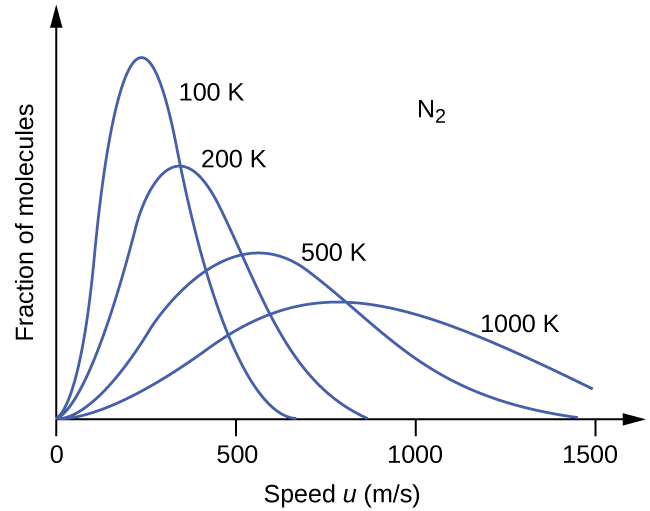
Figure 9.33図 9.33
The molecular speed distribution for nitrogen gas (N2) shifts to the right and flattens as the temperature increases; it shifts to the left and heightens as the temperature decreases.
窒素気体(N2)の分子の速さの分布は、温度が上がると右へ移って平たくなり、温度が下がると左へ移って高くなる。
At a given temperature, all gases have the same KEavg for their molecules. Gases composed of lighter molecules have more high-speed particles and a higher urms, with a speed distribution that peaks at relatively higher speeds. Gases consisting of heavier molecules have more low-speed particles, a lower urms, and a speed distribution that peaks at relatively lower speeds. This trend is demonstrated by the data for a series of noble gases shown in Figure 9.34.
英語のヒント
一定の温度では、すべての気体の分子は同じKEavgを持つ。軽い分子からなる気体は、速い粒子が多く、urmsも大きく、比較的速さの大きいところで速度分布がピークを示す。重い分子からなる気体は、遅い粒子が多く、urmsは小さく、比較的速さの小さいところで分布がピークを示す。この傾向を、図9.34の一連の希ガスのデータで示す。
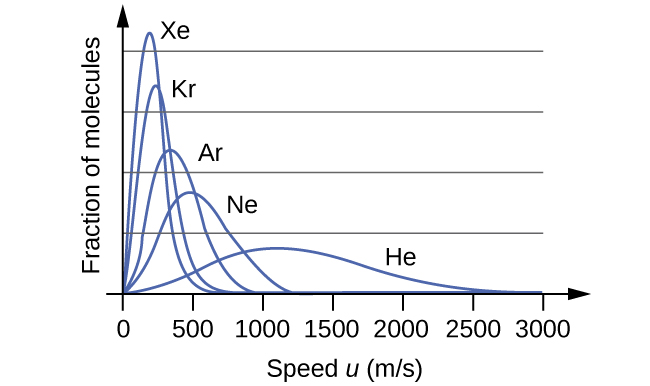


Figure 9.34図 9.34
molecular speed is directly related to molecular mass. At a given temperature, lighter molecules move faster on average than heavier molecules.
分子の速さは分子質量と直接関係している。同じ温度では、軽い分子は平均して重い分子より速く動く。