第3章確率
Exercises 38–39練習問題 38–39
Use the following information to answer the next two exercises. You are rolling a fair, six-sided number cube. Let E = the event that it lands on an even number. Let M = the event that it lands on a multiple of three.
次の情報を使い、続く二つの問題に答えよ。公平な6面の数字付きの立方体を投げる。E = 偶数の目が出る事象、M = 3の倍数の目が出る事象、とする。
Exercise 38問題 38
What does P(E|M) mean in words?
P(E|M)は何を意味するか、言葉で述べよ。
Exercise 39問題 39
What does P(E OR M) mean in words?
P(E OR M)は何を意味するか、言葉で述べよ。
Solution解き方
the probability of landing on an even number or a multiple of three
偶数または3の倍数の目が出る確率。
Homework宿題
Exercises 40–41練習問題 40–41
Exercise 40問題 40
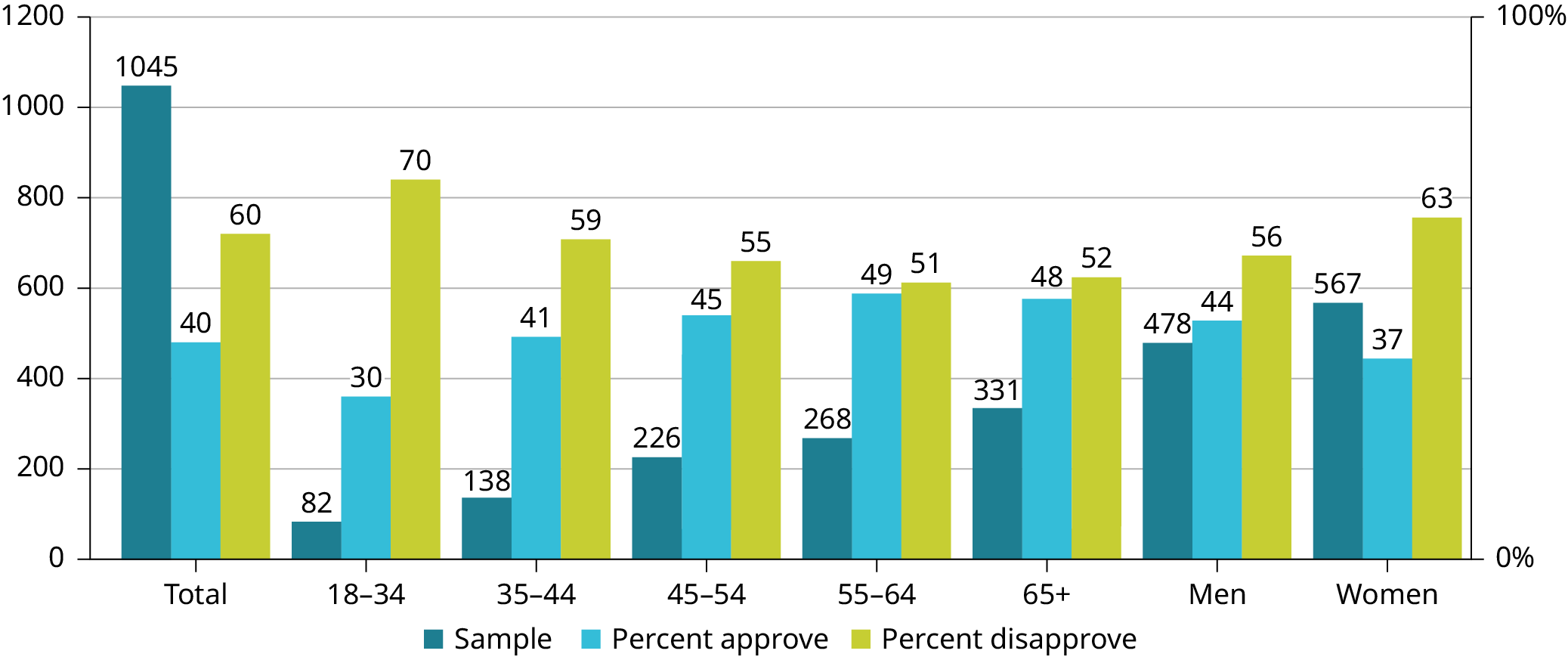

Figure 3.3図 3.3
The graph in Figure 3.3 displays the sample sizes and percentages of people in different age and gender groups who were polled concerning their approval of Mayor Ford’s actions in office. The total number in the sample of all the age groups is 1,045.
英語のヒント
図3.3は、フォード市長の在任中の行動を支持するかどうかを尋ねた調査について、年齢・ジェンダー別の各集団の標本数と割合を示している。すべての年齢層を合わせた標本の総人数は1,045人である。
- Define three events in the graph.グラフの中で三つの事象を定義せよ。
- Describe in words what the entry 40 means.40という値が何を意味するか、言葉で説明せよ。
- Describe in words the complement of the entry in question 2.問い2の値に対応する余事象を、言葉で説明せよ。
- Describe in words what the entry 30 means.30という値が何を意味するか、言葉で説明せよ。
- Out of the men and women, what percent are men?男女全体のうち、男性は何パーセントか。
- Out of the women, what percent disapprove of Mayor Ford?女性のうち、フォード市長を支持しない人は何パーセントか。
- Out of all the age groups, what percent approve of Mayor Ford?すべての年齢層のうち、フォード市長を支持する人は何パーセントか。
- Find P(Approve|Men).P(支持|男性)を求めよ。
- Out of the age groups, what percent are more than 44 years old?すべての年齢層のうち、44歳を超える人は何パーセントか。
- Find P(Approve|Age < 35).P(支持|年齢 < 35)を求めよ。
Exercise 41問題 41
Explain what is wrong with the following statements. Use complete sentences.
次の記述のどこが誤っているか、完全な文を使って説明せよ。
- If there is a 60% chance of rain on Saturday and a 70% chance of rain on Sunday, then there is a 130% chance of rain over the weekend.土曜日に雨が降る確率が60%、日曜日に雨が降る確率が70%なら、週末に雨が降る確率は130%である。
- The probability that a baseball player hits a home run is greater than the probability that he gets a successful hit.野球選手が本塁打を打つ確率は、安打を打つ確率より大きい。
Solution解き方
- You can't calculate the joint probability knowing the probability of both events occurring, which is not in the information given; the probabilities should be multiplied, not added; and probability is never greater than 100%両方の事象が起こる確率は与えられた情報に含まれていないので、その確率を把握して同時確率を計算することはできない。確率は足すのではなく掛けるべきであり、確率が100%を超えることは決してない。
- A home run by definition is a successful hit, so he has to have at least as many successful hits as home runs.本塁打は定義上、安打なので、安打数は少なくとも本塁打数以上でなければならない。
Conditional Probability
条件付き確率
the likelihood that an event will occur given that another event has already occurred
別の事象がすでに起こったという条件のもとで、ある事象が起こる可能性。
Equally Likely
同様に確からしい
Each outcome of an experiment has the same probability.
実験の各結果が同じ確率を持つこと。
Event
事象
a subset of the set of all outcomes of an experiment; the set of all outcomes of an experiment is called a sample space and is usually denoted by S. An event is an arbitrary subset in S. It can contain one outcome, two outcomes, no outcomes (empty subset), the entire sample space, and the like. Standard notations for events are capital letters such as A, B, C, and so on.
英語のヒント
実験のすべての結果の集合の部分集合。実験のすべての結果の集合を標本空間と呼び、通常Sで表す。事象はSの任意の部分集合である。結果を一つ含むもの、二つ含むもの、何も含まないもの(空の部分集合)、標本空間全体などがある。事象は通常、A、B、Cなどの大文字で表す。
Experiment
実験
a planned activity carried out under controlled conditions
管理された条件のもとで行う、計画的な活動。
Outcome
結果
a particular result of an experiment
実験で得られる特定の結果。
Probability
確率
a number between zero and one, inclusive, that gives the likelihood that a specific event will occur; the foundation of statistics is given by the following 3 axioms (by A.N. Kolmogorov, 1930’s): Let S denote the sample space and A and B are two events in S. Then:
特定の事象が起こる可能性を表す、0以上1以下の数。統計学の基礎は、次の三つの公理によって与えられる(A・N・コルモゴロフ、1930年代)。Sを標本空間、AとBをS内の二つの事象とする。このとき、
- 0 ≤ P(A) ≤ 1
- If A and B are any two mutually exclusive events, then P(A OR B) = P(A) + P(B).AとBが任意の二つの排反な事象であれば、P(A OR B) = P(A) + P(B)となる。
- P(S) = 1
Sample Space
標本空間
the set of all possible outcomes of an experiment
実験で起こりうるすべての結果の集合。
AND Event
ANDの事象
An outcome is in the event A AND B if the outcome is in both A AND B at the same time.
ある結果がAとBの両方に同時に含まれるとき、その結果は事象A AND Bに含まれる。
Complement Event
余事象
The complement of event A consists of all outcomes that are NOT in A.
事象Aの余事象は、Aに含まれないすべての結果からなる。
Conditional Probability of A GIVEN B
Bが起こったという条件のもとでのAの条件付き確率
P(A|B) is the probability that event A will occur given that the event B has already occurred.
P(A|B)は、事象Bがすでに起こったという条件のもとで、事象Aが起こる確率である。
Or Event
ORの事象
An outcome is in the event A OR B if the outcome is in A or is in B or is in both A and B.
ある結果がAに含まれるか、Bに含まれるか、またはAとBの両方に含まれるとき、その結果は事象A OR Bに含まれる。