第10章多項式
Simplify Expressions with Zero Exponents指数が0の式を簡単にする
A special case of the Quotient Property is when the exponents of the numerator and denominator are equal, such as an expression like From earlier work with fractions, we know that
のように、分子と分母の指数が等しい場合は、商の性質の特別な場合である。分数についてのこれまでの学習から、次が分かっている。
In words, a number divided by itself is So for any (), since any number divided by itself is
言葉で表すと、ある数をそれ自身で割るとになる。したがって、どの()についてもである。どの数もそれ自身で割るとになるからだ。
The Quotient Property of Exponents shows us how to simplify when and when by subtracting exponents. What if ?
同じ底の累乗の商の性質により、のときとのとき、指数を引いてを簡単にできる。では、のときはどうだろうか。
Now we will simplify in two ways to lead us to the definition of the zero exponent.
を2通りの方法で簡単にして、指数が0の場合の定義を導こう。
Consider first which we know is
まずを考える。これはであることが分かっている。
Write 8 as . 8をと書く。 |
|
Subtract exponents. 指数を引く。 |
|
Simplify. 簡単にする。 |
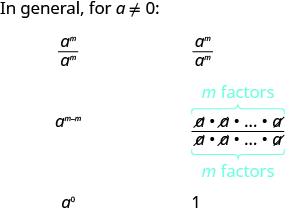
We see simplifies to a and to . So .
は、ともとも表せる。したがって、である。
In this text, we assume any variable that we raise to the zero power is not zero.
英語のヒント
この本では、0乗する変数はどれも0ではないと仮定する。
Example 10.48例題 10.48
Simplify:
簡単にせよ。
- ⓐ
- ⓑ
Solution解答
The definition says any non-zero number raised to the zero power is
定義より、0でない数を0乗するとになる。
ⓐ |
|
Use the definition of the zero exponent. 指数が0の場合の定義を使う。 |
1 |
ⓑ |
|
Use the definition of the zero exponent. 指数が0の場合の定義を使う。 |
1 |
Try It (2)確認問題(2題)
Now that we have defined the zero exponent, we can expand all the Properties of Exponents to include whole number exponents.
英語のヒント
指数が0の場合を定義したので、指数に関するすべての性質を、指数が非負整数の場合まで広げられる。
What about raising an expression to the zero power? Let's look at We can use the product to a power rule to rewrite this expression.
式を0乗するとどうなるだろうか。を見よう。積の累乗の性質を使えば、この式を書き直せる。
Use the Product to a Power Rule. 積の累乗の性質を使う。 |
|
Use the Zero Exponent Property. 指数が0の場合の性質を使う。 |
|
Simplify. 簡単にする。 |
1 |
This tells us that any non-zero expression raised to the zero power is one.
このことから、0でない式を0乗すると1になると分かる。
Example 10.49例題 10.49
Simplify:
次の式を簡単にする:
Solution解答
Use the definition of the zero exponent. 指数が0の場合の定義を使う。 |
1 |
Try It (2)確認問題(2題)
Example 10.50例題 10.50
Simplify:
簡単にせよ。
- ⓐ
- ⓑ
Solution解答
ⓐ |
|
The product is raised to the zero power. 積全体を0乗している。 |
|
Use the definition of the zero exponent. 指数が0の場合の定義を使う。 |
ⓑ |
|
Notice that only the variable is being raised to the zero power. 変数だけが0乗されていることに注目する。 |
|
Use the definition of the zero exponent. 指数が0の場合の定義を使う。 |
|
Simplify. 簡単にする。 |
Try It (2)確認問題(2題)
Simplify Expressions Using the Quotient to a Power Property商の累乗の性質を使って式を簡単にする
Now we will look at an example that will lead us to the Quotient to a Power Property.
次に、商の累乗の性質を導く例を見る。
This means これは次を意味する。 |
|
Multiply the fractions. 分数どうしを掛ける。 |
|
Write with exponents. 指数を使って書く。 |
Notice that the exponent applies to both the numerator and the denominator.
指数は分子と分母の両方に適用されることに注目しよう。
We see that is
がになることが分かる。
This leads to the Quotient to a Power Property for Exponents.
ここから、商の累乗の性質が得られる。
An example with numbers may help you understand this property:
数を使った例を見ると、この性質を理解しやすい。
Example 10.51例題 10.51
Simplify:
簡単にせよ。
- ⓐ
- ⓑ
- ⓒ
Solution解答
ⓐ |
|
 |
|
Use the Quotient to a Power Property, . 商の累乗の性質を使う。 |
 |
Simplify. 簡単にする。 |
 |
ⓑ |
|
 |
|
Use the Quotient to a Power Property, . 商の累乗の性質を使う。 |
 |
Simplify. 簡単にする。 |
 |
ⓒ |
|
 |
|
Raise the numerator and denominator to the third power. 分子と分母をそれぞれ3乗する。 |
 |
Try It (2)確認問題(2題)
Simplify Expressions by Applying Several Properties複数の性質を使って式を簡単にする
We'll now summarize all the properties of exponents so they are all together to refer to as we simplify expressions using several properties. Notice that they are now defined for whole number exponents.
複数の性質を使って式を簡単にするときに参照できるよう、指数の性質をすべて1か所にまとめよう。これらは今では、指数が非負整数の場合について定義されていることに注目しよう。
Example 10.52例題 10.52
Simplify:
次の式を簡単にする:
Solution解答
Multiply the exponents in the numerator, using the Power Property. 累乗の累乗の性質を使い、分子の指数どうしを掛ける。 |
|
Subtract the exponents. 指数を引く。 |
Try It (2)確認問題(2題)
Example 10.53例題 10.53
Simplify:
次の式を簡単にする:
Solution解答
Multiply the exponents in the numerator, using the Power Property. 累乗の累乗の性質を使い、分子の指数どうしを掛ける。 |
|
Subtract the exponents. 指数を引く。 |
|
Zero power property 指数が0の場合の性質 |
Try It (2)確認問題(2題)
Example 10.54例題 10.54
Simplify:
次の式を簡単にする:
Solution解答
Solution解答
Remember parentheses come before exponents, and the bases are the same so we can simplify inside the parentheses. Subtract the exponents. 括弧内の計算を累乗より先に行うことを思い出そう。底が同じなので、括弧内を簡単にできる。指数を引く。 |
|
Simplify. 簡単にする。 |
|
Multiply the exponents. 指数どうしを掛ける。 |
Try It (2)確認問題(2題)
Example 10.55例題 10.55
Simplify:
次の式を簡単にする:
Solution解答
Here we cannot simplify inside the parentheses first, since the bases are not the same.
ここでは底が異なるので、括弧内を先に簡単にすることはできない。
Raise the numerator and denominator to the third power using the Quotient to a Power Property, 商の累乗の性質を使い、分子と分母をそれぞれ3乗する。 |
|
Use the Power Property, 累乗の累乗の性質を使う。 |
Try It (2)確認問題(2題)
Example 10.56例題 10.56
Simplify:
次の式を簡単にする:
Solution解答
Solution解答
Raise the numerator and denominator to the fourth power using the Quotient to a Power Property. 商の累乗の性質を使い、分子と分母をそれぞれ4乗する。 |
|
Raise each factor to the fourth power, using the Power to a Power Property. 累乗の累乗の性質を使い、それぞれの因数を4乗する。 |
|
Use the Power Property and simplify. 累乗の累乗の性質を使って、式を簡単にする。 |
Try It (2)確認問題(2題)
Example 10.57例題 10.57
Simplify:
次の式を簡単にする:
Solution解答
Solution解答
Use the Power Property. 累乗の累乗の性質を使う。 |
|
Add the exponents in the numerator, using the Product Property. 同じ底の累乗の積の性質を使い、分子の指数を足す。 |
|
Use the Quotient Property. 同じ底の累乗の商の性質を使う。 |