第11章政治哲学Political Philosophy
The Tradition of Exclusion排除の伝統
When thinking about foundational texts, we must pause to consider the missing voices of those denied a role in governance, which ironically represents a significant injustice embedded in early theories of justice. In ancient Greek texts, as in many texts that make up the foundational base of political philosophy, the citizenry generally consists of wealthy men. Women are excluded from consideration, as are those born into slavery (rights are occasionally extended to enslaved individuals obtained through war). According to Aristotle, women are by nature born into a lower hierarchy than men and are not reasonable enough to engage in political life. Aristotle also deems the elderly to be no longer competent to engage politically, while children (presumably male children) are not yet old enough to be competent: “The slave is wholly lacking the deliberative element; the female has it but it lacks authority; the child has it but it is incomplete” (1984, 1260a11). Aristotle’s requirements for citizenship are a bit murky. In his view, an unconditional citizen is one who can participate in government, holding either deliberative or judicial office. Nonetheless, Plato’s Republic does imagine a role for women as members of the ruling guardian class: “Men and women alike possess the qualities which make a guardian; they differ only in their comparative strength or weakness” (1892, 456a).
英語のヒント
基礎となる文献について考えるときには、いったん立ち止まり、統治に関わる役割を拒まれた人々の、欠けている声について考えなければならない。皮肉にも、そこには初期の正義論に埋め込まれた重大な不正義が表れている。古代ギリシアの文献では、政治哲学の基礎をなす多くの文献と同じく、市民は一般に裕福な男性から成る。女性は考慮から除かれ、生まれながらの奴隷も同様である。ただし、戦争によって奴隷にされた人々には、ときとして権利が広げられる。アリストテレスによれば、女性は本性上、男性より低い階層に生まれ、政治生活に関わるほど十分に理性的ではない。アリストテレスはまた、高齢者はもはや政治に関わる能力をもたず、子ども、おそらく男児は、まだその能力をもてる年齢に達していないと見なす。「奴隷には熟慮する部分がまったく欠けている。女性にはそれがあるが、権威を欠いている。子どもにはそれがあるが、不完全である」(1984, 1260a11)。アリストテレスの市民権の要件は、やや曖昧である。彼の見解では、無条件の市民とは、審議または司法の職務を担い、統治に参加できる者である。それでもプラトンの『国家』は、支配する守護者階級の成員として、女性にも役割を想定している。「男性も女性も等しく、守護者をつくる資質を備えている。異なるのは、比較したときの強さと弱さだけである」(1892, 456a)。
Mohism in China中国の墨家
Roughly 8,000 miles east of the birthplace of The Republic, a group of thinkers called Mohists were engaged in similar conversations about justice and governance. Mohism arose during China’s Warring States era (481–221 BCE), a period of great social upheaval. Though this conflict was eventually resolved by the unification of the central states and the establishment of the Qin dynasty, the constant shifting of political boundaries led to a massive exchange of cultural, economic, and intellectual information. For this reason, this era is also known as the “‘hundred schools’ of thought” period (Fraser 2020, xi). The chapter on normative moral theory discusses the central tenets of Mohist thought; this section will examine its political ideals.
英語のヒント
『国家』が生まれた地から東へおよそ8,000マイルの場所では、墨家と呼ばれる思想家の集団が、正義と統治について同様の議論をしていた。墨家は、大きな社会的混乱の時代だった、中国の戦国時代(紀元前481–221)に興った。この争いは、最終的には中心となる諸国の統一と秦王朝の成立によって収束したが、政治的境界が絶えず移り変わったことで、文化、経済、知的情報の大規模な交流が生じた。そのため、この時代は「諸子百家」の時代としても知られる(Fraser 2020, xi)。規範的な道徳理論の章では、墨家思想の中心的な教えを論じる。この節では、その政治的理想を検討する。
The Book of Mozi『墨子』
The central tenets of Mohism can be found in the Mozi, an important text in Chinese philosophy. Compiled by followers of the teacher and reformer Mo Di, or Mozi (470–391 BCE), the Mozi explores a range of topics, including logic, economics, science, and political and ethical theory. Like Plato’s Republic, the Mozi explores what constitutes virtuous behavior and arrives at ideas of universal love and benevolence. Mohists evaluate behavior according to how well it benefits others. Governance should focus on how best to promote social welfare. The morality of an action or policy is determined by its outcome. According to the Mozi, aggression and injury to others, even in military operations, should be opposed.
英語のヒント
墨家の中心的な教えは、中国哲学の重要な文献『墨子』に見いだせる。教育者・改革者の墨翟、すなわち墨子(紀元前470–391)の弟子たちが編纂した『墨子』は、論理、経済、科学、政治理論、倫理理論を含む幅広い話題を探究する。プラトンの『国家』と同様、『墨子』は何が有徳な行動をなすかを探り、普遍的な愛と仁愛の考えに至る。墨家は、他者の利益にどれほど役立つかに応じて行動を評価する。統治は、社会の福祉を最もよく高める方法に焦点を当てるべきである。行動や政策の道徳性は、その結果によって決まる。『墨子』によれば、たとえ軍事作戦の中でも、他者への侵略と加害には反対すべきである。
The Mohist Ruler in China中国の墨家の統治者
The Mohists believed that individuals are essentially good and want to do what is morally right, but they often lack an understanding of moral norms. Therefore, a virtuous and benevolent ruler is necessary to provide a standard of moral education and behavior. The Mozi describes social disorder in antiquity:
英語のヒント
墨家は、人は本来よい存在で、道徳的に正しいことを行いたいと望むが、道徳規範の理解を欠いていることが多いと考えた。そのため、道徳教育と行動の基準を示す、有徳で仁愛ある統治者が必要となる。『墨子』は、古代の社会的混乱を次のように描く。
In the beginning of human life, when there was yet no law and government, the custom was “everybody according to his own idea.” Accordingly each man had his own idea, two men had two different ideas and ten men had ten different ideas—the more people the more different notions. And everybody approved of his own view and disapproved the views of others, and so arose mutual disapproval among men. (Mozi n.d., I.1)
英語のヒント
人間の生活の始まりに、まだ法も政府もなかったとき、慣習は「誰もが自分自身の考えに従う」というものだった。そのため、一人には一つの考えがあり、二人には二つの異なる考えがあり、十人には十の異なる考えがあった。人が多ければ、それだけ異なる考えも多かった。そして、誰もが自分の見解をよしとし、他人の見解を退けた。こうして、人々の間に相互の否認が生じた。(Mozi n.d., I.1)
To combat this disorder and establish a form of peaceful cooperation, it became necessary to identify a ruler. Thus, “Heaven” chose a sage ruler, “crown[ing] him emperor” and “charging him with the duty of unifying the wills in the empire” (Mozi n.d., II.2).
英語のヒント
この混乱に対処し、平和な協力の形を確立するために、統治者を選び出すことが必要となった。そこで「天」は賢明な統治者を選び、「皇帝の位につけ」、「天下の意志を統一する任務を負わせた」(Mozi n.d., II.2)。
The sage ruler in turn chose three wise ministers to help him. However, they realized “the difficulty of unifying all the peoples in mountains and woods and those far distant,” so they further divided the empire and appointed feudal lords as local rulers, who in turn chose “ministers and secretaries and all the way down to the heads of districts and villages, sharing with them the duty of unifying the standards in the state” (Mozi n.d., II.2). Once this governmental hierarchy was established, the ruler issued an edict to the people to report moral misconduct among both the citizenry and the leaders. In this way, the Mozi says, people would behave judiciously and act in good character.
英語のヒント
その賢明な統治者は、今度は自分を助ける三人の賢い大臣を選んだ。しかし彼らは、「山や森の人々、遠く離れた人々をすべて統一することの難しさ」を認め、さらに天下を分けて、地方の統治者として諸侯を任命した。諸侯もまた、「大臣や書記官から、地区や村の長に至るまで」を選び、「国内の基準を統一する任務を分担した」(Mozi n.d., II.2)。この統治の階層が整うと、統治者は、市民と指導者の双方の道徳的不正行為を報告するよう、人々に命じた。このようにすれば、人々は分別をもって振る舞い、よい品性をもって行動する、と『墨子』は述べる。
In the Warring States period, Mohism competed with Confucianism. With the rise of the Qin and Imperial dynasties that followed, it declined, although many of its tenets were absorbed into Confucianism, whose influence in China lasted over 2,000 years.
英語のヒント
戦国時代、墨家は儒家と競い合っていた。秦と、それに続く帝国の諸王朝が興るにつれ、墨家は衰退した。しかし、その教えの多くは儒教に取り込まれ、儒教の中国における影響は2,000年以上続いた。
Al-Farabi’s View of Rulershipファーラービーの統治者観
The emphasis on virtuous behavior as a condition for a civic peace can also be seen in the work of Islamic philosopher Al-Farabi (870–950 CE). While there is not much information regarding Al-Farabi’s life, it is known that he came to Baghdad during the golden age of Islam, likely from central Asia. Alongside Arab geographers and historians and Christian scholars translating texts from Greek to Arabic, Al-Farabi wrote and taught. Baghdad was home not only to the largest urban population at the time but also to great libraries and educational centers that produced advances in math, optics, astronomy, and biology. Al-Farabi fled Baghdad due to political turmoil later in his life and is believed to have died in Damascus. He remains an important thinker who influenced later, and perhaps better known, philosophers such as Avicenna and Averroes. Early biographers emphasize his contributions to the fields of logic and metaphysics, which are still recognized as pivotal today. Al-Farabi was one of the first Islamic philosophers to study Greek political philosophy and write about it (Fakhry 2002). He advances some of the Greeks’ ideas in his discussion of the supreme ruler and the city of excellence (Galston 1990). For this reason, he is often called the “second master,” with Aristotle being the first.
英語のヒント
市民の平和の条件として有徳な行動を重視することは、イスラムの哲学者ファーラービー(西暦870–950)の著作にも見られる。ファーラービーの生涯についての情報は多くないが、イスラムの黄金時代に、おそらく中央アジアからバグダードへ来たことは知られている。アラブの地理学者や歴史家、ギリシア語の文献をアラビア語に訳すキリスト教徒の学者たちとともに、ファーラービーは執筆と教育に取り組んだ。当時のバグダードには、世界最大の都市人口だけでなく、大規模な図書館や教育機関もあり、数学、光学、天文学、生物学の進歩を生み出していた。ファーラービーは晩年、政治的混乱のためバグダードを逃れ、ダマスカスで亡くなったと考えられている。彼は、その後の、おそらくより名の知られたアヴィセンナやアヴェロエスなどの哲学者に影響した重要な思想家である。初期の伝記作家は、論理学と形而上学への貢献を強調しており、それは今日も重要なものと認められている。ファーラービーは、ギリシアの政治哲学を研究し、それについて執筆した最初期のイスラム哲学者の一人だった(Fakhry 2002)。最高統治者と卓越した都市についての議論で、ギリシア人の思想の一部を発展させている(Galston 1990)。このため、第一の師であるアリストテレスに続く、「第二の師」と呼ばれることが多い。
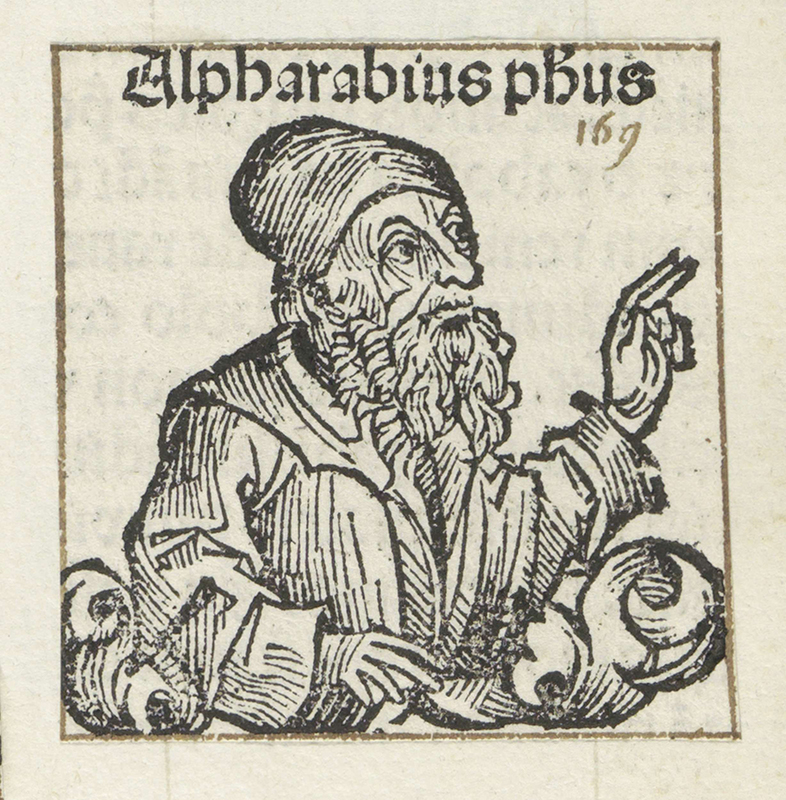
Figure 11.3 This woodcut from the fifteenth century depicts Al-Farabi as a wise, old man. Al-Farabi made important contributions to philosophy as well as to the fields of science, sociology, medicine, mathematics, and music. (credit: “Al-Farabi” by Michel Wolgemut/Europeana, Public Domain)
図11.3 この15世紀の木版画は、ファーラービーを賢い老人として描いている。ファーラービーは哲学のほか、科学、社会学、医学、数学、音楽の分野にも重要な貢献をした。(クレジット:Michel Wolgemut/Europeanaによる “Al-Farabi”、パブリックドメイン)