第11章政治哲学Political Philosophy
11.3 Political Legitimacy and Duty11.3 政治的正統性と義務
Learning Objectives学習目標
By the end of this section, you will be able to:
この節を学び終えると、次のことができるようになる。
Identify two key arguments for political legitimacy.
政治的正統性を擁護する二つの主要な論証を挙げる。
Explain how a person might have a duty to others without having an obligation to the state.
国家に対する義務を負わなくても、他者に対して義務をもちうるのはなぜかを説明する。
No matter what system of government a society adopts, a government needs authority to rule. What gives rulers their authority, and what rights, if any, do citizens have? One fundamental question of political theory becomes, What are the sources of the legitimacy of a political system, and by extension, how much authority do rulers or leaders have over citizens? Further, what obligations does a state owe its citizens, and vice versa? This section will explore different ideas and characteristics of the source of authority and the obligations of its members.
英語のヒント
社会がどのような統治制度を採用するにせよ、政府が統治するには権威が必要である。何が統治者に権威を与え、市民には権利があるとすれば、どのような権利があるのだろうか。こうして政治理論の根本的な問いの一つは、政治制度の正統性は何に由来し、ひいては統治者や指導者が市民に対してどれほどの権威をもつのか、というものになる。さらに、国家は市民にどのような義務を負い、逆に市民は国家にどのような義務を負うのだろうか。この節では、権威の源と、その成員の義務について、さまざまな考え方や特徴を探究する。
Divine Rule神授の支配
The Mohists claimed that the emperor is chosen by heaven rather than the people. In order to fight against social chaos, heaven identifies a wise ruler to establish control and act as a model of virtuous behavior (Mozi n.d.). This is an example of divine rule, which legitimizes the rule of monarchs and lines of succession in a royal family by stating that monarchs are chosen by divine authority and therefore are not answerable to the people. The idea of divine rule became prevalent in Europe after the Roman Empire adopted Christianity. Yet with the rise of Protestantism and the middle classes in Europe, new ideas emerged about authority and the rights and responsibilities of leaders and citizens. Philosophers in western Europe, such as Thomas Hobbes and John Locke, began to argue that the legitimacy of government rests on a social contract between the ruler and the ruled.
英語のヒント
墨家は、皇帝を選ぶのは人民ではなく天だと主張した。天は、社会的混乱と闘うために、統制を確立し、有徳な行動の模範となる賢い統治者を選び出す(Mozi n.d.)。これは神授の支配の例である。神授の支配は、君主は神的権威によって選ばれるため、人民に説明責任を負わないと述べることで、君主の支配と王家の継承系統を正統化する。神授の支配の考えは、ローマ帝国がキリスト教を受け入れた後、ヨーロッパで広まった。しかし、ヨーロッパでプロテスタンティズムと中産階級が台頭すると、権威や、指導者と市民の権利・責任について、新たな考えが現れた。トマス・ホッブズやジョン・ロックなど、西ヨーロッパの哲学者は、政府の正統性は、統治する者とされる者の社会契約に基づくと論じ始めた。
Thomas Hobbes and Absolute Monarchyトマス・ホッブズと絶対君主制
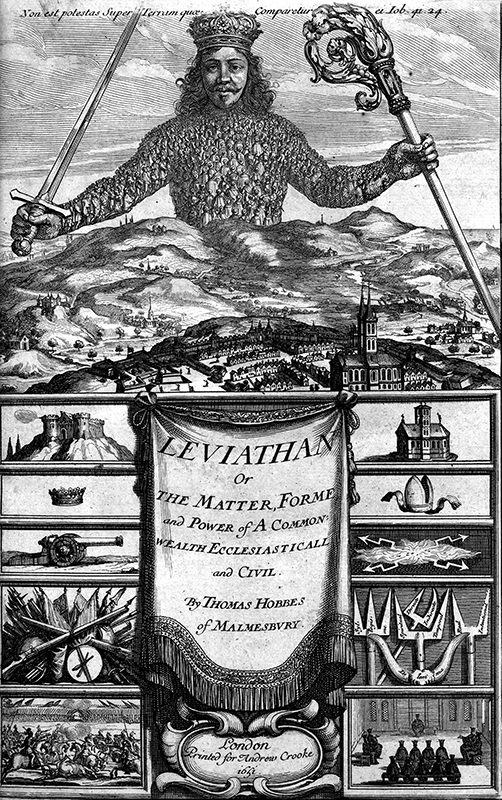
Figure 11.5 Thomas Hobbe’s Leviathan, first published in 1651, presents absolute monarchy as an order-creating and necessary force in society. (credit: “Frontispiece of Leviathan engraved by Abraham Bosse, with input from Thomas Hobbes, the author” by Abraham Bosse by unknown author/Wikimedia, Public Domain)
図11.5 1651年に初めて出版されたトマス・ホッブズの『リヴァイアサン』は、絶対君主制を、社会に秩序を生む必要な力として提示する。(クレジット:“Frontispiece of Leviathan engraved by Abraham Bosse, with input from Thomas Hobbes, the author”、Abraham Bosse、原クレジット記載 unknown author/Wikimedia、パブリックドメイン)
Leviathan, written by the English philosopher Thomas Hobbes (1588–1679) and first published in 1651, looks at the structure of systems of government and develops the social contract theory. In the text, Hobbes imagines a time prior to the creation of social institutions, when humans were motivated solely by satisfying their desires. When land and food are plentiful, people can meet their needs and even store surplus for lean times. But as population increases, people compete for resources, which means that one person’s gain is another’s loss. Scarcity leads to conflict when people fight to obtain what they need. Prior to the establishment of political authority, there is no check on violence, and thus human beings enter a state of perpetual war, which Hobbes considers the state of nature. In this state,
英語のヒント
イングランドの哲学者トマス・ホッブズ(1588–1679)が著し、1651年に初めて出版した『リヴァイアサン』は、統治制度の構造を考察し、社会契約論を展開する。本文でホッブズは、社会制度が作られる以前、人間が自分の欲求を満たすことだけによって動かされていた時代を想像する。土地や食糧が豊富なとき、人々は必要を満たし、乏しい時期に備えて余剰を蓄えることさえできる。しかし、人口が増えると、人々は資源を求めて競い合う。ある人の利益は、別の人の損失を意味する。必要なものを得るために争うとき、希少性は対立を生む。政治的権威が確立する以前には、暴力に歯止めがないため、人間は永続的な戦争状態に入る。ホッブズは、それを自然状態と捉える。この状態では、
there is no place for Industry; because the fruit thereof is uncertain; and consequently no Culture of the Earth; no Navigation, nor use of the commodities that may be imported by Sea; no commodious Building; no Instruments of moving, and removing such things as require much force; no Knowledge of the face of the Earth; no account of Time; no Arts; no Letters; no Society; and which is worst of all, continuall feare, and danger of violent death; And the life of man, solitary, poore, nasty, brutish, and short. (Hobbes [1968] 2002, ch. 13)
英語のヒント
勤労の余地はない。その成果が確かでないからである。したがって、土地の耕作もない。航海も、海から輸入できる品物の利用もない。便利な建物も、大きな力を要する物を動かし移す道具もない。地表についての知識も、時の計算も、技芸も、文字も、社会もない。そして何より悪いことに、絶えざる恐怖と、暴力による死の危険がある。人間の生は、孤独で、貧しく、汚らしく、野蛮で、短い。(Hobbes [1968] 2002, ch. 13)
To successfully leave the state of nature, people must form a political community that ensures their basic needs are met, moderates conflicts, and codifies rules of behavior. Part of that project includes identifying a power that can hold authority. Hobbes believed that power should be held by the monarchy, arguing that one absolute and central authority is the best method of maintaining peace and avoiding discord and factionalism.
英語のヒント
自然状態を無事に離れるには、人々は、基本的な必要が満たされることを確保し、争いを調整し、行動規則を明文化する政治的共同体を形成しなければならない。その取り組みの一部には、権威を担いうる権力を定めることが含まれる。ホッブズは、その権力を君主制が握るべきだと考え、唯一の絶対的・中央集権的な権威が、平和を保ち、不和と派閥争いを避ける最善の方法だと論じた。
John Locke and Representative Governmentジョン・ロックと代表制による統治
Other proponents of the social contract, including French philosopher Jean-Jacques Rousseau (1712–1778) and English philosopher John Locke (1632–1704), rejected absolute monarchy. Instead, they argued for representative government. In fact, John Locke’s Second Treatise on Civil Government (1689) served as a major inspiration for the American founding fathers. Some of his well-known ideas can be found in the Declaration of Independence and the Constitution. Locke defends the necessity of the separation of the church and state, for example, and provides the origin of the edict on self-preservation that leads to retaining the right to bear arms.
英語のヒント
フランスの哲学者ジャン=ジャック・ルソー(1712–1778)や、イングランドの哲学者ジョン・ロック(1632–1704)など、社会契約論の他の支持者は、絶対君主制を退けた。代わりに、代表制による統治を支持した。実際、ジョン・ロックの『統治二論』後篇(1689)は、アメリカ建国の父たちに大きな着想を与えた。その有名な考えのいくつかは、独立宣言と憲法に見られる。たとえばロックは、教会と国家を分離する必要性を擁護し、武器を保有する権利の保持につながる、自己保存についての命令の源を示している。
Similar to Hobbes, Locke imagines that people begin in the state of nature and eventually agree to give up some liberties to an impartial authority in exchange for peace and security. But unlike Hobbes, Locke says that we exist peacefully for the most part and can be counted on to act in our interests when necessary. Locke invokes natural law, which is the notion that humankind is granted rationality by God and can use that rationality to determine moral laws. These laws are obligatory and include respect for others and the recognition of individual liberty. As Locke sees it, humans are born into “a state also of equality, wherein all the power and jurisdiction is reciprocal” (Locke 2016, 122). We are naturally free and equal; no one person has more natural power or right to rule than another. Locke maintains “that all men are naturally in that state, and remain so, till by their own consents they make themselves members of some politic society” (129).
英語のヒント
ホッブズと同様にロックも、人々は自然状態から始まり、やがて平和と安全と引き換えに、公平な権威へ一部の自由を譲ることに同意すると想像する。しかし、ホッブズとは異なりロックは、私たちは大半の場合、平和に存在し、必要なときには自分の利益に沿って行動すると信頼できる、と述べる。ロックは自然法を持ち出す。人類は神から理性を授けられ、その理性によって道徳法則を定められるという考えである。これらの法則は義務を課すものであり、他者への尊重と個人の自由の承認を含む。ロックによれば、人間は「また平等の状態、すなわち、あらゆる権力と管轄権が相互的である状態」に生まれる(Locke 2016, 122)。私たちは生まれながらに自由かつ平等であり、ある人が他の人より多くの自然的権力や支配権をもつことはない。ロックは、「すべての人は本来自然にその状態にあり、自分自身の同意によって何らかの政治社会の成員になるまで、その状態にとどまる」と主張する(129)。
In Locke’s state of nature, we have the right to own ourselves and can do what we like with ourselves, and we can own limited property. At first, property is things from nature that God gave to us in common to fulfill our basic needs and survival. Later, as society develops and begins using money, property is extended to include what we improve through our labor. Even in this early state, we are not free to abuse others. We are not free to take more than we need, for example. The law of self-preservation is prominent throughout Locke’s treatise and can be found in his discussion of war as well in his solution to a tyrannical government (that people exercise their right to change it). Locke’s philosophy is based on the assumption that moral law, which precedes the establishment of any political structure, leads to a type of natural justice.
英語のヒント
ロックの自然状態では、私たちは自分自身を所有する権利をもち、自分自身については好きなことができ、限られた財産も所有できる。当初、財産とは、基本的な必要と生存を満たすため、神が私たちに共同で与えた自然のものである。その後、社会が発展し、貨幣を使い始めると、財産には、自らの労働によって改良したものも含まれるようになる。この初期の状態でも、他者を害する自由があるわけではない。たとえば、必要以上のものを取る自由はない。自己保存の法は、ロックの論考全体で大きな位置を占める。戦争についての議論にも、専制的な政府への解決策、すなわち、人々が政府を変える権利を行使するという考えにも見られる。ロックの哲学は、いかなる政治構造の成立にも先立つ道徳法が、一種の自然的正義をもたらすという想定に基づく。
Locke also differentiates between natural liberty, which grows out of natural law, and civil liberty, which is the product of governance by a commonwealth. Remember that Locke establishes that we are allowed to gain property. We do so through our labor, when we improve the land that was given to us in common. This work, in turn, benefits others. As we gain more and more property, we develop a need to defend our property. If a person does not have property, they will still be under the protection of the laws of the civil society, though they will not have a hand in determining those laws. We agree to move from the state of nature into a society to protect property, both ourselves (as property) and our goods. By moving into a civil society, we gain the protection of laws, an impartial judge, and a means to enforce laws. The legislative power of civil society establishes its laws. These laws presumably are created with the interests of the entire commonwealth in mind, so individual interests may not supersede the interests of the whole. The executive power enforces these laws and should not have a hand in establishing laws. Locke views this requirement as a safeguard against personal interest.
英語のヒント
ロックはまた、自然法から生じる自然的自由と、政治的共同体による統治の産物である市民的自由を区別する。ロックが、私たちには財産を得ることが許されるとしたことを思い出してほしい。共同で与えられた土地を労働によって改良するとき、私たちは財産を得る。この労働は、ひいては他者の利益にもなる。財産が増えるにつれ、それを守る必要が生じる。財産をもたない人も、市民社会の法の保護は受けるが、その法を定めることには関与しない。私たちは、財産としての自分自身と、自分の持ち物の両方を守るために、自然状態から社会へ移ることに同意する。市民社会へ移ることで、法の保護、公平な裁判官、法を執行する手段を得る。市民社会の立法権が、その法を制定する。これらの法は、政治的共同体全体の利益を念頭に置いて作られると考えられるため、個人の利益が全体の利益に優先してはならない。行政権はこれらの法を執行し、法の制定には関与すべきではない。ロックは、この要件を、私的利益の追求を防ぐ保障と捉える。
After civil society is established, Locke addresses the question of how much freedom the government should have to act without consulting the commonwealth as a whole and what limits should be put on its power. Above all, the good of the society must be the goal of government. Those who make up the legislative and executive powers must be cautious that these powers do not become a micro society. The longer individuals stay in positions of power, the greater the chance they may fall into corruption. If that happens, then the civil state will become worse than the state of nature. For that reason, people then have the right to remove the governmental powers; a state that has become tyrannical can justly be dissolved. The people may reestablish the structure that previously worked best or change to a system that better protects their interests. Ultimately, it is the commonwealth (the people) who oversee the society at large and determine its ability to function properly. Thus, Locke’s safeguard against tyranny allows people to return to the state of nature, if necessary, and begin again.
英語のヒント
市民社会が成立した後、ロックは、政府が政治的共同体全体に相談せずに行動する自由を、どこまでもつべきか、その権力にどのような制限を置くべきかを問う。何よりも、社会の善が政府の目標でなければならない。立法権と行政権を担う人々は、それらの権力が小さな社会を形成してしまわないよう、注意しなければならない。人が権力の地位に長くとどまるほど、腐敗に陥る可能性は高まる。そうなれば、市民国家は自然状態より悪くなる。そのため人々には、政府の権力を取り除く権利がある。専制的になった国家は、正当に解体できる。人々は、以前最もうまく機能した構造を再建することも、自分たちの利益をよりよく守る制度へ変えることもできる。最終的に、社会全体を監督し、その適切な機能を決めるのは、政治的共同体、すなわち人民である。このように、ロックの専制に対する保障は、必要なら人々が自然状態へ戻り、やり直すことを認める。
Watch a short overview of Locke’s ideas about government.
統治についてのロックの考えを、短い解説動画で見てみよう。