第10章応用倫理学Applied Ethics
Normative Moral Frameworks Applied to Clinical Trials臨床試験に応用する規範倫理学の枠組み
The four main ethical concepts discussed above can (and should) guide decision-making in a clinical setting. Not only do normative moral frameworks provide additional and more robust guidance for moral decision making and conduct, but their application to specific issues can also shed light on why we support the adoption of ethical practices.
英語のヒント
以上で論じた四つの主要な倫理的概念は、臨床の場で意思決定の指針となりうるし、そうなるべきでもある。規範倫理学の枠組みは、道徳的な意思決定と行動に、いっそうしっかりした追加の指針を与えるだけではない。それを具体的な問題に適用することによって、なぜ私たちが倫理的な実践の採用を支持するのかも、明らかにできる。
Utilitarians like Jeremy Bentham (1748–1832) and John Stuart Mill (1806–1873) proposed that the rightness of an action is determined by its consequences, by what it produces. They argued that we act morally when our actions produce the greatest happiness for the greatest number. In clinical trials, the utilitarian emphasis on consequences and, in particular, happiness provides a framework that may help us balance scientific/research goals and the interests of human research subjects. Mill argued that we should assess the morality of an action from the standpoint of an impartial, benevolent spectator. We are impartial when we consider everyone’s happiness, including our own, equally and don’t give preference to some individuals’ or some groups’ happiness or interests over others. We are benevolent when we strive to choose those actions that produce the most overall happiness and do not sacrifice the happiness of some for the happiness of others. Clinical trials ought to weigh the interests of human subjects carefully and be conducted in ways that do not sacrifice the subjects’ interests for the sake of science. Research is often funded by the private sector. Companies pursuing new treatments and interventions must balance their interests in profits, the costs associated with research and clinical trials, the aims of science, and the interests of the human subjects in their trials. If decisions are not made with these interests in mind, it is possible that choices in how clinical trials are conducted may be made not based on producing the greatest overall happiness but rather to increase overall profits for certain individuals or private groups.
英語のヒント
ジェレミー・ベンサム(1748〜1832年)やジョン・スチュアート・ミル(1806〜1873年)らの功利主義者は、行為の正しさは、その帰結、すなわち、その行為が何を生み出すかによって決まると提唱した。彼らによれば、私たちの行為が最大多数に最大の幸福をもたらすとき、私たちは道徳的に行動している。臨床試験では、帰結、とりわけ幸福を重視する功利主義の姿勢が、科学・研究の目的と、研究の被験者となる人々の利益との釣り合いを取るための枠組みとなりうる。ミルは、行為の道徳性を、公平で善意ある観察者の立場から評価するべきだと論じた。自分自身を含むすべての人の幸福を等しく考慮し、一部の個人や集団の幸福・利益を、他の人々より優先しないとき、私たちは公平である。また、全体として最大の幸福をもたらす行為を選ぼうと努め、一部の人々の幸福のために他の人々の幸福を犠牲にしないとき、私たちは善意ある態度を取っている。臨床試験は、人である被験者の利益を慎重に考慮し、科学のためにその利益を犠牲にすることのない方法で行われるべきである。研究には民間部門が資金を提供することが多い。新たな治療や介入を追求する企業は、利益を得たいという自社の関心、研究と臨床試験に伴う費用、科学の目的、試験の被験者である人々の利益の間で、釣り合いを取らなければならない。これらの利益を念頭に置かずに意思決定をすると、臨床試験の実施方法が、全体として最大の幸福を生み出すためではなく、特定の個人や民間集団の利益を最大限に増やすために選ばれる可能性がある。
A deontologist like Kant would examine the relevant rules and norms that apply to clinical trials. For Kant, an important rule that must be considered when using human research subjects is the imperative to always treat all persons as ends in themselves, never as means only. In other words, Kant believed that all people have inherent worth and value that is not dependent simply on usefulness for some end or goal. Kant’s ethics emphasizes the rights of human subjects and makes clear that potential research subjects must make an informed, free decision whether to participate in a clinical trial. Additionally, human beings’ rights cannot be ignored or denied because some other end (e.g., the goals of science, profits, or even greater human interests) is deemed more valuable. A Kantian approach would affirm the rights, choice, and autonomy of trial participants.
英語のヒント
カントのような義務論者は、臨床試験に適用される規則や規範を検討するだろう。カントにとって、人を研究の被験者として用いる際に考慮しなければならない重要な規則は、すべての人格を常にそれ自体が目的であるものとして扱い、決して単なる手段としてのみ扱わない、という命法である。言い換えればカントは、すべての人には、何らかの目的や目標にとって役立つかどうかだけには依存しない、内在的な価値があると考えた。カントの倫理学は、被験者となる人の権利を重視し、参加候補者が臨床試験に参加するかどうかを、必要な情報を得たうえで、自由に決めなければならないことを明確にする。また、科学の目的、利益の獲得、さらには人類全体のより大きな利益など、別の目的のほうが価値が高いと判断されたからといって、人間の権利を無視したり否定したりすることはできない。カント的なアプローチは、試験参加者の権利、選択、自律を肯定する。
Care ethics takes a character-centered approach, but it makes the values of caring central in our moral deliberation and decision-making. Care ethics uses the caring relationship as the ethical paradigm and thus highlights the importance of subjective and concrete factors when evaluating the rightness of certain actions and choices. In clinical trials, care ethics reminds us to value all humans and consider the importance of virtues like compassion and empathy when interacting with and treating patients.
英語のヒント
ケアの倫理は人格を中心に据えるアプローチを取り、道徳的な熟慮と意思決定において、ケアの価値を中心に置く。ケアの関係を倫理の基本的なモデルとし、そのため、特定の行為や選択の正しさを評価するときには、主観的で具体的な要因の重要性を強調する。臨床試験においてケアの倫理は、すべての人間を大切にし、患者と関わり、治療するときに、思いやりや共感といった徳の重要性を考えるよう促す。
Human Augmentation and Genetic Modification人間の能力増強と遺伝子改変
Human augmentation refers to attempts to enhance or increase human capabilities through technological, biomedical, or other interventions. While the notion of enhancement is broad, philosopher Eric Juengst and psychiatrist Daniel Moseley define it as “biomedical interventions that are used to improve human form or functioning beyond what is necessary to restore or sustain health” (Juengst and Moseley 2019). Human augmentation, then, refers to interventions sought not for individual health but for the sake of improving an individual’s capabilities and functioning. For example, the cyclist Lance Armstrong famously won the Tour de France seven years in a row (1999–2005). Armstrong became infamous, however, when he was later stripped of his titles after it became clear that he had practiced “blood doping” to improve his performance when competing in the Tour de France. He used illegal and banned interventions to enhance his performance and gain an unfair edge over competition. There are many potential biomedical interventions (e.g., pharmacological) that can be used to improve or enhance capabilities in certain areas, and it can often be difficult to clearly define why some raise moral concerns and others do not. Many people, for instance, ingest caffeine on a regular basis. Caffeine is a mild stimulant that may enhance capabilities, but caffeine use is accepted and generally does not raise moral concerns. In contrast, using Adderall, a pharmaceutical amphetamine salt, not as prescribed for medical and health reasons but to enhance energy levels and memory is the sort of intervention that is often viewed as ethically problematic.
英語のヒント
人間の能力増強とは、技術的、生物医学的、あるいはその他の介入によって、人間の能力を高めたり増やしたりする試みをいう。「増強」という概念は広いが、哲学者エリック・ユングストと精神科医ダニエル・モーズリーは、それを「健康を回復または維持するために必要な範囲を超えて、人間の形態や機能を改善するために用いられる生物医学的介入」と定義する(Juengst and Moseley 2019)。つまり、人間の能力増強は、個人の健康のためではなく、その人の能力や機能を高めるために求められる介入である。たとえば、自転車競技選手のランス・アームストロングは、ツール・ド・フランスで7年連続優勝(1999〜2005年)を果たしたことで知られた。しかし後に、その大会で競う際の成績を高めるため、「血液ドーピング」を行っていたことが明らかになると、タイトルを剥奪され、悪名を得た。彼は、禁止された違法な介入によって競技能力を高め、競争相手に対して不公正な優位を得ていたのである。特定の領域での能力を改善・増強するために使える生物医学的介入、たとえば薬物による介入は数多く考えられる。ある介入が道徳上の懸念を生み、別の介入は生まない理由を、明確に定めるのは難しいことが多い。たとえば、多くの人はカフェインを日常的に摂取している。カフェインは能力を高める可能性がある弱い興奮剤だが、その使用は受け入れられており、一般に道徳上の懸念を生まない。対照的に、医薬品であるアンフェタミン塩製剤のアデラールを、医学的・健康上の理由で処方されたとおりに使うのではなく、活力や記憶力を高めるために使うことは、倫理的に問題があるとみなされがちな介入である。
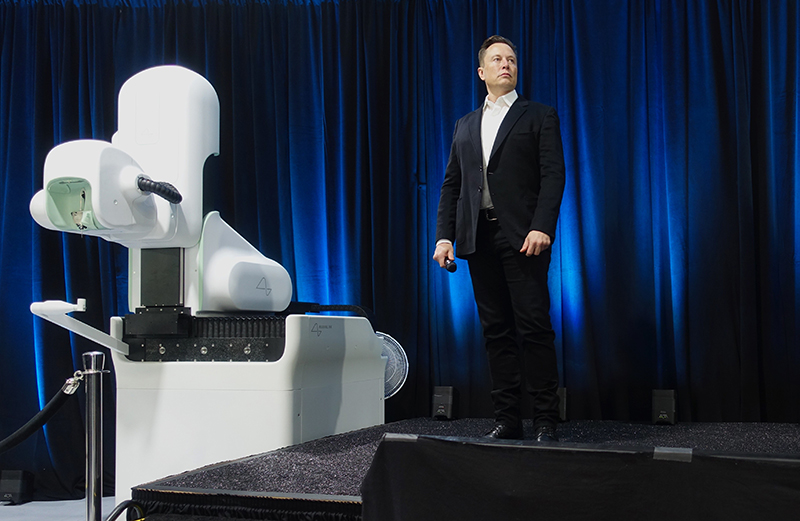
Figure 10.5 Elon Musk stands next to a machine for inserting a Neuralink implant in the human brain. This implant is designed to make it possible for people to operate devices like smartphones and computers using their minds. (credit: “Elon Musk and the Neuralink Future” by Steve Jurvetson/Flickr, CC BY 2.0)
図10.5 人の脳にニューラリンクのインプラントを埋め込む機械の隣に立つ、イーロン・マスク。このインプラントは、スマートフォンやコンピューターのような機器を、思考によって操作できるようにするために設計されている。(クレジット:Steve Jurvetson/Flickrによる「Elon Musk and the Neuralink Future」、CC BY 2.0)
Advancements in human biotechnology have created an opportunity for some people to exercise genetic choices that could yield potential therapeutic benefits and make it possible to augment human capacities through genetic modification. Developments in gene editing technologies like CRISPR (clustered regularly interspaced short palindromic repeats), for example, have made genetic modification easier, faster, and more affordable. New technologies have also demonstrated the potential of gene editing.
英語のヒント
人間を対象とするバイオテクノロジーの進歩によって、一部の人々は、治療上の利益をもたらす可能性のある遺伝的な選択を行い、遺伝子改変を通じて人間の能力を増強する機会を得た。たとえば、CRISPR(一定間隔で集積した短い回文構造の反復配列)のような遺伝子編集技術が発展し、遺伝子の改変は、より簡単で、速く、費用も手頃になった。新たな技術は、遺伝子編集の可能性も示している。
The characteristics of an organism can be deliberately modified and altered through genetic engineering. Genetic modification has been practiced in agriculture to intentionally alter the characteristics of certain crops (e.g., rice and corn) so that plants, for example, produce higher yields, are more robust, and have increased nutritional properties. Human augmentation through genetic engineering raises numerous ethical concerns. If genetic information is altered to promote certain traits, then how we define “positive” and “negative” genetic traits could have far-reaching consequences. Positive genetic traits will naturally be ones that are promoted and reinforced, whereas negative genetic traits will be reduced and eliminated. In the future, if human genetic modification becomes widely practiced, it is possible that a focus on “positive” genetic traits will decrease human genetic diversity, making us less adaptable and more vulnerable.
英語のヒント
遺伝子工学によって、生物の特徴を意図的に改変し、変えることができる。農業では、イネやトウモロコシなどの作物の性質を意図的に変え、たとえば収量を増やし、丈夫にし、栄養面の性質を高めるために、遺伝子改変が行われてきた。遺伝子工学による人間の能力増強は、数多くの倫理的な懸念を生む。特定の形質を促すために遺伝情報を変えるなら、どの遺伝的形質を「望ましい」、どれを「望ましくない」と定義するかが、広範な影響を及ぼしうる。望ましい形質は、当然、促され、強化されるものとなり、望ましくない形質は減らされ、取り除かれる。将来、人間の遺伝子改変が広く行われるようになれば、「望ましい」遺伝的形質を重視することで、人間の遺伝的多様性が低下し、適応力が下がり、弱いものになる可能性がある。