第10章応用倫理学Applied Ethics
10.1 The Challenge of Bioethics10.1 生命倫理学の課題
Learning Objectives学習目標
By the end of this section, you will be able to:
この節を学ぶと、次のことができるようになる。
Summarize current scientific advances and social and political factors that contribute to our understanding of today’s bioethical controversies.
現在の生命倫理上の論争を理解するうえで関わってくる、近年の科学的進歩と社会的・政治的要因を要約する。
Explain the main philosophical positions in major areas of bioethical debate including abortion, euthanasia, clinical trials, and human augmentation.
人工妊娠中絶、安楽死、臨床試験、人間の能力増強など、生命倫理上の主要な論争における主な哲学的立場を説明する。
Propose a position on each bioethical issue.
それぞれの生命倫理上の問題について、自分の立場を提示する。
The term bioethics, which essentially means “life ethics,” was coined in 1970 by Van Rensselaer Potter (1911–2011), an American biochemist. It is a field that studies ethical issues that emerge with advances in biology, technology, and medicine. For example, bioethics deals with issues related to patient autonomy, the distribution of and access to medical resources, human experimentation, online privacy, and life-and-death decisions in medicine. When confronted with issues like these, ethicists consider a multiplicity of views, any potentially relevant interests, and complex situational factors. The bioethicist, like anyone doing applied ethics, must be prepared to wear many hats in order to explore all sides and perspectives. This section looks at current areas of controversy and debate in the field of bioethics.
英語のヒント
bioethicsという語は、基本的には「生命の倫理」を意味し、アメリカの生化学者ヴァン・レンセラー・ポッター(1911〜2011年)が1970年に作った。生命倫理学は、生物学、技術、医療の進歩とともに生じる倫理的な問題を研究する分野である。たとえば、患者の自律、医療資源の配分とそれへのアクセス、人体実験、オンライン上のプライバシー、医療における生死の決定に関する問題を扱う。こうした問題に向き合うとき、倫理学者は、多様な見解、関わりうるあらゆる利害、そして複雑な状況上の要因を考慮する。生命倫理学者は、応用倫理学を行う誰もがそうであるように、あらゆる側面と観点を探究するため、いくつもの役割を担う用意がなければならない。この節では、生命倫理学で現在論争や議論になっている領域を取り上げる。
The Abortion Debate人工妊娠中絶をめぐる議論
This section investigates biological, political, legal, and moral aspects of the issue of abortion. Unlike a miscarriage, a spontaneous loss of pregnancy due to injury or natural defect, an abortion is the intentional ending of a pregnancy. When abortions are medically induced, a pregnancy is terminated using drugs, surgery, or a combination of the two. In some cases, abortions are performed out of medical necessity to save the life of a pregnant person (therapeutic abortion), while in others a person who is pregnant elects to have the procedure for other reasons.
英語のヒント
この節では、人工妊娠中絶の問題を、生物学・政治・法律・道徳の側面から検討する。けがや自然な異常によって妊娠が自然に終わる流産とは異なり、人工妊娠中絶は、妊娠を意図的に終わらせる行為である。医学的な処置によって中絶を行う場合、薬剤、手術、あるいはその両方を用いて妊娠を終了させる。妊娠している人の命を救うため、医学的な必要から中絶が行われる場合もある(治療的中絶)。それ以外の理由で、妊娠している本人が処置を受けることを選ぶ場合もある。
Political efforts to legalize contraception and later abortion arose as part of many women’s rights movements. As shown in Figure 10.2, some countries still prohibit abortion, and others place limits on when it is allowed, such as when the life of the person carrying the pregnancy is at risk.
英語のヒント
避妊を合法化し、その後には人工妊娠中絶も合法化しようとする政治的な取り組みは、さまざまな女性の権利運動の一環として起こった。図10.2に示すように、中絶を今なお禁止する国もあれば、妊娠している人の生命が危険にさらされている場合など、中絶を認める条件を制限する国もある。
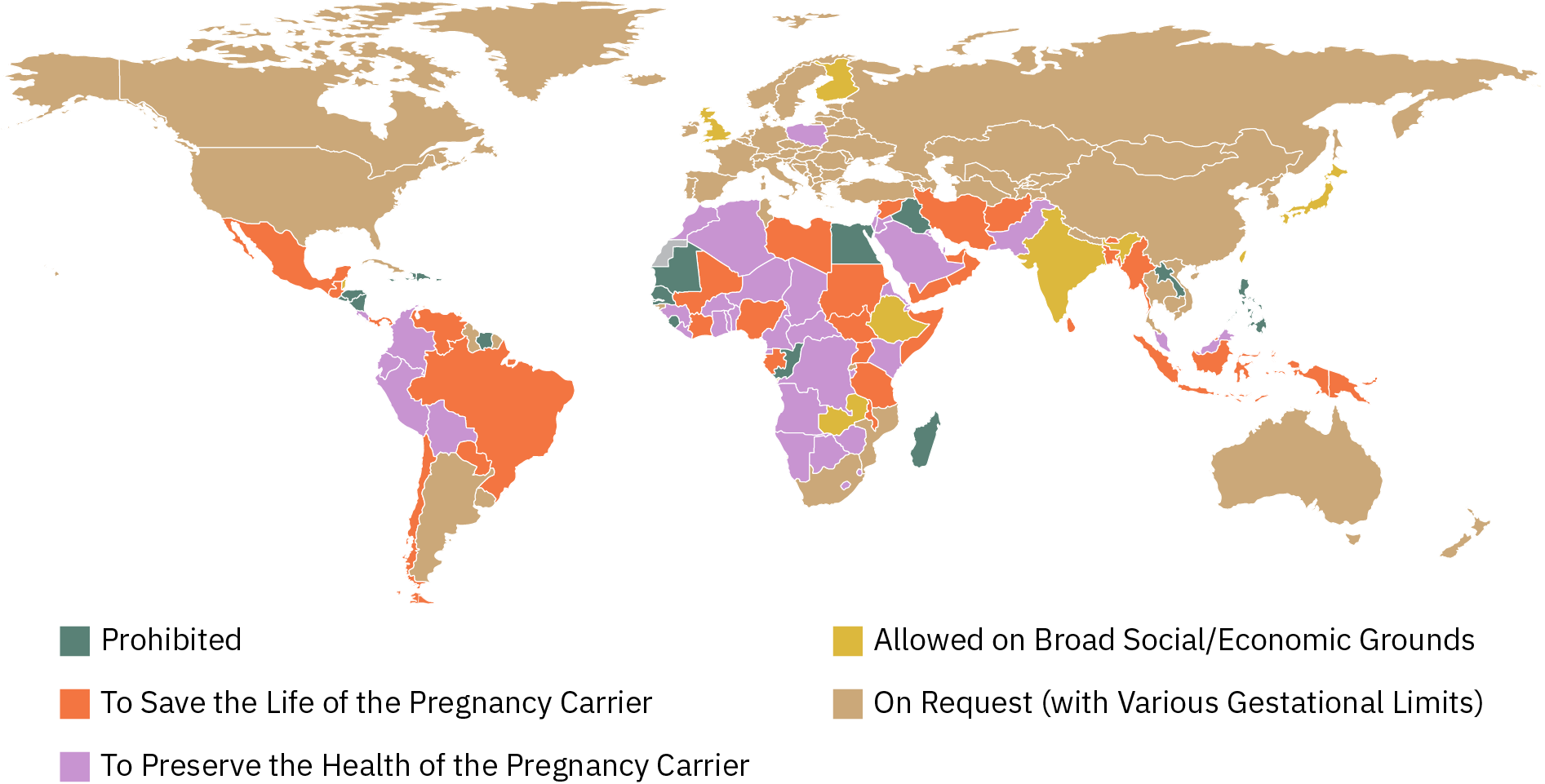
Figure 10.2 Legal status of abortion around the world as of March 2022. (source: Center for Responsive Politics; attribution: Copyright Rice University, OpenStax, under CC BY 4.0 license)
図10.2 2022年3月時点における、世界各地の人工妊娠中絶の法的な扱い。(出典:Center for Responsive Politics。帰属表示:© Rice University/OpenStax、CC BY 4.0)
In the United States, the right to an abortion prior to the viability of the fetus was deemed protected by the Constitution in the historic Supreme Court decision Roe v. Wade (1973). The court established a trimester system to guide abortion decisions. The court initially acknowledged an unmitigated right to abort in the first three months of pregnancy but left it up to the government to regulate abortion in the second trimester and restrict or ban it in the last trimester if the life of the person carrying the pregnancy was not in danger.
英語のヒント
アメリカでは、1973年の歴史的な連邦最高裁判決、ロー対ウェイド判決で、胎児が母体外で生存できるようになる前の中絶の権利は、憲法によって保護されると判断された。裁判所は、中絶に関する判断の指針として、妊娠期間を三つに分ける枠組みを設けた。当初、裁判所は妊娠最初の3か月について、制限を受けない中絶の権利を認めた。一方、第2期の中絶を規制し、最終期には、妊娠している人の生命が危険にさらされていなければ中絶を制限または禁止することを、政府に委ねた。
A subsequent Supreme Court decision, Planned Parenthood v. Casey (1992), reaffirmed Roe v. Wade and ruled that state abortion regulations could not place serious obstacles in the path of someone who chose to seek an abortion before a fetus was viable. The decision also replaced the trimester system with the notion of fetal viability—or the fetus’s ability to survive outside the womb (approximately at 25 to 28 weeks). Someone therefore cannot freely seek an abortion if the fetus is viable.
英語のヒント
その後の連邦最高裁判決であるプランド・ペアレントフッド対ケイシー判決(1992年)は、ロー対ウェイド判決を再確認した。また、胎児が母体外で生存可能になる前に中絶を求めることを選んだ人の進路に、州の中絶規制が重大な障害を設けてはならないと判断した。この判決はさらに、妊娠期間を三つに分ける枠組みに代えて、胎児の生存可能性、すなわち母体の外で生存する能力(およそ妊娠25〜28週)という考え方を採用した。そのため、胎児が生存可能であれば、自由に中絶を求めることはできない。
Utilitarianism and Liberal Views on Individual Rights功利主義と、個人の権利に関する自由主義の見解
Normative moral theories, such as those we considered in the previous chapter, factor into how societies view abortion. In Hinduism, for example, moral actions are based on the principle of ahimsa, or “non-harming,” which means that in considering abortion, the choice is governed by what does the least harm to all involved (e.g., to the parents, the fetus, and society). Portions of the Vedas, Hinduism’s most sacred texts, condemn abortion (BBC 2009). Hinduism considers abortion wrong unless it is necessary to save the life of the person carrying the pregnancy. At the same time, in practice, abortion is common in India because some families prefer to have boy children (Dhillon 2020).
英語のヒント
前章で考察したような規範的な道徳理論は、社会が人工妊娠中絶をどう捉えるかに関わってくる。たとえばヒンドゥー教では、道徳的な行為はアヒンサー、すなわち「害を与えないこと」の原理に基づく。そのため中絶を考える際には、関わるすべての者、たとえば親、胎児、社会に対して、最も害が少ないのは何かによって選択が決まる。ヒンドゥー教の最も神聖な文献であるヴェーダの一部は、中絶を非難している(BBC 2009)。ヒンドゥー教は、妊娠している人の命を救うために必要な場合を除き、中絶を悪い行為とみなす。同時に、実際のインドでは、男児を望む家庭があるため、中絶は一般的に行われている(Dhillon 2020)。
Utilitarianism, the consequentialist approach first advanced by Jeremy Bentham, judges an action to be moral if it provides the greatest good to the greatest number. John Stuart Mill’s work On Liberty popularized and adapted this idea so that it could be implemented within representative governments. Mill recognized that the natural rights of various individuals in society will often come into conflict. To maximize individual freedom, Mill proposed the harm principle. It states that a person’s actions should only be limited if they harm another person. A person’s speech should therefore not be curtailed unless it harms another by, for example, directly inciting violence. The harm principle became the cornerstone of 19th-century liberalism. As a result, many people living in liberal societies today evaluate the morality of abortion by weighing the rights of the pregnant person against the rights of the living organism inside the womb. Those who support abortion tend to use the term fetus for the living organism and do not regard it as a person with rights. Those who oppose abortion use the term unborn child and maintain that it has the rights of personhood.
英語のヒント
ジェレミー・ベンサムが最初に提唱した帰結主義的なアプローチである功利主義は、最大多数に最大の善をもたらす行為を道徳的だと判断する。ジョン・スチュアート・ミルの『自由論』は、この考え方を広め、代議制の政府のもとで実行できるように適応させた。ミルは、社会のさまざまな個人の自然権が、しばしば衝突することを認めていた。個人の自由を最大限にするため、ミルは危害原理を提唱した。この原理によれば、人の行為が制限されるべきなのは、それが他者に害を及ぼす場合だけである。したがって、人の発言は、たとえば直接暴力をあおることによって他者に害を及ぼすのでなければ、制限されるべきではない。危害原理は、19世紀の自由主義の礎となった。その結果、今日の自由主義社会で暮らす多くの人は、妊娠している人の権利と、子宮内にいる生物の権利を比較衡量することで、中絶の道徳性を評価している。中絶を支持する人は、その生物を「胎児」と呼ぶ傾向があり、権利を持つ人格とはみなさない。中絶に反対する人は「まだ生まれていない子ども」という表現を用い、人格としての権利を持つと主張する。
Metaphysical perspectives heavily inform the debate over whether or under what circumstances an abortion is a moral act. For some, the question revolves around what constitutes a person and what rights persons and nonpersons possess. For those who embrace the Judeo-Christian view that humans have a mind, body, and soul, the question often becomes about when the soul enters the body.
英語のヒント
形而上学的な観点は、中絶が道徳的な行為なのか、また、どのような状況であれば道徳的なのかという議論を、大きく方向付ける。何をもって人格とするのか、人格であるものと人格でないものはどのような権利を持つのか、という点を中心に考える人もいる。人間には心、身体、魂があるというユダヤ教・キリスト教の見方を受け入れる人にとっては、しばしば、魂がいつ身体に入るのかが問いとなる。