第10章応用倫理学Applied Ethics
Social Ecology社会的エコロジー
Social ecologists see environmental problems as stemming from the same faulty political and economic system that promotes inequity and is responsible for racism, sexism, and classism. In this view, capitalism has created a system of domination over both humanity and nature and has turned nature into just one more commodity. Murray Bookchin (1921–2006), an American political philosopher and a founder of social ecology, was highly influential in this line of thought. Bookchin believed that most, if not all, of the problems that make up our current environmental crisis are the result of long-standing social problems. He argued that the only way to address our ecological problems is to address our social problems. Bookchin proposed that we change society by rejecting large political structures and big business and empowering smaller, locally based groups that are more tied to their environments and thus more environmentally aware.
英語のヒント
社会的エコロジーの立場を取る人々は、環境問題は、不公平を促進し、人種差別、性差別、階級差別を生み出すのと同じ、欠陥ある政治・経済制度から生じていると考える。この見方によれば、資本主義は、人類と自然の双方を支配する仕組みを作り、自然を、数ある商品の一つにしてしまった。アメリカの政治哲学者で、社会的エコロジーの創始者の一人であるマレー・ブクチン(1921〜2006年)は、この考え方に大きな影響を与えた。ブクチンは、現在の環境危機を構成する問題の、すべてとはいわないまでも大部分は、長く続く社会問題の結果だと考えた。彼は、生態学的な問題に対処する唯一の方法は、社会問題に対処することだと論じた。そして、大規模な政治機構と大企業を退け、地域を基盤とする小さな集団に力を与えることによって、社会を変えるよう提案した。そうした集団は、自らの環境とより強く結び付いているため、環境への自覚もより強いというのである。
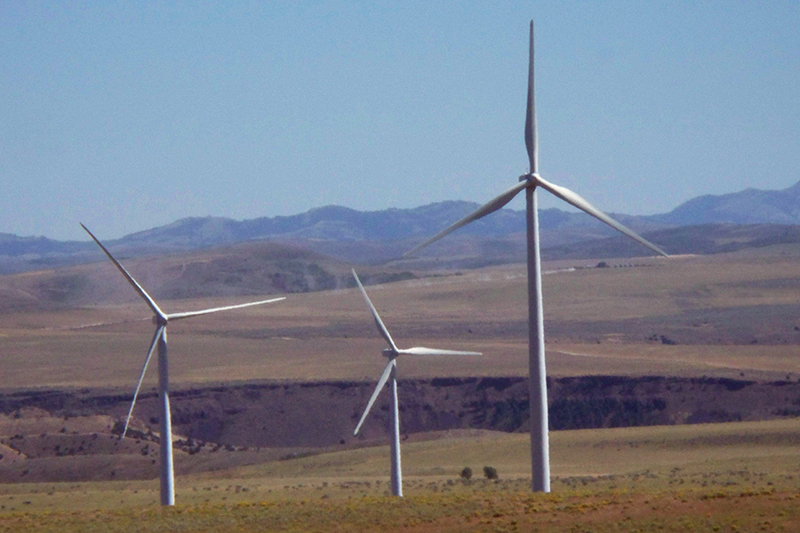
Figure 10.8 Wind is a renewable energy source, in that there is theoretically an infinite supply of it. Wind farms have been popping up in the landscape in many parts of the world. (credit: “Wind Turbines” by Zechariah Judy/Flickr, CC BY 2.0)
図10.8 風は、理論上、無限に供給されるという点で、再生可能エネルギー源である。世界各地の風景の中に、風力発電所が次々と現れている。(クレジット:Zechariah Judy/Flickrによる「Wind Turbines」、CC BY 2.0)
Concerns have also been raised about the unequal impact environmental problems have on different segments of society. Robert Bullard’s 1990 book Dumping in Dixie argues that environmentalism is intertwined with issues of racial and socioeconomic equity. It is thus not just an issue of individual health but rather a concern about the health of communities. Historically marginalized communities in particular are statistically more likely to be exposed to environmental dangers. One egregious and well-publicized example of these types of dangers is the water crisis in Flint, Michigan. In 2014, it was realized that drinking water in Flint was contaminated with high levels of lead. This contamination was the result of a decision made by emergency managers appointed by the state government to switch Flint’s water supply from the Detroit water system to the Flint River, in order to save money. The Flint River water not only contained bacteria and carcinogens but also leached lead from the pipes that brought water to people’s homes. As a result, many suffered from rashes, hair loss, and elevated blood levels of lead (Denchak 2018). Another example can be seen in the South Bronx, in New York City. This area is sometimes referred to as an “island of pollution,” as it lies at the confluence of three major highways. The pollution from the traffic has resulted in an increase in asthma diagnoses and asthma-related hospitalizations in those living in this neighborhood, the majority of them Black Americans, Latinos, and new immigrants (Butini 2018).
英語のヒント
環境問題が、社会の異なる集団へ不平等な影響を及ぼすことについても、懸念が示されてきた。ロバート・ブラードの1990年の著書『南部への廃棄物投棄』は、環境保護が、人種的・社会経済的な公正の問題と絡み合っていると論じる。そのため、環境保護は個人の健康だけの問題ではなく、共同体の健康に関わる問題でもある。特に、歴史的に周縁へ追いやられてきた共同体は、統計的に、環境上の危険にさらされる可能性が高い。こうした危険の、特にひどく、広く報道された例の一つが、ミシガン州フリントの水危機である。2014年、フリントの飲料水が、高濃度の鉛に汚染されていることが判明した。この汚染は、州政府が任命した緊急財政管理者たちが、費用を節約するために、フリントの水源をデトロイトの水道システムからフリント川へ切り替える決定を下した結果だった。フリント川の水は、細菌や発がん性物質を含んでいただけでなく、各家庭へ水を運ぶ配管から鉛を溶出させた。その結果、多くの人々が、発疹、脱毛、血中鉛濃度の上昇に苦しんだ(Denchak 2018)。別の例は、ニューヨーク市のサウス・ブロンクスに見られる。この地域は、三つの主要高速道路が合流する場所にあるため、「汚染の島」と呼ばれることがある。交通による汚染は、この地域の住民の喘息診断と、喘息に関連した入院を増加させた。住民の大多数は、黒人アメリカ人、ラティーノ、新たに入国した移民である(Butini 2018)。
Similar differences in environmental dangers can be observed on a global scale. A 2016 United Nations report reported that people in developing countries are more likely to live on land that has been exposed to contamination and chemical pollutants than those in wealthier nations (United Nations 2016).
英語のヒント
同様に、環境上の危険にさらされる程度の違いは、世界規模でも見られる。2016年の国連報告書によると、開発途上国の人々は、より裕福な国々の人々に比べ、汚染や化学汚染物質にさらされてきた土地で暮らす可能性が高い(United Nations 2016)。
Summaryまとめ
Environmental ethics is an area of applied ethics that attempts to rethink our relationship to the natural world and identify right conduct in our dealings with the nonhuman world. This section explores important aspects of environmental ethics like the political and legal dimensions, the value of nature, deep ecology, social ecology, and inequalities in environmental impact globally.
環境倫理学は、自然界との関係を考え直し、人間以外の世界を扱う際の正しい行動を明らかにしようとする、応用倫理学の一分野である。この節では、政治と法律の側面、自然の価値、ディープ・エコロジー、社会的エコロジー、世界における環境影響の不平等など、環境倫理学の重要な側面を探究した。
Review Questions確認問題
Historically, Western thinking has been dominated by the anthropocentric perspective. What does Lynn White attribute this to?
歴史的に、西洋の考え方は、人間中心主義的な見方に支配されてきた。リン・ホワイトは、その原因を何に求めているか。
Why does William Baxter adopt an anthropocentric environmental ethic?
ウィリアム・バクスターは、なぜ人間中心主義的な環境倫理を採用するのか。
What are some of the main beliefs held by deep ecologists?
ディープ・エコロジーの立場を取る人々が持つ、主な信念には何があるか。
For social ecologists, what is the root cause of most of our environmental problems?
社会的エコロジーの立場では、環境問題の大部分の根本原因は何か。
Suggested Readingさらに読むために
Berry, Thomas. 1987. “The Dream of the Earth: Our Way into the Future.” CrossCurrents 37 (2/3): 200–215. https://www.jstor.org/stable/24459049.
Berry, Thomas. 1987. “The Dream of the Earth: Our Way into the Future.” CrossCurrents 37 (2/3): 200–215. https://www.jstor.org/stable/24459049.
Carson, Rachel. 1962, Silent Spring. Boston: Houghton Mifflin.
Carson, Rachel. 1962, Silent Spring. Boston: Houghton Mifflin.
Rasmussen, Larry L. 1996. Earth Community Earth Ethics. Maryknoll, NY: Orbis Books.
Rasmussen, Larry L. 1996. Earth Community Earth Ethics. Maryknoll, NY: Orbis Books.
Taylor, Paul W. 2011. Respect for Nature: A Theory of Environmental Ethics. Princeton, NJ: Princeton University Press.
Taylor, Paul W. 2011. Respect for Nature: A Theory of Environmental Ethics. Princeton, NJ: Princeton University Press.
Anthropocentric
人間中心主義的な
human-centered.
人間を中心に据えること。
Anthropogenic climate change
人為的な気候変動
changes in Earth’s climate caused or influenced by human activity.
人間の活動によって引き起こされ、または影響を受ける、地球の気候の変化。
Deep ecology
ディープ・エコロジー
an approach to environmental ethics that assumes all living things are valuable in their own right and not only because of their usefulness.
すべての生き物には、役に立つからというだけではなく、それ自体として価値があるとする、環境倫理学のアプローチ。
Deontologist
義務論者
someone who believes that ethical actions follow universal moral laws.
倫理的な行為は、普遍的な道徳法則に従うと考える人。
Environmental ethics
環境倫理学
an area of applied ethics that attempts to rethink our relationship to the natural world and identify right conduct in our dealings with the nonhuman world.
自然界との関係を考え直し、人間以外の世界を扱う際の正しい行動を明らかにしようとする、応用倫理学の一分野。
Instrumental value
道具的価値
possessing value as a means to something else or for the sake of something else.
何か別のものの手段として、または何か別のもののために持つ価値。
Intrinsic value
内在的価値
possessing value in itself or for its own sake.
それ自体において、またはそのもの自体のために持つ価値。