第8章価値論Value Theory
8.5 Aesthetics8.5 美学
Learning Objectives学習目標
By the end of this section, you will be able to:
この節を学び終えると、次のことができるようになる。
Compare and contrast objective and subjective concepts of beauty.
美の客観的概念と主観的概念の共通点と相違点を比較する。
Describe aesthetic judgment.
美的判断を説明する。
Explain the relation between aesthetics and environmentalism.
美学と環境主義の関係を説明する。
Explain the relation between aesthetics and feminism.
美学とフェミニズムの関係を説明する。
Describe everyday aesthetics.
日常美学を説明する。
Thus far, the chapter has touched on fairly abstract concepts related to value. However, value theory has very concrete applications. Aesthetics is an area of value theory that examines how people evaluate works of art and other aesthetic experiences in nature and their everyday lives.
英語のヒント
ここまで本章では、価値に関わるかなり抽象的な概念を扱ってきた。しかし、価値論には非常に具体的な応用がある。美学は価値論の一領域であり、人々が芸術作品や、自然・日常生活の中でのその他の美的経験を、どのように評価するかを検討する。
Beauty美
A central concept in aesthetics is beauty. What is beauty? Is beauty an objective or subjective value? Even if you take beauty to be a subjective judgment, there are different ways to approach thinking about it. Are judgments of beauty completely “in the eye of the beholder,” as the popular phrase indicates, or are there criteria or patterns that determine individuals’ responses? Is beauty arbitrary, or can we discover some framework for explaining our experiences of it?
英語のヒント
美学の中心的な概念は美である。美とは何か。美は客観的な価値なのか、主観的な価値なのか。美を主観的判断と捉えるとしても、それを考える方法はさまざまである。美の判断は、よく言われるように、完全に「見る者の目の中にある」のか。それとも、個々人の反応を定める基準や型があるのだろうか。美は恣意的なものなのか、それとも、美の経験を説明する何らかの枠組みを発見できるのだろうか。
Objective Concepts of Beauty美の客観的概念
For ancient philosophers like Plato and Aristotle, beauty is a quality of an object. These thinkers asserted that there was objective criteria for explaining what is beautiful. Plato believed that beauty is a quality of an object and that there is one true “form” or essence of the beautiful that explains why individual things are beautiful. The beautiful itself has to do with harmony, proportion, and balance.
英語のヒント
プラトンやアリストテレスのような古代の哲学者にとって、美は対象の性質である。これらの思想家は、何が美しいかを説明する客観的な基準があると主張した。プラトンは、美は対象の性質であり、個々のものがなぜ美しいかを説明する、美そのものの真なる「イデア」または本質が一つあると考えた。美そのものは、調和、比例、釣り合いに関わる。
This concept of the beautiful makes sense if you look at ancient Greek art. The ancient Greeks used mathematical ratios to determine the perfect proportions for their temples and sculptures. The Greek sculptor Polykleitos (5th century BCE) developed mathematical rules for sculpting the human form so that the proportions of the body would be beautiful and lifelike.
英語のヒント
美についてのこの概念は、古代ギリシアの芸術を見ると理解しやすい。古代ギリシア人は、神殿や彫刻の完全な比例を定めるために、数学的な比率を用いた。ギリシアの彫刻家ポリュクレイトス(紀元前5世紀)は、人体の比例が美しく、生きているように見えるよう、人体を彫刻するための数学的な規則を作った。
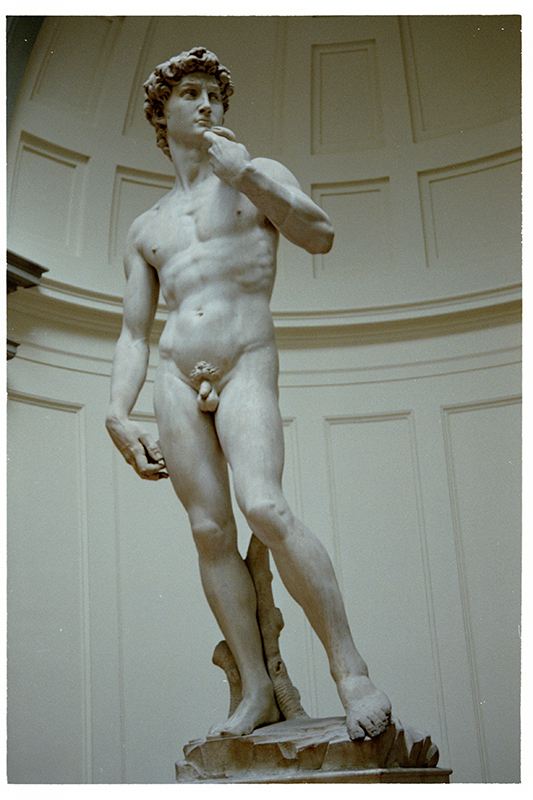
Figure 8.7 Michaelangelo was heavily inspired by Greek and Roman mythology, and Michaelangelo’s David displays the mathematical ratios and proportions that were an integral part of the Greek understanding of beauty. This sculpture exhibits the contrapposto stance: one foot forward and the opposite arm raised as if about to shift its weight. The contrapposto position expresses balance and harmonious movement. (credit: “Florence1988” by David Wright/Flickr, CC BY 2.0)
図8.7 ミケランジェロは、ギリシア・ローマ神話から強い影響を受けていた。ミケランジェロの『ダヴィデ』には、ギリシアにおける美の理解の不可欠な部分だった数学的な比率と比例が表れている。この彫刻は、片足を前に出し、重心を移そうとするかのように反対側の腕を上げる、コントラポストの姿勢を示している。コントラポストの姿勢は、釣り合いと調和ある動きを表す。(クレジット:David Wright/Flickrによる “Florence1988”、CC BY 2.0)
In Plato’s philosophy, moreover, beauty is not simply a sensory or emotional response to things of this world; it is transcendent and immaterial and involves one’s soul and mind. The experience of beauty is ecstatic in the sense that it lifts one beyond this world. In the Phaedrus, Plato describes the soul sprouting and growing wings when it beholds something beautiful. As the wings grow, the soul is able to ascend to new heights.
英語のヒント
さらに、プラトンの哲学では、美はこの世界の物事への単なる感覚的・情緒的反応ではない。美は超越的で非物質的であり、人の魂と精神に関わる。美の経験は、人をこの世界の向こうへ引き上げるという意味で、脱自的である。『パイドロス』でプラトンは、魂が美しいものを見ると翼が芽生え、伸びていくと述べる。翼が成長すると、魂は新たな高みへ上昇できるようになる。
Subjective Concepts of Beauty美の主観的概念
In contrast to Plato and Aristotle, Enlightenment philosophers argued that beauty is a subjective judgment, meaning it is a statement about what a person feels rather a quality of an object. For Hume, judgments of beauty are statements of taste. In Hume’s “Of the Standard of Taste” (1757), he points out that we witness great variety in taste, even among people who share similar cultural and educational backgrounds. He also notes the way that debates about taste frequently descend into condescension and defensiveness. Taste is very personal, and people feel passionately about their judgments of taste. Yet Hume still asserts that people can educate, develop, and refine their taste, which can then give their judgments more weight. For Hume, critics with refined taste ultimately decide what is good or bad art.
英語のヒント
プラトンやアリストテレスとは対照的に、啓蒙期の哲学者は、美は主観的判断であると論じた。つまり、対象の性質ではなく、人が感じることについての言明である。ヒュームにとって、美の判断は趣味の表明である。ヒュームは「趣味の標準について」(1757)で、文化や教育の背景が似ている人々の間でさえ、趣味に大きな違いが見られると指摘する。また、趣味をめぐる議論が、しばしば相手を見下す態度や自己防衛へと陥ることも指摘する。趣味は非常に個人的であり、人は自分の趣味の判断に強い思いを抱く。それでもヒュームは、趣味を教育し、育て、洗練させることは可能であり、それによって判断により大きな重みを与えられると主張する。ヒュームにとって、最終的に芸術のよしあしを決めるのは、洗練された趣味をもつ批評家である。
Aesthetic Judgment美的判断
Aesthetic theory also examines how people make judgments about art. Are aesthetic judgments rational? Do they have justifications, and if so, what kind of justifications?
英語のヒント
美学の理論は、人が芸術についてどのように判断するかも検討する。美的判断は合理的なのだろうか。そこには正当化があるのか。あるなら、どのような正当化なのだろうか。
Kant and Aesthetic Judgmentカントと美的判断
In the Critique of the Power of Judgment (1790), Kant, like Hume, considers judgments of taste to be subjective—that is, a statement about the subject’s response to an object. However, he thinks that when people experience beauty, they also think that others ought to feel the same way. Moreover, Kant thinks that art and beauty are not a matter of personal preference because values and ideals are involved. If you enjoy something that is a mere personal preference, like an ice cream flavor, you will not necessarily expect others to like it and will not feel insulted if they dislike it. But the same is not necessarily true for art. For example, maybe you cannot explain why you prefer chocolate ice cream—it simply tastes better to you. However, you can explain why you love Toni Morrison’s Beloved and think that others should read it too. Kant cares about the values involved with aesthetic judgments because he believes that the beautiful prepares people to love what is good.
英語のヒント
『判断力批判』(1790)でカントは、ヒュームと同様、趣味の判断を主観的、すなわち対象に対する主体の反応についての言明と捉える。しかし、人は美を経験すると、他者も同じように感じるべきだと思う、とカントは考える。さらに、芸術や美には価値や理想が関わるため、個人的な好みだけの問題ではないと考える。アイスクリームの味のように、単なる個人的な好みで何かを楽しむ場合、他者もそれを好きになると必ずしも期待しないし、他者が嫌いでも侮辱されたとは感じないだろう。しかし、芸術でも必ず同じことが言えるわけではない。たとえば、なぜチョコレートアイスが好きかは説明できないかもしれない。自分には、ただそのほうがおいしいのである。しかし、なぜトニ・モリスンの『ビラヴド』が好きなのかは説明でき、他者も読むべきだと考えられる。カントが美的判断に関わる価値を重視するのは、美しいものが、人によいものを愛する準備をさせると信じているからである。
Sibley and Aesthetic Judgmentシブリーと美的判断
How do people justify aesthetic judgments? Are there rules or a specific rationale that are needed? In “Aesthetic Concepts,” British philosopher Frank Sibley (1923 – 1996) distinguishes between two types of remarks people make about art: sensory observations—what anyone with the sense of sight or hearing can observe—and aesthetic judgments, which require sensitivity to details and discernment (1959). Sibley notes that people frequently base aesthetic judgments on sensory observations. For example, you might describe a painting as melancholic because of its blue palette. However, Sibley argues that this does not mean that a person’s sensory observations require that they arrive at a particular aesthetic judgment. Someone could disagree with your assessment of the painting and describe it as calm rather than melancholic. In this sense, aesthetic judgments have justifications but not necessary rules, conditions, or relations between what a person sees and how they interpret or judge it.
英語のヒント
人は美的判断をどう正当化するのだろうか。必要な規則や特定の根拠はあるのだろうか。イギリスの哲学者フランク・シブリー(1923–1996)は「美的概念」で、人が芸術について行う発言を二種類に分ける。一つは、視覚や聴覚がある人なら誰でも観察できる感覚的観察であり、もう一つは、細部への感受性と識別力を必要とする美的判断である(1959)。シブリーは、人がしばしば感覚的観察に基づいて美的判断を行うことを指摘する。たとえば、青系統の配色を理由に、ある絵を憂鬱だと表現するかもしれない。しかしシブリーは、だからといって、感覚的観察が特定の美的判断に至ることを要求するわけではない、と論じる。誰かはあなたの評価に同意せず、その絵を憂鬱ではなく穏やかだと表現するかもしれない。この意味で、美的判断には正当化があるが、人が見るものと、それをどう解釈・判断するかの間に、必然的な規則、条件、関係があるわけではない。