第8章価値論Value Theory
Divine and Religious Foundations for Moral Values道徳的価値の神的・宗教的基礎
One way to analyze moral reasoning is by examining its foundation—that is, how it supports claims about morality. Throughout history, many humans have relied upon a concept of the divine to justify moral claims and values.
英語のヒント
道徳的推論を分析する一つの方法は、その基礎、すなわち、道徳についての主張をどう支えているかを検討することである。歴史を通じて、多くの人々は、道徳的主張や価値を正当化するために、神的なものの概念に依拠してきた。
Ethical frameworks that are based on God can function in a variety of ways depending on the concept of the divine. God can function as the highest good. In this case, God provides an exemplar for the virtues and values that should guide human action. For example, if God is a loving being, humans should develop their ability to love, and performing loving actions will be the basis for morality. The concept of God can function as an ultimate judge who decides what is right and wrong from an omnipotent and infallible position. In this case, God provides an objective standpoint for moral judgment. With this ethical framework, humans may disagree on what is right or wrong because of their limited perspectives, but morality is not relative or arbitrary because it rests on eternal truths from an all-knowing God.
英語のヒント
神に基づく倫理の枠組みは、神的なものの捉え方に応じて、さまざまに機能しうる。神は最高善として機能することがある。この場合、神は人間の行動を導くべき徳や価値の模範となる。たとえば神が愛に満ちた存在なら、人間は愛する能力を育てるべきであり、愛ある行動をすることが道徳の基礎となる。神の概念は、全能で誤ることのない立場から、何が正しく間違っているかを決める究極の裁判官として機能することもある。この場合、神は道徳的判断の客観的な視点を提供する。この倫理的枠組みでは、人間の視野は限られているため、何が正しいか、間違っているかについて意見が分かれることがある。しかし、道徳は全知の神に由来する永遠の真理に基づくため、相対的でも恣意的でもない。
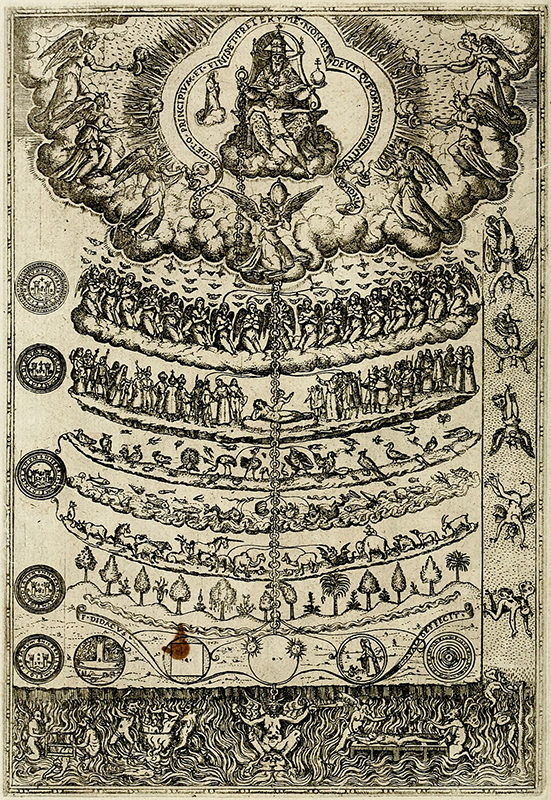
Figure 8.4 This medieval engraving of the Great Chain of Being from the Rhetorica Christiana by Fray Diego de Valadés (1579) depicts God on a throne ruling over all that exists. The concept of God can function as a foundation for deciding what is right and wrong. (credit: “The Great Chain of Being from the Rhetorica christiana by Fray Diego de Valades (1579)” by Diego de Valadés/Wikimedia, Public Domain)
図8.4 フライ・ディエゴ・デ・バラデスの『キリスト教修辞学』(1579)に収められた「存在の大いなる連鎖」を表すこの中世の版画は、神が玉座に座り、存在するすべてを支配する姿を描く。神の概念は、何が正しく、何が間違っているかを決める基礎として機能しうる。(クレジット:Diego de Valadés/Wikimediaによる “The Great Chain of Being from the Rhetorica christiana by Fray Diego de Valades (1579)”、パブリックドメイン)
Religions frequently claim knowledge about the nature and source of reality, the meaning of human existence, the foundations for morality, the purpose of suffering in the world, and what happens when people die. Many religions consider the tenets of their faith to come from a divine source, sacred revelations, or prophets. Religions also look to scripture, sacred practices and customs, images, and objects to determine moral values.
英語のヒント
宗教はしばしば、現実の本性と起源、人間が存在する意味、道徳の基礎、世界に苦しみがある目的、人が死んだときに何が起きるかについて、知識をもつと主張する。多くの宗教は、自らの信仰の教義が、神的な源、聖なる啓示、預言者に由来すると考える。また宗教は、道徳的価値を定めるために、聖典、聖なる実践や慣習、図像、事物にも依拠する。
Augustine on Faith and Knowledge信仰と知識についてのアウグスティヌスの考え
Those who challenge the divine as a source of moral authority question whether these moral beliefs are based on only faith or whether they are justified true beliefs that can be accepted as knowledge. Faith refers to beliefs that are not proven, including beliefs that cannot be proven. The medieval monk, theologian, and philosopher Augustine of Hippo (354–430) argued that there are many things in life people claim to know that are actually based on faith. His argument attempts to blur the distinction between faith and knowledge. For example, if people are not adopted, they typically claim to know who their parents are and take that as firm knowledge, not belief. Yet people are not able to remember their own births or the earliest years of their lives, so they did not confirm this belief with their own observations. For Augustine, this is how faith works. In this sense, faith and knowledge serve a similar purpose in human life and the values people hold.
英語のヒント
道徳的権威の源として神的なものを用いることに異議を唱える人々は、そうした道徳的信念が信仰だけに基づくのか、それとも知識として受け入れられる、正当化された真なる信念なのかを問う。信仰とは、証明されていない信念を指し、証明できない信念も含む。中世の修道士、神学者、哲学者であるヒッポのアウグスティヌス(354–430)は、人生には、人が知っていると主張していても、実は信仰に基づいていることが数多くあると論じた。彼の論証は、信仰と知識の区別を曖昧にしようとするものである。たとえば、養子でない人は、普通、自分の両親が誰かを知っていると主張し、それを単なる信念ではなく、確かな知識と見なす。しかし、人は自分自身の誕生や、人生の最初の数年間を覚えていないため、自分の観察によってこの信念を確認したわけではない。アウグスティヌスにとって、信仰はこのように働く。この意味で、信仰と知識は、人間の生活や人々がもつ価値において、似た目的を果たす。
The Euthyphro problemエウテュプロンの問題
Using God as the basis for moral values can introduce challenging philosophical questions that are difficult to answer. The Euthyphro problem describes such a challenge in theistic ethical systems. It asks whether something is good because God commands it or if God commands it because it is good. The name comes from the Platonic dialogue Euthyphro, which features a conversation between the philosopher Socrates and a man named Euthyphro who claims to be an expert on piety. Socrates asks, “Is the pious being loved by the gods because it is pious, or is it pious because it is being loved by the gods?” (Plato, Euthyphro 10a). In the former case, the gods do not determine what is good, so there must be a higher authority above the gods. In the latter case, the gods remain the ultimate authority, but there are no discernible principles for why they love what they love. That means that piety is a command from above without reason, which limits one’s ability to theorize about it. This idea is called divine command theory.
英語のヒント
道徳的価値の基礎として神を用いると、答えるのが難しい哲学的な問いが生じうる。エウテュプロンの問題は、有神論的な倫理体系における、そのような難題を表す。あることがよいのは神が命じるからなのか、それとも、よいから神が命じるのか、という問いである。名称は、プラトンの対話篇『エウテュプロン』に由来する。そこでは、哲学者ソクラテスと、敬虔についての専門家を自任するエウテュプロンという男性が対話する。ソクラテスは、「敬虔なものは、敬虔であるから神々に愛されるのか。それとも、神々に愛されるから敬虔なのか」と問う(Plato, Euthyphro 10a)。前者の場合、何がよいかを決めるのは神々ではないため、神々より上位の権威がなければならない。後者の場合、神々は究極の権威にとどまるが、なぜそれを愛するかについて、見分けられる原理が存在しない。そうなると、敬虔は理由なく上から与えられる命令であり、それについて理論化する能力が制限される。この考えは、神命説と呼ばれる。
The former case, however, introduces a problem regarding God’s sovereignty and omnipotence because it places moral principles above the divine and seems to set up a situation in which there are rules not even God may violate. In other words, if God cannot act immorally, is God truly all-powerful?
英語のヒント
しかし前者の場合、神の主権と全能性に関わる問題が生じる。道徳原理が神的なものの上位に置かれ、神でさえ破ってはならない規則がある状況を作るように見えるからである。言い換えれば、神が不道徳に行動できないなら、神は本当に全能なのだろうか。
Natural and Human Foundations for Moral Values道徳的価値の自然的・人間的基礎
Different ethical frameworks rest on different foundations or justifications: some appeal to a nonhuman principle like nature; others appeal to shared human institutions like culture, tradition, society, or law; and still others appeal to the individual and their resources for moral reasoning. This section examines moral reasoning based on nature, society, politics, the self, or reason.
英語のヒント
倫理の枠組みが異なれば、依拠する基礎や正当化も異なる。自然のような人間以外の原理に訴えるものもあれば、文化、伝統、社会、法といった、人間が共有する制度に訴えるものもある。また、個人と、その人が道徳的推論のためにもつ資源に訴えるものもある。この節では、自然、社会、政治、自己、理性に基づく道徳的推論を検討する。
Nature and Natural Law自然と自然法
One approach to ethics appeals to nature or natural law to make claims about what is good or bad. An action, goal, or characteristic is good if it accords with nature or natural law and is bad if it violates it. Here, nature can refer to human nature or the observed features of the natural world.
英語のヒント
倫理への一つの取り組み方は、何がよいか悪いかを主張するために、自然や自然法に訴えるものである。ある行動、目標、特性は、自然や自然法にかなっていればよく、それに反すれば悪い。ここでの自然は、人間本性を指す場合もあれば、自然界に観察される特徴を指す場合もある。
According to the medieval philosopher Thomas Aquinas (1225–1274), there are four types of laws: eternal, natural, human, and divine. Eternal laws govern the universe, natural laws govern the natural world, and human laws govern human societies. Divine laws are supernatural and allow humans to reach salvation but cannot be known through human reason alone. Instead, they must be revealed by God (e.g., the Ten Commandments, Scriptures, and other divine revelations). Humans can use reason, however, to discover natural laws and create human laws. For Aquinas, human laws must align with natural law. Human laws that violate the laws of nature are “no longer a law but a perversion of law” (Aquinas [1485] 1948, 649). Aquinas’s argument contributes to classical natural law theory, which sees laws as upholding natural order. Because nature is not subjective, natural law theory sees values as objective.
英語のヒント
中世の哲学者トマス・アクィナス(1225–1274)によれば、法には、永久法、自然法、人定法、神法の四種類がある。永久法は宇宙を統べ、自然法は自然界を統べ、人定法は人間社会を統べる。神法は超自然的であり、人間が救済に至ることを可能にするが、人間の理性だけでは知りえない。神によって啓示されなければならないのである。たとえば、十戒、聖書、その他の神の啓示がそれに当たる。しかし人間は、理性によって自然法を発見し、人定法を作ることができる。アクィナスにとって、人定法は自然法にかなっていなければならない。自然の法に反する人定法は、「もはや法ではなく、法の歪曲である」(Aquinas [1485] 1948, 649)。アクィナスの論証は、法を自然の秩序を支えるものと捉える、古典的自然法論に寄与している。自然は主観的ではないため、自然法論は価値を客観的と捉える。