第4章古典哲学の成立The Emergence of Classical Philosophy
Early Jewish Ethics and Metaphysics初期ユダヤ教の倫理学と形而上学
At the time of Philo, the Jewish Bible consisted of the five books of Moses, known as the Pentateuch, the Prophets, and the later books that make up the Tanakh. Much of Jewish theological, legal, and philosophical thought was passed down orally. Following the Roman Empire’s destruction of Jerusalem and the Kingdom of Judah in 70 CE, the Sanhedrin, a semiautonomous Jewish legal and judicial body that had been forcibly relocated to northern Israel, began transcribing the oral traditions so as not to lose them. These writings would later become the Talmud. Among these writings is the text Ethics of Our Fathers, which provides a moral guide to everyday life. Later, Jewish scholars also began to explore metaphysics, culminating in the Kabbalah, which examines the relationship between God—defined as the infinite, unchanging, and eternal—and the finite world we experience. Eventually, the brutal repression of Jews who remained in their homeland led to the collapse of the Hellenized Jewish communities throughout the Roman Empire. As a result, the continuation of Philo’s work fell to a subgroup of Jews whose new religion, Christianity, would be adopted by Rome.
英語のヒント
フィロンの時代、ユダヤ教の聖書は、モーセ五書、預言書、そしてタナハを構成する後代の諸書からなっていた。ユダヤ教の神学、法、哲学に関する思想の多くは、口伝で受け継がれていた。紀元後70年にローマ帝国がエルサレムとユダ王国を破壊した後、サンヘドリンは、口承の伝統が失われないよう、それを書き記し始めた。サンヘドリンは、イスラエル北部へ強制的に移されていた、半ば自治的なユダヤ教の立法・司法機関である。これらの記録は、後にタルムードとなる。そのなかには、日常生活の道徳的な指針を示す『父祖の教訓』という文献がある。後には、ユダヤ教の学者たちは形而上学も探究し始め、それはカバラにおいて一つの頂点に達した。カバラは、無限、不変、永遠と定義される神と、私たちが経験する有限な世界との関係を検討する。やがて、故郷にとどまったユダヤ人に対する残虐な抑圧が、ローマ帝国全土のヘレニズム化したユダヤ人共同体の崩壊をもたらした。その結果、フィロンの仕事を継続する役割は、ユダヤ人の一集団に引き継がれた。彼らの新しい宗教であるキリスト教は、後にローマによって採用されることになる。
Early Christian Philosophy初期のキリスト教哲学
Late antiquity witnessed the gradual demise of the Roman Empire in the West, a political development accompanied by great social turmoil and uncertainty. The Catholic Church gradually filled this political and cultural void, as it sought to make itself the legitimate heir of Roman power. Philosophy reflects this transformation in Western European society, with the uncertainty and turmoil of the period reflected in the work of philosophers of late antiquity such as Augustine and Boethius. The triumph of Christianity can be seen in the grand edifice of scholasticism that developed later, reflected in the writings of Thomas Aquinas.
英語のヒント
古代末期には、西方のローマ帝国が徐々に衰退した。この政治的な展開には、大きな社会的混乱と不確実性が伴っていた。カトリック教会は、ローマの権力の正統な継承者となることを目指し、政治と文化の空白を徐々に埋めた。哲学にも、西ヨーロッパ社会のこの変容が反映されている。アウグスティヌスやボエティウスなど、古代末期の哲学者の著作には、その時代の不確実性と混乱が表れている。後に発展したスコラ哲学の壮大な体系には、キリスト教の勝利を見ることができる。その体系は、トマス・アクィナスの著作に表れている。
Augustineアウグスティヌス
Augustine (354–430 CE) was one of the most influential philosophers and theologians of late antiquity. In his Confessions, he used his own life and the story of his initially reluctant turn to Christianity as an allegory for understanding God’s universe and humanity’s place within it. His narrative begins with a discussion of his struggles with faith, particularly with sexual desire. In later books, he turned to considerations of history and the nature of time. Augustine famously posits a theory of time that holds that we experience the temporal present in three different ways: the present anticipates the future and bleeds into the recent past.
英語のヒント
アウグスティヌス(紀元後354~430年)は、古代末期の最も影響力のある哲学者・神学者の一人だった。『告白』では、自分の人生と、当初はためらいながらキリスト教へ改宗していく物語を、神の宇宙と、そのなかでの人類の位置を理解するための寓意として用いた。彼の物語は、信仰をめぐる葛藤、特に性欲との格闘についての議論から始まる。後半の巻では、歴史や時間の本性についての考察へ向かう。アウグスティヌスは、時間上の現在を私たちは3つの異なる仕方で経験するという、有名な時間論を提示する。現在は未来を予期し、ごく近い過去へとにじみ込んでいくのである。
As Bishop of Hippo, Augustine sought to defend theological orthodoxy against various heresies. He wrote against the Pelagian heresy, which held that humans could achieve salvation themselves without divine grace, and the Manichean heresy, which held that the universe was a battlefield between the forces of good and evil that are equal in power. In contrast, Augustine held that all of creation was good simply by virtue of the fact that God had created it. Nothing in God’s creation was evil: things that appeared evil to us were all part of God’s providential plan. Even Satan’s rebellion was part of God’s plan.
英語のヒント
ヒッポの司教として、アウグスティヌスはさまざまな異端から神学上の正統教義を守ろうとした。彼は、神の恩寵なしに人間は自力で救済を達成できるとするペラギウス派の異端に反駁した。また、宇宙は同等の力を持つ善と悪の勢力の戦場であるとするマニ教の異端にも反駁した。これに対してアウグスティヌスは、神が創造したという、まさにその事実によって、被造物はすべて善いと考えた。神の創造のうちに悪いものは一つもない。私たちに悪く見える事物も、すべて神の摂理の計画の一部だった。サタンの反逆でさえ、神の計画の一部だったのである。
Augustine’s ideas raise interesting issues with respect to free will. How can we reconcile individual human freedom in a world where an all-powerful God knows all? In opposition to the strict determinism of the Manicheans, Augustine sought to make room for some amount of human freedom. Despite the original sin of Adam and Eve discussed in the Christian and Jewish Bible and the fall from grace that this entails, Augustine held that it is within our power to choose the good. Augustine sees this conflict as one between two rival wills, one that wills the good and one that desires sinfulness. Only divine grace can ultimately resolve this, though it is within our power to choose whether to sin.
英語のヒント
アウグスティヌスの思想は、自由意志について興味深い問題を提起する。全能の神がすべてを知っている世界で、個々の人間の自由をどう両立させられるのだろうか。マニ教徒の厳格な決定論に対して、アウグスティヌスは人間の自由のために、いくらかの余地を確保しようとした。キリスト教とユダヤ教の聖書で語られるアダムとエバの原罪、そしてそれがもたらす恩寵からの転落にもかかわらず、アウグスティヌスは、善を選ぶことは私たちの力の及ぶ範囲にあると考えた。彼はこの葛藤を、互いに争う2つの意志、すなわち善を意志するものと、罪深さを欲するものの争いと見る。これを最終的に解決できるのは神の恩寵だけである。しかし、罪を犯すかどうかを選ぶことは、私たち自身の力の及ぶ範囲にある。
Not only did Augustine articulate Christian doctrine that shaped medieval European philosophy for centuries to come, but he raised questions that are still being pondered today. Queries about the nature of time and temporality as well as agency and free will remain relevant for philosophers today, as does Augustine’s development of possible answers.
英語のヒント
アウグスティヌスは、その後何世紀にもわたり中世ヨーロッパ哲学を形づくるキリスト教の教義を明確にしただけではない。現在も考察され続ける問いを提起した。時間と時間性の本性、そして行為主体性と自由意志をめぐる問いは、今日の哲学者にとっても意義を持ち続けている。アウグスティヌスが展開した、それらへの回答の可能性についても同じことがいえる。
Boethiusボエティウス
Like Augustine, Boethius (c. 477–524 CE) was a philosopher who straddled the late Roman and Christian worlds. Indeed, he serves as one of the most important intermediaries between these two very different worlds. A Roman statesman and Christian theologian, Boethius is best known for his work The Consolation of Philosophy. Boethius was imprisoned on conspiracy charges and subsequently executed by the ruler he had served, the Ostrogothic King Theodoric the Great. Prior to his imprisonment, he had translated and written commentaries on Aristotle’s work, logic, music theory, astronomy, and mathematics that were influential for medieval philosophers. However, while imprisoned, he wrote The Consolation of Philosophy, which takes the form of a dialogue between Boethius and philosophy personified by a beautiful woman who visits him in his cell. The text starts out with a bitter Boethius complaining of his fall from power to Lady Philosophy. She consoles him by showing Boethius that happiness remains possible for him even in his wretched state. She argues that Boethius has not lost true happiness, or the true Platonic form of happiness, as these are not found in material possessions or high stature, but in family, virtuous actions, and wisdom. She then reminds him that true good—and so true happiness—is found in God. Extremely popular throughout the Middle Ages and Renaissance (Marenbon 2020), The Consolation never makes mention of Christianity. In facing death, Boethius turns to Plato. His work and influence exemplify how Catholicism incorporated classical philosophy into its worldview.
英語のヒント
アウグスティヌスと同じく、ボエティウス(紀元後477年頃~524年頃)は、ローマ末期とキリスト教という2つの世界にまたがる哲学者だった。実際、彼はこの非常に異なる2つの世界をつなぐ、最も重要な仲介者の一人である。ローマの政治家でありキリスト教の神学者でもあったボエティウスは、『哲学の慰め』によって最もよく知られている。彼は陰謀の容疑で投獄され、その後、自らが仕えていた支配者、東ゴート王テオドリック大王によって処刑された。投獄以前には、アリストテレスの著作、論理学、音楽理論、天文学、数学について翻訳や注釈を著し、それらは中世の哲学者に影響を与えた。しかし、投獄中に書いたのが『哲学の慰め』である。この著作は、ボエティウスと、牢獄を訪れる美しい女性として人格化された哲学との対話という形を取る。冒頭では、憤りに満ちたボエティウスが、権力の座から転落したことを「哲学の女神」に嘆いている。彼女は、この悲惨な境遇にあっても幸福はなお可能だと示し、彼を慰める。彼女によれば、ボエティウスは真の幸福、すなわち幸福の真のプラトン的イデアを失ったわけではない。幸福は物質的な所有物や高い地位にあるのではなく、家族、有徳な行為、知恵のうちにあるからである。そして彼女は、真の善、したがって真の幸福は神のうちにあることを、彼に思い起こさせる。中世からルネサンスにかけて非常に広く読まれた『哲学の慰め』(Marenbon 2020)は、キリスト教には一度も言及しない。死に直面するボエティウスは、プラトンに頼る。彼の著作とその影響は、カトリックが古典哲学を自らの世界観にどのように取り込んだかを例示している。
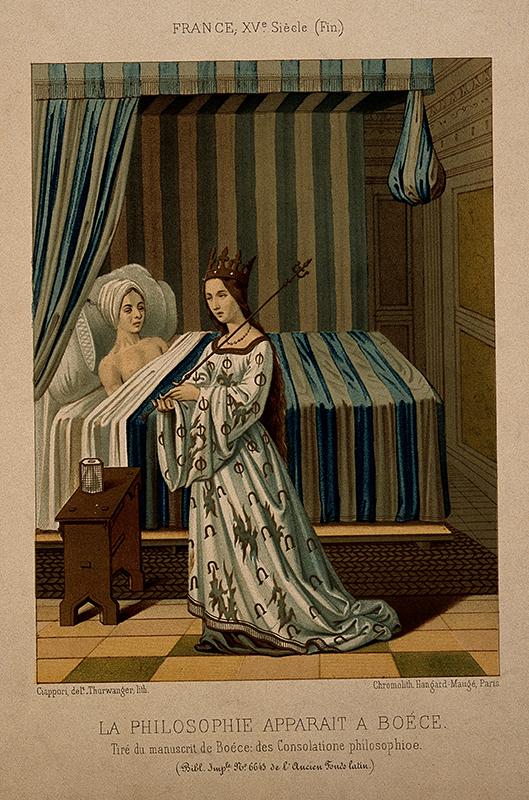
Figure 4.8 In this copy of a 15th-century painting, Lady Philosophy consoles Boethius as he faces death. (credit: “The Figure of Philosophy Appearing to Boethius” by Wellcome Collection/Public Domain)
図4.8 15世紀の絵画を複製したこの図では、死を目前にしたボエティウスを「哲学の女神」が慰めている。 (credit: “The Figure of Philosophy Appearing to Boethius” by Wellcome Collection/Public Domain)