第4章古典哲学の成立The Emergence of Classical Philosophy
Academic Skepticismアカデメイア派の懐疑主義
Academic Skepticism is another aspect of Roman philosophy that developed out of a tendency found in earlier Greek thought. Recall that Socrates questioned whether we could ever know anything at all. The Academic Skeptics opposed the Stoic claims that sense impressions could yield true knowledge, holding instead that knowledge is impossible. Instead of knowledge, Academic Skeptics articulated the idea of degrees of belief. Things are more or less believable based on various criteria, and this degree of believability is the basis for judgment and action. Disciples of the Greek philosopher Pyrrho (c. 360–270 BCE) held that we had to suspend judgment when it comes to knowledge claims, going so far as to say that we cannot even reliably claim that we cannot know anything. Rather than suspending all judgment, Academic Skeptics sought to demonstrate that knowledge claims lead us to paradoxical conclusions and that one can argue cogently both for and against the same proposition.
英語のヒント
アカデメイア派の懐疑主義もまた、それ以前のギリシア思想に見られた傾向から発展した、ローマ哲学の一側面である。ソクラテスは、私たちがそもそも何かを知ることなどできるのかと問うたことを思い出してほしい。アカデメイア派の懐疑主義者たちは、感覚的印象から真の知識が得られるというストア派の主張に反対し、知識は不可能だと考えた。彼らは知識に代えて、信念には程度があるという考えを明確にした。物事は、さまざまな基準に照らして、より信じられるものにも、より信じにくいものにもなる。この信じられやすさの程度が、判断と行動の基礎となる。ギリシアの哲学者ピュロン(紀元前360年頃~前270年頃)の弟子たちは、知識の主張に関しては判断を保留しなければならないと考えた。それどころか、私たちは何も知りえないということさえ、確実には主張できないとまで述べた。アカデメイア派の懐疑主義者は、あらゆる判断を保留するのではなく、知識の主張が私たちを逆説的な結論へ導くこと、そして同じ命題について賛成の側からも反対の側からも説得力のある論証ができることを示そうとした。
The philosopher, orator, and statesman Cicero (106–43 BCE) was the most prominent of the Academic Skeptics. His works provide much of the information we have about the school. He had a decisive influence on Latin style and grammar and was decisive in the introduction of Hellenistic philosophy into Rome. The rediscovery of his work in the 15th century ushered in the European Renaissance.
英語のヒント
哲学者、弁論家、政治家であったキケロ(紀元前106~前43年)は、アカデメイア派の懐疑主義者のなかで最も著名だった。この学派について私たちが得ている情報の多くは、彼の著作に由来する。キケロはラテン語の文体と文法に決定的な影響を与え、ヘレニズム哲学をローマに導入するうえでも決定的な役割を果たした。15世紀に彼の著作が再発見されたことが、ヨーロッパのルネサンスの到来を告げた。
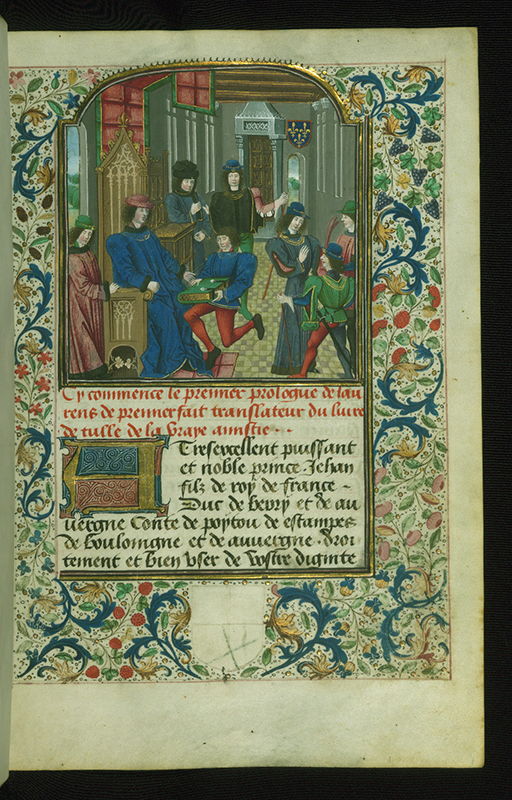
Figure 4.6 This Flemish illuminated manuscript, dated to approximately 1470, is a French translation of Cicero’s philosophical treatise De amicitia. The rediscovery of Cicero’s work in the 15th century has been connected to the European Renaissance. (credit: “Cicero’s De amicitia (French Translation), Presentation of the Book to Its Patron, Walters Manuscript W.312, Fol. 1r” by Walters Art Museum Illuminated Manuscripts/Flickr, CC0)
図4.6 1470年頃のものとされるこのフランドルの彩飾写本は、キケロの哲学的著作『友情について』(De amicitia)のフランス語訳である。15世紀にキケロの著作が再発見されたことは、ヨーロッパのルネサンスと関連づけられている。 (credit: “Cicero’s De amicitia (French Translation), Presentation of the Book to Its Patron, Walters Manuscript W.312, Fol. 1r” by Walters Art Museum Illuminated Manuscripts/Flickr, CC0)
Neoplatonism新プラトン主義
Plotinus (c. 204–270) led a revival of Plato’s thought in the late Roman Empire that lasted until Emperor Justinian closed Plato’s Academy in 529. Plotinus believed that he was simply an expositor of Plato’s work, but the philosophy he developed, known as Neoplatonism, expanded on Plato’s idea. Neoplatonism arose during a time of cultural ferment in the Roman Empire, incorporating ideas borrowed from sources such as Judaism and early Christianity. The key metaphysical problem in Neoplatonism was accounting for how a perfect God could create a universe that was manifestly imperfect. Plotinus solved this problem by applying ideas similar to Plato’s theory of forms. The perfect, unchanging realm is the one inhabited by God, but creation inhabits the changing realm, which only mirrors forms imperfectly. Plotinus claims that creation emanates from God, but the further one is from this source the less perfect things become.
英語のヒント
プロティノス(204年頃~270年頃)はローマ帝国後期にプラトン思想の復興を主導した。その復興は、皇帝ユスティニアヌスが529年にプラトンのアカデメイアを閉鎖するまで続いた。プロティノス自身は、単にプラトンの著作を解説しているだけだと考えていた。しかし、彼が発展させた哲学は新プラトン主義として知られ、プラトンの思想を拡張するものだった。新プラトン主義は、ローマ帝国で文化が活発に変動する時期に生まれ、ユダヤ教や初期キリスト教などから借りた考えを取り入れた。新プラトン主義の形而上学上の中心問題は、完全な神がどうして明らかに不完全な宇宙を創造しえたのかを説明することだった。プロティノスは、プラトンのイデア論に似た考え方を適用して、この問題を解決した。完全で変化しない領域は神の住む領域であるが、被造物は変化する領域にあり、そこはイデアを不完全に映すにすぎない。プロティノスによれば、被造物は神から流出する。しかし、この源から遠ざかるほど、事物の完全さは低下する。
Summaryまとめ
Classical Greek philosophy owes much to Egyptian scholarship emanating from Heliopolis, as both Pythagoras and Plato are believed to have studied at that center of learning. Indeed, the Plimpton 332 clay tablet reveals that Babylonian mathematicians knew not only of the Pythagorean theorem of right triangles but also of trigonometric functions. Classical philosophy emerged in ancient Greece with the Presocratics; the three great philosophers Socrates (470–399 BCE), Plato (c. 428–347 BCE), and Aristotle (384–322 BCE); and schools of thought that came after—Epicureans, stoics, and others. From what remains of the works of the Presocratics, they were primarily interested in questions of metaphysics and natural philosophy. Some Presocratics, such as Parmenides, were monists while others, such as Heraclitus, were plurists. Plato advanced a theory of the forms, a metaphysical doctrine that holds that every particular thing that exists participates in an immaterial form or essence that gives this thing its identity. The invisible realm of the forms differs fundamentally from the changing realm we experience in this world. The invisible realm is eternal, unchanging, and perfect. Aristotle’s work centers on his doctrine of the four causes: “What’s it made of?” (material cause), “What shape does it have?” (formal cause), “What agent gave it this form?” (efficient cause), and, finally, “What is its end goal?” (final cause). The four causes can explain nature of all things in this universe, including the universe itself. Aristotle’s universe is a closed system of final causes. Each final cause leads to another, until we get to the first cause or prime mover.
古典ギリシア哲学は、ヘリオポリスを中心とするエジプトの学問に多くを負っている。ピュタゴラスもプラトンも、この学問の中心地で学んだと考えられているからである。実際、プリンプトン332の粘土板は、バビロニアの数学者たちが直角三角形に関するピュタゴラスの定理だけでなく、三角関数についても知っていたことを示している。古典哲学は古代ギリシアにおいて、ソクラテス以前の哲学者たち、ソクラテス(紀元前470~前399年)、プラトン(紀元前428年頃~前347年頃)、アリストテレス(紀元前384~前322年)という3人の大哲学者、そしてその後に登場したエピクロス派やストア派などの学派とともに成立した。ソクラテス以前の哲学者の著作の現存部分を見ると、彼らは主に形而上学と自然哲学の問題に関心を持っていた。パルメニデスのような一元論者もいれば、ヘラクレイトスのような多元論者もいた。プラトンはイデア論を提唱した。これは、存在する個々の事物はすべて、その事物に固有のあり方を与える非物質的なイデア、すなわち本質を分有するという形而上学上の学説である。目に見えないイデアの領域は、私たちがこの世界で経験する、変化し続ける領域とは根本的に異なる。目に見えない領域は、永遠で、不変で、完全である。アリストテレスの著作の中心にあるのは、四原因の学説である。「何でできているのか」(質料因)、「どんな形をしているのか」(形相因)、「何がそれにこの形を与えたのか」(作用因)、そして最後に「その最終的な目標は何か」(目的因)という4つの問いである。四原因は、この宇宙にあるあらゆるものの本性を、宇宙そのものも含めて説明できる。アリストテレスの宇宙は、目的因からなる閉じた体系である。それぞれの目的因は別の目的因へとつながり、ついには第一原因、すなわち第一動者に至る。
Review Questions復習問題
What evidence suggests that many of the ideas that we attribute to Greek philosophers may have had their origin in ancient Egypt or Babylonia?
私たちがギリシアの哲学者に帰している多くの考えが、実際には古代エジプトやバビロニアに起源を持っていた可能性を、どのような証拠が示しているか。
How can one justify Parmenides’s claim that the world is unchanging?
世界は変化しないというパルメニデスの主張は、どのように正当化できるか。
What are Aristotle’s four causes, and how did he apply them?
アリストテレスの四原因とは何か。また、彼はそれらをどのように適用したか。
How can one justify Parmenides’s claim that the world is unchanging?
世界は変化しないというパルメニデスの主張は、どのように正当化できるか。
What are Aristotle’s four causes, and how did he apply them?
アリストテレスの四原因とは何か。また、彼はそれらをどのように適用したか。
Empiricism
経験論
a belief that all knowledge is derived inductively from sense experience.
あらゆる知識は、感覚経験から帰納的に導き出されるという考え。
Monism
一元論
the belief that the universe is made up of one substance.
宇宙は1つの実体からできているという考え。
Natural philosophy
自然哲学
the fields of study that eventually gave rise to science.
後に科学を生み出すことになった学問分野。
Plurism
多元論
the belief that the universe is made up of more than one substance.
宇宙は複数の実体からできているという考え。
Theory of the forms
イデア論
a metaphysical doctrine that holds that every particular thing that exists in our changing, material world participates in an immaterial form or essence, which is unchanging, invisible, and perfect and which gives this thing its identity.
変化する物質的世界に存在する個々の事物はすべて、非物質的なイデア、すなわち本質を分有するという形而上学上の学説。そのイデアは不変で、目に見えず、完全であり、当の事物に固有のあり方を与える。
Zeno’s paradoxes
ゼノンのパラドックス
paradoxes proposed by Zeno that attempt to prove that change and motion are illusory.
変化と運動が錯覚であることを証明しようとして、ゼノンが提出したパラドックス。