第4章古典哲学の成立The Emergence of Classical Philosophy
4.2 Classical Philosophy4.2 古典哲学
Learning Objectives学習目標
By the end of this section, you will be able to:
この節を学び終えると、次のことができるようになる。
Evaluate the influence of Egyptian scholarship on classical Greek philosophy.
エジプトの学問が古代ギリシャ哲学に与えた影響を評価する。
Describe the key ideas of the most influential Greek philosophers.
最も影響力のあるギリシャの哲学者の中心的な考えを説明する。
Describe the key ideas of the most influential Roman philosophers.
最も影響力の大きかったローマの哲学者の中心的な思想を説明する。
Distinguish between major schools of classical thought.
古典思想の主要な学派を区別する。
Egyptian Origins of Classical Philosophy古典哲学のエジプト起源
The understanding that the roots of classical thought lie, at least in part, in Egypt is as old as the ancient Greeks themselves. In The Histories of Herodotus, the ancient Greek historian Herodotus (c. 484–425 BCE) traces Greek beliefs about the gods, religious practices, and understanding of the natural world to Egypt. Herodotus claimed the ancient Greeks adopted practices and ideas as diverse as solemn processions to temples, the belief in an immortal soul, and the knowledge of geometry and astrology from the Egyptians. Herodotus notes that the people of Heliopolis, one of the largest cities in ancient Egypt, “are said to be the most learned in records of the Egyptians” (Herodotus 1890, 116). Plato spent 13 years in Heliopolis, and Pythagoras (c. 570–495 BCE) studied mathematics in Heliopolis for more than two decades (Boas 1948).
英語のヒント
古典思想の根は少なくとも一部がエジプトにある、という理解は、古代ギリシャ人自身の時代から存在していた。古代ギリシャの歴史家ヘロドトス(紀元前484年ごろ~425年ごろ)は『歴史』で、神々についてのギリシャ人の信仰、宗教的な実践、自然界の理解を、エジプトにさかのぼっている。ヘロドトスは、神殿への厳粛な行列、不死の魂への信仰、幾何学や占星術の知識といった、実に多様な実践や考えを、古代ギリシャ人はエジプト人から取り入れたと主張した。彼は、古代エジプト最大の都市の一つヘリオポリスの人々は、「エジプト人の記録について最も学識があるといわれる」と記している(Herodotus 1890, 116)。プラトンはヘリオポリスで13年を過ごし、ピュタゴラス(紀元前570年ごろ~495年ごろ)は20年以上にわたって、そこで数学を学んだ(Boas 1948)。
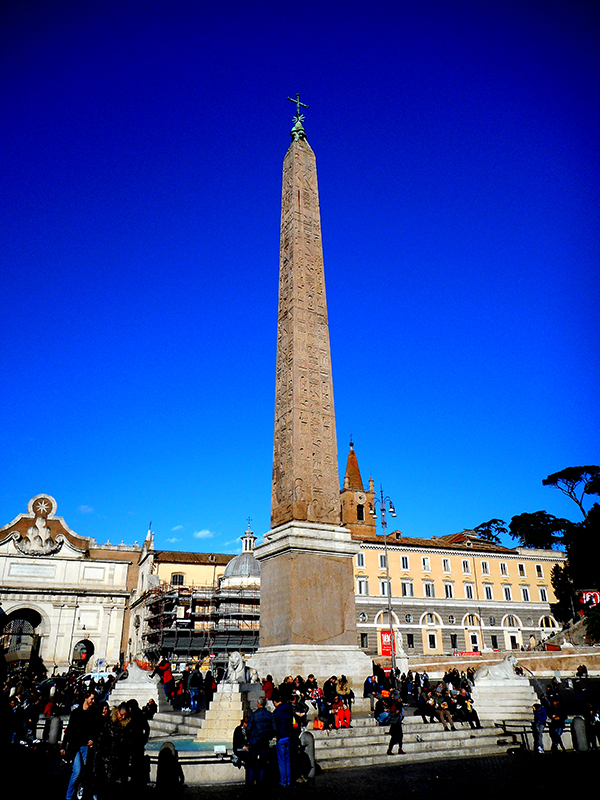
Figure 4.2 This obelisk, erected in Heliopolis, Egypt, in approximately 1200 BCE, was transported to Rome in the 16th century and made part of that city’s public environment. Similarly, many of the ideas of what is now considered classical Greek philosophy can be traced back to Egyptian origins. (credit: “Egyptian Obelisk (Metres 25), Erected at Heliopolis” by Carlo Raso/Flickr, Public Domain)
図4.2 このオベリスクは紀元前1200年ごろ、エジプトのヘリオポリスに建てられ、16世紀にローマへ運ばれて、その都市の公共空間の一部となった。同じように、現在では古典ギリシャ哲学とされる多くの考えも、エジプト起源にさかのぼることができる。 (credit: “Egyptian Obelisk (Metres 25), Erected at Heliopolis” by Carlo Raso/Flickr, Public Domain)
Egyptian and Babylonian Mathematicsエジプトとバビロニアの数学
Could Pythagoras have learned, rather than discovered, the “Pythagorean” theorem—the law of relationships between the sides and hypotenuse of a right triangle—in Egypt? Almost assuredly. A Babylonian clay tablet dating to approximately 1800 BCE, known as Plimpton 322, demonstrates that the Babylonians had knowledge not only of the relationship of the sides and hypotenuses of a right triangle but also of trigonometric functions (Lamb 2017). Further, the Rhind Mathematical Papyrus provides evidence that the Egyptians had advanced knowledge of algebra and geometry as early as 1550 BCE, presenting problems that include calculating the volume of cylindrical granaries and the slope of pyramids. The Berlin Papyrus 6619, usually dated between 1800 BCE and 1649 BCE, contains a solution to a problem involving the Pythagorean theorem and evidence that the Egyptians could solve quadratic equations. Pythagoras studied with the priests of Heliopolis more than 1,000 years after these documents were created. It is possible that this Egyptian mathematical knowledge had been lost and that Pythagoras rediscovered the relationship during or after his studies in Heliopolis. However, given what we know now about Greek individuals visiting and residing in Egypt, it seems more likely that he was introduced to the knowledge there. As with mathematics, there are specific philosophical ideas that can be traced back to Egypt. This is particularly the case within metaphysics, the branch of philosophy that studies reality, being, causation, and related abstract concepts and principles.
英語のヒント
ピュタゴラスは、「ピュタゴラスの」定理――直角三角形の辺と斜辺の関係を示す法則――を、自分で発見したのではなく、エジプトで学んだのだろうか。ほぼ間違いなく、その可能性がある。プリンプトン322として知られる、紀元前1800年ごろのバビロニアの粘土板は、バビロニア人が直角三角形の辺と斜辺の関係だけでなく、三角関数の知識も持っていたことを示している(Lamb 2017)。さらにリンド数学パピルスは、早くも紀元前1550年に、エジプト人が代数と幾何学の高度な知識を持っていた証拠を示す。そこには、円柱形の穀倉の体積や、ピラミッドの傾斜を計算する問題が含まれる。通常、紀元前1800年から1649年の間のものとされるベルリン・パピルス6619には、ピュタゴラスの定理を使う問題の解と、エジプト人が二次方程式を解けたことの証拠がある。ピュタゴラスがヘリオポリスの神官のもとで学んだのは、これらの文書が作られてから1000年以上後のことだった。エジプトのこの数学的知識が失われており、ピュタゴラスがヘリオポリスで学んでいる間、あるいはその後に、その関係を再発見した可能性もある。しかし、ギリシャ人がエジプトを訪れたり住んだりしていたことについて、現在わかっていることを踏まえると、彼はそこでこの知識を教わったと考えるほうが、よりありそうに思える。数学と同じように、エジプトに起源をたどれる具体的な哲学思想もある。これはとくに、実在、存在、因果、および関連する抽象的な概念や原理を研究する哲学の分野、形而上学に当てはまる。
Akhenaten’s Metaphysicsアクエンアテンの形而上学
In the mid-14th century BCE, Akhenaten became pharaoh in Egypt. Partly in an attempt to undercut the growing power of the priests, Akhenaten abolished all other gods and established Aten, the sun god, as the one true god. Akhenaten held that solar energy was the element out of which all other elements evolved or emanated (Flegel 2018). In proposing this idea, Akhenaten established an unseen divinity responsible for causation. Aten became the one true substance that created the observable world. One hymn reads, “You create millions of forms from yourself, the one, / cities and towns / fields, paths and river” (Assmann [1995] 2009, 154). Although the Egyptian elite quickly reestablished the temples and the practices of the full pantheon of gods after Akhenaten’s death, theological thought incorporated this idea of an all-powerful invisible first cause. This idea evolved, with the phrase “one and the millions” coming to signify the sun god as the soul and the world as its body (Assmann 2004, 189). As you will see later in this chapter, this same concept—a single, invisible, unchanging substance expressing itself through forms to give rise to the material world—is the key principle in Plato’s metaphysics.
英語のヒント
紀元前14世紀の半ば、アクエンアテンがエジプトのファラオになった。彼は、力を増す神官たちを弱めることも意図し、ほかのすべての神々を廃して、太陽神アテンを唯一の真の神とした。アクエンアテンは、太陽のエネルギーこそ、ほかのあらゆる要素がそこから生じ、あるいは流出するもととなる要素だと考えた(Flegel 2018)。この考えによって、彼は因果の源となる、目に見えない神を立てた。アテンは、観察される世界を創造する唯一の真の実体となった。ある讃歌はこう歌う。「あなたは、唯一なるあなた自身から、幾百万もの形を創る。/都市と町を/野と道と川を」(Assmann [1995] 2009, 154)。アクエンアテンの死後、エジプトの支配層はすぐに神殿を建て直し、神々全体の祭祀を復活させたが、神学的な思想には、この全能で不可視の第一原因という考えが取り込まれた。さらにこの考えは変化し、「一者と幾百万」という表現が、太陽神を魂、世界をその身体として意味するようになった(Assmann 2004, 189)。この章の後半で見るように、単一で目に見えず不変の実体が、さまざまな形を通して自らを表し、物質世界を生み出すという同じ概念が、プラトンの形而上学の中心原理となる。
The Egyptian Origins Controversyエジプト起源をめぐる論争
Scholars have long puzzled over to what extent the origins of classical thought can be said to lie in Egypt. In recent years, a heated debate has erupted over this question. In the three-volume text Black Athena: The Afroasiatic Roots of Classical Civilization, Martin Bernal, a contemporary American professor specializing in modern Chinese political history, argued that the ancient Egyptians and Phoenicians played a foundational role in the formation of Greek civilization and philosophy. He further claimed that an “ancient model” recognizing the African and Middle Eastern origins of Greece was widely accepted until the 19th century, when it was replaced by a racist “Aryan model” proposing Indo-European origins instead. Mary Lefkowitz, a contemporary professor of classical studies, has famously critiqued Bernal’s work. Lefkowitz’s position is that though it is important to acknowledge the debt the Greeks owe to Egyptian thought, Greek philosophy was not wholly derived from Egypt, nor did Western civilization arise from Africa. A bitter academic war of words has ensued, with Lefkowitz and other prominent scholars noting significant errors in Bernal’s scholarship. Lefkowitz authored Not Out of Africa: How Afrocentrism Became an Excuse to Teach Myth as History in 1997. Bernal responded with Black Athena Writes Back in 2001. This exchange reflects a much broader phenomenon in which academics spar over the accuracy of historical narratives and the interpretation of philosophical ideas, often presenting the issues as ethical questions. By thinking critically about these disagreements, we gain deeper insight not only into the topic of study but also into philosophical and political discourse today.
英語のヒント
古典思想の起源がどの程度エジプトにあると言えるのかは、長い間、研究者を悩ませてきた。近年、この問いをめぐって激しい論争が起きた。現代中国政治史を専門とするアメリカの大学教授マーティン・バナールは、全3巻の『ブラック・アテナ――古典文明のアフロ・アジア的ルーツ』(Black Athena: The Afroasiatic Roots of Classical Civilization)で、古代エジプト人とフェニキア人が、ギリシャ文明と哲学の形成に根本的な役割を果たしたと論じた。さらに彼は、ギリシャのアフリカ・中東起源を認める「古代モデル」は19世紀まで広く受け入れられていたが、その後、インド・ヨーロッパ起源を唱える、人種差別的な「アーリア人モデル」に置き換えられたと主張した。古典学の大学教授メアリー・レフコウィッツによる、バナールの仕事への批判はよく知られている。レフコウィッツは、ギリシャ人がエジプト思想に負うものを認めることは重要だが、ギリシャ哲学のすべてがエジプトに由来するわけではなく、西洋文明がアフリカから生まれたわけでもない、という立場を取る。厳しい学術上の応酬が続き、レフコウィッツら著名な研究者は、バナールの研究の重大な誤りを指摘した。レフコウィッツは1997年に『Not Out of Africa: How Afrocentrism Became an Excuse to Teach Myth as History』を著し、バナールは2001年に『Black Athena Writes Back』で応答した。このやり取りは、研究者たちが歴史の叙述の正確さや哲学思想の解釈をめぐって争い、それをしばしば倫理の問題として提示するという、はるかに広い現象を反映している。これらの意見の対立を批判的に考えることで、研究対象だけでなく、今日の哲学的・政治的な言説についても、より深く理解できる。