第4章古典哲学の成立The Emergence of Classical Philosophy
Ancient Greek Philosophy古代ギリシャ哲学
Classical philosophy emerged in ancient Greece, following a procession from what are known as the Presocratics; to the three great philosophers, Socrates (470–399 BCE), Plato (c. 428–347 BCE), and Aristotle (384–322 BCE); and then to later schools of thought, including the Epicureans and Stoics. As is the case with all ancient societies, knowledge of these thinkers is limited by the documentation that has survived. Socrates, for example, wrote down nothing. Rather, Plato wrote dialogues featuring his mentor Socrates engaged in philosophical debate with various individuals in Athens, some of them his fellow citizens and other prominent visitors to the city. The material that has survived from ancient Greece has fueled philosophical discourse for two millennia.
英語のヒント
古典哲学は古代ギリシャで生まれた。その歩みは、「ソクラテス以前の哲学者」と呼ばれる人々から、三大哲学者ソクラテス(紀元前470~399年)、プラトン(紀元前428年ごろ~347年ごろ)、アリストテレス(紀元前384~322年)を経て、エピクロス派やストア派など後の学派へと続く。どの古代社会についてもそうだが、これらの思想家についての知識は、残された資料によって制限される。例えばソクラテスは何も書き残さなかった。代わりにプラトンが、師のソクラテスがアテナイのさまざまな人々と哲学的な論争をする対話篇を書いた。相手には同じ都市の市民もいれば、都市を訪れた著名な人々もいた。古代ギリシャから残された資料は、2000年にわたって哲学的な議論に力を与えてきた。
The Presocraticsソクラテス以前の哲学者
The term Presocratics is somewhat problematic. At least a few of the thinkers considered part of this school were contemporaries of Socrates and are mentioned in Plato’s dialogues. Foremost among these are the Sophists, traveling teachers of rhetoric who serve as foils for Plato’s philosophers. Plato sought to distinguish philosophers, seekers of truth, from Sophists, whom he regarded as seeking wealth and fame and peddling in fallacious arguments. Indeed, one of the most prominent Sophists, Protagoras, is a main character in the dialogue that bears his name.
英語のヒント
「ソクラテス以前の哲学者」という呼び名には、いくらか問題がある。この集まりに含められる思想家の少なくとも数人は、ソクラテスと同時代に生き、プラトンの対話篇でも言及されている。その代表がソフィストである。彼らは各地を巡って弁論術を教え、プラトンの描く哲学者の対照役となる。プラトンは、真理を求める哲学者と、富と名声を求め、誤った論証を売り歩く者だと彼が見なすソフィストとを、区別しようとした。実際、最も著名なソフィストの一人プロタゴラスは、その名を題とする対話篇の主要人物である。
Researching the Presocratics is difficult because so little of their work has survived. What we have is fragmentary and often based on the testimony of later philosophers. Still, based on the work that is available, we can characterize the Presocratics as interested in questions of metaphysics and natural philosophy, with many of them proposing that nature consisted of one or more basic substances.
英語のヒント
ソクラテス以前の哲学者の研究は、作品がほとんど残っていないため難しい。手元にあるものは断片的で、しばしば後代の哲学者の証言に基づいている。それでも、利用できる著作に基づけば、彼らは形而上学と自然哲学の問いに関心を持ち、その多くが、自然は一つ以上の基本的な実体から成ると提案した、と特徴づけられる。
The fragments of the works of these early philosophers that have come down to us focus on metaphysical questions. One of the central debates among the Presocratics is between monism and plurism. Those who think nature consisted of a single substance are called monists, in contrast to pluralists, who see it as consisting of multiple substances. For example, the monist Thales of Miletus thought that the basic element that comprised everything was water, while Empedocles the pluralist sought to show that there were four basic elements (earth, air, fire, and water) that were resolved and dissolved by the competing forces of love and strife.
英語のヒント
私たちのもとに伝わる、初期の哲学者の著作の断片は、形而上学的な問題に焦点を当てている。ソクラテス以前の哲学者の間の中心的な論争の一つは、一元論と多元論との対立である。自然は単一の実体から成ると考える人々を一元論者と呼び、複数の実体から成るとみなす多元論者と対比する。例えば、一元論者ミレトスのタレスは、すべてを構成する基本的な要素は水だと考えた。それに対して多元論者エンペドクレスは、土・空気・火・水という四つの基本要素があり、それらが愛と争いという拮抗する力によって結合し、分離すると示そうとした。
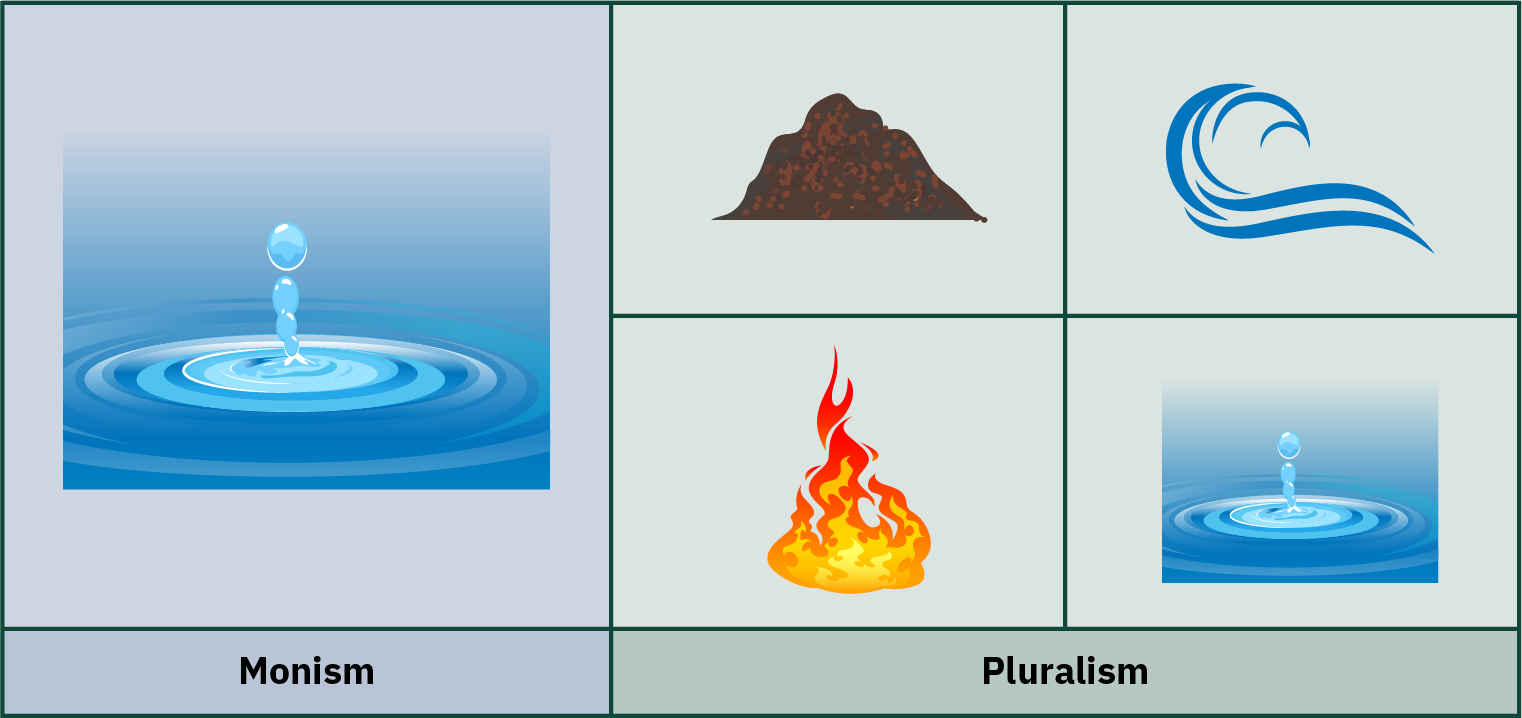
Figure 4.3 A central debate among PreSocratic Greek philosophers concerned whether nature consisted of a single substance—an approach taken by the monists—or was made up of a number of substances—a position taken by the pluralists. One prominent monist, Thales of Miletus, posited that all of nature was made of water. Empedocles, a pluralist, argued instead that the four elements of earth, air, fire, and water formed the basis of the natural world. (attribution: Copyright Rice University, OpenStax, under CC BY 4.0 license)
図4.3 ソクラテス以前のギリシャの哲学者の間の中心的な論争は、自然が単一の実体から成るのか、それとも複数の実体でできているのかという点にあった。前者が一元論者、後者が多元論者の立場である。著名な一元論者ミレトスのタレスは、自然のすべては水でできていると考えた。これに対して多元論者エンペドクレスは、土・空気・火・水の四元素が自然界の基礎をなすと論じた。 (attribution: Copyright Rice University, OpenStax, under CC BY 4.0 license)
Prominent Monists代表的な一元論者
Presocratic philosophers who sought to present a unified conception of nature held that nature ultimately consists of a single substance. This proposition can be interpreted in various ways. The claim proposed by Thales of Miletus (620–546 BCE) that the basic substance of the universe was water is somewhat ambiguous. It might mean that everything is ultimately made of water, or it might mean that water is the origin of all things. Thales and two of his students, Anaximander and Anaximenes, made up the monist Milesian school. Anaximander thought that water was too specific to be the basis for everything that exists. Instead, he thought the basic stuff of the universe was the apeiron, the indefinite or boundless. Anaximenes held that air was the basic substance of the universe.
英語のヒント
自然について統一的な捉え方を示そうとしたソクラテス以前の哲学者たちは、自然は究極的には単一の実体から成ると考えた。この命題は、さまざまな仕方で解釈できる。ミレトスのタレス(紀元前620~546年)が提案した、宇宙の基本的実体は水であるという主張には、いくらか曖昧さがある。すべては究極的には水でできている、という意味かもしれないし、水が万物の起源である、という意味かもしれない。タレスと二人の弟子アナクシマンドロス、アナクシメネスは、一元論を取るミレトス学派を形成した。アナクシマンドロスは、水は特定されすぎていて、存在するすべてのものの基礎にはなれないと考えた。代わりに、宇宙の根本的なものはアペイロン、すなわち無限定で限りのないものだと考えた。アナクシメネスは、空気が宇宙の基本的実体であると考えた。
Parmenides, one of the most influential Presocratic monists, went so far as to deny the reality of change. He presented his metaphysical ideas in a poem that portrays himself being taken on a chariot to visit a goddess who claims she will reveal the truths of the universe to him. The poem has two parts, “the Way of the Truth”, which explains that what exists is unified, complete, and unchanging, and “the Way of Opinion”, which argues that the perception of change in the physical world is mistaken. Our senses mislead us. Although it might seem to us that Parmenides’s claim that change is not real is absurd, he and his student Zeno advanced strong arguments. Parmenides was the first person to propose that the light from the moon came from the sun and to explain the moon’s phases. In this way, he showed that although we see the moon as a crescent, a semicircle, or a complete circle, the moon itself does not change (Graham 2013). The perception that the moon is changing is an illusion.
英語のヒント
ソクラテス以前の一元論者の中で、最も影響力の大きかった一人パルメニデスは、変化の実在まで否定した。彼は形而上学的な考えを詩の形で示した。その詩では、彼自身が戦車に乗って女神のもとへ運ばれ、女神は宇宙の真理を明かすと告げる。詩には二つの部分がある。「真理の道」は、存在するものは一つで、完全で、不変であると説明する。「思わくの道」は、物理的世界に変化があるという知覚は誤りだと論じる。感覚は私たちを欺くのである。変化は実在しないというパルメニデスの主張は、不合理に思えるかもしれない。しかし彼と弟子のゼノンは、強い論証を提示した。パルメニデスは月の光が太陽から来ることを初めて提案し、月の満ち欠けを説明した。このようにして彼は、私たちには月が三日月、半円、完全な円と見えるが、月そのものは変化していない、と示した(Graham 2013)。月が変化しているという知覚は、錯覚なのである。
Zeno proposed paradoxes, known as Zeno’s paradoxes, that demonstrate that what we think of as plurality and motion are simply not possible. Say, for example, that you wish to walk from the library to the park. To get there, you first must walk halfway there. To finish your trip, you must walk half of the remaining distance (one quarter). To travel that final quarter of the distance, you must first walk half of that (an eighth of the total distance). This process can continue forever—creating an infinite number of discrete distances that you must travel. It is therefore impossible that you arrive at the park. A more common way to present this paradox today is as a mathematical asymptote or limit (Figure 4.4). From this point of view, you can never reach point a from point b because no matter where you are along the path, there will always be a distance between wherever you are and where you want to be.
英語のヒント
ゼノンは、私たちが多や運動と考えるものは実は不可能だと示す、ゼノンの逆説と呼ばれる逆説を提示した。例えば、図書館から公園まで歩きたいとしよう。そこに着くには、まず道のりの半分を歩かなければならない。残りを歩き切るには、その残りの距離の半分、すなわち全体の4分の1を進まなければならない。最後の4分の1を進むには、その半分、つまり全体の8分の1を、まず歩かなければならない。この過程はいつまでも続き、歩くべき、互いに分かれた距離が無限個生じる。したがって、公園に到着することは不可能となる。今日、この逆説を示す、より一般的な方法は、数学の漸近線や極限によるものである(図4.4)。この見方によれば、点bから点aへ決して到達できない。道の途中のどこにいても、今いる場所と行きたい場所との間には、必ず距離が残るからである。
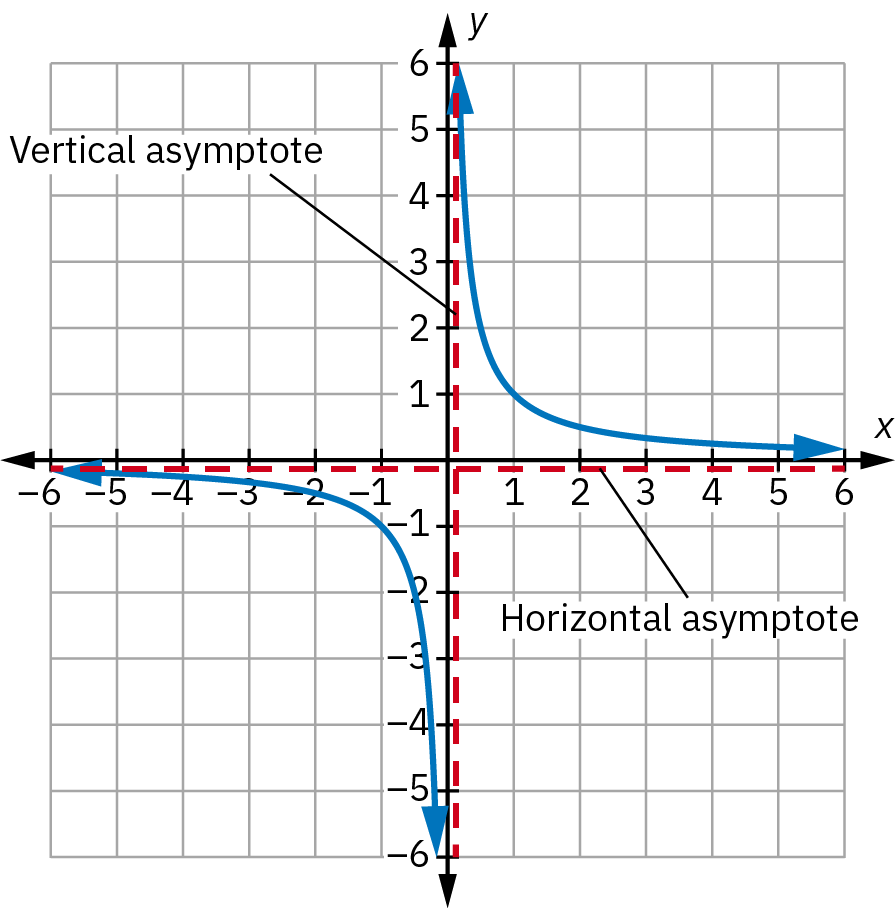
Figure 4.4 For the function y = 1/x, neither x nor y can have a value of zero because y approaches infinity as x approaches zero and x approaches infinity as y approaches zero. Other functions show these same characteristics, which are called asymptotes or limits. (attribution: Copyright Rice University, OpenStax, under CC BY 4.0 license)
図4.4 関数y = 1/xでは、xが0に近づくとyは無限大に近づき、yが0に近づくとxは無限大に近づくため、xもyも0の値を取れない。ほかの関数にも、漸近線や極限と呼ばれる同じ特徴が見られる。 (attribution: Copyright Rice University, OpenStax, under CC BY 4.0 license)