第12章反応速度
Key Concepts and Summary重要な概念とまとめ
Catalysts affect the rate of a chemical reaction by altering its mechanism to provide a lower activation energy. Catalysts can be homogenous (in the same phase as the reactants) or heterogeneous (a different phase than the reactants).
触媒は、反応機構を変えて活性化エネルギーを低くすることで、化学反応速度に影響する。触媒には、反応物と同じ相の均一系触媒と、異なる相の不均一系触媒がある。
Chemistry End of Chapter Exercises章末の化学演習
Exercises 76–84練習問題 76–84
Exercise 76問題 76
Account for the increase in reaction rate brought about by a catalyst.
触媒によって反応速度が上がる理由を説明しなさい。
Solution解き方
The general mode of action for a catalyst is to provide a mechanism by which the reactants can unite more readily by taking a path with a lower reaction energy. The rates of both the forward and the reverse reactions are increased, leading to a faster achievement of equilibrium.
触媒は一般に、反応物がより低い反応エネルギーの経路を通り、より容易に結合できる機構を与える。正反応と逆反応の両方が速くなり、平衡に早く到達する。
Exercise 77問題 77
Compare the functions of homogeneous and heterogeneous catalysts.
均一系触媒と不均一系触媒の働きを比較しなさい。
Exercise 78問題 78
Consider this scenario and answer the following questions: Chlorine atoms resulting from decomposition of chlorofluoromethanes, such as CCl2F2, catalyze the decomposition of ozone in the atmosphere. One simplified mechanism for the decomposition is:
次の状況を考え、問いに答えなさい。CCl2F2などのクロロフルオロメタンの分解で生じる塩素原子は、大気中のオゾン分解を触媒する。分解の簡略化した機構の一つは、である。
(a) Explain why chlorine atoms are catalysts in the gas-phase transformation:
(a) 気相の変換で、塩素原子が触媒である理由を説明しなさい。
(b) Nitric oxide is also involved in the decomposition of ozone by the mechanism:
(b) 一酸化窒素も、次の機構でオゾン分解に関わる。
Is NO a catalyst for the decomposition? Explain your answer.
NOはこの分解の触媒か。理由を説明しなさい。
Solution解き方
(a) Chlorine atoms are a catalyst because they react in the second step but are regenerated in the third step. Thus, they are not used up, which is a characteristic of catalysts. (b) NO is a catalyst for the same reason as in part (a).
(a) 塩素原子は第2段階で反応するが、第3段階で再生されるので触媒である。したがって使い尽くされず、これは触媒の特徴である。(b) NOも(a)と同じ理由で触媒である。
Exercise 79問題 79
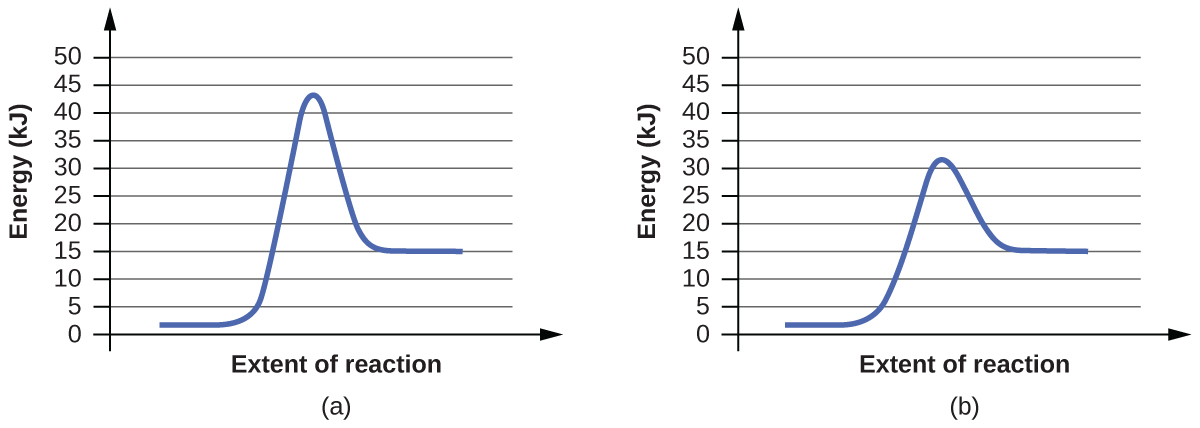
Exercise 80問題 80
For each of the following pairs of reaction diagrams, identify which of the pairs is catalyzed:
次の各組の反応図について、触媒のあるほうを特定しなさい。
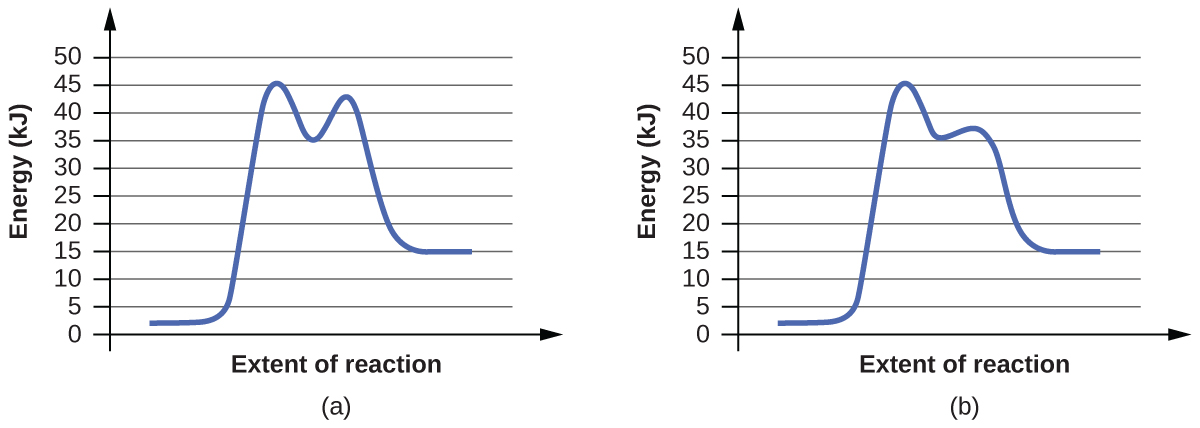
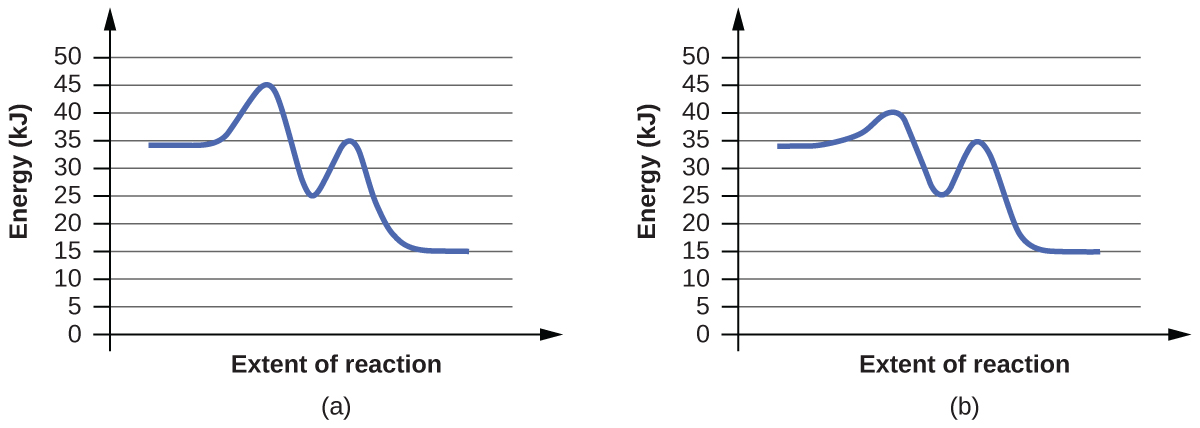
Solution解き方
The lowering of the transition state energy indicates the effect of a catalyst. (a) B; (b) B
遷移状態のエネルギーの低下が触媒の効果を示す。(a) B;(b) B。
Exercise 81問題 81
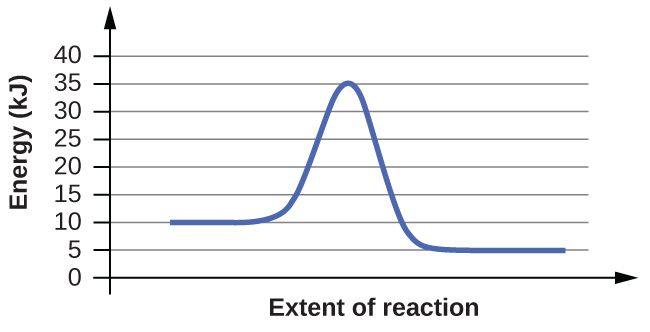
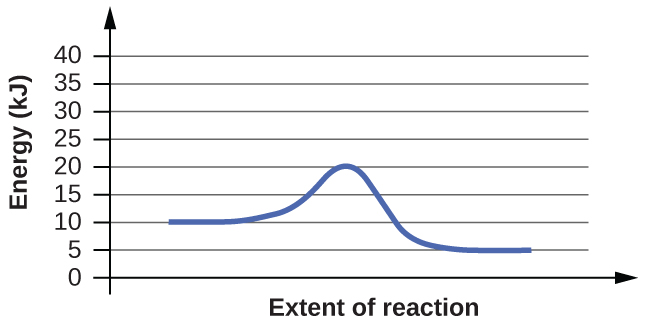
Exercise 82問題 82
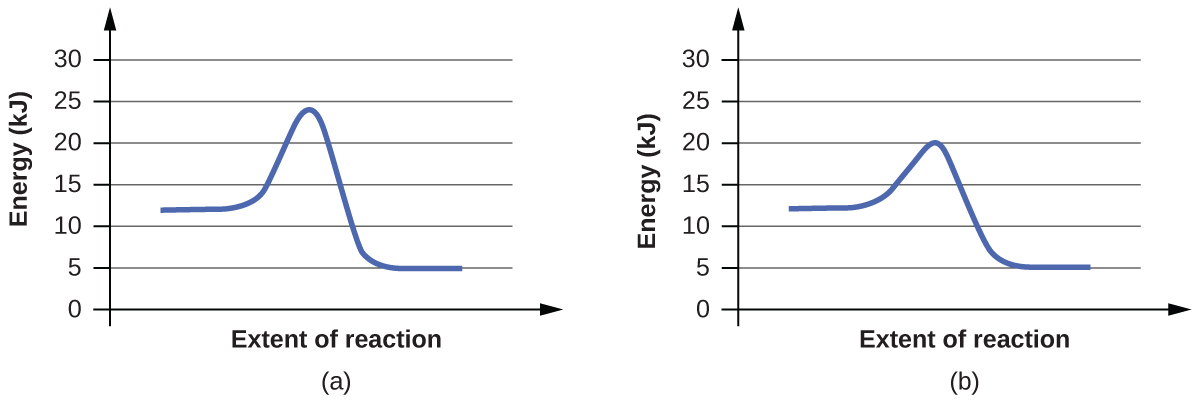
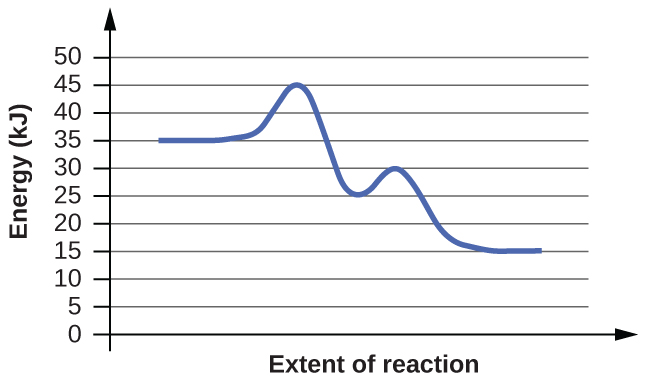
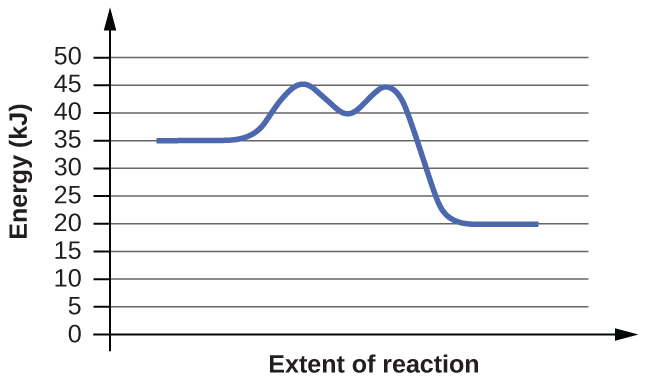
For each of the following reaction diagrams, estimate the activation energy (Ea) of the reaction:
次の各反応図について、反応の活性化エネルギー(Ea)を見積もりなさい。


Solution解き方
The energy needed to go from the initial state to the transition state is (a) 10 kJ; (b) 10 kJ.
初期状態から遷移状態までに必要なエネルギーは、(a) 10 kJ、(b) 10 kJである。
Exercise 83問題 83
Assuming the diagrams in Exercise 81 represent different mechanisms for the same reaction, which of the reactions has the faster rate?
問題81の図が同じ反応の異なる機構を表すと仮定すると、どちらの反応が速いか。
Exercise 84問題 84
Consider the similarities and differences in the two reaction diagrams shown in Exercise 82. Do these diagrams represent two different overall reactions, or do they represent the same overall reaction taking place by two different mechanisms? Explain your answer.
問題82の二つの反応図の共通点と違いを考えなさい。これらは二つの異なる全反応を表すか。それとも、同じ全反応が異なる二つの機構で進む様子を表すか。理由を説明しなさい。
Solution解き方
Both diagrams describe two-step, exothermic reactions, but with different changes in enthalpy, suggesting the diagrams depict two different overall reactions.
どちらも2段階の発熱反応であるが、エンタルピー変化が異なるので、二つの異なる全反応を表すと考えられる。
heterogeneous catalyst
不均一系触媒
catalyst present in a different phase from the reactants, furnishing a surface at which a reaction can occur
反応物と異なる相に存在し、反応が起こる表面を与える触媒。
homogeneous catalyst
均一系触媒
catalyst present in the same phase as the reactants
反応物と同じ相に存在する触媒。