第12章反応速度
12.3 Rate Laws12.3 速度式
Learning Objectives学習目標
By the end of this section, you will be able to:
この節を終えると、次のことができるようになる。
- Explain the form and function of a rate law速度式の形と役割を説明する。
- Use rate laws to calculate reaction rates速度式を使って反応速度を計算する。
- Use rate and concentration data to identify reaction orders and derive rate laws速度と濃度のデータを使って反応次数を特定し、速度式を導く。
As described in the previous module, the rate of a reaction is often affected by the concentrations of reactants. Rate laws (sometimes called differential rate laws) or rate equations are mathematical expressions that describe the relationship between the rate of a chemical reaction and the concentration of its reactants. As an example, consider the reaction described by the chemical equation
英語のヒント
前の節で述べたように、反応速度は反応物の濃度に影響されることがよくある。速度式(微分速度式と呼ぶこともある)は、化学反応の速度と反応物の濃度の関係を表す数式である。例として、次の化学反応式で表される反応を考えてみよう。
where a and b are stoichiometric coefficients. The rate law for this reaction is written as:
ここでaとbは化学量論係数である。この反応の速度式は、次のように書く。
in which [A] and [B] represent the molar concentrations of reactants, and k is the rate constant, which is specific for a particular reaction at a particular temperature. The exponents m and n are the reaction orders and are typically positive integers, though they can be fractions, negative, or zero. The rate constant k and the reaction orders m and n must be determined experimentally by observing how the rate of a reaction changes as the concentrations of the reactants are changed. The rate constant k is independent of the reactant concentrations, but it does vary with temperature.
英語のヒント
ここで、[A]と[B]は反応物のモル濃度、kは速度定数で、ある温度での特定の反応に固有の値である。指数mとnは反応次数で、通常は正の整数であるが、分数、負数、ゼロの場合もある。速度定数kと反応次数m、nは、反応物の濃度を変えたときに反応速度がどう変わるかを観測して、実験的に決めなければならない。速度定数kは反応物濃度には依存しないが、温度によっては変わる。
The reaction orders in a rate law describe the mathematical dependence of the rate on reactant concentrations. Referring to the generic rate law above, the reaction is m order with respect to A and n order with respect to B. For example, if m = 1 and n = 2, the reaction is first order in A and second order in B. The overall reaction order is simply the sum of orders for each reactant. For the example rate law here, the reaction is third order overall (1 + 2 = 3). A few specific examples are shown below to further illustrate this concept.
英語のヒント
速度式の反応次数は、速度が反応物濃度に数学的にどう依存するかを表す。上の一般的な速度式では、反応はAについてm次、Bについてn次である。たとえばm = 1、n = 2なら、Aについて1次、Bについて2次である。全反応次数は、各反応物の次数を単純に足したものである。この例の速度式では、全体として3次反応である(1 + 2 = 3)。この概念をさらに説明するため、次に具体例をいくつか示す。
The rate law:
速度式
describes a reaction that is first order in hydrogen peroxide and first order overall. The rate law:
は、過酸化水素について1次で、全体でも1次の反応を表す。速度式
describes a reaction that is second order in C4H6 and second order overall. The rate law:
は、C4H6について2次で、全体でも2次の反応を表す。速度式
describes a reaction that is first order in H+, first order in OH−, and second order overall.
は、H+について1次、OH−について1次で、全体では2次の反応を表す。
Example 12.3例題 12.3
Writing Rate Laws from Reaction Orders反応次数から速度式を書く
An experiment shows that the reaction of nitrogen dioxide with carbon monoxide:
実験によると、二酸化窒素と一酸化炭素の反応
is second order in NO2 and zero order in CO at 100 °C. What is the rate law for the reaction?
は、100 °CでNO2について2次、COについて0次である。この反応の速度式は何か。
Solution解答
The reaction will have the form:
この反応は次の形になる。
The reaction is second order in NO2; thus m = 2. The reaction is zero order in CO; thus n = 0. The rate law is:
反応はNO2について2次なので、m = 2である。COについて0次なので、n = 0である。速度式は、
Remember that a number raised to the zero power is equal to 1, thus [CO]0 = 1, which is why the CO concentration term may be omitted from the rate law: the rate of reaction is solely dependent on the concentration of NO2. A later chapter section on reaction mechanisms will explain how a reactant’s concentration can have no effect on a reaction rate despite being involved in the reaction.
英語のヒント
数の0乗は1に等しいことを思い出せ。したがって[CO]0 = 1であり、CO濃度の項を速度式から省けるのはこのためである。反応速度は、NO2の濃度だけに依存する。この章の後半の反応機構の節で、ある反応物が反応に関わっているのに、その濃度が反応速度に影響しない仕組みを説明する。
Check Your Learning理解度を確認
The rate law for the reaction:
次の反応の速度式は、
has been determined to be rate = k[NO]2[H2]. What are the orders with respect to each reactant, and what is the overall order of the reaction?
速度 = k[NO]2[H2]と求められている。各反応物についての次数と、全反応次数は何か。
Check Your Learning理解度を確認
In a transesterification reaction, a triglyceride reacts with an alcohol to form an ester and glycerol. Many students learn about the reaction between methanol (CH3OH) and ethyl acetate (CH3CH2OCOCH3) as a sample reaction before studying the chemical reactions that produce biodiesel:
英語のヒント
エステル交換反応では、トリグリセリドがアルコールと反応して、エステルとグリセロールを生じる。多くの学生は、バイオディーゼルを製造する化学反応を学ぶ前に、メタノール(CH3OH)と酢酸エチル(CH3CH2OCOCH3)の反応を例として学ぶ。
The rate law for the reaction between methanol and ethyl acetate is, under certain conditions, determined to be:
メタノールと酢酸エチルの反応の速度式は、ある条件では次のように求められている。
What is the order of reaction with respect to methanol and ethyl acetate, and what is the overall order of reaction?
メタノールと酢酸エチルについての反応次数と、全反応次数は何か。
A common experimental approach to the determination of rate laws is the method of initial rates. This method involves measuring reaction rates for multiple experimental trials carried out using different initial reactant concentrations. Comparing the measured rates for these trials permits determination of the reaction orders and, subsequently, the rate constant, which together are used to formulate a rate law. This approach is illustrated in the next two example exercises.
英語のヒント
速度式を求める一般的な実験法に、初速度法がある。この方法では、反応物の初濃度を変えた複数の実験で、反応速度を測定する。各実験の測定速度を比べることで、反応次数、続いて速度定数を求め、それらから速度式を立てる。次の二つの例題で、この方法を示す。
Example 12.4例題 12.4
Determining a Rate Law from Initial Rates初速度から速度式を求める
Ozone in the upper atmosphere is depleted when it reacts with nitrogen oxides. The rates of the reactions of nitrogen oxides with ozone are important factors in deciding how significant these reactions are in the formation of the ozone hole over Antarctica (Figure 12.8). One such reaction is the combination of nitric oxide, NO, with ozone, O3:
英語のヒント
上層大気のオゾンは、窒素酸化物との反応によって減少する。窒素酸化物とオゾンの反応速度は、これらの反応が南極上空のオゾンホール形成にどれほど重要かを判断する要因である(図12.8)。そのような反応の一つが、一酸化窒素NOとオゾンO3の結合である。
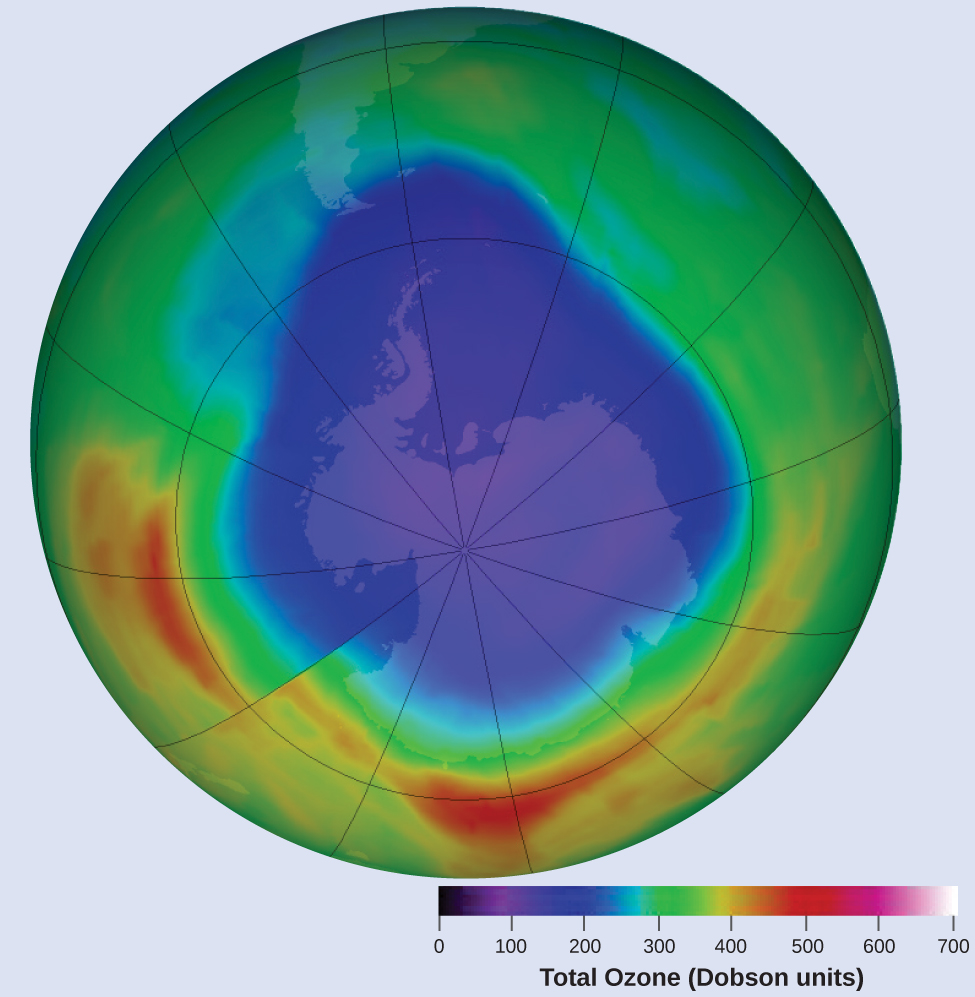
OpenStax, Rice University, Chemistry 2e. Original caption credit: (credit: modification of work by NASA) Source work: 2012 Antarctic Ozone Hole.jpg · Public domain; OpenStax adaptation CC BY 4.0 · Source出典

Figure 12.8図 12.8
A contour map showing stratospheric ozone concentration and the “ozone hole” that occurs over Antarctica during its spring months. (credit: modification of work by NASA)
成層圏のオゾン濃度と、南極の春の数か月間に上空で発生する「オゾンホール」を示す等値線図。(出典:NASAの作品を改変)
This reaction has been studied in the laboratory, and the following rate data were determined at 25 °C.
この反応は実験室で研究され、25 °Cで次の速度データが得られた。
Trial 実験 |
[NO] (mol/L) |
[O3] (mol/L) |
|
|---|---|---|---|
1 |
1.00 10−6 |
3.00 10−6 |
6.60 10−5 |
2 |
1.00 10−6 |
6.00 10−6 |
1.32 10−4 |
3 |
1.00 10−6 |
9.00 10−6 |
1.98 10−4 |
4 |
2.00 10−6 |
9.00 10−6 |
3.96 10−4 |
5 |
3.00 10−6 |
9.00 10−6 |
5.94 10−4 |
Determine the rate law and the rate constant for the reaction at 25 °C.
25 °Cでの反応の速度式と速度定数を求めなさい。
Solution解答
The rate law will have the form:
速度式は次の形になる。
Determine the values of m, n, and k from the experimental data using the following three-part process:
次の3段階の手順を使って、実験データからm、n、kの値を求める。
- Determine the value of m from the data in which [NO] varies and [O3] is constant. In the last three experiments, [NO] varies while [O3] remains constant. When [NO] doubles from trial 3 to 4, the rate doubles, and when [NO] triples from trial 3 to 5, the rate also triples. Thus, the rate is also directly proportional to [NO], and m in the rate law is equal to 1.
英語のヒント
[NO]が変わり、[O3]が一定のデータからmを求める。最後の三つの実験では、[O3]を一定に保ち、[NO]を変えている。実験3から4で[NO]を2倍にすると速度も2倍になり、実験3から5で[NO]を3倍にすると速度も3倍になる。したがって、速度は[NO]にも正比例し、速度式のmは1である。 - Determine the value of n from data in which [O3] varies and [NO] is constant. In the first three experiments, [NO] is constant and [O3] varies. The reaction rate changes in direct proportion to the change in [O3]. When [O3] doubles from trial 1 to 2, the rate doubles; when [O3] triples from trial 1 to 3, the rate increases also triples. Thus, the rate is directly proportional to [O3], and n is equal to 1.The rate law is thus:
英語のヒント
[O3]が変わり、[NO]が一定のデータからnを求める。最初の三つの実験では、[NO]を一定に保ち、[O3]を変えている。反応速度は、[O3]の変化に正比例して変わる。実験1から2で[O3]を2倍にすると速度も2倍になり、実験1から3で[O3]を3倍にすると速度も3倍になる。したがって、速度は[O3]に正比例し、nは1である。よって速度式は、 - Determine the value of k from one set of concentrations and the corresponding rate. The data from trial 1 are used below:一組の濃度と対応する速度からkを求める。以下では実験1のデータを使う。
Check Your Learning理解度を確認
Acetaldehyde decomposes when heated to yield methane and carbon monoxide according to the equation:
アセトアルデヒドを加熱すると、次の反応式に従って分解し、メタンと一酸化炭素を生じる。
Determine the rate law and the rate constant for the reaction from the following experimental data:
次の実験データから、この反応の速度式と速度定数を求めなさい。
Trial 実験 |
[CH3CHO] (mol/L) |
|
|---|---|---|
1 |
1.75 10−3 |
2.06 10−11 |
2 |
3.50 10−3 |
8.24 10−11 |
3 |
7.00 10−3 |
3.30 10−10 |
Example 12.5例題 12.5
Determining Rate Laws from Initial Rates初速度から速度式を求める
Using the initial rates method and the experimental data, determine the rate law and the value of the rate constant for this reaction:
初速度法と実験データを使って、次の反応の速度式と速度定数の値を求めなさい。
Trial 実験 |
[NO] (mol/L) |
[Cl2] (mol/L) |
|
|---|---|---|---|
1 |
0.10 |
0.10 |
0.00300 |
2 |
0.10 |
0.15 |
0.00450 |
3 |
0.15 |
0.10 |
0.00675 |
Solution解答
The rate law for this reaction will have the form:
この反応の速度式は次の形になる。
As in Example 12.4, approach this problem in a stepwise fashion, determining the values of m and n from the experimental data and then using these values to determine the value of k. In this example, however, an explicit algebraic approach (vs. the implicit approach of the previous example) will be used to determine the values of m and n:
英語のヒント
例題12.4と同じく段階的に考え、実験データからmとnを求めて、それらを使ってkを求める。ただしこの例では、前の例の暗黙的な方法に対して、代数的な手順を明示する方法でmとnを求める。
- Determine the value of m from the data in which [NO] varies and [Cl2] is constant. Write the ratios with the subscripts x and y to indicate data from two different trials:[NO]が変わり、[Cl2]が一定のデータからmを求める。異なる二つの実験のデータを表す添字x、yを使い、比を書く。Using the third trial and the first trial, in which [Cl2] does not vary, gives:[Cl2]が変わらない実験3と実験1を使うと、Canceling equivalent terms in the numerator and denominator leaves:分子と分母で等しい項を消去すると、which simplifies to:これを簡単にすると、Use logarithms to determine the value of the exponent m:対数を使って指数mの値を求める。Confirm the result結果を確かめる。
- Determine the value of n from data in which [Cl2] varies and [NO] is constant.[Cl2]が変わり、[NO]が一定のデータからnを求める。Cancelation gives:消去すると、which simplifies to:これを簡単にすると、Thus n must be 1, and the form of the rate law is:したがってnは1でなければならず、速度式は次の形になる。
- Determine the numerical value of the rate constant k with appropriate units. The units for the rate of a reaction are mol/L/s. The units for k are whatever is needed so that substituting into the rate law expression affords the appropriate units for the rate. In this example, the concentration units are mol3/L3. The units for k should be mol−2 L2/s so that the rate is in terms of mol/L/s.
英語のヒント
速度定数kの数値を、適切な単位とともに求める。反応速度の単位はmol/L/sである。kの単位は、速度式に代入したとき、速度の単位が正しくなるように決まる。この例では、濃度の単位を合わせるとmol3/L3である。速度をmol/L/sで表すためには、kの単位をmol−2 L2/sにする。To determine the value of k once the rate law expression has been solved, simply plug in values from the first experimental trial and solve for k:英語のヒント
速度式が求まったら、実験1の値を代入してkについて解くだけで、kの値が得られる。
Check Your Learning理解度を確認
Use the provided initial rate data to derive the rate law for the reaction whose equation is:
与えられた初速度のデータを使って、次の反応式で表される反応の速度式を導きなさい。
Trial 実験 |
[OCl−] (mol/L) |
[I−] (mol/L) |
Initial Rate (mol/L/s) 初速度 (mol/L/s) |
|---|---|---|---|
1 |
0.0040 |
0.0020 |
0.00184 |
2 |
0.0020 |
0.0040 |
0.00092 |
3 |
0.0020 |
0.0020 |
0.00046 |
Determine the rate law expression and the value of the rate constant k with appropriate units for this reaction.
この反応の速度式と速度定数kの値を、適切な単位とともに求めなさい。