第12章反応速度
Second-Order Reactions2次反応
The equations that relate the concentrations of reactants and the rate constant of second-order reactions can be fairly complicated. To illustrate the point with minimal complexity, only the simplest second-order reactions will be described here, namely, those whose rates depend on the concentration of just one reactant. For these types of reactions, the differential rate law is written as:
英語のヒント
2次反応の反応物濃度と速度定数を関係づける式は、かなり複雑になる場合がある。できるだけ単純に説明するため、ここでは一種類の反応物の濃度だけに速度が依存する、最も簡単な2次反応だけを扱う。この種の反応の微分速度式は、次のように書ける。
For these second-order reactions, the integrated rate law is:
これらの2次反応の積分速度式は、次のとおりである。
where the terms in the equation have their usual meanings as defined earlier.
式中の各項は、先ほど定義した通常の意味をもつ。
Example 12.8例題 12.8
The Integrated Rate Law for a Second-Order Reaction2次反応の積分速度式
The reaction of butadiene gas (C4H6) to yield C8H12 gas is described by the equation:
ブタジエン気体(C4H6)からC8H12気体が生じる反応は、次の式で表される。
This “dimerization” reaction is second order with a rate constant equal to 5.76 10−2 L mol−1 min−1 under certain conditions. If the initial concentration of butadiene is 0.200 M, what is the concentration after 10.0 min?
英語のヒント
この「二量化」反応は2次で、ある条件での速度定数は5.76 10−2 L mol−1 min−1である。ブタジエンの初濃度が0.200 Mなら、10.0 min後の濃度はいくらか。
Solution解答
For a second-order reaction, the integrated rate law is written
2次反応の積分速度式は、次のように書ける。
We know three variables in this equation: [A]0 = 0.200 mol/L, k = 5.76 10−2 L/mol/min, and t = 10.0 min. Therefore, we can solve for [A], the fourth variable:
この式の変数のうち、[A]0 = 0.200 mol/L、k = 5.76 10−2 L/mol/min、t = 10.0 minの三つが分かっている。したがって、四つ目の変数[A]について解ける。
Therefore 0.179 mol/L of butadiene remain at the end of 10.0 min, compared to the 0.200 mol/L that was originally present.
したがって、初めに0.200 mol/Lあったブタジエンは、10.0 min後には0.179 mol/L残る。
Check Your Learning理解度を確認
If the initial concentration of butadiene is 0.0200 M, what is the concentration remaining after 20.0 min?
ブタジエンの初濃度が0.0200 Mなら、20.0 min後に残る濃度はいくらか。
The integrated rate law for second-order reactions has the form of the equation of a straight line:
2次反応の積分速度式は、直線の方程式の形になっている。
A plot of versus t for a second-order reaction is a straight line with a slope of k and a y-intercept of If the plot is not a straight line, then the reaction is not second order.
英語のヒント
2次反応でをtに対してプロットすると、傾きk、縦軸切片の直線になる。直線にならなければ、反応は2次ではない。
Example 12.9例題 12.9
Graphical Determination of Reaction Order and Rate Constantグラフから反応次数と速度定数を求める
The data below are for the same reaction described in Example 12.8. Prepare and compare two appropriate data plots to identify the reaction as being either first or second order. After identifying the reaction order, estimate a value for the rate constant.
英語のヒント
以下のデータは、例題12.8と同じ反応についてのものである。適切な二種類のデータのプロットを作って比べ、反応が1次か2次かを判定しなさい。反応次数を特定した後、速度定数の値を見積もりなさい。
Solution解答
Time (s) 時間 (s) |
[C4H6] (M) |
|---|---|
0 |
1.00 10−2 |
1600 |
5.04 10−3 |
3200 |
3.37 10−3 |
4800 |
2.53 10−3 |
6200 |
2.08 10−3 |
In order to distinguish a first-order reaction from a second-order reaction, prepare a plot of ln[C4H6]t versus t and compare it to a plot of versus t. The values needed for these plots follow.
英語のヒント
1次反応と2次反応を区別するため、ln[C4H6]tをtに対してプロットし、をtに対してプロットしたものと比べる。必要な値は次のとおりである。
Time (s) 時間 (s) |
ln[C4H6] |
|
|---|---|---|
0 |
100 |
−4.605 |
1600 |
198 |
−5.289 |
3200 |
296 |
−5.692 |
4800 |
395 |
−5.978 |
6200 |
481 |
−6.175 |
The plots are shown in Figure 12.10, which clearly shows the plot of ln[C4H6]t versus t is not linear, therefore the reaction is not first order. The plot of versus t is linear, indicating that the reaction is second order.
英語のヒント
図12.10のプロットを見ると、ln[C4H6]tとtの関係は明らかに直線ではなく、反応は1次ではない。とtの関係は直線なので、反応は2次である。
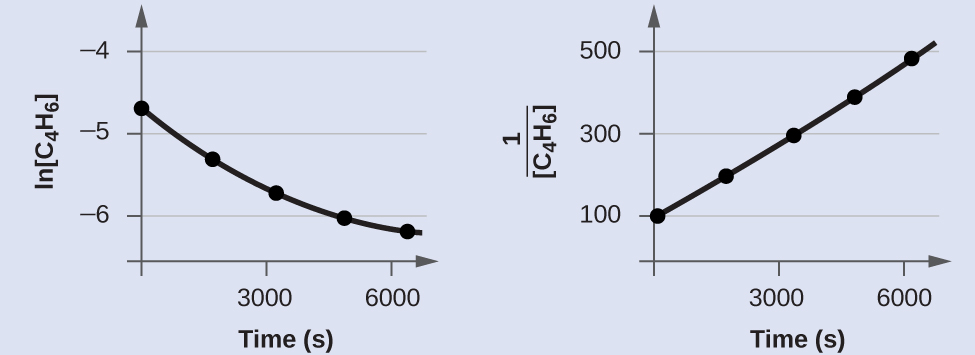
Figure 12.10図 12.10
These two graphs show first- and second-order plots for the dimerization of C4H6. The linear trend in the second-order plot (right) indicates that the reaction follows second-order kinetics.
C4H6の二量化について、1次と2次の形式で描いた二つのグラフである。右の2次のプロットが直線になることから、反応は2次の速度論に従うと分かる。
According to the second-order integrated rate law, the rate constant is equal to the slope of the versus t plot. Using the data for t = 0 s and t = 6200 s, the rate constant is estimated as follows:
英語のヒント
2次の積分速度式によると、速度定数はをtに対して描いたプロットの傾きに等しくなる。t = 0 sとt = 6200 sのデータを使い、次のように速度定数を見積もる。
Check Your Learning理解度を確認
Do the following data fit a second-order rate law?
次のデータは、2次の速度式に合うか。
Time (s) 時間 (s) |
[A] (M) |
|---|---|
5 |
0.952 |
10 |
0.625 |
15 |
0.465 |
20 |
0.370 |
25 |
0.308 |
35 |
0.230 |
Zero-Order Reactions0次反応
For zero-order reactions, the differential rate law is:
0次反応の微分速度式は、
A zero-order reaction thus exhibits a constant reaction rate, regardless of the concentration of its reactant(s). This may seem counterintuitive, since the reaction rate certainly can’t be finite when the reactant concentration is zero. For purposes of this introductory text, it will suffice to note that zero-order kinetics are observed for some reactions only under certain specific conditions. These same reactions exhibit different kinetic behaviors when the specific conditions aren’t met, and for this reason the more prudent term pseudo-zero-order is sometimes used.
英語のヒント
したがって、0次反応は反応物の濃度によらず一定の速度を示す。反応物濃度がゼロなのに反応速度が有限の値をもつことは確かにないので、これは直感に反するように見えるかもしれない。この入門書では、一部の反応で0次の速度論が観測されるのは、特定の条件下だけであると押さえれば十分である。同じ反応でも、その条件を満たさなければ異なる速度論的挙動を示す。このため、より慎重な言い方として「擬0次」という用語を使う場合もある。
The integrated rate law for a zero-order reaction is a linear function:
0次反応の積分速度式は、1次関数である。
A plot of [A] versus t for a zero-order reaction is a straight line with a slope of −k and a y-intercept of [A]0. Figure 12.11 shows a plot of [NH3] versus t for the thermal decomposition of ammonia at the surface of two different heated solids. The decomposition reaction exhibits first-order behavior at a quartz (SiO2) surface, as suggested by the exponentially decaying plot of concentration versus time. On a tungsten surface, however, the plot is linear, indicating zero-order kinetics.
英語のヒント
0次反応で[A]をtに対してプロットすると、傾き−k、縦軸切片[A]0の直線になる。図12.11は、加熱した二種類の固体の表面でアンモニアが熱分解する際の、[NH3]とtのプロットである。石英(SiO2)表面では、濃度が時間とともに指数関数的に減衰するプロットが示すように、分解は1次の挙動を示す。しかし、タングステン表面では直線となり、0次の速度論を示している。
Example 12.10例題 12.10
Graphical Determination of Zero-Order Rate Constantグラフから0次反応の速度定数を求める
Use the data plot in Figure 12.11 to graphically estimate the zero-order rate constant for ammonia decomposition at a tungsten surface.
図12.11のデータのプロットを使い、タングステン表面でのアンモニア分解の0次速度定数を、グラフから見積もりなさい。
Solution解答
The integrated rate law for zero-order kinetics describes a linear plot of reactant concentration, [A]t, versus time, t, with a slope equal to the negative of the rate constant, −k. Following the mathematical approach of previous examples, the slope of the linear data plot (for decomposition on W) is estimated from the graph. Using the ammonia concentrations at t = 0 and t = 1000 s:
英語のヒント
0次の積分速度式では、反応物濃度[A]tを時間tに対してプロットすると直線となり、その傾きは速度定数に負号を付けた−kである。前の例と同じ数学的な方法で、W上の分解の直線プロットの傾きをグラフから見積もる。t = 0とt = 1000 sでのアンモニア濃度を使うと、
Check Your Learning理解度を確認
The zero-order plot in Figure 12.11 shows an initial ammonia concentration of 0.0028 mol L−1 decreasing linearly with time for 1000 s. Assuming no change in this zero-order behavior, at what time (min) will the concentration reach 0.0001 mol L−1?
英語のヒント
図12.11の0次のプロットでは、アンモニアの初濃度0.0028 mol L−1から、1000 sにわたって濃度が時間に対して直線的に下がっている。この0次の挙動が変わらないとすると、濃度が0.0001 mol L−1になるのは何分後か。
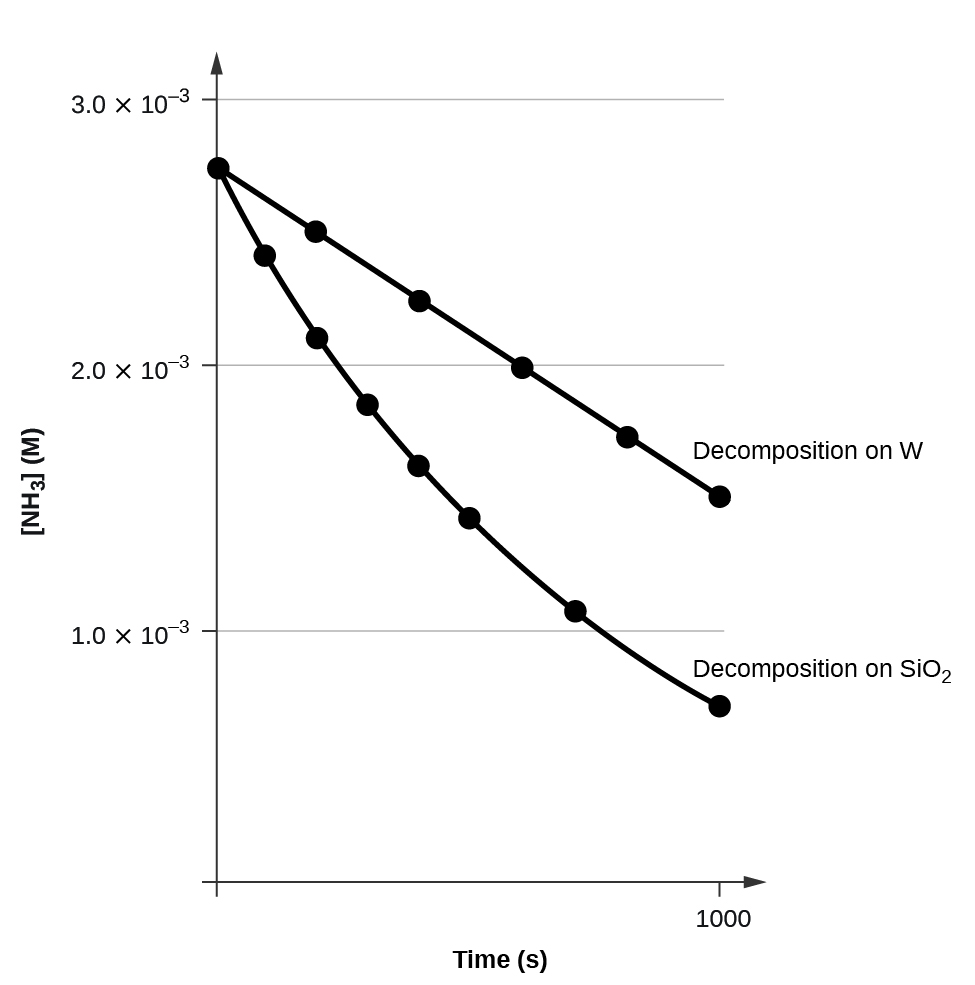


Figure 12.11図 12.11
The decomposition of NH3 on a tungsten (W) surface is a zero-order reaction, whereas on a quartz (SiO2) surface, the reaction is first order.
タングステン(W)表面でのNH3の分解は0次反応であるが、石英(SiO2)表面では1次反応である。