第12章反応速度
12.6 Reaction Mechanisms12.6 反応機構
Learning Objectives学習目標
By the end of this section, you will be able to:
この節を終えると、次のことができるようになる。
- Distinguish net reactions from elementary reactions (steps)正味の反応と素反応(各段階)を区別する。
- Identify the molecularity of elementary reactions素反応の分子数を特定する。
- Write a balanced chemical equation for a process given its reaction mechanism与えられた反応機構から、その過程のつり合った化学反応式を書く。
- Derive the rate law consistent with a given reaction mechanism与えられた反応機構と整合する速度式を導く。
Chemical reactions very often occur in a step-wise fashion, involving two or more distinct reactions taking place in sequence. A balanced equation indicates what is reacting and what is produced, but it reveals no details about how the reaction actually takes place. The reaction mechanism (or reaction path) provides details regarding the precise, step-by-step process by which a reaction occurs.
英語のヒント
化学反応は、異なる二つ以上の反応が順に起こる、段階的な形で進むことが非常によくある。係数のつり合った反応式は、何が反応し、何ができるかを示すが、実際にどのように反応が起こるかは明らかにしない。反応機構(反応経路)は、反応が起こる正確な段階ごとの過程を詳しく示す。
The decomposition of ozone, for example, appears to follow a mechanism with two steps:
たとえば、オゾンの分解は、2段階の機構に従うと考えられる。
Each of the steps in a reaction mechanism is an elementary reaction. These elementary reactions occur precisely as represented in the step equations, and they must sum to yield the balanced chemical equation representing the overall reaction:
英語のヒント
反応機構の各段階は素反応である。素反応は、各段階の反応式で表したとおりに起こり、それらを足すと、全反応を表す係数のつり合った反応式にならなければならない。
Notice that the oxygen atom produced in the first step of this mechanism is consumed in the second step and therefore does not appear as a product in the overall reaction. Species that are produced in one step and consumed in a subsequent step are called intermediates.
英語のヒント
この機構の第1段階でできた酸素原子は、第2段階で消費されるため、全反応の生成物には現れないことに注目せよ。ある段階ででき、後の段階で消費される化学種を、中間体という。
While the overall reaction equation for the decomposition of ozone indicates that two molecules of ozone react to give three molecules of oxygen, the mechanism of the reaction does not involve the direct collision and reaction of two ozone molecules. Instead, one O3 decomposes to yield O2 and an oxygen atom, and a second O3 molecule subsequently reacts with the oxygen atom to yield two additional O2 molecules.
英語のヒント
オゾン分解の全反応式は、2分子のオゾンから3分子の酸素ができることを示す。しかし、反応機構は2分子のオゾンが直接衝突して反応するものではない。まず一つのO3が分解してO2と酸素原子を生じ、続いて二つ目のO3分子がその酸素原子と反応して、さらに二つのO2分子を生じる。
Unlike balanced equations representing an overall reaction, the equations for elementary reactions are explicit representations of the chemical change taking place. The reactant(s) in an elementary reaction’s equation undergo only the bond-breaking and/or making events depicted to yield the product(s). For this reason, the rate law for an elementary reaction may be derived directly from the balanced chemical equation describing the reaction. This is not the case for typical chemical reactions, for which rate laws may be reliably determined only via experimentation.
英語のヒント
全反応を表すつり合った反応式とは異なり、素反応の式は、起こる化学変化を明示的に表す。素反応の式の反応物は、描かれた結合の切断や形成だけを経て、生成物になる。このため、素反応の速度式は、その反応を記述するつり合った化学反応式から直接導ける。普通の化学反応ではそうではなく、速度式を確実に求めるには実験が必要である。
Unimolecular Elementary Reactions単分子素反応
The molecularity of an elementary reaction is the number of reactant entities (atoms, molecules, or ions). For example, a unimolecular reaction involves the reaction of a single reactant entities to produce one or more molecules of product:
英語のヒント
素反応の分子数は、反応する粒子(原子、分子、イオン)の数である。たとえば単分子反応では、一つの反応物粒子から一つ以上の生成物分子ができる。
The rate law for a unimolecular reaction is first order:
単分子反応の速度式は1次である。
A unimolecular reaction may be one of several elementary reactions in a complex mechanism. For example, the reaction:
単分子反応は、複雑な機構を構成するいくつかの素反応の一つである場合がある。たとえば、反応
illustrates a unimolecular elementary reaction that occurs as one part of a two-step reaction mechanism as described above. However, some unimolecular reactions may be the only step of a single-step reaction mechanism. (In other words, an “overall” reaction may also be an elementary reaction in some cases.) For example, the gas-phase decomposition of cyclobutane, C4H8, to ethylene, C2H4, is represented by the following chemical equation:
英語のヒント
は、先ほど述べた2段階の反応機構の一部として起こる単分子素反応を示している。一方、単分子反応が、1段階の反応機構の唯一の段階である場合もある。言い換えると、「全反応」そのものが素反応である場合もあるのである。たとえば、気相のシクロブタンC4H8がエチレンC2H4に分解する反応は、次の式で表される。
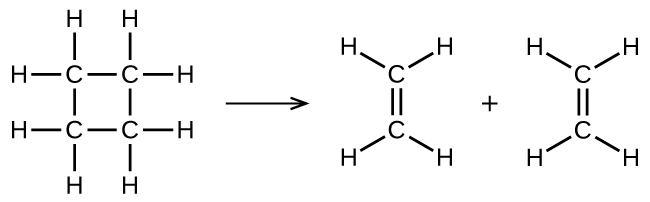
This equation represents the overall reaction observed, and it might also represent a legitimate unimolecular elementary reaction. The rate law predicted from this equation, assuming it is an elementary reaction, turns out to be the same as the rate law derived experimentally for the overall reaction, namely, one showing first-order behavior:
英語のヒント
この式は観測された全反応を表すが、妥当な単分子素反応を表している可能性もある。素反応だと仮定してこの式から予測する速度式は、全反応について実験から得た速度式と同じ、次の1次の挙動を示すものになる。
This agreement between observed and predicted rate laws is interpreted to mean that the proposed unimolecular, single-step process is a reasonable mechanism for the butadiene reaction.
観測された速度式と予測された速度式の一致は、提案した単分子・1段階過程が、ブタジエンの反応の妥当な機構であることを意味すると解釈される。
Bimolecular Elementary Reactions二分子素反応
A bimolecular reaction involves two reactant entities, for example:
二分子反応には、二つの反応物粒子が関与する。たとえば、
For the first type, in which the two reactant molecules are different, the rate law is first-order in A and first order in B (second-order overall):
最初の型では反応物の二分子が異なるため、速度式はAについて1次、Bについて1次で、全体では2次である。
For the second type, in which two identical molecules collide and react, the rate law is second order in A:
二つ目の型では同じ分子が二つ衝突して反応するので、速度式はAについて2次である。
Some chemical reactions occur by mechanisms that consist of a single bimolecular elementary reaction. One example is the reaction of nitrogen dioxide with carbon monoxide:
一つの二分子素反応だけからなる機構で進む化学反応もある。その例が、二酸化窒素と一酸化炭素の反応である。
(see Figure 12.17)
(図12.17参照)



Figure 12.17図 12.17
The probable mechanism for the reaction between NO2 and CO to yield NO and CO2.
NO2とCOからNOとCO2ができる反応の、考えられる機構。
Bimolecular elementary reactions may also be involved as steps in a multistep reaction mechanism. The reaction of atomic oxygen with ozone is the second step of the two-step ozone decomposition mechanism discussed earlier in this section:
英語のヒント
二分子素反応も、多段階の反応機構の一段階として関与することがある。酸素原子とオゾンの反応は、この節の前半で扱ったオゾン分解の2段階機構の、第2段階である。