第12章反応速度
Relative Rates of Reaction反応速度の相対関係
The rate of a reaction may be expressed as the change in concentration of any reactant or product. For any given reaction, these rate expressions are all related simply to one another according to the reaction stoichiometry. The rate of the general reaction
英語のヒント
反応速度は、どの反応物や生成物の濃度変化でも表せる。一つの反応について、これらの速度の表式はすべて、反応の化学量論によって互いに簡単に関係づけられる。一般的な反応
can be expressed in terms of the decrease in the concentration of A or the increase in the concentration of B. These two rate expressions are related by the stoichiometry of the reaction:
の速度は、Aの濃度の減少、またはBの濃度の増加を使って表せる。この二つの速度の表式は、反応の化学量論によって次のように関係づけられる。
Consider the reaction represented by the following equation:
次の反応式で表される反応を考えてみよう。
The relation between the reaction rates expressed in terms of nitrogen production and ammonia consumption, for example, is:
たとえば、窒素の生成とアンモニアの消費で表した反応速度の関係は、次のようになる。
This may be represented in an abbreviated format by omitting the units of the stoichiometric factor:
化学量論因子の単位を省けば、これを短い形で表せる。
Note that a negative sign has been included as a factor to account for the opposite signs of the two amount changes (the reactant amount is decreasing while the product amount is increasing). For homogeneous reactions, both the reactants and products are present in the same solution and thus occupy the same volume, so the molar amounts may be replaced with molar concentrations:
英語のヒント
二つの量の変化は符号が逆なので、因子として負号を含めていることに注意せよ(反応物の量は減り、生成物の量は増える)。均一反応では、反応物と生成物は同じ溶液中にあり、同じ体積を占めるので、物質量をモル濃度に置き換えられる。
Similarly, the rate of formation of H2 is three times the rate of formation of N2 because three moles of H2 are produced for each mole of N2 produced.
同様に、N2が1モル生じるごとにH2が3モル生じるので、H2の生成速度はN2の生成速度の3倍である。
Figure 12.5 illustrates the change in concentrations over time for the decomposition of ammonia into nitrogen and hydrogen at 1100 °C. Slopes of the tangent lines at t = 500 s show that the instantaneous rates derived from all three species involved in the reaction are related by their stoichiometric factors. The rate of hydrogen production, for example, is observed to be three times greater than that for nitrogen production:
英語のヒント
図12.5は、1100 °Cでアンモニアが窒素と水素に分解する際の、濃度の時間変化を示している。t = 500 sでの接線の傾きから、反応に関与する三つの化学種のそれぞれから求めた瞬間速度が、化学量論因子で関係づけられることが分かる。たとえば水素の生成速度は、窒素の生成速度の3倍になっている。
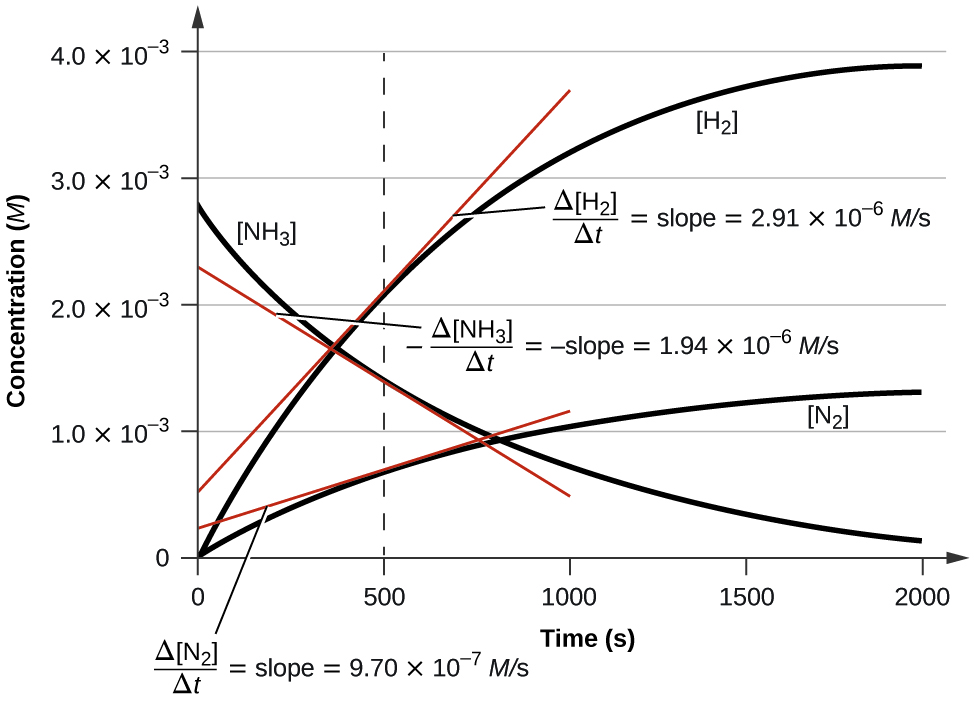

Figure 12.5図 12.5
Changes in concentrations of the reactant and products for the reaction The rates of change of the three concentrations are related by the reaction stoichiometry, as shown by the different slopes of the tangents at t = 500 s.
反応における反応物と生成物の濃度変化。t = 500 sでの接線の傾きの違いが示すように、三つの濃度の変化速度は反応の化学量論によって関係づけられる。
Example 12.1例題 12.1
Expressions for Relative Reaction Rates相対的な反応速度の表式
The first step in the production of nitric acid is the combustion of ammonia:
硝酸の製造の最初の段階は、アンモニアの燃焼である。
Write the equations that relate the rates of consumption of the reactants and the rates of formation of the products.
反応物の消費速度と生成物の生成速度を関係づける式を書きなさい。
Solution解答
Considering the stoichiometry of this homogeneous reaction, the rates for the consumption of reactants and formation of products are:
この均一反応の化学量論を考えると、反応物の消費速度と生成物の生成速度は次のようになる。
Check Your Learning理解度を確認
The rate of formation of Br2 is 6.0 10−6 mol/L/s in a reaction described by the following net ionic equation:
次の正味のイオン反応式で表される反応で、Br2の生成速度は6.0 10−6 mol/L/sである。
Write the equations that relate the rates of consumption of the reactants and the rates of formation of the products.
反応物の消費速度と生成物の生成速度を関係づける式を書きなさい。
Example 12.2例題 12.2
Reaction Rate Expressions for Decomposition of H2O2H2O2の分解の反応速度の表式
The graph in Figure 12.3 shows the rate of the decomposition of H2O2 over time:
図12.3のグラフは、H2O2の分解速度の時間変化を示している。
Based on these data, the instantaneous rate of decomposition of H2O2 at t = 11.1 h is determined to be
3.20 10−2 mol/L/h, that is:
3.20 10−2 mol/L/h, that is:
このデータから、t = 11.1 hでのH2O2の瞬間分解速度は3.20 10−2 mol/L/hと求められる。すなわち、
What is the instantaneous rate of production of H2O and O2?
H2OとO2の瞬間生成速度はいくらか。
Solution解答
The reaction stoichiometry shows that
反応の化学量論から、次のことが分かる。
Therefore:
したがって:
and
および
Based on the stoichiometry of this reaction as shown above, the rate of water product is therefore
したがって、上に示した反応の化学量論から、水の生成速度は次のようになる。
Check Your Learning理解度を確認
If the rate of decomposition of ammonia, NH3, at 1150 K is 2.10 10−6 mol/L/s, what is the rate of production of nitrogen and hydrogen?
1150 KでのアンモニアNH3の分解速度が2.10 10−6 mol/L/sなら、窒素と水素の生成速度はいくらか。
Key Concepts and Summary重要な概念とまとめ
The rate of a reaction can be expressed either in terms of the decrease in the amount of a reactant or the increase in the amount of a product per unit time. Relations between different rate expressions for a given reaction are derived directly from the stoichiometric coefficients of the equation representing the reaction.
反応速度は、単位時間あたりの反応物の量の減少、または生成物の量の増加で表せる。ある反応について異なる速度の表式どうしの関係は、その反応を表す反応式の化学量論係数から直接導ける。
Key Equations重要な式
Chemistry End of Chapter Exercises章末の化学演習
Exercises 1–6練習問題 1–6
Exercise 1問題 1
What is the difference between average rate, initial rate, and instantaneous rate?
平均速度、初速度、瞬間速度は、それぞれどう違うか。
Solution解き方
The instantaneous rate is the rate of a reaction at any particular point in time, a period of time that is so short that the concentrations of reactants and products change by a negligible amount. The initial rate is the instantaneous rate of reaction as it starts (as product just begins to form). Average rate is the average of the instantaneous rates over a time period.
瞬間速度は、任意の特定の時点での反応速度である。その時間区間は非常に短く、反応物と生成物の濃度の変化を無視できる。初速度は、反応が始まるとき(生成物が生じ始めたばかりのとき)の瞬間反応速度である。平均速度は、ある時間区間の瞬間速度を平均したものである。
Exercise 2問題 2
Ozone decomposes to oxygen according to the equation Write the equation that relates the rate expressions for this reaction in terms of the disappearance of O3 and the formation of oxygen.
オゾンは、反応式に従って酸素に分解する。O3の消失と酸素の生成で表した、この反応の速度の表式を関係づける式を書きなさい。
Exercise 3問題 3
In the nuclear industry, chlorine trifluoride is used to prepare uranium hexafluoride, a volatile compound of uranium used in the separation of uranium isotopes. Chlorine trifluoride is prepared by the reaction Write the equation that relates the rate expressions for this reaction in terms of the disappearance of Cl2 and F2 and the formation of ClF3.
英語のヒント
原子力産業では、ウラン同位体の分離に使う揮発性のウラン化合物、六フッ化ウランを作るために三フッ化塩素を使う。三フッ化塩素は反応で作る。Cl2とF2の消失、およびClF3の生成で表した、この反応の速度の表式を関係づける式を書きなさい。
Solution解き方
Exercise 4問題 4
A study of the rate of dimerization of C4H6 gave the data shown in the table:
英語のヒント
C4H6の二量化の速度を調べたところ、表のデータが得られた。
Time (s) 時間 (s) |
0 |
1600 |
3200 |
4800 |
6200 |
[C4H6] (M) |
1.00 10−2 |
5.04 10−3 |
3.37 10−3 |
2.53 10−3 |
2.08 10−3 |
(a) Determine the average rate of dimerization between 0 s and 1600 s, and between 1600 s and 3200 s.
(a) 0 sから1600 sまでと、1600 sから3200 sまでの、二量化の平均速度を求めなさい。
(b) Estimate the instantaneous rate of dimerization at 3200 s from a graph of time versus [C4H6]. What are the units of this rate?
(b) 時間と[C4H6]のグラフから、3200 sでの二量化の瞬間速度を見積もりなさい。この速度の単位は何か。
(c) Determine the average rate of formation of C8H12 at 1600 s and the instantaneous rate of formation at 3200 s from the rates found in parts (a) and (b).
(c) (a)と(b)で得た速度から、1600 sでのC8H12の平均生成速度と、3200 sでの瞬間生成速度を求めなさい。
Exercise 5問題 5
A study of the rate of the reaction represented as gave the following data:
と表される反応の速度を調べたところ、次のデータが得られた。
Time (s) 時間 (s) |
0.0 |
5.0 |
10.0 |
15.0 |
20.0 |
25.0 |
35.0 |
[A] (M) |
1.00 |
0.775 |
0.625 |
0.465 |
0.360 |
0.285 |
0.230 |
(a) Determine the average rate of disappearance of A between 0.0 s and 10.0 s, and between 10.0 s and 20.0 s.
(a) 0.0 sから10.0 sまでと、10.0 sから20.0 sまでの、Aの平均消失速度を求めなさい。
(b) Estimate the instantaneous rate of disappearance of A at 15.0 s from a graph of time versus [A]. What are the units of this rate?
(b) 時間と[A]のグラフから、15.0 sでのAの瞬間消失速度を見積もりなさい。この速度の単位は何か。
(c) Use the rates found in parts (a) and (b) to determine the average rate of formation of B between 0.00 s and 10.0 s, and the instantaneous rate of formation of B at 15.0 s.
(c) (a)と(b)で得た速度を使って、0.00 sから10.0 sまでのBの平均生成速度と、15.0 sでのBの瞬間生成速度を求めなさい。
Solution解き方
(a) average rate, 0 − 10 s = 0.0375 mol L−1 s−1; average rate, 10 − 20 s = 0.0265 mol L−1 s−1; (b) instantaneous rate, 15 s = 0.023 mol L−1 s−1; (c) average rate for B formation = 0.0188 mol L−1 s−1; instantaneous rate for B formation = 0.012 mol L−1 s−1
(a) 平均速度、0~10 s = 0.0375 mol L−1 s−1;平均速度、10~20 s = 0.0265 mol L−1 s−1。(b) 瞬間速度、15 s = 0.023 mol L−1 s−1。(c) Bの平均生成速度 = 0.0188 mol L−1 s−1;Bの瞬間生成速度 = 0.012 mol L−1 s−1。
Exercise 6問題 6
Consider the following reaction in aqueous solution:
次の水溶液中の反応を考えなさい。
If the rate of disappearance of Br–(aq) at a particular moment during the reaction is 3.5 10−4 mol L−1 s−1, what is the rate of appearance of Br2(aq) at that moment?
反応中のある瞬間でのBr–(aq)の消失速度が3.5 10−4 mol L−1 s−1なら、その瞬間でのBr2(aq)の出現速度はいくらか。
average rate
平均速度
rate of a chemical reaction computed as the ratio of a measured change in amount or concentration of substance to the time interval over which the change occurred
測定した物質の量または濃度の変化を、その変化が起こった時間間隔で割って求める化学反応の速度。
initial rate
初速度
instantaneous rate of a chemical reaction at t = 0 s (immediately after the reaction has begun)
t = 0 s、すなわち反応が始まった直後の、化学反応の瞬間速度。
instantaneous rate
瞬間速度
rate of a chemical reaction at any instant in time, determined by the slope of the line tangential to a graph of concentration as a function of time
任意の瞬間での化学反応の速度。濃度を時間の関数として示したグラフの接線の傾きから求める。
rate of reaction
反応速度
measure of the speed at which a chemical reaction takes place
化学反応が進む速さを表す尺度。
rate expression
速度の表式
mathematical representation defining reaction rate as change in amount, concentration, or pressure of reactant or product species per unit time
反応速度を、反応物または生成物の化学種の量・濃度・圧力の単位時間あたりの変化として定義する数学的な表式。