第12章反応速度
12.4 Integrated Rate Laws12.4 積分速度式
Learning Objectives学習目標
By the end of this section, you will be able to:
この節を終えると、次のことができるようになる。
- Explain the form and function of an integrated rate law積分速度式の形と役割を説明する。
- Perform integrated rate law calculations for zero-, first-, and second-order reactions0次、1次、2次反応について、積分速度式を使う計算を行う。
- Define half-life and carry out related calculations半減期を定義し、関連する計算を行う。
- Identify the order of a reaction from concentration/time data濃度と時間のデータから反応次数を特定する。
The rate laws discussed thus far relate the rate and the concentrations of reactants. We can also determine a second form of each rate law that relates the concentrations of reactants and time. These are called integrated rate laws. We can use an integrated rate law to determine the amount of reactant or product present after a period of time or to estimate the time required for a reaction to proceed to a certain extent. For example, an integrated rate law is used to determine the length of time a radioactive material must be stored for its radioactivity to decay to a safe level.
英語のヒント
ここまでの速度式は、速度と反応物濃度の関係を表していた。各速度式について、反応物濃度と時間を関係づける、もう一つの形を求めることもできる。これを積分速度式という。積分速度式を使うと、一定時間後に存在する反応物や生成物の量を求めたり、反応がある程度まで進むのに必要な時間を見積もったりできる。たとえば、放射性物質の放射能が安全な水準まで下がるのに、どのくらいの期間保管すべきかを求める際に使われる。
Using calculus, the differential rate law for a chemical reaction can be integrated with respect to time to give an equation that relates the amount of reactant or product present in a reaction mixture to the elapsed time of the reaction. This process can either be very straightforward or very complex, depending on the complexity of the differential rate law. For purposes of discussion, we will focus on the resulting integrated rate laws for first-, second-, and zero-order reactions.
英語のヒント
微積分を使って化学反応の微分速度式を時間について積分すると、反応混合物中に存在する反応物や生成物の量と、反応の経過時間を関係づける式が得られる。微分速度式の複雑さによって、この計算は非常に簡単な場合も、非常に複雑な場合もある。ここでは、1次、2次、0次反応について、積分して得られる速度式に注目する。
First-Order Reactions1次反応
Integration of the rate law for a simple first-order reaction (rate = k[A]) results in an equation describing how the reactant concentration varies with time:
単純な1次反応の速度式(速度 = k[A])を積分すると、反応物濃度の時間変化を表す式が得られる。
where [A]t is the concentration of A at any time t, [A]0 is the initial concentration of A, and k is the first-order rate constant.
ここで[A]tは任意の時刻tのAの濃度、[A]0はAの初濃度、kは1次反応の速度定数である。
For mathematical convenience, this equation may be rearranged to other formats, including direct and indirect proportionalities:
数学的な扱いやすさのため、この式は、比例や反比例の関係を含む別の形に変形できる。
and a format showing a linear dependence of concentration in time:
また、濃度の時間に対する直線的な依存を示す形にもできる。
Example 12.6例題 12.6
The Integrated Rate Law for a First-Order Reaction1次反応の積分速度式
The rate constant for the first-order decomposition of cyclobutane, C4H8 at 500 °C is 9.2 10−3 s−1:
500 °CでのシクロブタンC4H8の1次分解反応の速度定数は、9.2 10−3 s−1である。
How long will it take for 80.0% of a sample of C4H8 to decompose?
C4H8試料の80.0%が分解するまで、どのくらいかかるか。
Solution解答
Since the relative change in reactant concentration is provided, a convenient format for the integrated rate law is:
反応物濃度の相対的な変化が与えられているので、次の形の積分速度式が便利である。
The initial concentration of C4H8, [A]0, is not provided, but the provision that 80.0% of the sample has decomposed is enough information to solve this problem. Let x be the initial concentration, in which case the concentration after 80.0% decomposition is 20.0% of x or 0.200x. Rearranging the rate law to isolate t and substituting the provided quantities yields:
英語のヒント
C4H8の初濃度[A]0は与えられていないが、試料の80.0%が分解したという条件だけで解ける。初濃度をxとすると、80.0%分解した後の濃度はxの20.0%、すなわち0.200xである。速度式をtについて解く形に変形し、与えられた量を代入すると、
Check Your Learning理解度を確認
Iodine-131 is a radioactive isotope that is used to diagnose and treat some forms of thyroid cancer. Iodine-131 decays to xenon-131 according to the equation:
英語のヒント
ヨウ素131は、一部の甲状腺がんの診断と治療に使われる放射性同位体である。次の反応式に従って、キセノン131に崩壊する。
The decay is first-order with a rate constant of 0.138 d−1. How many days will it take for 90% of the iodine−131 in a 0.500 M solution of this substance to decay to Xe-131?
崩壊は1次反応で、速度定数は0.138 d−1である。この物質の0.500 M溶液中のヨウ素131の90%がXe-131に崩壊するのに、何日かかるか。
In the next example exercise, a linear format for the integrated rate law will be convenient:
次の例題では、直線の形にした積分速度式が便利である。
A plot of ln[A]t versus t for a first-order reaction is a straight line with a slope of −k and a y-intercept of ln[A]0. If a set of rate data are plotted in this fashion but do not result in a straight line, the reaction is not first order in A.
英語のヒント
1次反応でln[A]tをtに対してプロットすると、傾き−k、縦軸切片ln[A]0の直線になる。一組の速度データをこのようにプロットしても直線にならなければ、その反応はAについて1次ではない。
Example 12.7例題 12.7
Graphical Determination of Reaction Order and Rate Constantグラフから反応次数と速度定数を求める
Show that the data in Figure 12.2 can be represented by a first-order rate law by graphing ln[H2O2] versus time. Determine the rate constant for the decomposition of H2O2 from these data.
英語のヒント
ln[H2O2]を時間に対してグラフに描き、図12.2のデータが1次の速度式で表せることを示しなさい。このデータから、H2O2の分解の速度定数を求めなさい。
Solution解答
The data from Figure 12.2 are tabulated below, and a plot of ln[H2O2] is shown in Figure 12.9.
Time (h) 時間 (h) |
[H2O2] (M) |
ln[H2O2] |
|---|---|---|
0.00 |
1.000 |
0.000 |
6.00 |
0.500 |
−0.693 |
12.00 |
0.250 |
−1.386 |
18.00 |
0.125 |
−2.079 |
24.00 |
0.0625 |
−2.772 |
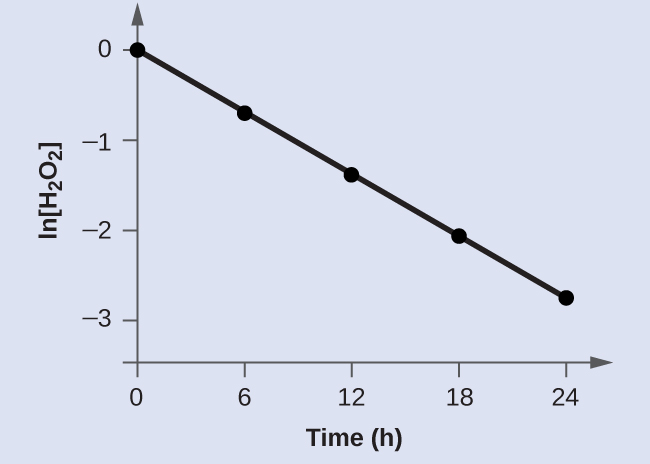

Figure 12.9図 12.9
A linear relationship between ln[H2O2] and time suggests the decomposition of hydrogen peroxide is a first-order reaction.
ln[H2O2]と時間の間の直線関係は、過酸化水素の分解が1次反応であることを示唆する。
The plot of ln[H2O2] versus time is linear, indicating that the reaction may be described by a first-order rate law.
ln[H2O2]を時間に対してプロットすると直線になるため、この反応は1次の速度式で記述できると分かる。
According to the linear format of the first-order integrated rate law, the rate constant is given by the negative of this plot’s slope.
1次の積分速度式を直線の形にすると、速度定数はこのプロットの傾きに負号を付けた値になる。
The slope of this line may be derived from two values of ln[H2O2] at different values of t (one near each end of the line is preferable). For example, the value of ln[H2O2] when t is 0.00 h is 0.000; the value when t = 24.00 h is −2.772
英語のヒント
この直線の傾きは、異なるtでの二つのln[H2O2]から求められる。直線の両端に近い点を一つずつ使うとよいだろう。たとえば、t = 0.00 hのときln[H2O2]は0.000、t = 24.00 hのときは−2.772である。
Check Your Learning理解度を確認
Graph the following data to determine whether the reaction is first order.
次のデータをグラフに描き、反応が1次かどうかを判断しなさい。
Time (s) 時間 (s) |
[A] |
|---|---|
4.0 |
0.220 |
8.0 |
0.144 |
12.0 |
0.110 |
16.0 |
0.088 |
20.0 |
0.074 |